Green Fireworks: CSIR-NEERI’s Cleaner Crackers Explained
Green fireworks reduce particulate emissions by 30 to 40 percent versus traditional crackers. CSIR-NEERI chemistry, SWAS-STAR-SAFAL types, PESO certification, and Supreme Court rulings explained for UPSC.
Every October a familiar argument returns to north Indian newspapers. Air-quality monitors in Delhi creep into the severe range, doctors warn of paediatric admissions for asthma, and the Supreme Court hears yet another plea on whether the right to breathe outweighs the right to celebrate Diwali with firecrackers. For two decades the courts oscillated between blanket bans and full permission. The compromise that emerged from this tug-of-war is a class of pyrotechnics called green fireworks, certified, lab-tested, and meant to keep the cultural ritual alive while clipping its worst emissions.
Green fireworks were not invented by industry on its own initiative. They came out of the Council of Scientific and Industrial Research’s National Environmental Engineering Research Institute, better known as CSIR-NEERI, which sits in Nagpur and has long worked on urban pollution. The idea was simple enough. Replace the heavy-metal salts that produce the brightest flashes with chemistry that puts less particulate matter and fewer toxic gases into the air. The execution was the harder part, since the fireworks industry runs on tight margins and traditional formulations have decades of supply-chain inertia behind them.
For UPSC, green fireworks sit at the crossroads of environmental science, public health, judicial activism, and urban planning. The topic appears in prelims through chemistry-and-certification stems and in mains through the larger air-pollution canvas. This guide explains what green fireworks actually are, how their chemistry differs from conventional crackers, what the Supreme Court has said, and where the policy is heading.
Quick Facts
- Developed by: CSIR-NEERI, Nagpur
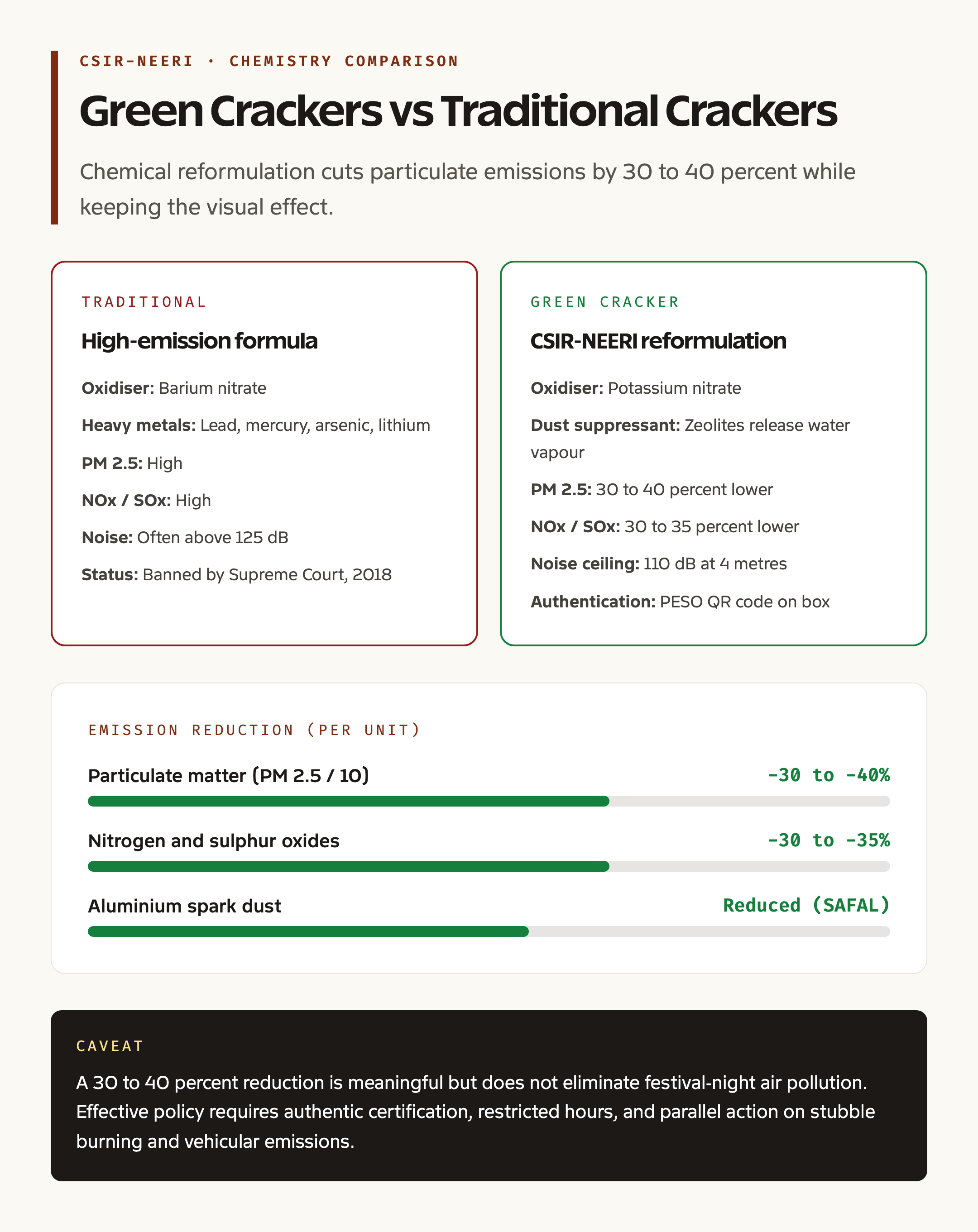
- Aim: Reduce particulate emissions by 30 to 40 percent versus traditional crackers
- Certifying authority: Petroleum and Explosives Safety Organisation (PESO)
- Three approved types: SWAS, STAR, SAFAL
- Replaced chemical: Barium nitrate (banned by Supreme Court, 2018)
- Substituted with: Potassium nitrate, zeolites
- Banned chemicals: Lithium, arsenic, lead, mercury, barium
- Noise ceiling: 110 decibels at 4 metres
- Authentication: QR code on every box
- Latest SC ruling: Allowed sale of certified green crackers in Delhi-NCR for Deepavali (2025)
- Manufacturing hub: Sivakasi, Tamil Nadu
- Regulatory framework: Explosives Act, 1884; Environment (Protection) Act, 1986; Air Act, 1981
What Are Green Fireworks
Green fireworks are pyrotechnic devices reformulated to lower their environmental footprint while retaining most of the visual effect of conventional crackers. The “green” prefix here is narrow and technical. It does not mean zero emissions or zero noise. It means a measurable reduction in particulate matter and toxic gases compared with the traditional formulation that has dominated Indian Diwali markets for fifty years.
CSIR-NEERI defines a green firework along three axes. First, the device must produce 30 to 40 percent less particulate matter than its conventional counterpart of the same shell size. Second, it must exclude a list of toxic heavy metals and oxidants. Third, it must carry a QR code that links to its laboratory certification, so that buyers and inspectors can verify authenticity in real time.
A green cracker is therefore not a different kind of firework in shape or experience. The bursts, the colours, and the aerial effects are similar. The change is internal, in the powder mixture inside the shell. What gets burnt, and what comes out, is what differs.
Background and Historical Context
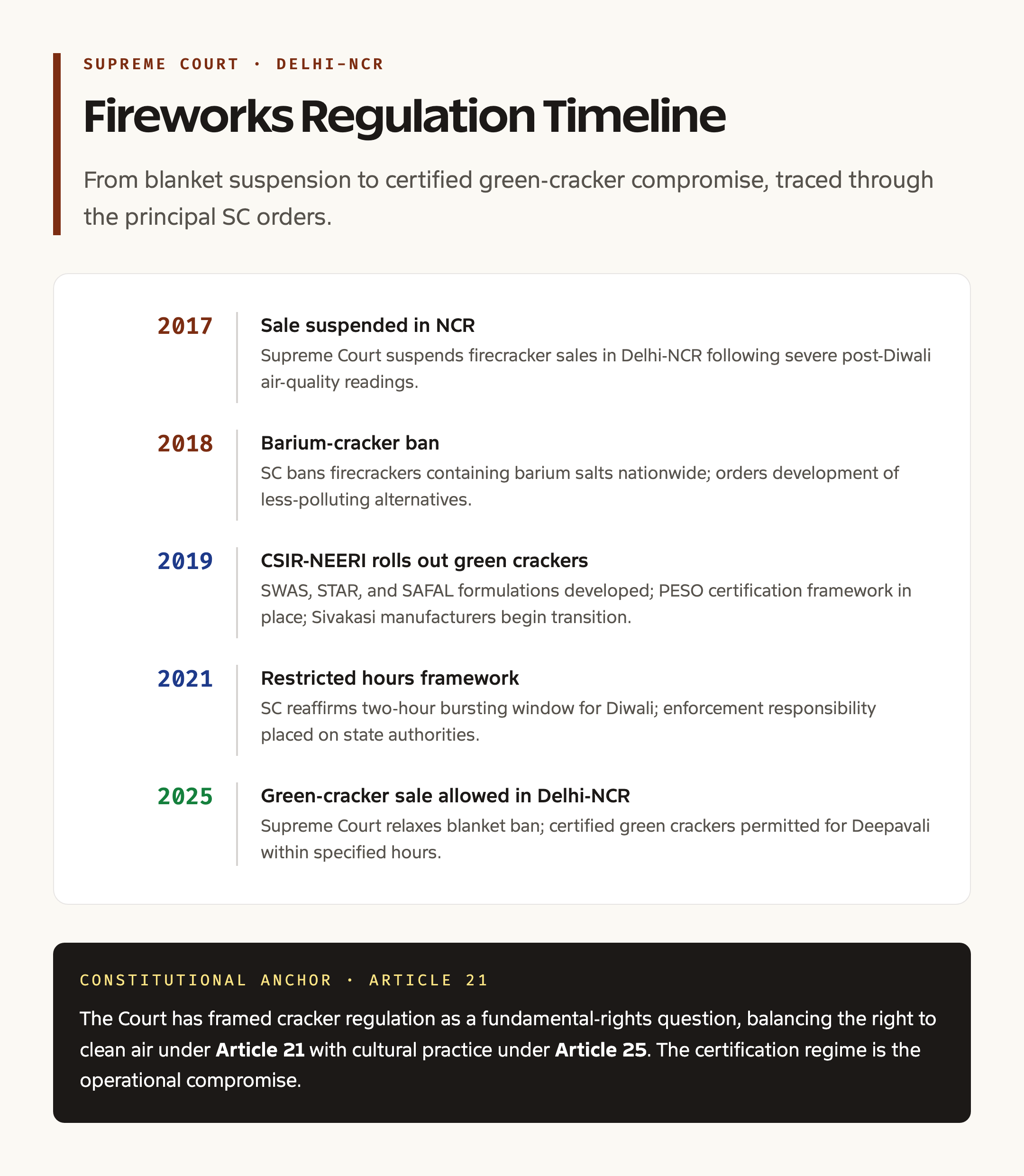
The road to green fireworks runs through India’s worsening urban air-quality story. Delhi’s particulate readings began crossing severe thresholds in the early 2010s, and by 2016 the post-Diwali smog had become a national emergency. The Supreme Court, hearing public-interest petitions filed on behalf of children and asthma patients, intervened in stages. In 2017 it suspended the sale of firecrackers in the National Capital Region. In 2018 it imposed restrictions across the country, banning crackers containing barium salts and asking the Union government to find a less polluting alternative.
That request landed at the doors of CSIR-NEERI. By 2019 the institute had developed prototype formulations and signed memoranda of understanding with manufacturers in Sivakasi, Tamil Nadu, where roughly 90 percent of India’s fireworks are made. The PESO, which sits under the Department for Promotion of Industry and Internal Trade, took on the certification role. Green crackers were rolled out in time for Diwali 2019, although the shift was uneven and counterfeit products quickly appeared.
The years since have seen a back-and-forth. Some state governments banned all crackers regardless of certification. Others allowed only certified green ones. Manufacturers complained of inadequate testing infrastructure. Doctors complained that even green crackers, used at high density on a single night, still pushed pollution above safe levels. The Supreme Court has periodically intervened, most recently relaxing the Delhi blanket ban in October 2025 to allow certified green-cracker sales for a limited window. The architecture of permissible celebration is now defined by three components: certification, restricted hours, and authenticity tracking.
Key Chemistry and Certification
The chemical heart of a traditional firecracker is an oxidiser combined with a fuel and metallic salts that give colour. Conventional formulations relied heavily on barium nitrate as the oxidiser, giving the bright green flashes that dominate Indian shells. Barium compounds, however, are toxic when inhaled at high concentration, and their combustion adds barium-laden particulate to ambient air. Green crackers replace barium nitrate with potassium nitrate, which is less toxic and produces a comparable burn rate.
The second innovation is the use of zeolites and other dust suppressants. Zeolites are microporous aluminosilicate minerals. When packed into the firework, they release water vapour on combustion, which condenses and helps settle the very fine particles that would otherwise stay suspended in the air. The mechanism is similar in spirit to a chemical scrubber, only on a one-shot scale.
Heavy metals beyond barium are also excluded. Green-cracker formulations leave out lithium, arsenic, lead, and mercury, all of which contribute to long-term toxicity even at small doses. The result is a firework whose combustion products are dominated by potassium oxides, water vapour, carbon dioxide, and nitrogen oxides, with markedly less of the heavy-metal load that characterises traditional crackers. PESO certification verifies the formulation through laboratory testing, after which an authentication QR code is printed on the packaging.
Three Types of Green Crackers
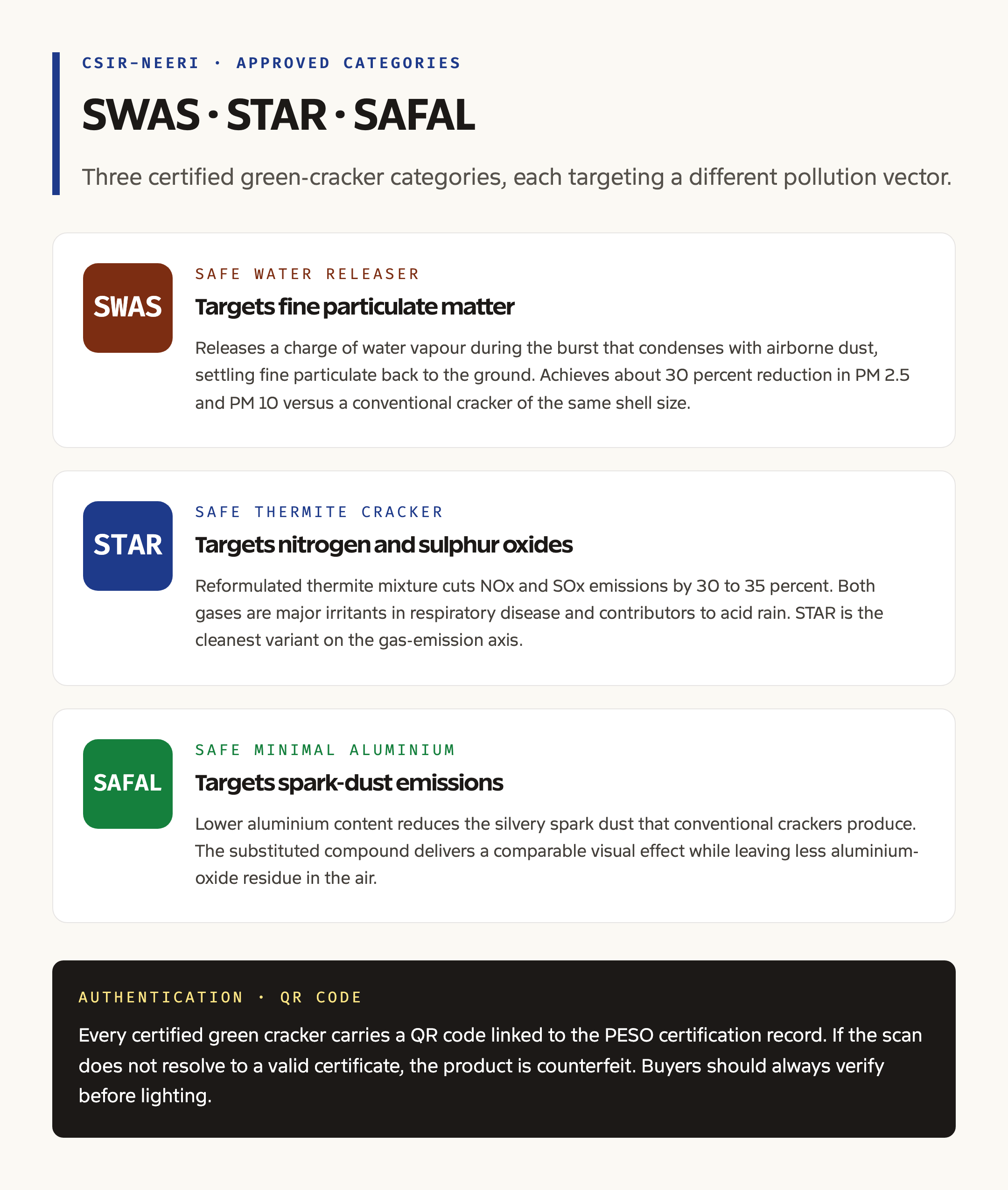
CSIR-NEERI has rolled out three approved categories, each addressing a different pollution vector.
SWAS (Safe Water Releaser) is built around the dust-suppression idea. When the cracker bursts, a small charge of water vapour is released alongside the visible effect, and the vapour binds with airborne particulate to settle it back to ground level faster than a conventional plume would. SWAS crackers achieve roughly 30 percent reduction in fine particulate matter compared with their conventional equivalents.
STAR (Safe Thermite Cracker) targets the gas component. Conventional crackers release significant volumes of nitrogen oxides and sulphur oxides, which are precursors to acid rain and major irritants in respiratory disease. STAR formulations cut these emissions by 30 to 35 percent through reformulated thermite mixtures.
SAFAL (Safe Minimal Aluminium) addresses spark dust. Aluminium powders give the bright silvery sparks of conventional crackers but leave fine aluminium oxide particles in the air. SAFAL formulations use less aluminium and a substituted spark-producing compound, reducing this fraction substantially. All three categories carry the PESO QR code, and their sale is contingent on that authentication being scannable and verifiable.
Why Green Fireworks Matter
Diwali night is a single-evening shock to the urban airshed. Across north India, particulate matter readings on Diwali typically rise three to five times the daily average, and a sustained inversion layer in late October keeps that load near ground level for two or three days. The respiratory consequences are real. Hospital admissions for paediatric asthma and chronic bronchitis spike across Delhi-NCR, Lucknow, and Kanpur every year on the night of and the day after Diwali.
Green fireworks do not solve this problem. A 30 percent reduction is meaningful but does not move the needle from severe to safe. What they do is offer a politically viable middle path. The blanket ban was unenforceable in practice and culturally fraught. Total permission accelerated the public-health crisis. A certified, lower-emission alternative gives regulators something to enforce, manufacturers a transition path, and households a way to celebrate without entirely abandoning the ritual.
The economic stakes are also large. Sivakasi employs over 800,000 people directly and indirectly in the cracker industry. A blanket ban would devastate this cluster. The green-cracker transition keeps the industry alive while reorienting it toward less-polluting outputs, similar to the policy logic used in environmental laws in India for thermal power and brick kilns.
Detailed Analysis: Limitations
Green crackers are a partial solution, and a candid analysis must acknowledge their limits. First, the 30 to 40 percent reduction figure is a per-unit comparison. If green-cracker sales drive larger volumes of bursting because households feel that the product is now sanctioned, total emissions can rise. Second, counterfeiting is endemic. Reports from the past three Diwalis indicate that many crackers labelled as green do not match their certified formulation, and field testing infrastructure is too thin to catch this at scale.
Third, the noise issue is not fully addressed. The 110-decibel ceiling at four metres is enforced on paper but rarely on the ground, and even the certified ceiling is high enough to cause hearing damage with repeated close exposure. Fourth, the disposal of unburnt residue, which contains substituted oxidants and metallic compounds, is not handled by any waste-management protocol. Fifth, the post-Diwali smog episode is driven by multiple contributors, including stubble burning, construction dust, and vehicular emissions. Even an idealised cracker compliance regime would not by itself bring readings to safe levels.
Comparative Perspective
Internationally, the firework sector has been moving toward perchlorate-free and metal-substituted formulations for two decades. The United States has tightened its display-firework regulations under the Environmental Protection Agency. The European Union’s REACH framework restricts heavy metals in pyrotechnics. Japan, with its long display tradition, uses ammonium-perchlorate-free formulations in major public shows.
India’s approach is distinctive in two ways. The first is scale. Diwali generates a single-night demand spike on a scale that no Western festival approaches, with millions of households setting off small consumer crackers rather than relying on professional displays. The second is the role of judicial intervention. In most jurisdictions firework regulation has come through executive rule-making. In India, the Supreme Court has driven the policy, framing it explicitly as a fundamental-right question under Article 21.
Challenges and Issues
The challenges are practical and structural. Counterfeit certification is the single largest enforcement gap. Many small manufacturers print the QR code without holding a valid PESO certificate, and consumers rarely scan and verify. Testing infrastructure is concentrated at CSIR-NEERI Nagpur and a handful of state pollution-control board labs, which cannot match the inspection demand of a 5,000-tonne festival market.
State-level policy fragmentation also complicates compliance. Some states ban all crackers, some allow only green ones, some leave it to district administrations, and the Supreme Court orders apply with different force in different jurisdictions. Manufacturers face a patchwork of rules that change yearly. Retailers face uncertainty about which stocks they can legally sell. Consumers face a confusing array of products labelled green, eco, or organic without a uniform standard.
The fundamental challenge, however, is that even a perfectly enforced green-cracker regime would deliver only a fraction of the air-quality improvement that Delhi’s residents need. The festival emissions sit on top of a baseline that is already at hazardous levels. Tackling that baseline is the larger work of the air pollution India policy framework, the National Clean Air Programme, and the State of India Environment 2026 report recommendations.
Prelims Pointers
- Developing institution: CSIR-NEERI, Nagpur (Council of Scientific and Industrial Research).
- Certifying authority: Petroleum and Explosives Safety Organisation, headquartered in Nagpur, under DPIIT.
- Three categories: SWAS (Safe Water Releaser), STAR (Safe Thermite Cracker), SAFAL (Safe Minimal Aluminium).
- Banned chemicals: Lithium, arsenic, lead, mercury, barium.
- Substituted oxidiser: Potassium nitrate replaces barium nitrate.
- Dust suppressant: Zeolites, releasing water vapour on combustion.
- Noise ceiling: 110 dB at 4 metres.
- Manufacturing hub: Sivakasi, Tamil Nadu (about 90 percent of Indian production).
- Authentication: QR code linked to PESO certification.
- Supreme Court 2018 order: Banned barium-based crackers nationwide.
- Supreme Court 2025 order: Allowed certified green-cracker sale in Delhi-NCR for Deepavali.
Probable Mains Questions
- Examine the role of CSIR-NEERI in developing green fireworks. To what extent can technology substitution alone address India’s seasonal urban air-pollution crisis? (250 words)
- The Supreme Court has framed cracker regulation as a fundamental-rights issue under Article 21. Discuss the tension between cultural practice and the right to clean air, with reference to recent rulings. (250 words)
- Critically evaluate the green-cracker policy as a model for environment-versus-livelihood trade-offs in India, drawing on the experience of Sivakasi. (150 words)
Way Forward
The green-fireworks framework needs strengthening on four fronts. First, certification testing must decentralise, with state-level labs gaining accreditation to cut turnaround times and verify a wider range of products. Second, enforcement against counterfeiting must move from random raids to data-driven targeting, using QR-scan analytics to flag suspicious batches before they reach retail. Third, public communication should make the limits of green crackers explicit so that households do not assume the product is harmless. Fourth, the cracker question should sit inside the larger air-quality strategy, not be treated as a standalone festival problem.
In the medium term, India’s policy direction should encourage community displays in place of household-scale bursting, since a single professional display is far more emissions-efficient per spectator than thousands of household crackers. Some Indian cities have begun this experiment with civic firework events, and the results suggest a workable cultural compromise. Combined with stricter enforcement of stubble-burning controls and vehicular standards under the environmental laws in India, green fireworks can be a contributor to urban air quality rather than an alibi for inaction.
Frequently Asked Questions
What exactly are green fireworks?
Green fireworks are pyrotechnic devices reformulated to emit 30 to 40 percent less particulate matter than conventional crackers, exclude toxic heavy metals like barium, lead, and mercury, and stay within a 110-decibel noise ceiling. They are developed by CSIR-NEERI and certified by the Petroleum and Explosives Safety Organisation.
Who developed green crackers in India?
The Council of Scientific and Industrial Research’s National Environmental Engineering Research Institute, CSIR-NEERI, based in Nagpur, developed the formulations in 2018 and 2019 in response to Supreme Court directions following the 2018 ban on barium-based crackers.
What are SWAS, STAR, and SAFAL?
These are the three CSIR-NEERI green-cracker categories. SWAS releases water vapour to suppress dust and reduces particulate matter. STAR targets nitrogen and sulphur oxides through reformulated thermite mixtures. SAFAL uses minimal aluminium powder to reduce spark-dust emissions. All carry PESO QR-code authentication.
Are green fireworks completely safe?
No. They are less polluting than conventional crackers but not pollution-free. They reduce emissions by 30 to 40 percent on a per-unit basis. If used at high density on a single night, they can still push urban air-quality readings into severe territory.
What did the Supreme Court rule in 2025?
In October 2025 the Supreme Court relaxed its blanket ban on cracker sales in Delhi-NCR, allowing certified green crackers to be sold and used during Deepavali within specified hours. The ruling balanced cultural celebration with public-health concerns under Article 21.
Why was barium nitrate banned in firecrackers?
Barium compounds are toxic when inhaled and contribute heavy-metal particulate to ambient air. The Supreme Court banned barium-based crackers in 2018 because of their disproportionate contribution to post-Diwali air pollution in north Indian cities.
How can a buyer verify a green cracker?
Each PESO-certified green firework carries a QR code on the packaging. Scanning the code links to the certification record, including the manufacturer, batch number, and approved formulation. If the QR scan does not resolve to a valid record, the product is counterfeit.
Where are green crackers manufactured?
The vast majority are made in Sivakasi, Tamil Nadu, which is the historic centre of Indian fireworks manufacturing. Sivakasi accounts for roughly 90 percent of national production and supports about 800,000 direct and indirect jobs in the sector.
What is PESO?
The Petroleum and Explosives Safety Organisation is the regulatory body for explosives, fireworks, and petroleum products in India. It sits under the Department for Promotion of Industry and Internal Trade and certifies formulations under the Explosives Act, 1884.
Do green fireworks solve Delhi’s air-pollution problem?
No. They are one piece of a much larger puzzle that includes stubble burning, vehicular emissions, construction dust, and industrial sources. Even full compliance with the green-cracker regime would not bring Diwali-night air-quality readings to safe levels without simultaneous progress on the other contributors.