Air pollution kills more Indians every year than almost any other environmental factor. The State of Global Air report estimates that exposure to fine particulate matter alone is associated with over a million premature deaths annually in India, with cardiovascular disease, stroke, lung cancer, chronic obstructive pulmonary disease, and lower respiratory infections among the leading attributable conditions. The problem is unevenly distributed: the Indo-Gangetic Plain consistently records some of the worst PM2.5 levels in the world, and Delhi-NCR has become a global symbol of acute winter pollution. But pollution is not just an urban or northern problem. Rural cooking with biomass fuels exposes hundreds of millions to indoor particulate concentrations that exceed WHO limits, and agricultural ammonia from fertilisers and livestock is a hidden but rising contributor to fine particulate formation.
For UPSC aspirants, the major pollutants are a recurring prelims topic and a fertile area for mains questions on environment, public health, urbanisation, and federal coordination. Understanding the chemistry of primary and secondary pollutants, the sectoral sources, and the cascading health and ecosystem effects is foundational. So is knowing the regulatory regime: the Air (Prevention and Control of Pollution) Act 1981, the National Clean Air Programme, the National Air Quality Index, and the Graded Response Action Plan that triggers emergency measures in Delhi-NCR.
This guide unpacks each major pollutant by source, chemistry, and impact, links them to the underlying sectors driving emissions, and explores why Indian air pollution is structurally different from the smog problems that affected London or Los Angeles in earlier decades.
Quick Facts at a Glance
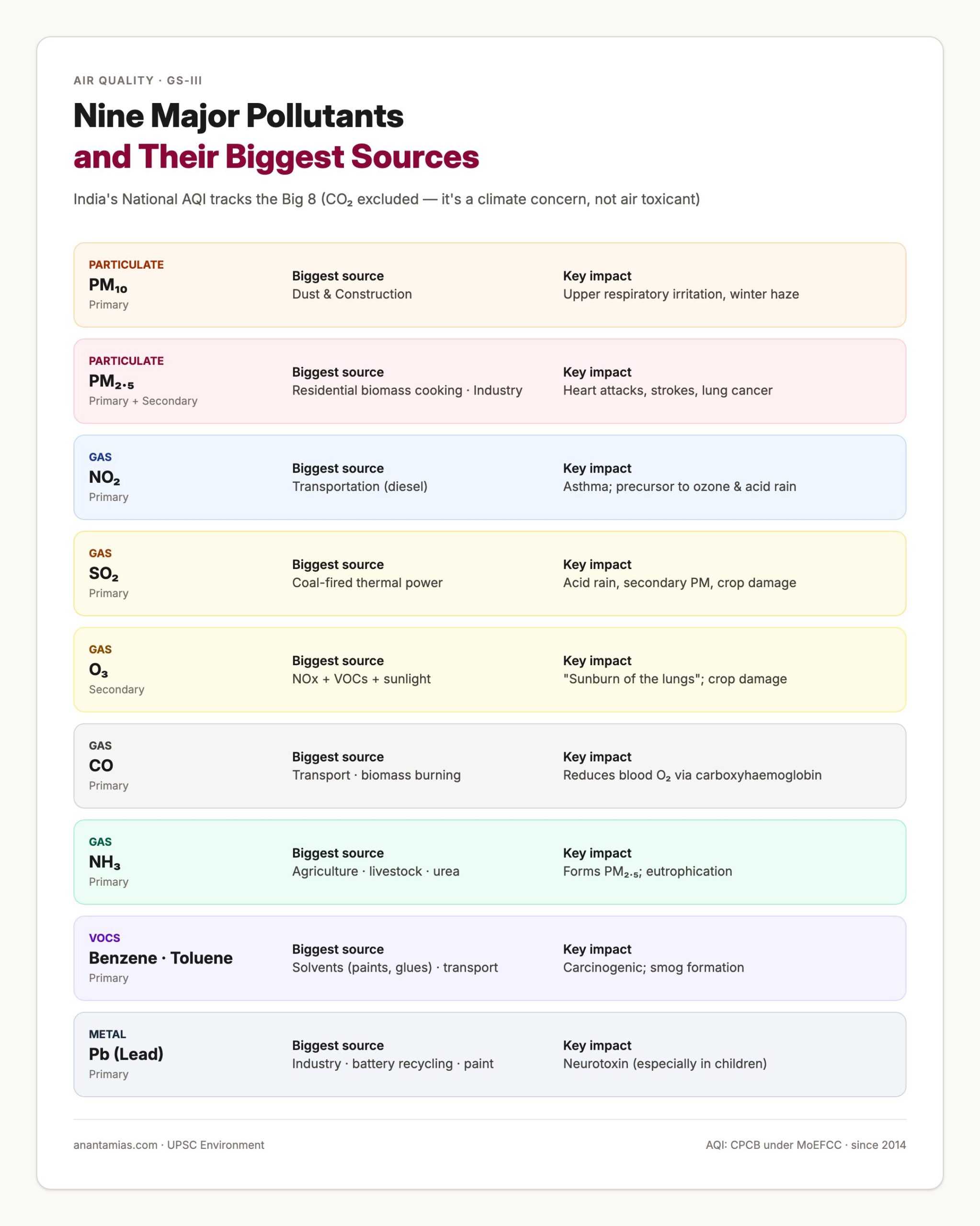
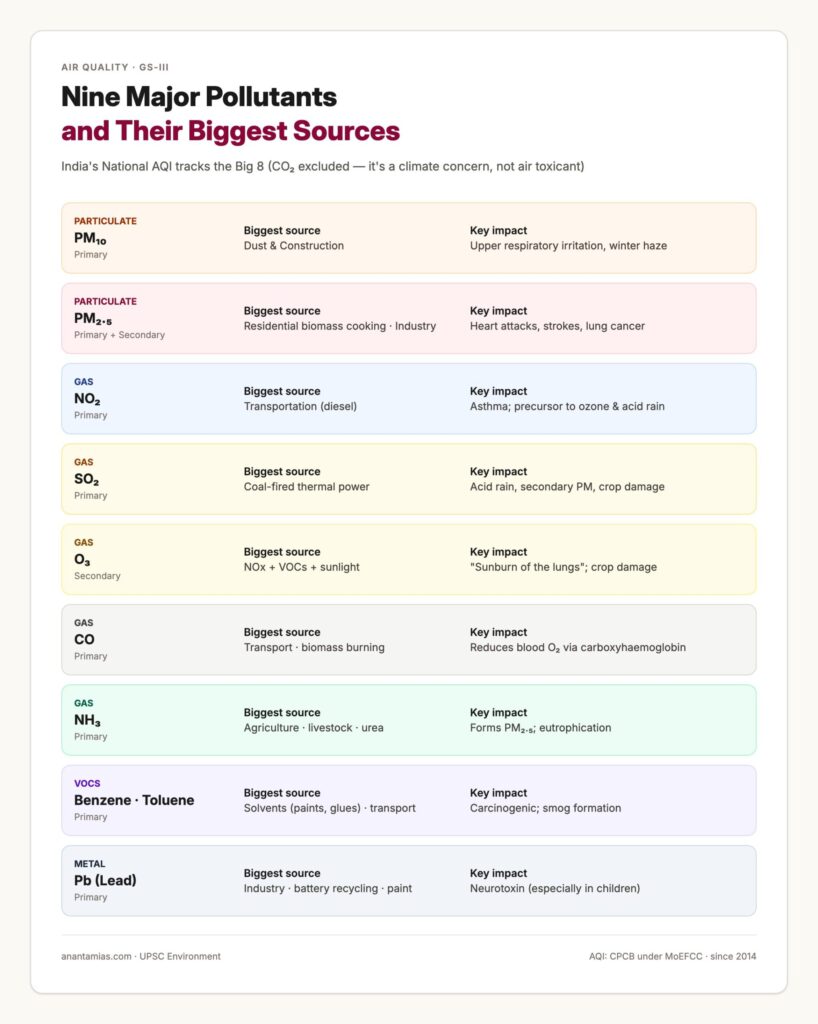
Nine pollutants dominate Indian air quality regulation: PM10, PM2.5, sulphur dioxide, nitrogen dioxide, ground-level ozone, carbon monoxide, ammonia, lead, and benzene. Particulate matter is the most damaging to health because the smallest particles bypass nasal filtration and enter the bloodstream. PM2.5 refers to particles less than 2.5 micrometres in diameter; PM10 includes particles up to 10 micrometres. The National Air Quality Index, launched in 2014 by the Central Pollution Control Board under the Ministry of Environment, Forest and Climate Change, monitors the Big 8 pollutants: PM10, PM2.5, NO2, SO2, CO, O3, NH3, and Pb. Carbon dioxide is not part of the AQI because it is a climate concern rather than a direct air toxicant. Pollutants are classified as primary if emitted directly, like SO2 from coal burning, or secondary if formed through atmospheric reactions, like ground-level ozone created when nitrogen oxides react with volatile organic compounds in sunlight.
What Air Pollution Is
Air pollution is the contamination of indoor or outdoor air with substances that harm human health, ecosystems, and built infrastructure. Pollutants can be solid, liquid, or gas. Some are toxic at the molecular level, like lead and benzene; others harm by disrupting respiratory or cardiovascular function through chronic exposure, like PM2.5. Pollutants have different lifetimes in the atmosphere, ranging from hours for some VOCs to years for some persistent organic compounds. Some pollutants are local; others travel hundreds or thousands of kilometres on prevailing winds, contributing to transboundary problems like acid rain or Asian dust events.
The distinction between primary and secondary pollutants is fundamental. Primary pollutants are emitted directly from sources, like SO2 from coal-fired power plants or PM10 from construction dust. Secondary pollutants form in the atmosphere through chemical or photochemical reactions, like ground-level ozone or secondary inorganic aerosol composed of ammonium sulphate and ammonium nitrate. Secondary pollutants are typically harder to control because they require addressing multiple precursor emissions across sectors.
Background and How India’s Pollution Crisis Took Shape
India’s air pollution problem reflects three intertwined trajectories. Rapid industrialisation and urbanisation have multiplied emissions from power plants, vehicles, and construction. Agriculture has become more intensive, raising ammonia from fertiliser and livestock and creating large seasonal smoke plumes from paddy stubble burning in Punjab, Haryana, and western Uttar Pradesh. Household cooking with biomass fuels still affects a large rural population despite the expansion of LPG access through the Pradhan Mantri Ujjwala Yojana.
The Indo-Gangetic Plain is geographically and meteorologically vulnerable. The Himalayan barrier traps polluted air, and a temperature inversion in winter creates a stagnant atmospheric lid that concentrates emissions near the surface. The combination of structural emissions, seasonal stubble burning, festive firecracker spikes, and adverse winter meteorology produces the recurring November and December air quality crisis in Delhi-NCR.
The Nine Major Pollutants and Their Sources
Particulate matter is the most consequential. PM10 is generated by mechanical disruption: crushing, grinding, road abrasion, construction, and windblown dust. The biggest sectoral contributor in India is dust and construction. PM10 irritates the upper respiratory tract and reduces visibility, contributing to winter haze. PM2.5 is both primary, from combustion of solid fuels and vehicle exhaust, and secondary, from atmospheric chemistry involving SO2, NOx, NH3, and VOCs. The biggest contributor in India is residential energy, where biomass cooking and heating dominates rural emissions, followed by industry. PM2.5 is particularly dangerous because it enters deep lungs and the bloodstream, causing heart attacks, strokes, and lung cancer.
Nitrogen dioxide is a primary pollutant formed by high-temperature combustion of fossil fuels. The biggest contributor is transportation, particularly diesel engines. NO2 aggravates asthma and is a precursor to ground-level ozone and acid rain. Sulphur dioxide is emitted by burning sulphur-containing fossil fuels, mainly coal, and by metal smelting. Thermal power plants burning coal are the dominant source in India. SO2 causes acid rain, harms vegetation, and forms secondary PM2.5 in the atmosphere.
Ground-level ozone is a secondary pollutant formed when nitrogen oxides and volatile organic compounds react in the presence of sunlight. Traffic and industry are the primary precursor sources. Ozone is sometimes called sunburn of the lungs because it damages respiratory tissue and reduces lung function; it also damages crops, reducing yields of wheat, rice, and other staples by an estimated several percent in heavily polluted regions.
Carbon monoxide is a primary pollutant from incomplete combustion of carbon-based fuels. Transportation and residential biomass burning are dominant sources. CO binds to haemoglobin to form carboxyhaemoglobin, reducing the blood’s oxygen-carrying capacity and causing headaches, dizziness, and at high concentrations, death.
Ammonia, often overlooked, is emitted by biological breakdown of organic matter and chemical production of fertilisers. Agriculture, particularly livestock waste and urea-based fertiliser application, dominates emissions in India. Ammonia reacts with sulphur and nitrogen oxides to form secondary particulate matter, contributing significantly to PM2.5 in regions like the Indo-Gangetic Plain. It also contributes to nutrient pollution and eutrophication of water bodies.
Volatile organic compounds, or VOCs, are emitted by evaporation of fuels, solvents, and paints, and by incomplete combustion. The leading sources are solvent use, including paints, glues, and coatings, and transportation. Some VOCs like benzene are carcinogenic; others contribute to ground-level ozone and smog formation. Lead is a primary pollutant emitted by metal processing, waste incineration, and informal battery recycling. Industry and recycling are the leading sources after the phase-out of leaded petrol in 2000. Lead is a neurotoxin that damages the developing nervous system, especially in children.
Primary vs Secondary Pollutants: Why It Matters
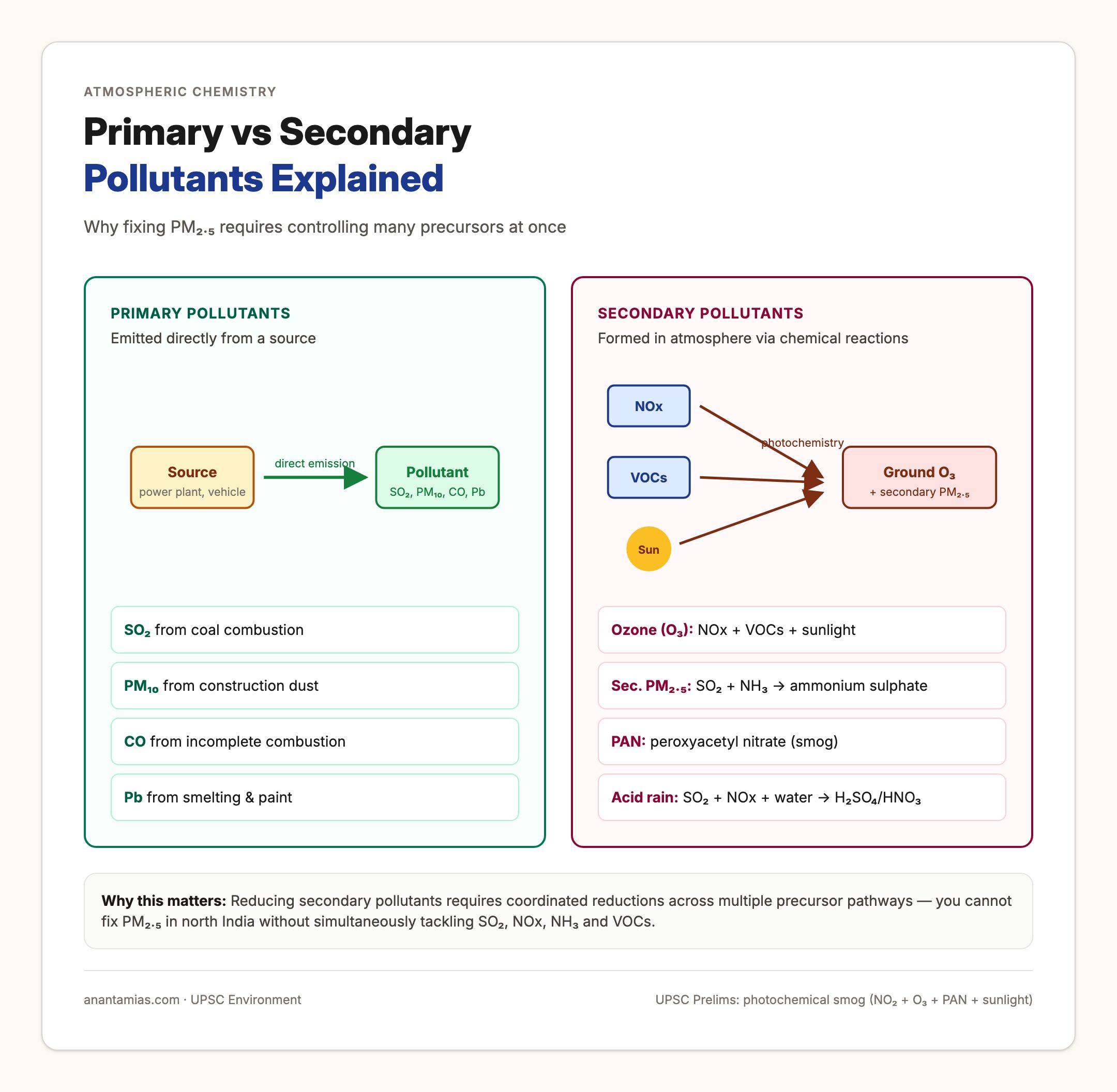
The classification matters because regulatory strategies differ. Primary pollutants can be reduced by controls at the source: flue gas desulphurisation for SO2, electrostatic precipitators for PM10, and catalytic converters for vehicular emissions. Secondary pollutants require coordinated reductions across multiple precursor pathways. Reducing PM2.5 in India is impossible without simultaneously addressing SO2, NOx, NH3, and VOCs, and the relative importance of each varies seasonally and geographically.
Why It Matters: Health, Crops, and Climate Co-benefits
The health burden is staggering. PM2.5 alone is linked to roughly a million premature deaths in India each year and a comparable number of years of life lost. The Air Quality Life Index from the University of Chicago has estimated that pollution shortens average life expectancy in north India by several years compared to a clean-air baseline. Children, the elderly, and those with pre-existing cardiopulmonary disease are most vulnerable.
Crops and ecosystems suffer too. Ozone damages leaves and reduces photosynthesis, lowering wheat and rice yields. Acid rain, formed when SO2 and NOx oxidise in the atmosphere and combine with water, damages forests, freshwater bodies, and stone monuments; the Taj Mahal’s discoloration is partly attributed to atmospheric SO2. Nitrogen deposition from NH3 and NOx upsets the balance of plant communities, favouring nitrogen-tolerant species and reducing biodiversity. For more on this, see our analysis of pollution, smog, microplastics, and thermal and smog.
There are also climate co-benefits to controlling air pollution. Black carbon, a component of PM2.5, is a short-lived climate forcer with high warming potential, and its reduction yields rapid climate gains. Methane reductions through landfill and oil and gas controls cut both ozone precursors and a potent greenhouse gas. India’s net zero pathway and clean air strategy are increasingly co-designed for this reason.
Photochemical Smog and Acid Rain
Photochemical smog is a chemical haze formed when nitrogen dioxide, ozone, and peroxyacetyl nitrate react in the presence of sunlight, often during summer afternoons. It is distinct from classical sulphurous smog of the kind that struck London in 1952, which was driven by SO2 and soot from coal burning under cold, foggy conditions. India experiences both: classical winter haze in northern cities and photochemical smog in summer, particularly in metropolitan areas with intense traffic.
Acid rain occurs when SO2 and NOx oxidise into sulphuric acid and nitric acid in the atmosphere and fall to the surface as wet or dry deposition. It acidifies soils and freshwater, damages forest canopies, leaches nutrients, and corrodes infrastructure. Coal-fired power plants and metal smelters are the dominant SO2 sources, and the rollout of flue gas desulphurisation systems on Indian thermal plants is intended to address this, though implementation has faced repeated delays. See our coverage of revised norms for thermal plants on SO2 and lead pollution in India.
Comparative Perspective and Regulatory Architecture
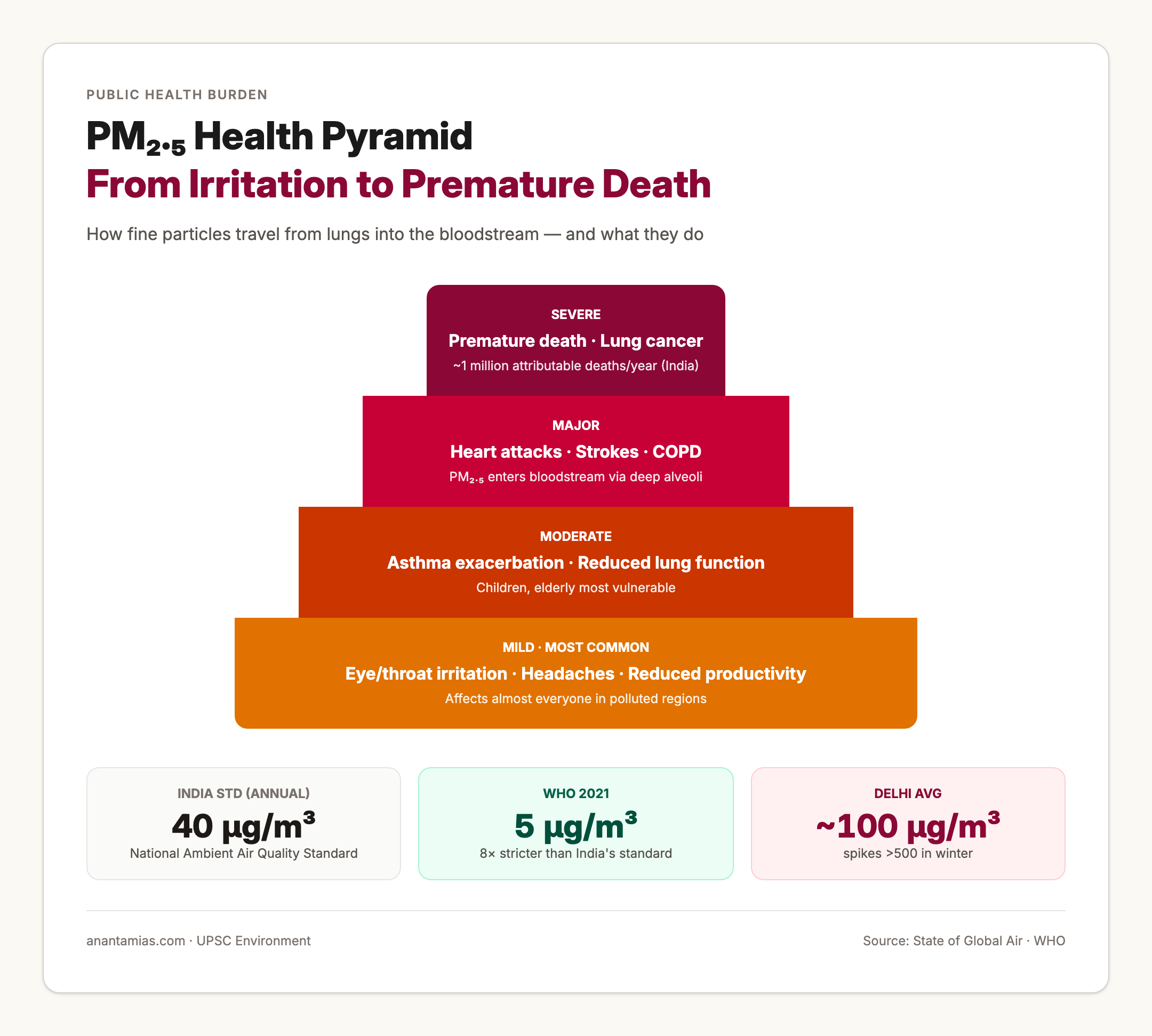
The Air (Prevention and Control of Pollution) Act, 1981, is the primary legislation, supplemented by the Environment Protection Act 1986 and the rules notified under it. The Central Pollution Control Board and State Pollution Control Boards are the implementing bodies. The National Clean Air Programme, launched in 2019, set initial targets for PM2.5 and PM10 reductions across non-attainment cities, later updated with sharper goals. The Graded Response Action Plan for Delhi-NCR triggers emergency measures, including construction halts and traffic restrictions, when air quality crosses defined thresholds; it is overseen by the Commission for Air Quality Management. Internationally, the World Health Organization revised its global air quality guidelines in 2021, lowering recommended PM2.5 limits to 5 micrograms per cubic metre, far stricter than India’s national ambient standard of 40 micrograms per cubic metre.
Challenges and Critiques
Several challenges shape the pollution debate. Source apportionment is contested, with different studies attributing different shares to vehicles, industry, agriculture, and residential burning. Federal coordination is complicated because air pollution crosses state boundaries and many sources, like agriculture and transport, fall under state jurisdiction. Enforcement is patchy, with many industrial units operating without continuous emission monitoring or with bypassed pollution controls. The agricultural sector remains undertaxed in policy terms, with stubble burning and ammonia receiving inadequate sustained attention. Data quality is uneven, with monitoring networks concentrated in metros and large gaps in smaller cities and rural areas.
UPSC Prelims Pointers
- AQI monitors Big 8: PM10, PM2.5, NO2, SO2, CO, O3, NH3, Pb. CO2 is not in the AQI.
- PM2.5: less than 2.5 micrometres; can enter the bloodstream and cause heart attacks and strokes.
- Biggest sectoral contributor to PM2.5 in India: residential energy (biomass cooking and heating).
- Biggest contributor to NO2 emissions: transportation, particularly diesel.
- Biggest contributor to SO2 emissions: thermal power plants burning coal.
- Ground-level ozone is secondary, formed from NOx and VOCs in sunlight.
- Photochemical smog: NO2, O3, and peroxyacetyl nitrate in the presence of sunlight.
- Ammonia: dominant source is agriculture (livestock waste, urea fertilisers).
- Lead: phase-out of leaded petrol in India in 2000; remaining sources are smelting, paint, and battery recycling.
- Benzene exposure: automobile exhaust, tobacco smoke, wood burning.
- Magnetite particles linked to brakes and engines of motor vehicles and to power plants.
- Carbon sequestration sites: depleted oil and gas reservoirs, abandoned coal seams, deep saline formations.
- Air Act 1981 and Environment Protection Act 1986 govern air pollution control.
- GRAP applies only to Delhi-NCR; CAQM oversees it.
Mains Practice Questions
- Examine the sources of PM2.5 pollution in India and discuss why a sectoral, multi-pollutant strategy is essential for effective control. (GS-III, 250 words)
- Photochemical smog and acid rain are two distinct pollution phenomena with shared precursors. Compare their formation, impacts, and policy responses. (GS-III, 200 words)
- The agricultural sector is increasingly recognised as a major contributor to ambient air pollution through ammonia emissions and stubble burning. Discuss the policy interventions needed to address this. (GS-III, 250 words)
- The Graded Response Action Plan in Delhi-NCR represents an emergency response to severe pollution. Critically evaluate its design and suggest reforms for stronger year-round air quality management. (GS-II/III, 250 words)
Way Forward
A coherent air pollution strategy for India must move beyond episodic crisis management to structural decarbonisation and pollution control across sectors. Power generation must transition away from unabated coal, with flue gas desulphurisation rolled out on remaining plants. Transportation needs accelerated electrification, stricter Bharat Stage VII norms, and far better non-motorised infrastructure. Residential energy must shift fully to LPG, electricity, and solar, finally retiring biomass cooking. Agriculture must address ammonia through better fertiliser management, livestock waste recycling, and sustained alternatives to stubble burning. Construction and waste management need stronger regulation and dust controls. Real-time monitoring should expand into rural and small-town India, and source apportionment studies should be regularly updated. Finally, the WHO 2021 guidelines should be a directional benchmark even if interim Indian standards remain looser, with a transparent timeline for tightening.
Frequently Asked Questions
What is the difference between PM2.5 and PM10?
PM10 refers to particulate matter with an aerodynamic diameter of 10 micrometres or less, while PM2.5 refers to fine particles 2.5 micrometres or less. PM10 mostly affects the upper respiratory tract and reduces visibility. PM2.5, being smaller, penetrates deep into the lungs and can enter the bloodstream, causing heart attacks, strokes, and lung cancer. PM2.5 includes both primary emissions and secondary aerosols formed in the atmosphere.
Which gases are part of India’s National Air Quality Index?
The National AQI monitors eight pollutants: PM10, PM2.5, sulphur dioxide, nitrogen dioxide, carbon monoxide, ground-level ozone, ammonia, and lead. Carbon dioxide and methane are not included in the AQI; they are tracked under climate frameworks.
What is photochemical smog and how is it formed?
Photochemical smog is a haze formed when nitrogen dioxide, ozone, and peroxyacetyl nitrate react in the presence of sunlight. It is most common during warm, sunny days in urban areas with heavy traffic and industrial emissions. It is distinct from sulphurous smog, which is driven by SO2 and soot under cold, foggy conditions like the historic London smog of 1952.
Which sector is the biggest source of PM2.5 in India?
The biggest sectoral contributor to ambient PM2.5 in India is residential energy, dominated by biomass cooking and heating fuels in rural areas. Industry, transport, agriculture, and construction follow, with the relative shares varying by region and season. Indo-Gangetic Plain pollution is also significantly driven by secondary aerosols formed from SO2, NOx, and NH3.
What is acid rain and what causes it?
Acid rain is precipitation with a pH lower than that of natural rainwater. It is caused mainly by atmospheric oxidation of sulphur dioxide and nitrogen oxides into sulphuric and nitric acids. The dominant SO2 source is coal-fired thermal power plants and metal smelters, while NOx comes from vehicles and high-temperature combustion. Acid rain damages forests, acidifies water bodies, and corrodes monuments.
What is the Graded Response Action Plan and where does it apply?
GRAP is an emergency response mechanism that triggers specific bans automatically when AQI crosses defined thresholds. It applies only to Delhi-NCR and is overseen by the Commission for Air Quality Management. Stages range from Poor to Severe Plus, with progressively stricter measures including bans on construction, restrictions on diesel generators, and traffic curbs.
Why is ground-level ozone a problem when stratospheric ozone is good?
Stratospheric ozone shields life from harmful ultraviolet radiation. Ground-level ozone, formed in the troposphere through reactions of NOx and VOCs in sunlight, is a respiratory irritant that damages lung tissue and reduces crop yields. The same molecule has opposite effects depending on altitude.
What is the role of ammonia in air pollution?
Ammonia is emitted mainly by agriculture, particularly livestock waste and urea fertilisers, with smaller contributions from industry. It reacts with sulphur and nitrogen oxides in the atmosphere to form secondary particulate matter, especially ammonium sulphate and ammonium nitrate, which are major contributors to PM2.5 in the Indo-Gangetic Plain. Ammonia also contributes to eutrophication when deposited in water bodies.
What sources of lead exposure remain after leaded petrol was banned?
Even after the phase-out of leaded petrol in India in 2000, lead exposure continues from smelting units, informal battery recycling, paint, certain pigments, traditional cosmetics, and contaminated water from old plumbing. Lead is a neurotoxin and is particularly harmful to developing children.
What is the WHO air quality guideline and how does India compare?
The World Health Organization revised its global air quality guidelines in 2021, recommending an annual mean PM2.5 limit of 5 micrograms per cubic metre. India’s national ambient air quality standard for annual mean PM2.5 is 40 micrograms per cubic metre, which is eight times the WHO limit. Most Indian cities exceed even this looser national standard.
Tell Google you want more of this.
Add Anantam IAS as a preferred sourceOne tap, and this site shows up more often in your own Top Stories, AI Overviews and AI Mode. Remove it any time.