UPSC GS 4 Syllabus (General Studies Paper IV): Every Topic and What It Actually Tests
The full General Studies Paper IV syllabus, broken into its official clauses, with what each one actually tests and which notes cover it.
General Studies Paper IV carries 250 marks, runs for three hours, and counts towards the Mains merit list like every other General Studies paper. What makes it unusual is the instruction in the syllabus itself: the paper is there to test your attitude and approach to integrity, probity in public life, and your problem-solving approach to conflicts you would face in dealing with society. The syllabus explicitly notes that questions may take the case-study route to get at those things.
That single sentence explains why treating this paper as a reading list does not work. The topics below are not a body of knowledge to be reproduced; they are the vocabulary you need in order to reason well in writing. This page lays out every clause of the official syllabus, says plainly what each one is testing, and points to where each part is covered in detail.
The Paper at a Glance
| Feature | Detail |
|---|---|
| Paper | General Studies Paper IV — Ethics, Integrity and Aptitude |
| Marks | 250 |
| Duration | 3 hours |
| Counts towards | Mains merit (not qualifying) |
| Medium | Any language listed in the Eighth Schedule, or English |
| Structure | Two halves — theory questions and case studies |
| Typical split | Roughly half the marks come from case studies |
The paper sits alongside the other three General Studies papers, each of 250 marks. For how Paper IV fits into the full scheme of Prelims, Mains and the interview, see the complete UPSC syllabus.
The Eight Syllabus Areas
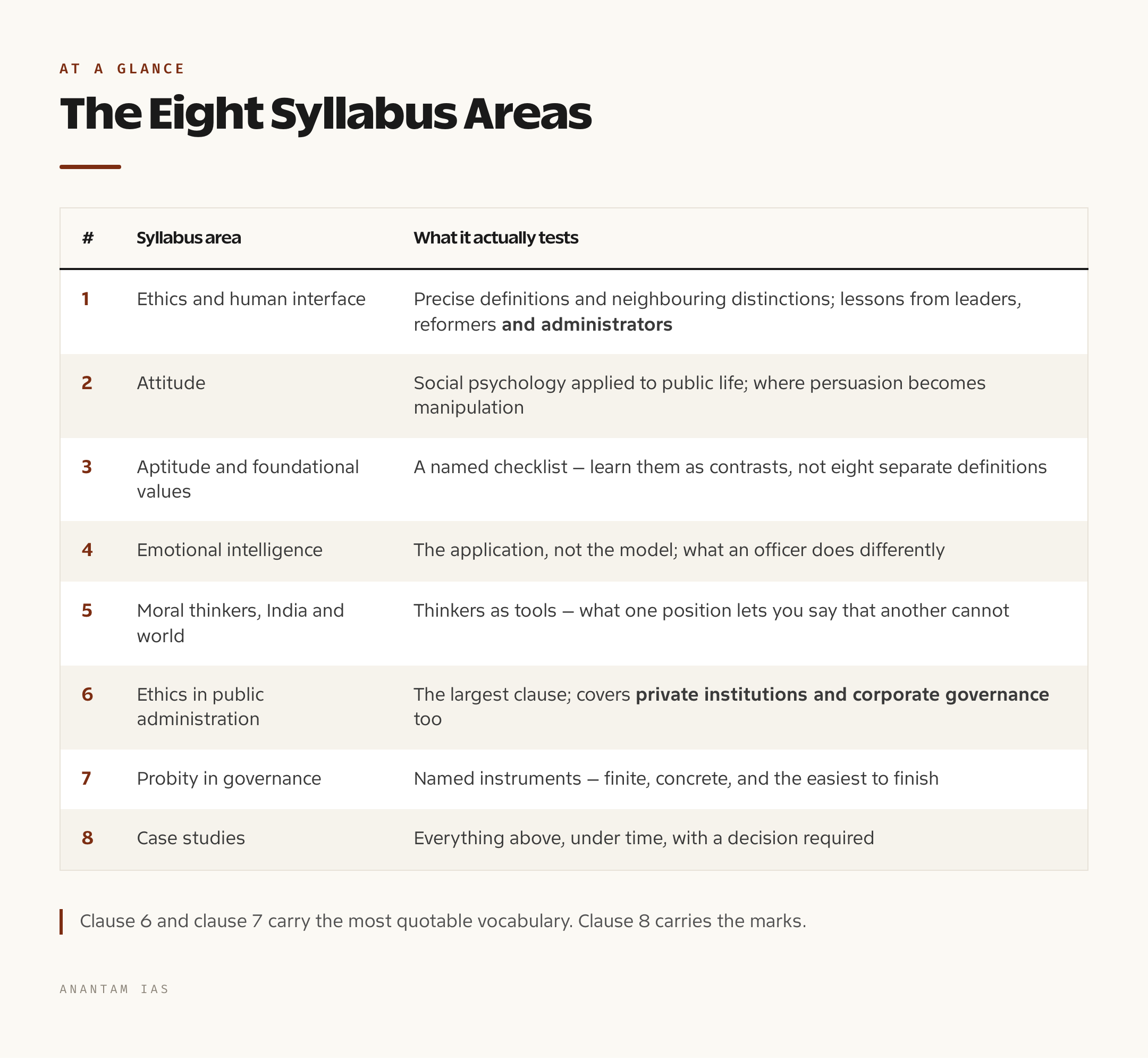
The official syllabus is a list of broad areas rather than a numbered chapter scheme. Set out below in the order it appears, with what each clause is actually asking of you.
1. Ethics and Human Interface. Essence, determinants and consequences of ethics in human actions; dimensions of ethics; ethics in private and public relationships. Human values — lessons from the lives and teachings of great leaders, reformers and administrators; role of family, society and educational institutions in inculcating values.
What it tests: whether you can define terms precisely and distinguish between neighbouring ones — ethics from morality, values from law. The “lessons from lives” clause is the one candidates skip, and it asks for administrators as well as leaders and reformers.
2. Attitude. Content, structure, function; its influence and relation with thought and behaviour; moral and political attitudes; social influence and persuasion.
What it tests: borrowed social psychology, applied to public life. You need the components of an attitude, how attitudes change, and where persuasion crosses into manipulation.
3. Aptitude and foundational values for civil service. Integrity, impartiality and non-partisanship, objectivity, dedication to public service, empathy, tolerance and compassion towards the weaker sections.
What it tests: the named values are effectively a checklist, and questions frequently ask you to distinguish two that sound alike — impartiality from non-partisanship, objectivity from neutrality. Learn them as a set of contrasts, not eight separate definitions.
4. Emotional intelligence. Concepts, and their utilities and application in administration and governance.
What it tests: the model and then the application. Naming the components earns little on its own; the marks are in showing what an emotionally intelligent officer does differently in a specific situation.
5. Contributions of moral thinkers and philosophers from India and the world.
What it tests: thinkers as tools. The useful question is never “who was Kant” but “what does a Kantian objection let you say that a utilitarian one cannot”. Both Indian and Western traditions are named, and Indian thinkers are the more commonly neglected half.
6. Public/civil service values and ethics in public administration. Status and problems; ethical concerns and dilemmas in government and private institutions; laws, rules, regulations and conscience as sources of ethical guidance; accountability and ethical governance; strengthening of ethical and moral values in governance; ethical issues in international relations and funding; corporate governance.
What it tests: the largest and most quotable clause. Note that it covers private institutions and corporate governance, not only government — a part many candidates ignore entirely.
7. Probity in Governance. Concept of public service; philosophical basis of governance and probity; information sharing and transparency in government, Right to Information, codes of ethics, codes of conduct, citizen’s charters, work culture, quality of service delivery, utilization of public funds, challenges of corruption.
What it tests: this clause names specific instruments, and those names are the answer vocabulary. It is the most concrete part of the syllabus and the easiest to prepare completely, because the list is finite.
8. Case Studies on the above issues.
What it tests: everything above, under time pressure, with a decision required. This is the half of the paper that separates scores.
How the Marks Are Split
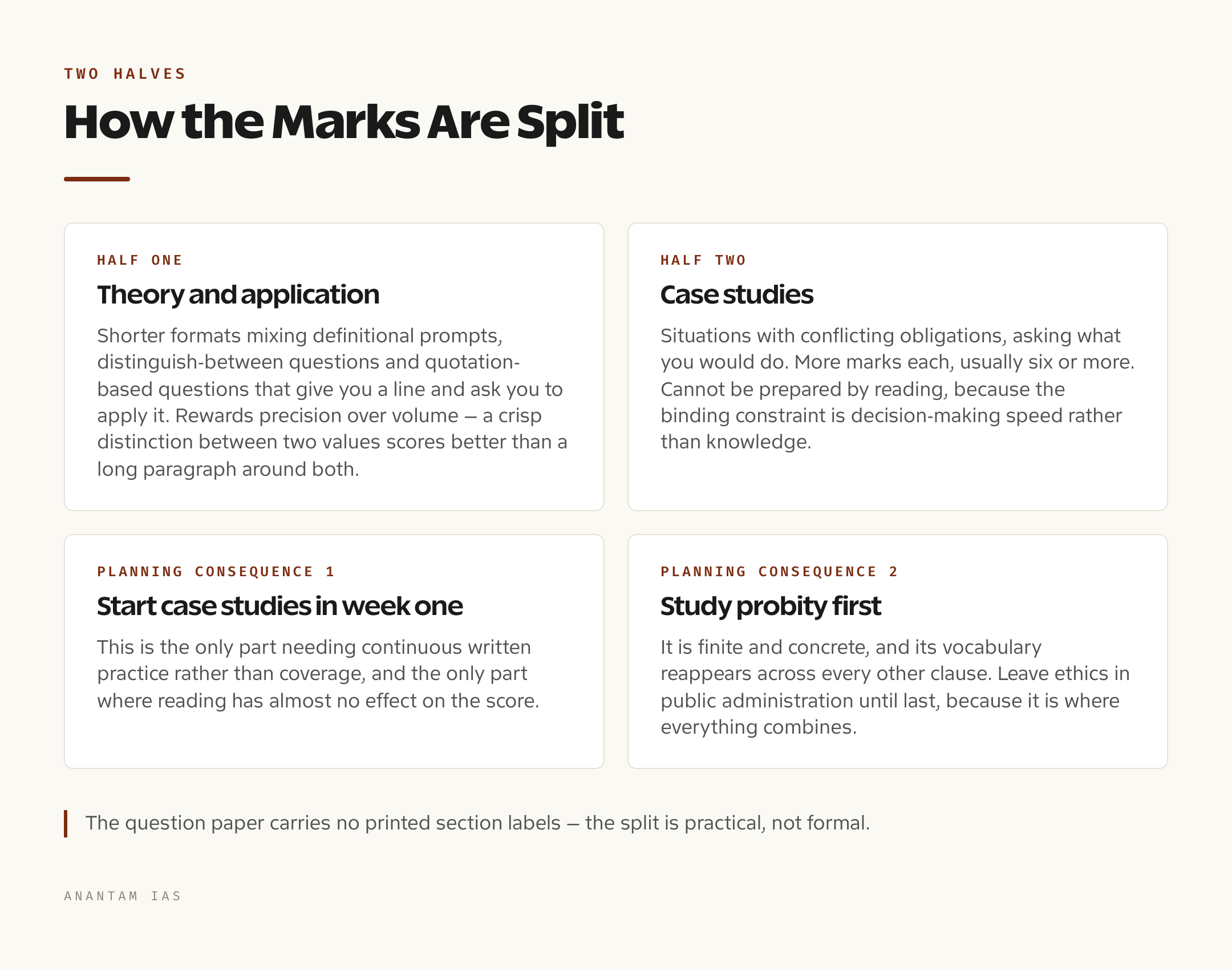
The paper is not formally divided into labelled sections in the question paper, but in practice it has two halves.
The first half asks theory and application questions on the areas above, usually in shorter formats with a mix of definitional, distinguish-between, and quotation-based prompts. Quotation questions give you a line from a thinker or a proverb and ask you to explain and apply it.
The second half is case studies. These present a situation with conflicting obligations and ask what you would do. They carry more marks each, and there are usually six or more.
Two planning consequences follow. First, the case-study half cannot be prepared by reading — it needs written attempts under time, because the constraint is decision-making speed rather than knowledge. Second, the theory half rewards precision over volume: a crisp distinction between two values scores better than a long paragraph around both.
Where to Study Each Part
The full, grouped note library — every piece on this site arranged by these syllabus areas — sits on the Ethics, Integrity and Aptitude hub.
The Words in the Syllabus That Carry Weight
A syllabus written this compactly repays close reading, because several phrases are doing more work than they appear to.
“Essence, determinants and consequences” is three separate demands, not one. Essence asks what ethics is; determinants ask what makes an action ethical; consequences ask what follows from ethical or unethical conduct at the level of individuals, institutions and society. Answers that only address the first leave two-thirds unaddressed.
“Its influence and relation with thought and behaviour” in the attitude clause is the reason attitude questions so often ask about inconsistency — the gap between what people believe and what they do. The clause invites exactly that.
“Utilities and application” in the emotional-intelligence clause is an instruction. Utility means what the concept is good for; application means a worked instance in administration or governance. A definition answers neither.
“Status and problems” under public service values signals a descriptive and a critical half — where Indian administrative ethics currently stands, and where it fails. Preparing only the normative theory leaves the “problems” half thin.
“Conscience” appears alongside laws, rules and regulations as a source of ethical guidance. Listing it as a fourth source is easy; the harder and better-rewarded point is what an officer does when conscience and rule conflict, which is also the engine of most case studies.
“Philosophical basis of governance and probity” is the most abstract phrase in the syllabus and the one most often skipped. It asks why the state may claim authority at all, and why holders of public office are held to a stricter standard than private citizens.
What the Syllabus Does Not Say
Three absences are worth noticing, because they are where candidates lose marks by guessing.
It does not prescribe books or thinkers by name. Beyond “from India and world”, no thinker is named. That means breadth of thinkers matters less than the ability to deploy two or three well.
It does not define the case-study format. There is no stated word limit convention or fixed number. Prepare a method that scales rather than a template of fixed length.
It does not separate theory from application. Every clause is written in a way that invites application. Answers that stop at definition are answering a question the syllabus did not ask.
How to Cover It Without Drowning
A workable order, because the syllabus order is not the best learning order.
Start with probity, clause 7. It is finite, concrete, and its vocabulary reappears everywhere else. Then do foundational values, clause 3, as a set of contrasts. Then thinkers, clause 5, but only enough to argue with — a handful each from the Indian and Western traditions, learned as positions rather than biographies.
Take attitude and emotional intelligence, clauses 2 and 4, next: they are self-contained and quick. Leave ethics in public administration, clause 6, until you have the vocabulary, because it is where everything combines. Read foundations, clause 1, alongside everything else rather than first — definitions land better once you have seen them used.
Begin case studies in week one and never stop. They are the only part that needs continuous practice rather than coverage, and the only part where reading has almost no effect on the score.
FAQ
How many marks is GS 4 in UPSC? 250 marks, over three hours. It counts towards the Mains merit list, like General Studies Papers I, II and III.
Is GS 4 easier to score in than the other GS papers? It has a higher floor and a lower ceiling. Almost everyone gets something, because there is no factual cut-off, but very high scores are uncommon. It is usually the paper where a candidate can most improve per hour invested, because the gains come from method rather than coverage.
How many case studies come in Paper IV? There is no fixed number stated in the syllabus. In practice there are usually six or more, carrying roughly half the paper’s marks.
Does the GS 4 syllabus include corporate governance? Yes. The clause on public/civil service values expressly covers ethical concerns and dilemmas in government and private institutions, ethical issues in international relations and funding, and corporate governance. It is one of the most commonly skipped parts of the syllabus.
Are quotations from thinkers compulsory to memorise? No. The syllabus names no thinker or quotation. A small stock you can apply accurately is worth more than a long list you can only reproduce.
Where does the “lessons from the lives of administrators” part come in? It is in the first clause, alongside great leaders and reformers. Administrators are named explicitly, so examples from public service — not only from the freedom struggle — are within scope.
What is the best order to study the GS 4 syllabus? Probity first because it is concrete and finite, then foundational values, then thinkers, then attitude and emotional intelligence, and ethics in public administration last. Start case studies immediately and continue throughout.