Gupta Dynasty — Golden Age of India, Major Rulers & Cultural Achievements
UPSC guide to the Gupta Dynasty — Chandragupta I, Samudragupta, Chandragupta II, Prayaga Prashasti, Nalanda, Fa-Hien, art, science, literature, and decline.
The Gupta Dynasty (c. 320 CE to 550 CE) ruled over a large part of the Indian subcontinent and is celebrated as the “Golden Age” of ancient India for its remarkable achievements in art, literature, science, mathematics, astronomy, and governance. Originating in the Gangetic plains, the Guptas consolidated political unity after centuries of post-Mauryan fragmentation and established a classical template of Hindu kingship. Key figures include Chandragupta I, Samudragupta (the “Napoleon of India”), and Chandragupta II Vikramaditya. The Gupta period is essential for UPSC Prelims and GS Paper I (Ancient Indian History).
Origins and Founding
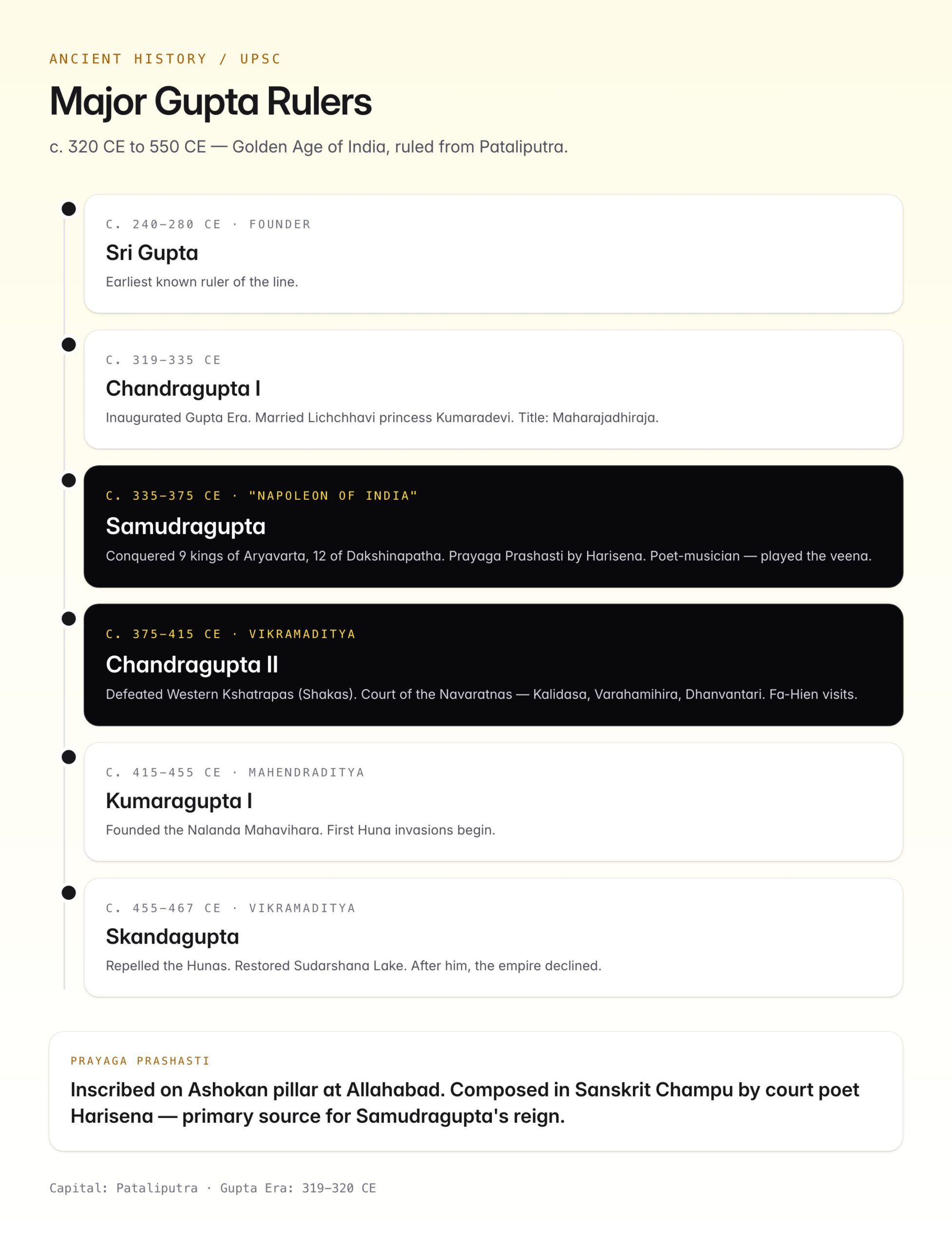
| Parameter | Details |
|---|---|
| Approximate period | c. 320 CE – 550 CE |
| Founder | Sri Gupta (c. 240-280 CE), believed to be the earliest known ruler of the line |
| First significant ruler | Chandragupta I (c. 319-335 CE) |
| Core region | Magadha (modern Bihar); expanded across northern and parts of central India |
| Capital | Pataliputra (modern Patna) |
| Era inaugurated | Gupta Era (beginning 319-320 CE), commemorating Chandragupta I's accession |
The Gupta Era (319-20 CE) is a critical dating reference for ancient Indian epigraphy.
Major Rulers of the Gupta Dynasty
1. Chandragupta I (c. 319-335 CE)
- Assumed the title Maharajadhiraja ("Great King of Kings").
- Matrimonial alliance with the Lichchhavi clan (of Vaishali) through marriage to Kumaradevi — a decisive step in establishing political legitimacy.
- Issued gold coins depicting himself and Queen Kumaradevi.
- Inaugurated the Gupta Era (319-320 CE).
2. Samudragupta (c. 335-375 CE)
Often called the "Napoleon of India" (by historian V.A. Smith) for his extensive military campaigns.
Conquests recorded in the Prayaga Prashasti:
- Conquered nine kings of Aryavarta (northern India) — annexed their territories.
- Defeated twelve kings of Dakshinapatha (South India) — captured, reinstated, and extracted tribute (dharma-vijaya).
- Reduced frontier kingdoms and forest tribes to tributary status.
- Received homage from the Shakas, Kushanas, and Sri Lanka (Meghavarna of Ceylon).
Titles: Parakramanka, Kaviraja (for his literary patronage), Ashvamedha-performer.
Cultural achievements:
- Performed the Ashvamedha Yajna (horse sacrifice) — commemorated in a special gold coin showing a horse before a sacrificial post.
- Himself a poet and musician — coins depict him playing the veena.
- Patronised the Buddhist scholar Vasubandhu.
3. Chandragupta II Vikramaditya (c. 375-415 CE)
Son of Samudragupta, widely considered the greatest ruler of the dynasty.
- Assumed the title Vikramaditya ("Sun of Valour").
- Defeated the Western Kshatrapas (Shakas) of Gujarat — extended Gupta control to the Arabian Sea coast (Sanchi, Saurashtra).
- Matrimonial alliances:
- Married Kuvera Naga (Naga princess).
- Married his daughter Prabhavati Gupta to Rudrasena II of the Vakataka dynasty — secured Deccan alliance.
- Minted silver coins after the Shaka conquest (previously Shakas minted silver).
- Court adorned by the Navaratnas (Nine Gems) including:
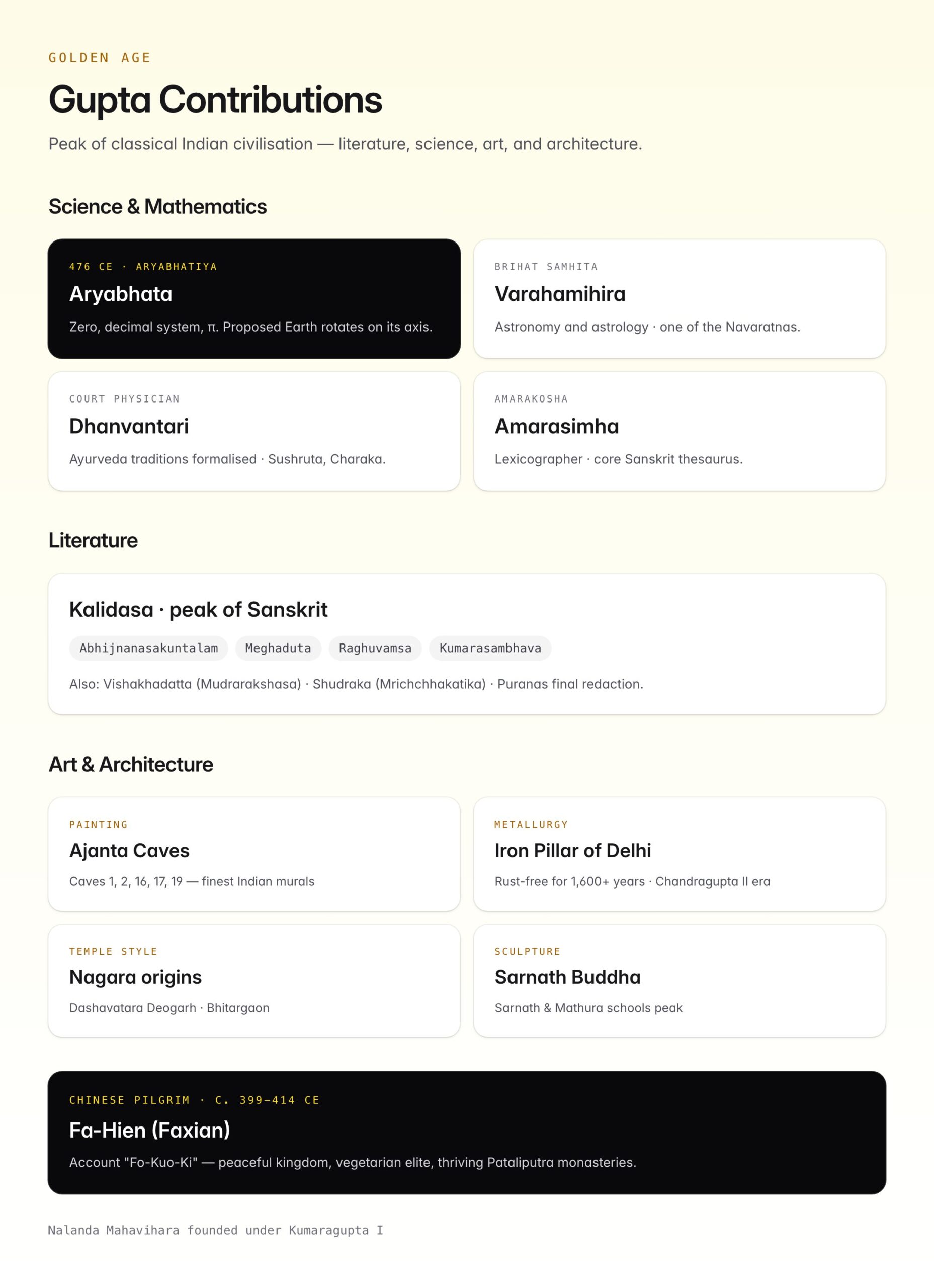
- Kalidasa — poet-dramatist (author of Abhijnanasakuntalam, Meghaduta, Raghuvamsa)
- Dhanvantari — physician
- Varahamihira — astronomer/mathematician (Brihat Samhita)
- Amarasimha — lexicographer (Amarakosha)
- Vararuchi, Kshapanaka, Ghatakarapara, Shanku, Vetala Bhatta
- Fa-Hien, the Chinese Buddhist pilgrim, visited India during his reign (c. 399-414 CE) and described the prosperity of the realm.
4. Kumaragupta I (c. 415-455 CE)
- Title Mahendraditya.
- Founded the Nalanda Mahavihara — the renowned centre of learning in Bihar (c. 5th century CE).
- Faced the first invasions of the Huns (Hunas) from Central Asia.
5. Skandagupta (c. 455-467 CE)
- Title Vikramaditya.
- Successfully repelled the Huna invasions — considered one of his greatest military achievements.
- Restored the Sudarshana Lake in Saurashtra (Junagadh Rock Inscription).
- After Skandagupta, the empire began to decline.
Later Rulers
Puragupta, Narasimhagupta (Baladitya), Kumaragupta II, Budhagupta, and Vishnugupta — the last Gupta ruler (c. 550 CE).
The Prayaga Prashasti (Allahabad Pillar Inscription)
The Prayaga Prashasti is an inscription on the Ashokan pillar at Allahabad (Prayagraj):
| Parameter | Details |
|---|---|
| Composed by | Harisena — court poet of Samudragupta |
| Language | Sanskrit (Champu style — mix of prose and verse) |
| Subject | Military campaigns, achievements, and character of Samudragupta |
| Significance | Primary source for Samudragupta's reign; inscribed on the same pillar as Ashoka's edicts |
Administration
| Feature | Description |
|---|---|
| King | Maharajadhiraja; divine kingship |
| Ministers | Mantri-parishad (council of ministers); senior officials styled Mahasandhivigrahika (war/peace), Mahabaladhikrita (military) |
| Provinces | Called bhuktis; governed by uparika |
| Districts | Called vishayas; governed by vishayapati |
| Villages | Called gramas; headed by gramika |
| Revenue | Land tax (bhaga) — typically 1/6 of produce; additional taxes on trade, crafts |
| Land grants | Agrahara (to Brahmins) and Devagrahara (to temples) — beginning of large-scale land grants |
| Judicial system | Hierarchical courts; Manusmriti used as legal guide |
The "Golden Age" — Cultural Achievements
Literature
| Work | Author | Significance |
|---|---|---|
| Abhijnanasakuntalam, Meghaduta, Raghuvamsa, Kumarasambhava | Kalidasa | Peak of Sanskrit literature |
| Mudrarakshasa, Devichandraguptam | Vishakhadatta | Political drama |
| Mrichchhakatika | Shudraka | Social drama |
| Puranas (final redaction) | Various | Religious literature |
Science and Mathematics
- Aryabhata (476 CE) — Aryabhatiya; introduced zero, decimal system, value of pi (π); proposed earth rotates on its axis.
- Varahamihira — Brihat Samhita, Panchasiddhantika; astronomy and astrology.
- Brahmagupta (later — 7th century) — rules of zero and negative numbers.
- Sushruta and Charaka traditions formalised in Ayurveda.
Art and Architecture
- Cave paintings of Ajanta (mostly Gupta period, Caves 1, 2, 16, 17, 19) — considered among the finest examples of Indian painting.
- Ellora caves (early stages), Udayagiri caves (Madhya Pradesh) — rock-cut temples.
- Iron Pillar of Delhi (Mehrauli) — Chandragupta II era; rust-free for 1,600+ years.
- Nagara style of temple architecture emerged (Dashavatara temple at Deogarh, Bhitargaon temple).
- Stone sculpture — Sarnath school of Buddha images; Mathura school.
Religion
- Hindu revival — Vaishnavism and Shaivism flourished; Guptas were Vaishnavites (titles Parama-Bhagavata).
- Buddhism continued to thrive — Nalanda founded under Kumaragupta I.
- Jainism had royal patronage in western India.
Foreign Accounts — Fa-Hien
Fa-Hien (also Faxian, c. 337-422 CE) was a Chinese Buddhist monk who visited India during Chandragupta II's reign (c. 399-414 CE):
- Travelled to collect Buddhist texts.
- His account Fo-Kuo-Ki (A Record of Buddhist Kingdoms) describes:
- Peaceful, prosperous kingdom.
- Absence of capital punishment.
- Vegetarianism among the elite.
- Flourishing monasteries, especially at Pataliputra and Magadha.
Decline of the Gupta Dynasty
| Cause | Explanation |
|---|---|
| Huna (Hun) invasions | Waves of invasions from Central Asia, especially under Toramana and Mihirakula, weakened central authority |
| Economic strain | Prolonged military campaigns drained the treasury; decline in gold coinage (later Gupta coins have lower gold purity) |
| Feudalisation | Large land grants to Brahmins, temples, and officials (samantas) created semi-independent feudatories |
| Weak successors | After Skandagupta, later rulers lacked military and administrative strength |
| Rise of regional powers | Vakatakas, Maukharis, Maitrakas, Pushyabhutis, and others gained independence |
| Trade decline | Disruption of Silk Road and Roman trade affected prosperity |
The dynasty formally ended around 550 CE. Power then fragmented among the Maukharis, Maitrakas, Vakatakas, Pushyabhutis (Thaneshwar), and Later Guptas (Magadha) — until Harshavardhana briefly reunified northern India in the 7th century.
UPSC Relevance
GS Paper I: Ancient Indian History; Indian Culture — Art, Architecture, Literature.
Prelims key points:
- The Gupta Dynasty ruled c. 320 CE to 550 CE from Pataliputra (Magadha).
- Chandragupta I inaugurated the Gupta Era (319-320 CE) and allied with the Lichchhavis.
- Samudragupta — "Napoleon of India"; campaigns documented in the Prayaga Prashasti (composed by Harisena) on the Ashokan pillar at Allahabad.
- Chandragupta II Vikramaditya defeated the Shaka Kshatrapas; his court had the Navaratnas including Kalidasa, Aryabhata, Varahamihira.
- Fa-Hien visited India during Chandragupta II's reign.
- Nalanda Mahavihara was founded under Kumaragupta I.
- Skandagupta repelled the Huna invasions.
- Aryabhata proposed earth's rotation and introduced zero and decimal system.
- The Iron Pillar of Delhi dates to the Gupta period.
- The Gupta period saw the rise of the Nagara style of temple architecture.