Haralambos Sociology for UPSC: A Selective Reading Guide
Use Haralambos and Holborn selectively: identify your edition, build a Paper I source map and turn one education debate into a reasoned answer.
A Haralambos sociology book can leave you with pages of highlighted theory and very little you can explain in an answer. The difficulty grows when a reading plan refers to a different edition from the copy on your desk. Start by identifying the book, then read one sociological debate at a time.
I recommend Haralambos and Holborn as a selective explanation source for Sociology Optional. Keep a usable copy if you already own one. Buy it when you need fuller arguments and examples; delay the purchase if your immediate problem is revising notes you already understand.
Identify Your Copy
The relevant title is Sociology: Themes and Perspectives, associated with Michael Haralambos and Martin Holborn. The family includes different editions and school-course versions. A familiar author name doesn’t make their contents interchangeable.
- The Collins eighth-edition record lists the broad textbook, ISBN 9780007498826. Its subject range includes stratification, family, methodology and sociological theory.
- Collins’ AQA Year 1 and AS book is a separate course-specific title. Its selected coverage should not be mistaken for the full textbook.
- The India Amazon listing for Haralambos and Holborn identifies the title and Collins. Check the seller’s edition, ISBN and contents before buying; this listing alone doesn’t establish an identical contents map to the eighth-edition record.
- If a seller describes a copy as abridged, compare its contents with your own topic list. Don’t assume it retains every argument in the full version.
Copy the title-page information into your notebook and use your own index. A chapter number borrowed from a different copy is a poor navigation tool.
Build A Paper I Source Map
Read by the problem a syllabus topic asks you to understand. The table below is a study map using the broad textbook’s published subject headings. Locate each heading in your edition before assigning pages.
| Study need | Book area to locate | Output from the session |
|---|---|---|
| Social inequality | Stratification, class and inequality | Compare an explanation of inequality with its criticism |
| Research design | Methodology | Match a method to a research question and a limitation |
| Sociological explanations | Sociological theory | State an argument, its mechanism and an objection |
| Family and kinship | Families and households | Separate household membership from family relationships |
| Religion and society | Religion | Identify the social process a religious practice might express |
| Power and institutions | Power, politics and the state | Distinguish power, authority and the basis of legitimacy |
These are reading tasks, not a claim that the book supplies the entire UPSC syllabus. The Sociology Optional guide can help you keep this source inside a wider preparation plan.
Turn A Debate Into An Answer
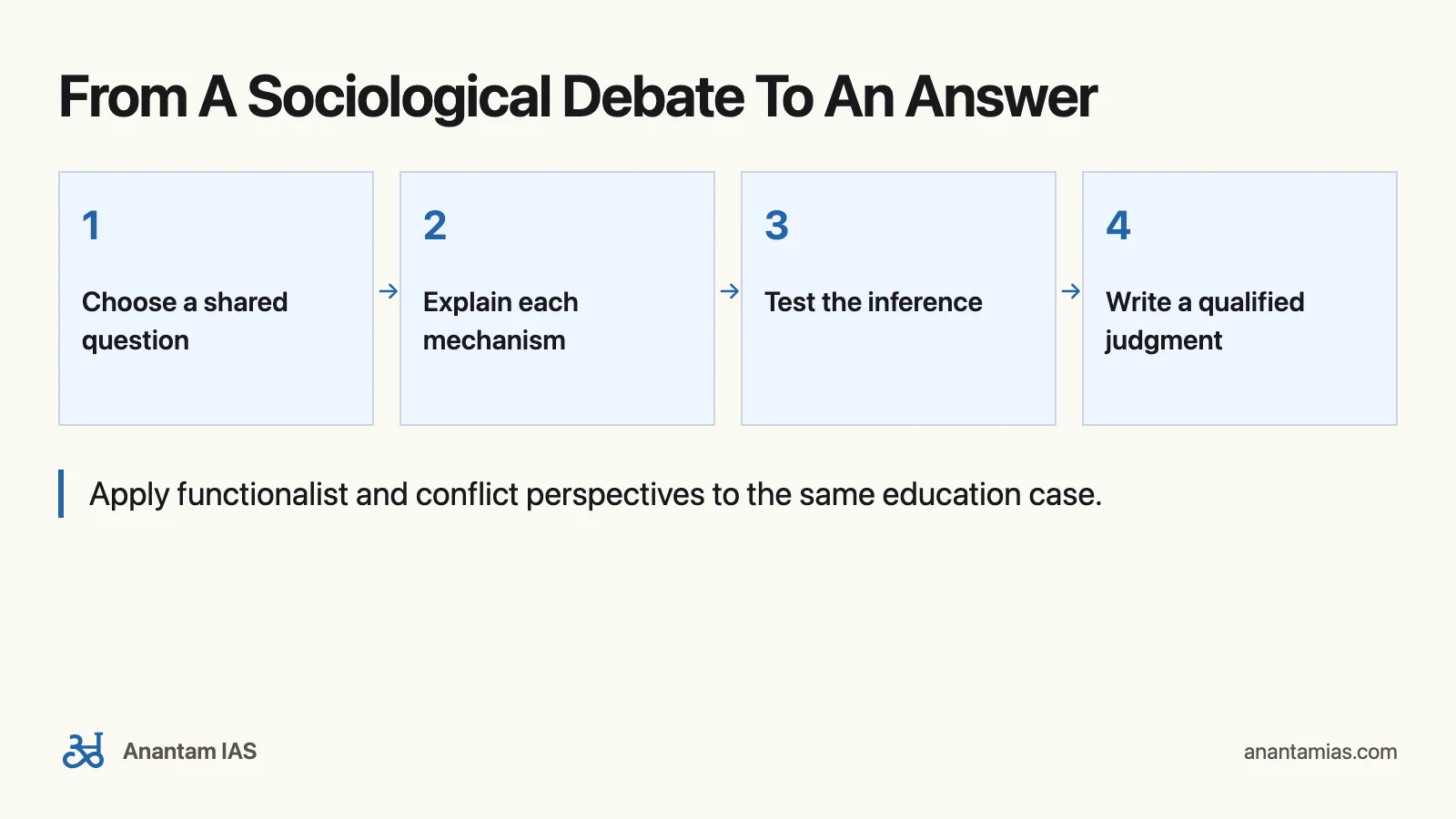
A theory comparison needs a shared question. Two disconnected biographies won’t explain why sociologists disagree.
Original practice example, not a UPSC question: “How can education support social integration while also reproducing inequality?”
Begin with a hypothetical school. All students sit the same entrance test, but some have private tutoring and a quiet room at home. We don’t have results or survey evidence. The situation simply lets us examine two mechanisms.
- Functionalist route: Shared rules and learning can help students participate in social life. Selection for different roles can be defended as a way to match skills with social needs. Ask whether the assessment actually measures the relevant skills.
- Conflict route: Unequal preparation can influence who succeeds. A formally common test may preserve advantages that existed before the test. Ask whose resources and experiences the selection process rewards.
- Test the inference: The existence of tutoring doesn’t prove every result is predetermined. The existence of a common test doesn’t prove equal opportunity. Evidence about preparation and outcomes is needed for either empirical claim.
OpenStax’s education chapter offers an accessible account of these perspectives if the vocabulary is still unfamiliar.
Now build an answer with intermediate steps:
| Answer move | What belongs in it | Why it earns space |
|---|---|---|
| Define the problem | Education has social functions and distributes opportunities | Establishes the issue both perspectives address |
| Explain integration | Shared learning, rules and role preparation | Shows the process behind the functional claim |
| Explain inequality | Unequal preparation can affect access to valued opportunities | Shows the process behind the conflict claim |
| Evaluate | Compare formal rules with the conditions under which students use them | Avoids treating either perspective as a universal verdict |
| Conclude | Integration and unequal outcomes can coexist; assess the conditions | Answers the question without choosing a slogan |
A weak note says “functionalism positive, Marxism negative.” A usable note tells you what each explanation makes visible. When you return to the book, record the named scholar and exact argument supporting the passage you read. The practice example above illustrates perspectives; it doesn’t attribute every sentence to a particular thinker.
Read With A Stopping Rule
One finished debate is a better session target than an arbitrary page count. You can adjust the time without changing the task.
- A 40-minute session: Spend 20 minutes reading one argument, 10 recalling it with the book closed and 10 making the comparison worksheet.
- A shorter day: Reduce the reading passage. Keep one explanation and one criticism rather than dropping recall completely.
- The next day: Reconstruct the mechanism before reopening the page. Repair the part you couldn’t explain.
- At the week’s end: Write one original answer using two perspectives. Check whether the criticism addresses the claim you actually made.
Stop a topic when you can explain the claim, show how it works and state its limit. If you can’t do that yet, reread the relevant passage rather than starting another source.
Fill The Indian Context Gap
A general sociology textbook needs Indian examples and syllabus-specific coverage around it. Country-specific cases in a textbook can’t simply be relabeled as Indian evidence.
- Pair a theoretical claim with a separately sourced Indian example. Distinguish an illustrative classroom situation from documented research.
- Check all remaining syllabus topics against your source map. An unmarked gap is more dangerous than an openly missing topic.
- Keep current figures outside older textbook notes until the source and date are clear.
- Use the published Sociology Optional notes to locate a topic, then check its argument against your reading.
Your next reading session should end with a comparison you can explain aloud. If your copy supports that work, an edition upgrade can wait until you identify a specific missing argument or section.
Frequently Asked Questions
Which Haralambos sociology book does this guide discuss?
It discusses Sociology: Themes and Perspectives, associated with Michael Haralambos and Martin Holborn. AQA Year 1 and AS is a separate course-specific title. Match your edition and contents before using a reading map.
Should I read Haralambos from cover to cover for UPSC?
A topic-based sequence is more practical when using it for the optional. Read the argument you need, identify its criticism and write an explanation before moving on.
Should I replace an older copy?
Keep a usable copy until you identify a specific missing argument or section. Check the new contents against that gap before buying an upgrade.
Can Haralambos cover the whole Sociology Optional?
This guide makes no full-syllabus claim. Audit remaining topics and add Indian examples and other sources where the preparation needs them.
How do I turn a theory passage into an answer?
Give two perspectives the same question. Explain each mechanism, test its assumptions and end with a judgment that answers the question. Record the actual scholar and argument from your reading.