Hindi Grammar Essentials for UPSC Compulsory Paper
Complete Hindi grammar guide for UPSC Compulsory: sandhi, samas, karaka, vaachya, tenses, sentence correction, idioms, and antonyms with memorisable tables.
Grammar and Usage is worth 40 marks in the UPSC Hindi Compulsory paper. Unlike essay or precis, grammar is fully predictable — the same core topics appear year after year. Two weeks of focused revision can fetch you 30+ marks here.
This guide distils the high-yield grammar topics — संधि, समास, कारक, वाच्य, काल, वाक्य शुद्धि — with rules, examples, and tables you can memorise.
What is Tested
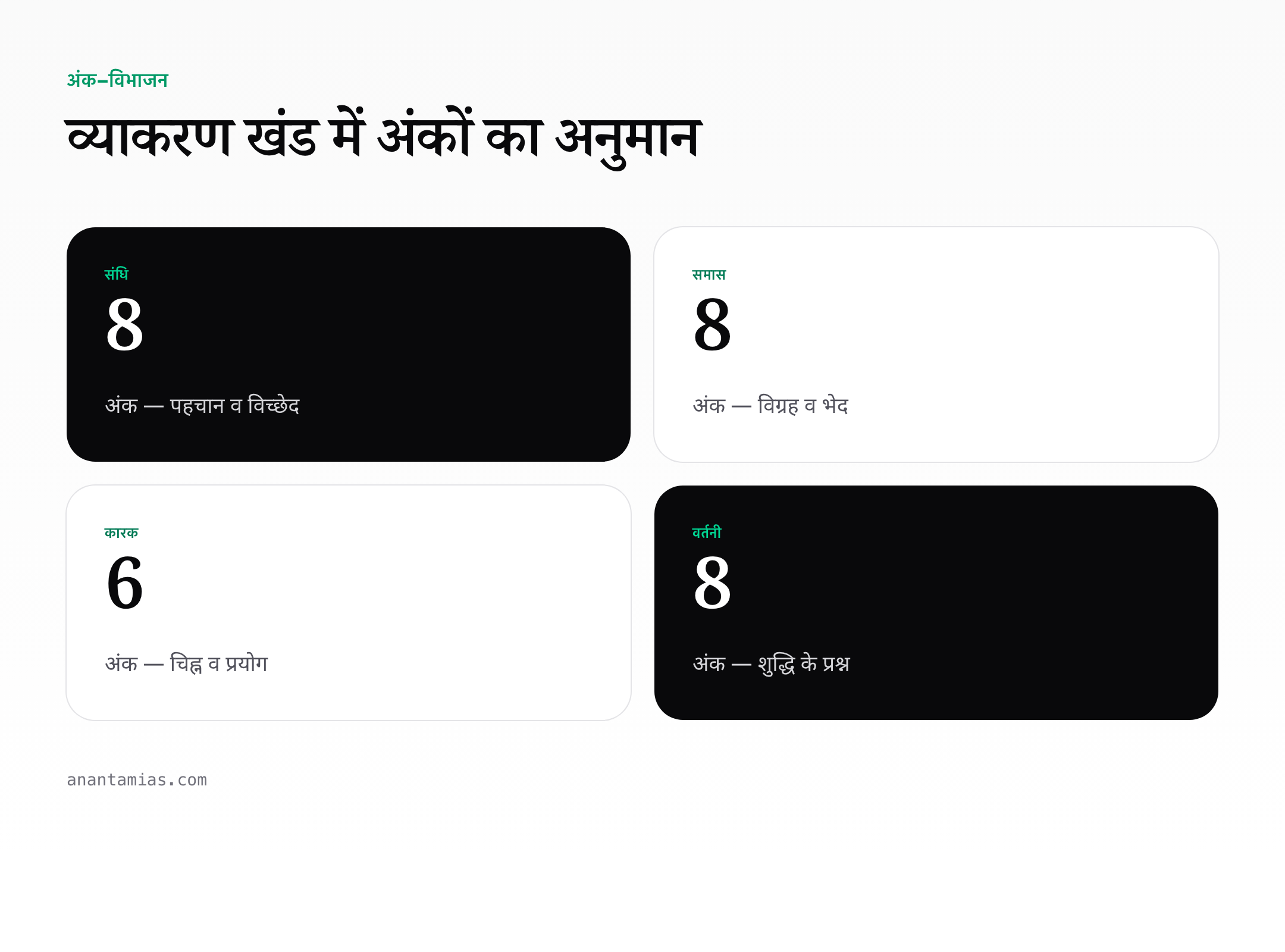
| Topic | Approximate Marks |
|---|---|
| वाक्य शुद्धि (sentence correction) | 10 |
| मुहावरे / लोकोक्तियाँ (idioms/proverbs) | 8 |
| विलोम / पर्यायवाची (antonyms/synonyms) | 8 |
| संधि / समास (sandhi/samas) | 8 |
| Miscellaneous usage | 6 |
1. संधि (Sandhi) — Sound Joining
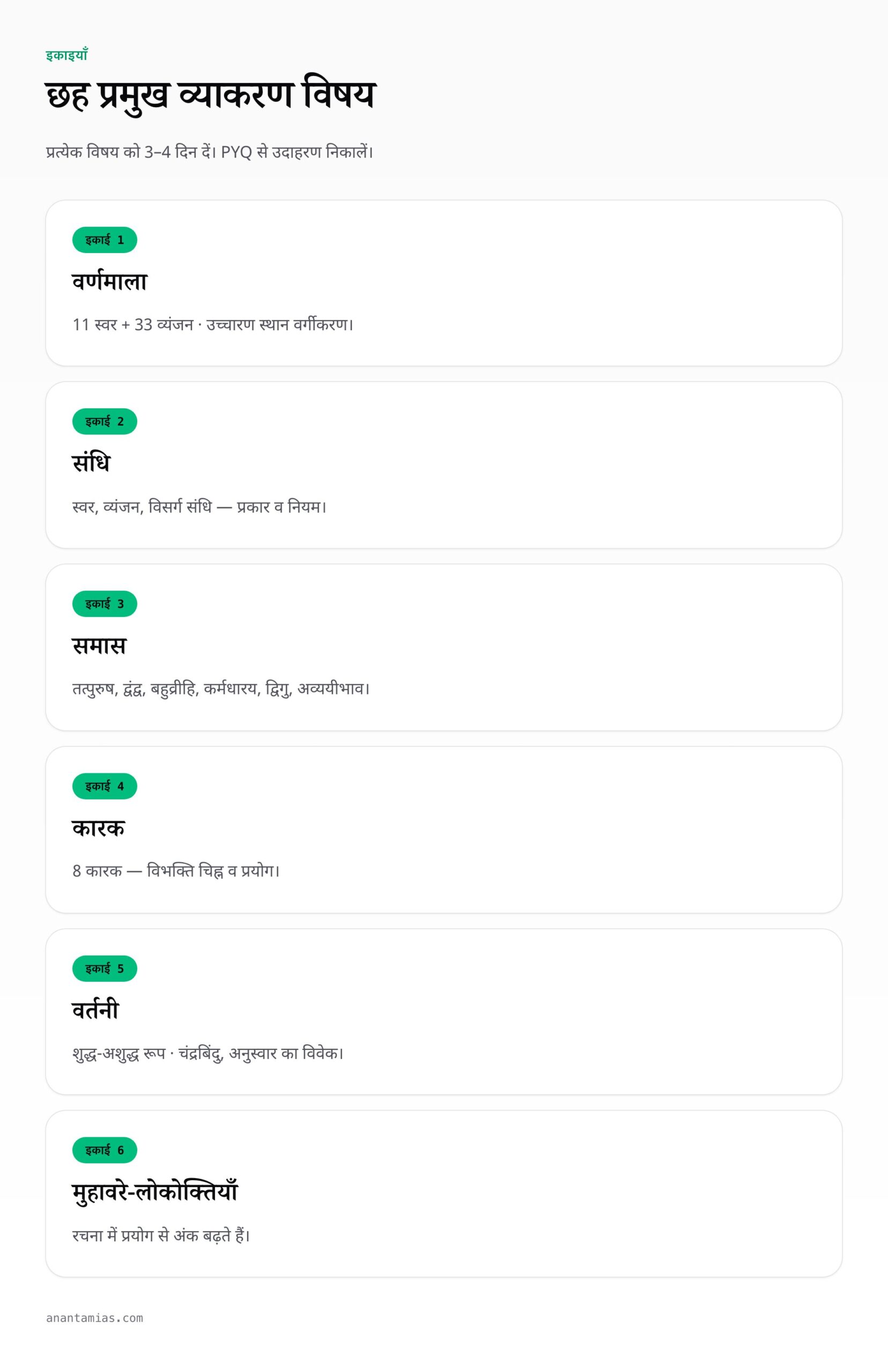
Sandhi is the joining of two letters/sounds. Three main types appear in UPSC:
स्वर संधि (Vowel Sandhi)
| Words | Joined Form | Type |
|---|---|---|
| विद्या + आलय | विद्यालय | दीर्घ संधि (आ+आ=आ) |
| सूर्य + उदय | सूर्योदय | गुण संधि (अ+उ=ओ) |
| देव + ऋषि | देवर्षि | गुण संधि |
| एक + एक | एकैक | वृद्धि संधि (ए+ए=ऐ) |
| इति + आदि | इत्यादि | यण् संधि |
व्यंजन संधि (Consonant Sandhi)
उत् + लास = उल्लास, सत् + जन = सज्जन, वाक् + ईश = वागीश।
विसर्ग संधि (Visarga Sandhi)
मनः + रथ = मनोरथ, निः + बल = निर्बल, दुः + आत्मा = दुरात्मा।
2. समास (Samas) — Compound Words
| Type | Example | Breakdown |
|---|---|---|
| तत्पुरुष | राजपुत्र | राजा का पुत्र |
| द्वंद्व | माता-पिता | माता और पिता |
| कर्मधारय | नीलकमल | नीला है जो कमल |
| बहुव्रीहि | दशानन | दस हैं आनन जिसके (रावण) |
| द्विगु | त्रिलोक | तीन लोकों का समूह |
| अव्ययीभाव | यथाशक्ति | शक्ति के अनुसार |
3. कारक (Karaka) — Case Markers
Hindi has 8 kaaraks, identified by vibhakti (post-positions):
| कारक | विभक्ति | Example |
|---|---|---|
| कर्ता (Nominative) | ने | राम ने खाना खाया। |
| कर्म (Accusative) | को | मैंने उसको देखा। |
| करण (Instrumental) | से / के द्वारा | वह कलम से लिखता है। |
| संप्रदान (Dative) | के लिए / को | माँ ने बच्चे के लिए खाना बनाया। |
| अपादान (Ablative) | से (separation) | पेड़ से पत्ता गिरा। |
| संबंध (Genitive) | का / की / के | राम का भाई। |
| अधिकरण (Locative) | में / पर | पुस्तक मेज़ पर है। |
| संबोधन (Vocative) | हे / अरे | हे राम! |
4. वाच्य (Voice)
- कर्तृ वाच्य — focus on doer: राम पत्र लिखता है।
- कर्म वाच्य — focus on action: राम के द्वारा पत्र लिखा जाता है।
- भाव वाच्य — focus on feeling/action (intransitive): मुझसे चला नहीं जाता।
5. काल (Tense)
| Tense | Example |
|---|---|
| सामान्य वर्तमान | वह पढ़ता है। |
| अपूर्ण वर्तमान (continuous) | वह पढ़ रहा है। |
| पूर्ण वर्तमान | वह पढ़ चुका है। |
| सामान्य भूत | वह पढ़ा। |
| सामान्य भविष्य | वह पढ़ेगा। |
6. वाक्य शुद्धि (Sentence Correction)
| Wrong | Correct | Rule |
|---|---|---|
| मैं स्कूल जाता हूँ है | मैं स्कूल जाता हूँ | Extra verb removed |
| लड़की खा रहा है | लड़की खा रही है | Gender agreement |
| छात्र पुस्तक पढ़ता है | छात्र पुस्तक पढ़ते हैं | Number agreement (plural) |
| मैंने किताब पढ़ा | मैंने किताब पढ़ी | Object-verb agreement (feminine) |
| वह घर के पास है रहता | वह घर के पास रहता है | Word order |
7. High-Yield Idioms (मुहावरे)
| मुहावरा | अर्थ |
|---|---|
| आँख का तारा होना | बहुत प्यारा होना |
| नाक में दम करना | परेशान करना |
| खून-पसीना एक करना | कठोर परिश्रम करना |
| लोहे के चने चबाना | अत्यंत कठिन कार्य करना |
| आसमान से बातें करना | बहुत ऊँचा होना |
| कान देना | ध्यान से सुनना |
| हाथ पीले करना | विवाह करना |
8. Common Antonyms (विलोम)
| शब्द | विलोम |
|---|---|
| आदर | अनादर |
| ज्ञान | अज्ञान |
| न्याय | अन्याय |
| सज्जन | दुर्जन |
| उत्थान | पतन |
| आय | व्यय |
| सफल | असफल |
Revision Plan (14 Days)
- Day 1–2: संधि + सामास
- Day 3–4: कारक + वाच्य
- Day 5–6: काल + वाक्य शुद्धि
- Day 7–9: 100 मुहावरे + 50 लोकोक्तियाँ
- Day 10–11: 100 विलोम + 100 पर्यायवाची
- Day 12–14: Full grammar mock tests
Grammar is where hard work pays cleanly. Memorise the tables, drill the patterns, and this section becomes a 30+ guaranteed scorer — a huge contribution to your 75-mark qualifying target.
Frequently Asked Questions
How many marks does grammar carry in UPSC Hindi Compulsory?
Approximately 40 marks out of 300. It includes sentence correction, idioms, antonyms, synonyms, sandhi, and samas.
Is grammar the easiest section?
Arguably yes — grammar topics are finite and repeat year after year. Two weeks of focused revision can fetch 30+ marks.
Which samas types are most important?
Tatpurush, Dvandva, Karmadharaya, and Bahuvrihi appear most often. Avyayibhav and Dvigu are less frequent but easy to identify.
How many idioms should I memorise?
100 high-frequency idioms are enough. Focus on idioms involving body parts (आँख, नाक, कान) and everyday actions — these dominate UPSC papers.
Do I need to know Sanskrit rules for sandhi?
Only the common स्वर, व्यंजन, and विसर्ग sandhi examples. Deep Sanskrit knowledge is not required — memorising 30–40 examples covers almost all questions.