Disclosure: this guide contains Amazon affiliate links. As an Amazon Associate, Anantam IAS earns from qualifying purchases — at no extra cost to you.
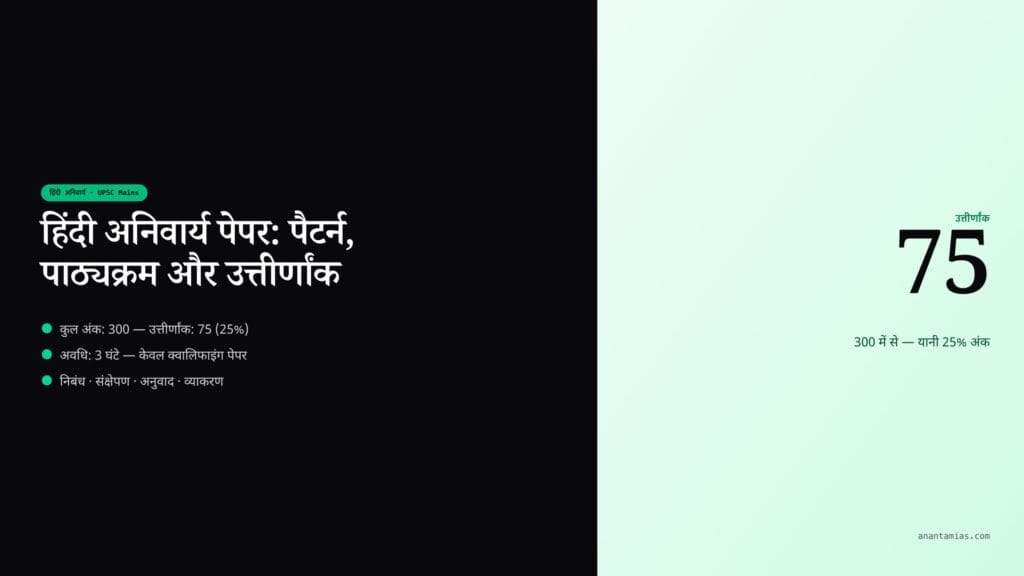
The UPSC Civil Services Mains examination includes two language papers: Paper A (Indian Language) and Paper B (English). For candidates who opt Hindi as the medium of examination or as their compulsory Indian language, the Hindi Compulsory Paper becomes Paper A. This is a qualifying paper of 300 marks, and you need only 25% (75 marks) to clear it.
Though qualifying in nature, failing this paper means your other Mains papers will not be evaluated at all. Understanding the pattern, syllabus, and structure is the first step toward easy qualification.
What is the Hindi Compulsory Paper?
Hindi Compulsory is a qualifying language paper conducted in the UPSC Civil Services Mains. It tests the candidate’s ability to read, comprehend, and express serious discursive prose in Hindi, and to translate between English and Hindi accurately.
The paper is applicable to all candidates who have chosen Hindi as one of the scheduled languages under the 8th Schedule of the Constitution. Candidates from states like Tamil Nadu, Meghalaya, Mizoram, Nagaland, and Arunachal Pradesh are exempted from the Indian language paper.
Exam Pattern at a Glance
| Feature | Details |
|---|---|
| Paper Name | Paper A – Indian Language (Hindi) |
| Total Marks | 300 |
| Qualifying Marks | 75 (25%) |
| Duration | 3 hours |
| Medium | Hindi (Devanagari script) |
| Nature | Qualifying (marks not counted in final merit) |
| Question Type | Descriptive / Subjective |
Syllabus Breakdown
The UPSC Hindi Compulsory Paper syllabus is divided into five sections. Each section tests a specific language skill.
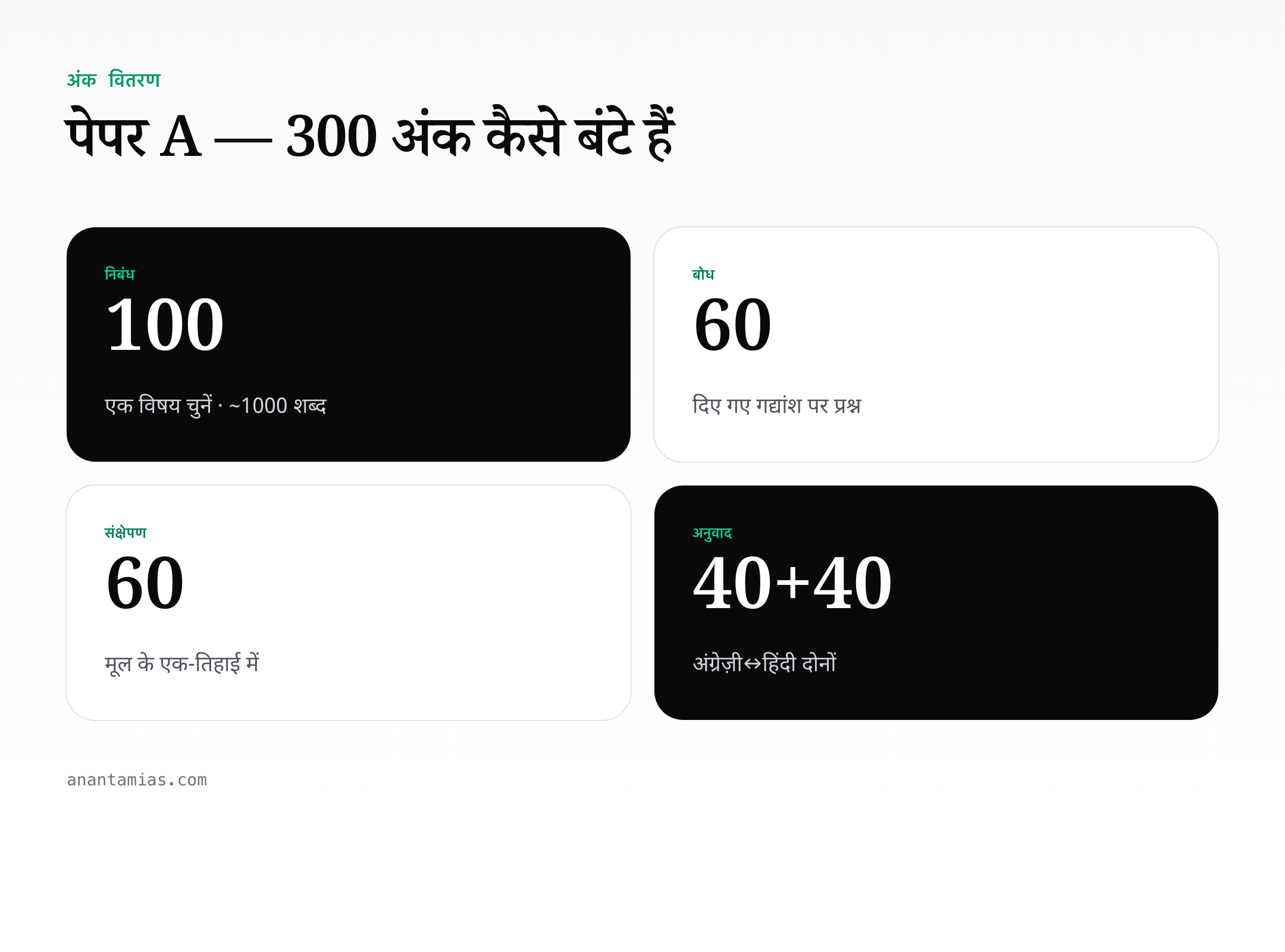
1. Essay Writing (निबंध) — 100 Marks
You write one essay of about 600 words on a given topic. Topics are usually general — society, culture, science, environment, or current affairs. Depth of thought, organised expression, and correct Hindi are evaluated.
2. Reading Comprehension (बोध) — 60 Marks
A Hindi passage is given, followed by 5–6 questions. You must read carefully, understand the passage, and answer in your own words.
3. Precis Writing (संक्षेपण) — 60 Marks
A passage of about 300 words is given. You have to summarise it in one-third of its length (100 words) without losing the core meaning.
4. Translation — 40 Marks
Two translation tasks: English to Hindi (20 marks) and Hindi to English (20 marks). Passages are short, about 100 words each, usually on administrative or general themes.
5. Grammar and Usage (व्याकरण) — 40 Marks
Tests basic Hindi grammar: वाक्य शुद्धि (sentence correction), मुहावरे और लोकोक्तियाँ (idioms and proverbs), विलोम शब्द (antonyms), पर्यायवाची (synonyms), and संधि / समास.
Marks Distribution Table
| Section | Marks |
|---|---|
| Essay | 100 |
| Comprehension | 60 |
| Precis | 60 |
| Translation (Eng→Hindi + Hindi→Eng) | 40 |
| Grammar | 40 |
| Total | 300 |
Who Must Write This Paper?
- Candidates choosing Hindi as the Mains medium of examination.
- Candidates whose Optional subject is Hindi Literature (still have to appear).
- All candidates except those from Tamil Nadu, Meghalaya, Mizoram, Nagaland, Arunachal Pradesh, Sikkim, and Manipur (who qualify for language exemption).
Qualifying Marks: What 75 Means
You need just 75 marks out of 300 to qualify — that is 25%. UPSC does not publish your exact Hindi Compulsory score in the final marksheet; they only confirm whether you qualified.
If you fail this paper, UPSC will not evaluate your GS and Optional papers at all. Your entire Mains effort becomes void. Hence, even though it is qualifying, you cannot afford to take it lightly.
Key Strategy Points
- Write the essay in simple, clear Hindi — avoid flowery or Sanskritised language unless you are fluent.
- Strictly stick to word limits in precis (about 100 words from 300).
- Practise 10–15 English-to-Hindi translations using official UPSC previous papers.
- Revise basic grammar — कारक, संधि, समास, वाच्य, काल.
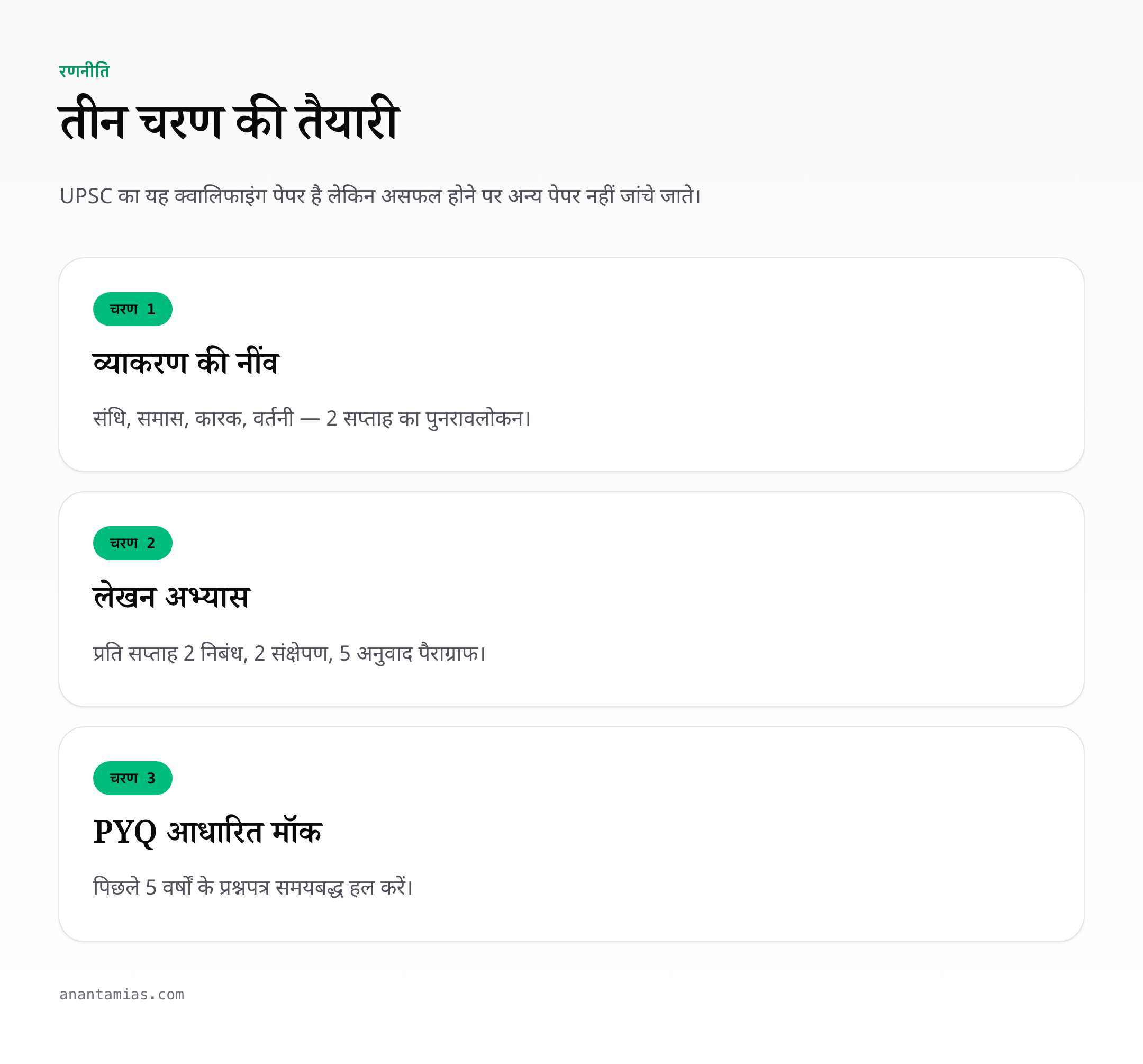
- Write at least 5 full-length mock papers before the real exam.
Common Misconceptions
Myth 1: ‘I speak Hindi at home, I do not need to practise.’ Spoken Hindi is very different from written, formal Hindi required in UPSC. Practice is essential.
Myth 2: ‘It is qualifying, so I can skip preparation.’ Thousands of strong candidates fail Mains every year because they did not prepare for this paper seriously.
Myth 3: ‘Hindi medium candidates do not need practice.’ Even Hindi-medium aspirants lose marks in precis, translation, and grammar due to lack of technique.

Lucent's Samanya Hindi (General Hindi)
- 458 pages, Lucent Publications, in Hindi
- Grammar, vocabulary, idioms and sentence correction in one book
- The most-cited book for UPSC Hindi Compulsory and the state exams
For the full three-book kit and what each one is for, see Best Books for UPSC Hindi Compulsory Paper.
Recommended Preparation Timeline
Begin at least 45 days before Mains. First 15 days: grammar revision + idioms. Next 15 days: essay and comprehension practice. Last 15 days: precis, translation, and full-length mock tests.
Consistency matters more than hours. Just one essay, one precis, and one translation per day builds the rhythm needed to qualify comfortably.
Frequently Asked Questions
Is the UPSC Hindi Compulsory Paper qualifying?
Yes. You need only 25% (75 out of 300). The marks are not counted in the final merit but you must clear it for your other Mains papers to be evaluated.
Can I skip the Hindi Compulsory paper?
No. Skipping it means your entire Mains will not be evaluated. The only exemption is if you belong to the seven states (Tamil Nadu, Meghalaya, Mizoram, Nagaland, Arunachal Pradesh, Sikkim, Manipur) with language relaxation.
What is the duration of the paper?
3 hours for 300 marks. Essay alone consumes ~1 hour; plan the rest for comprehension, precis, translation, and grammar.
Which script must I use?
Devanagari script only. Writing in Roman script will be rejected.
How many questions are asked?
One essay + one comprehension passage (5–6 sub-questions) + one precis + two translations + 4–5 grammar items. About 15 items in total.
Is Hindi Compulsory the same as Hindi Literature Optional?
No. Compulsory is qualifying (300 marks, 25% cutoff). Literature Optional is scoring (500 marks total across two papers, counted in final rank).
Tell Google you want more of this.
Add Anantam IAS as a preferred sourceOne tap, and this site shows up more often in your own Top Stories, AI Overviews and AI Mode. Remove it any time.