UPSC Hindi Compulsory Qualifying Marks & Strategy to Pass
Everything about UPSC Hindi Compulsory qualifying marks: 25% cutoff explained, fail rates, section-wise target, exemption list, and minimum viable 23-day plan to pass.
The UPSC Hindi Compulsory paper asks for just 25% — 75 out of 300 — to qualify. On paper, this sounds easy. In practice, every year a measurable percentage of otherwise-strong candidates fail this paper and see their entire Mains nullified.
This guide explains exactly how qualification works, what ‘qualifying paper’ really means, and the minimum strategy to walk across the cutoff with a comfortable buffer.
What ‘Qualifying’ Means
- Hindi Compulsory (Paper A) is qualifying in nature.
- Minimum marks required: 25% = 75 out of 300.
- If you fail, your GS and Optional papers are NOT evaluated.
- If you qualify, the Hindi Compulsory marks do NOT count toward your final merit rank.
- Only Paper I (Essay) to Paper VII (Optional-II) count for the final merit list.
Qualifying Cutoff History
The 25% cutoff has been stable for over a decade. UPSC does not publish exact year-wise pass percentages for the compulsory language paper, but estimates from RTI disclosures suggest:
| Year | Approx. Fail Rate (Hindi Compulsory) |
|---|---|
| 2019 | 4–5% |
| 2020 | 3–4% |
| 2021 | 4–5% |
| 2022 | 5–6% |
| 2023 | 4–5% |
5% of Mains candidates is not small — it is several hundred aspirants per year whose entire Mains effort is thrown away over a qualifying paper. Do not join that cohort.
How Marks Break Across 300
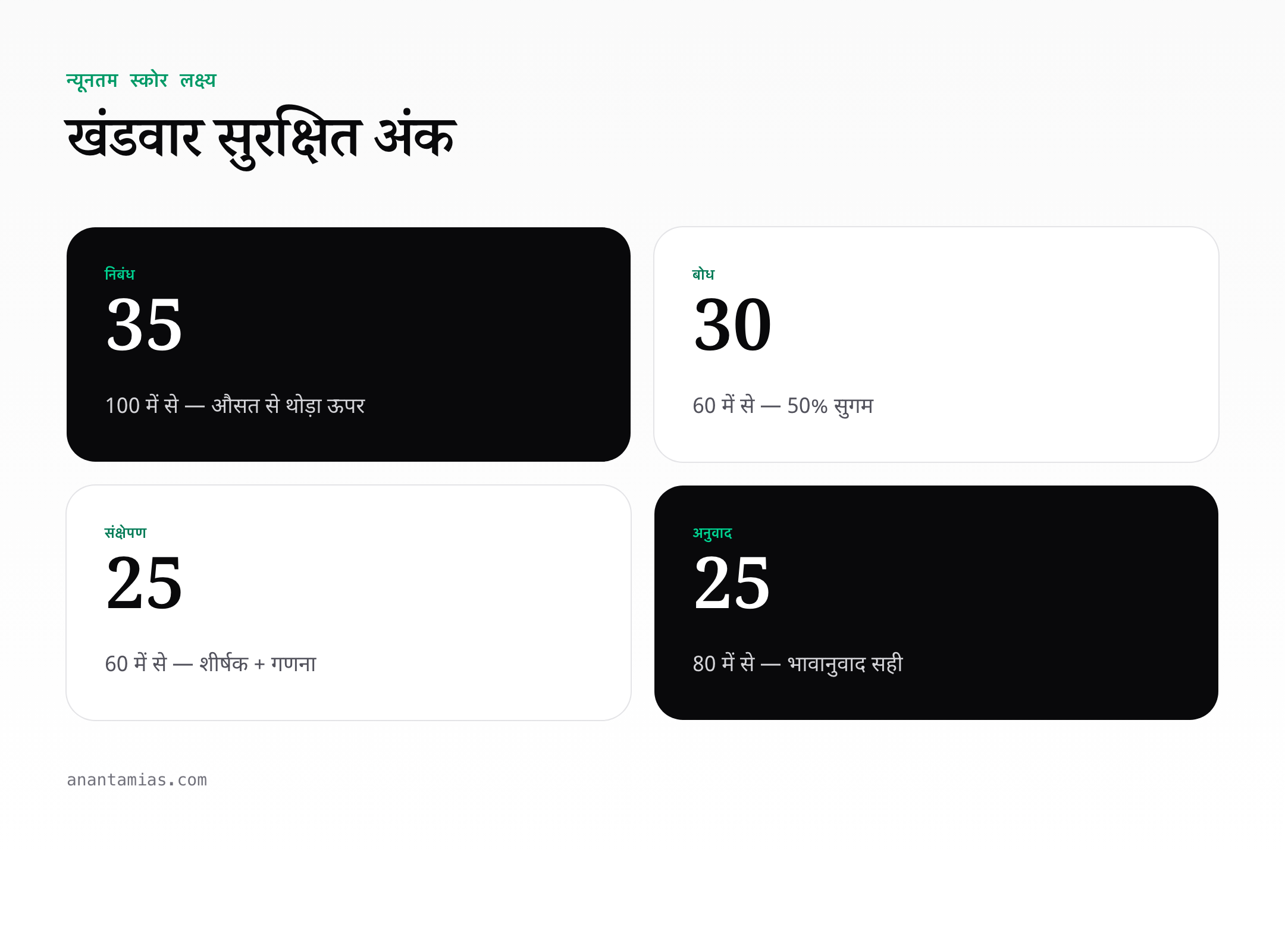
| Section | Max Marks | Minimum to Target |
|---|---|---|
| Essay | 100 | 50 |
| Comprehension | 60 | 35 |
| Precis | 60 | 35 |
| Translation | 40 | 22 |
| Grammar | 40 | 25 |
| Total (Targetable) | 300 | 167 |
Aim for 167+ (about 55%) — more than 2× the cutoff. Even with mistakes on exam day, this target keeps you safely above 100.
Minimum Strategy to Pass
Step 1: Do not leave anything unattempted
Empty pages guarantee failure. Write something in every section — partial marks add up.
Step 2: Score heavy on grammar
Grammar is the most predictable section. 14 days of focused drill fetches 25–30 out of 40 — nearly 40% of the cutoff from a single section.
Step 3: Nail the precis word count
Keep precis strictly at ~100 words with a clear title. This easily yields 40+ out of 60.
Step 4: Write a structured essay
Even a simple, well-structured essay with clear भूमिका, 3 body paragraphs, and उपसंहार fetches 55–65 out of 100.
Step 5: Translate every sentence
Never skip a sentence in translation. Even a weak but complete translation scores 20+ out of 40.
Sample Calculation
If you follow the 5 steps above at minimum competence:
- Essay: 55 / 100
- Comprehension: 30 / 60
- Precis: 40 / 60
- Translation: 22 / 40
- Grammar: 28 / 40
- Total: 175 / 300 — more than 2× the 75-mark cutoff.
Who Fails (and Why)
- Non-Hindi-medium aspirants who never practised the paper formally.
- Candidates who ran out of time and left grammar blank.
- Candidates who wrote in Roman script by mistake on one section.
- Candidates with severe gender, number, and tense errors throughout.
- Candidates who wrote below half the expected length in essay and precis.
Who Comfortably Qualifies
- Anyone who practises 15+ translations and 15+ precis.
- Anyone who memorises 100 idioms and 50 spelling corrections.
- Anyone who writes 6+ full-length essays before the exam.
- Anyone who completes 3+ full-length mock papers.
- Anyone who budgets time strictly (75+25+25+20+25+10 minutes).
Exemptions from Compulsory Language Paper
Candidates from the following states are exempted from the Indian Language Paper (Paper A):
- Tamil Nadu
- Meghalaya
- Mizoram
- Nagaland
- Arunachal Pradesh
- Sikkim
- Manipur
All other candidates must attempt Paper A (Hindi for most Hindi-speaking states; otherwise any scheduled Indian language).
Myths vs Reality
| Myth | Reality |
|---|---|
| It is easy, I can skip prep. | 5% fail rate is non-trivial; prep is essential. |
| Hindi medium candidates don’t need prep. | They lose marks in precis and translation without drills. |
| Any Hindi will do. | Examiners expect formal written Hindi, not spoken. |
| Marks don’t count — why care? | Failing means entire Mains is wasted. |
| One week is enough. | One week of focused drill is the bare minimum; 30 days is recommended. |
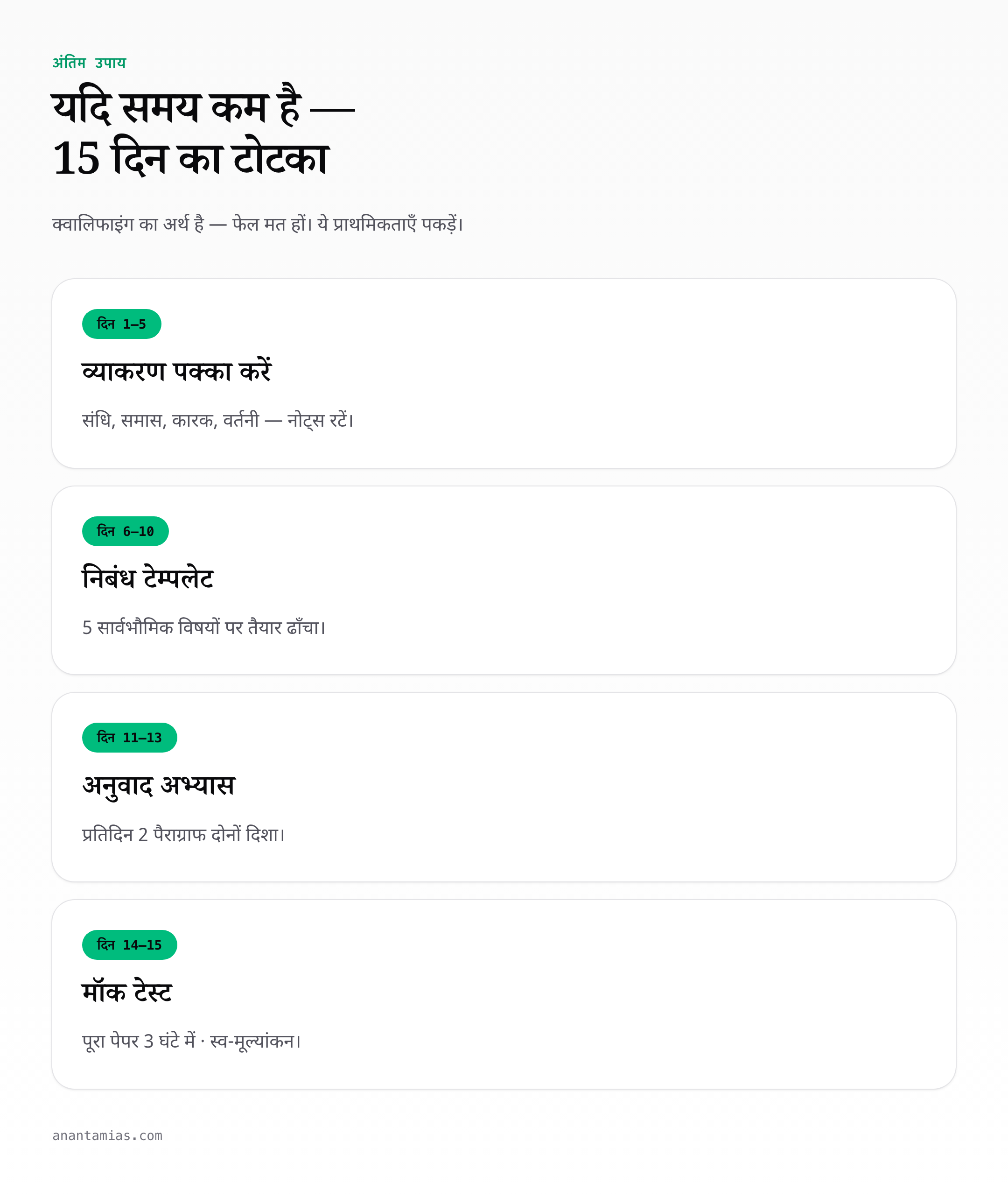
Minimum Viable Preparation Plan
- 7 days of grammar revision with Lucent.
- 7 days of daily precis + translation practice.
- 7 days of essay + comprehension practice.
- 2 full-length mock papers.
- Total: 23 days, 60 minutes per day.
Final Word
Qualifying Hindi Compulsory is not a test of literary ability. It is a test of basic language discipline, time management, and structured writing. The 25% cutoff is generous, but it punishes carelessness. Prepare 23 days, target 150+ marks, and this paper becomes a non-issue — freeing your full mental energy for GS and Optional, where the real merit battle happens.
Frequently Asked Questions
What are the qualifying marks for UPSC Hindi Compulsory?
25% — which is 75 out of 300. Score 75 or more and you qualify; your Hindi marks are not added to your final rank.
What happens if I fail the Hindi Compulsory paper?
UPSC does not evaluate your GS or Optional papers. Your entire Mains effort is nullified for that year.
Are there any exemptions from the compulsory Indian language paper?
Yes. Candidates from Tamil Nadu, Meghalaya, Mizoram, Nagaland, Arunachal Pradesh, Sikkim, and Manipur are exempted from Paper A.
Do Hindi Compulsory marks count in the final merit?
No. Hindi Compulsory and English Compulsory are both qualifying — their marks are not added to the final rank calculation.
How much should I target to comfortably qualify?
Aim for 150–170 out of 300 — roughly 2× the 75-mark cutoff. This buffer absorbs exam-day mistakes and ensures no surprises.
Is 30 days enough for Hindi Compulsory preparation?
Yes, for most candidates with basic Hindi literacy. A structured 30-day plan (grammar → precis/translation → essay → mocks) is sufficient to comfortably cross the cutoff.