Hindi Reading Comprehension Tips for UPSC
Master UPSC Hindi Compulsory comprehension (बोध): 3-read strategy, sample passage with 5 model answers, question types, and 25-minute time plan to score 50+ out of 60.
The Hindi Reading Comprehension (बोध) section carries 60 marks in the UPSC Hindi Compulsory paper. It is simultaneously the most predictable and the most poorly attempted section — most aspirants rush through it, losing 15–20 marks unnecessarily.
This guide gives you the reading strategy, answering technique, and common traps to avoid so that 50+ out of 60 becomes the default outcome.
What the Comprehension Section Tests
- Your ability to read a Hindi passage of 300–400 words.
- Understanding of explicit information (facts stated in the passage).
- Understanding of implicit meaning (ideas implied but not stated).
- Vocabulary (word meanings within context).
- Ability to answer in your own words without distorting meaning.
Typical Question Types
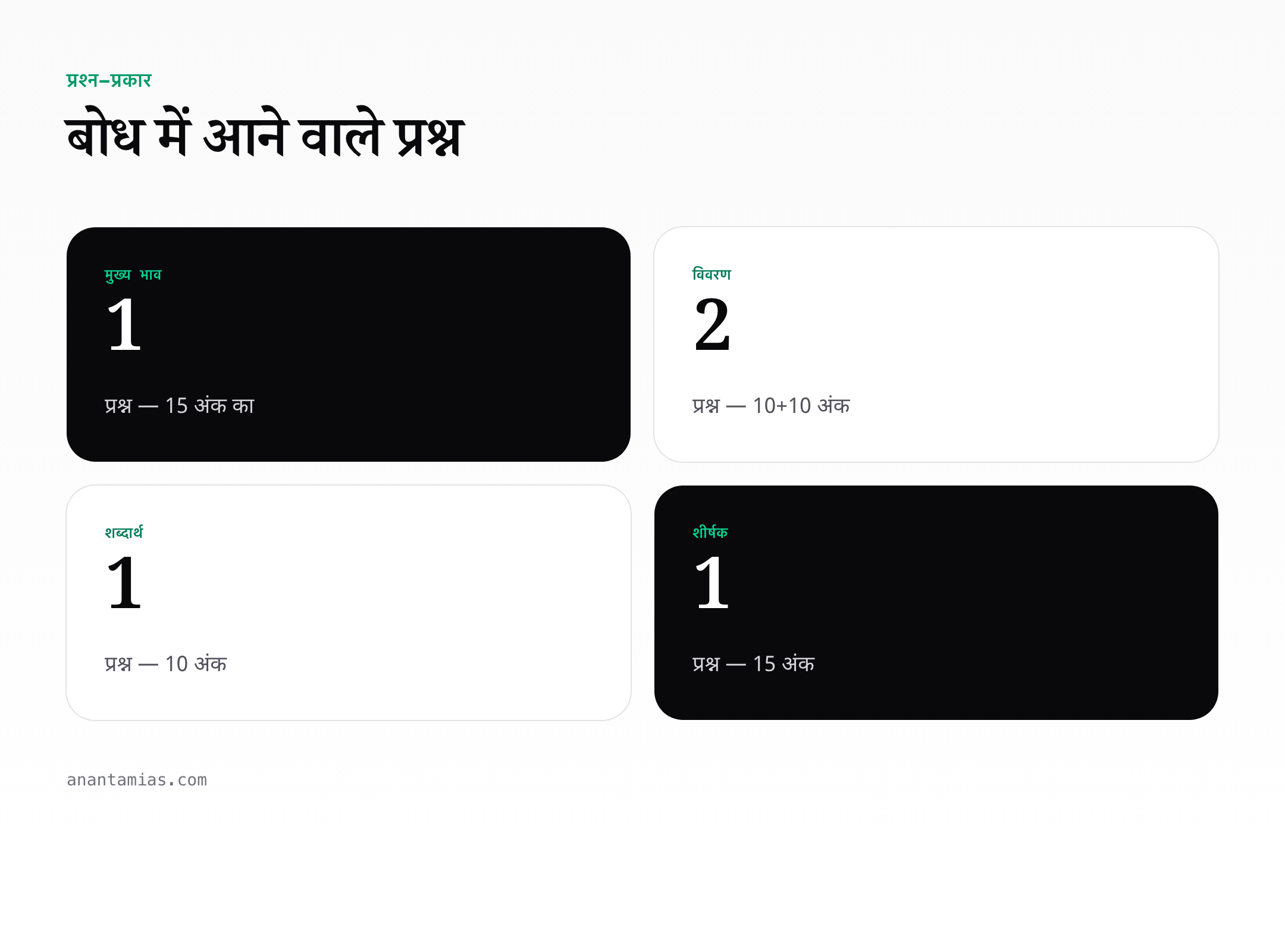
| Type | Example |
|---|---|
| Factual | लेखक ने किस वर्ष इस अभियान की शुरुआत बताई है? |
| Inferential | लेखक का मुख्य संदेश क्या है? |
| Vocabulary | ‘संवेदना’ शब्द का समानार्थी क्या है? |
| Interpretive | लेखक आधुनिक जीवन की किन समस्याओं को रेखांकित करता है? |
| Central theme | उपयुक्त शीर्षक दीजिए। |
The 3-Read Strategy
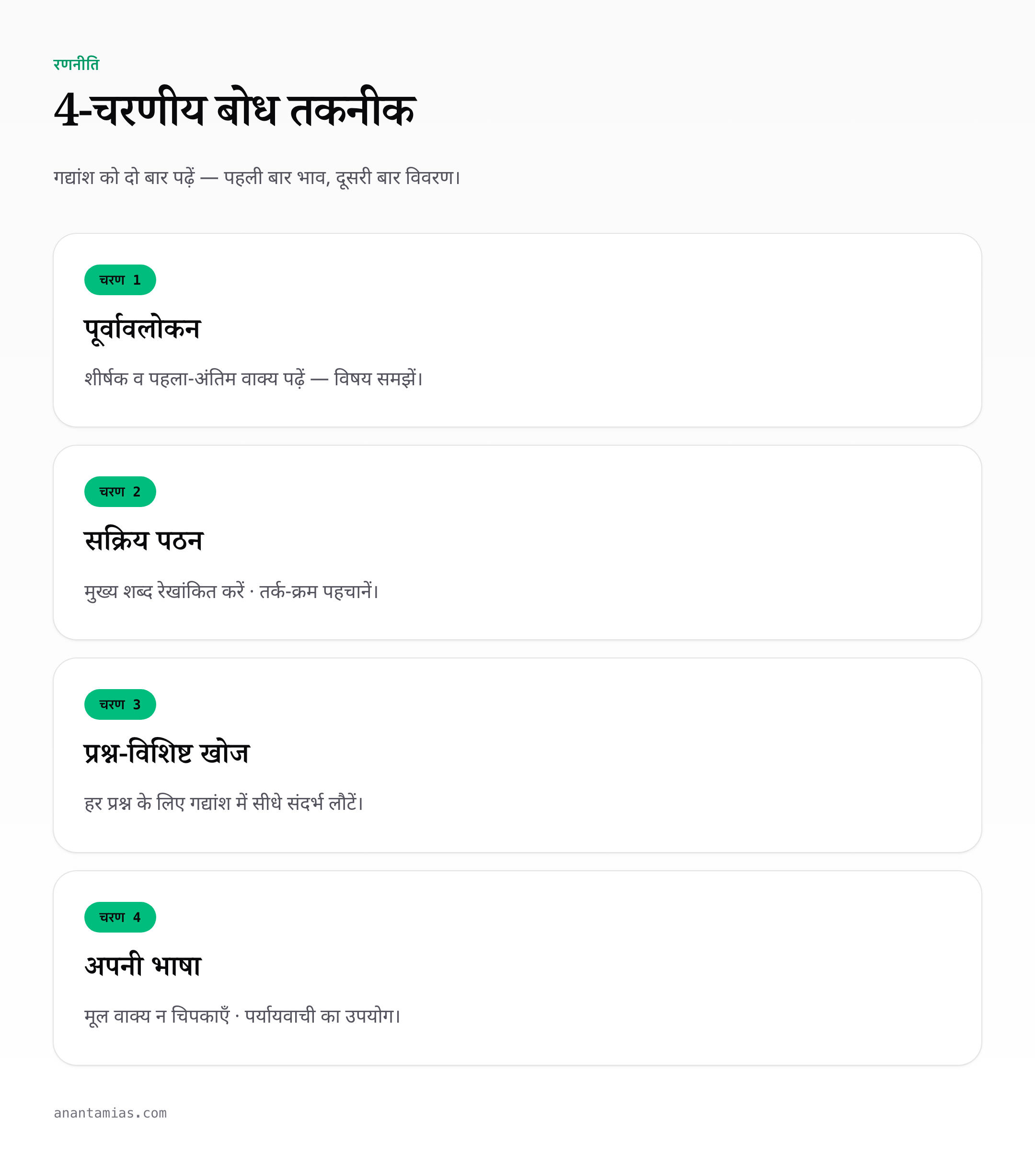
- Read 1 (4 min): Fast read to grasp the theme. Do not underline.
- Read 2 (5 min): Careful read. Underline key sentences and mark paragraphs.
- Read 3 (as needed): Targeted re-read while answering each question.
Answering Technique
- Write answers in complete sentences, not bullet points.
- Use your own words where possible. Verbatim copying is penalised.
- Keep answers proportional to marks: 2-mark answers in 2–3 lines, 5-mark answers in 6–8 lines.
- Stay within the passage’s scope. Do not add outside information.
- For ‘central theme’ or ‘title’ questions, capture the whole passage’s essence, not a single paragraph.
Sample Passage and Model Answers
Passage (~280 words):
शिक्षा मानव जीवन का सबसे महत्वपूर्ण आधार है। यह केवल अक्षर-ज्ञान तक सीमित नहीं, बल्कि संस्कार, विवेक और चरित्र-निर्माण का भी साधन है। प्राचीन भारत की गुरुकुल परंपरा इसी विचार पर आधारित थी, जहाँ विद्यार्थी गुरु के सान्निध्य में रहकर जीवन के हर पक्ष का अध्ययन करते थे। आधुनिक काल में शिक्षा का स्वरूप बदला है। आज वह पुस्तकों और परीक्षाओं में सीमित होती जा रही है। परिणामस्वरूप छात्र डिग्री तो प्राप्त कर लेते हैं, परंतु जीवन-मूल्यों से अनजान रह जाते हैं। इसी कारण समाज में तनाव, हिंसा और भौतिकवाद बढ़ रहे हैं। भारत सरकार की नई शिक्षा नीति 2020 में यह चिंता स्वीकार की गई है। इसमें कौशल विकास, मातृभाषा में शिक्षण और चरित्र-निर्माण पर ज़ोर दिया गया है। किंतु नीति तभी सफल होगी जब शिक्षक, अभिभावक और विद्यार्थी तीनों मिलकर इसे अपनाएँ। शिक्षा जब तक चरित्र-निर्माण से नहीं जुड़ती, वह अधूरी है। यही आज की सबसे बड़ी चुनौती है और सबसे बड़ा अवसर भी।
Q1 (2 marks): लेखक के अनुसार शिक्षा का उद्देश्य क्या है?
Answer: लेखक के अनुसार शिक्षा का उद्देश्य केवल अक्षर-ज्ञान तक सीमित नहीं है, बल्कि यह संस्कार, विवेक और चरित्र-निर्माण का साधन भी है।
Q2 (3 marks): आधुनिक शिक्षा की समस्या क्या है?
Answer: आधुनिक शिक्षा पुस्तकों और परीक्षाओं तक सीमित होती जा रही है। छात्र डिग्री तो प्राप्त कर लेते हैं, किंतु जीवन-मूल्यों से अनजान रहते हैं। इसी कारण समाज में तनाव, हिंसा और भौतिकवाद बढ़ रहे हैं।
Q3 (3 marks): नई शिक्षा नीति 2020 में किन बातों पर ज़ोर दिया गया है?
Answer: नई शिक्षा नीति 2020 में कौशल विकास, मातृभाषा में शिक्षण और चरित्र-निर्माण पर विशेष ज़ोर दिया गया है।
Q4 (2 marks): ‘सान्निध्य’ शब्द का अर्थ क्या है?
Answer: ‘सान्निध्य’ का अर्थ है — निकटता या समीपता।
Q5 (2 marks): उपयुक्त शीर्षक दीजिए।
Answer: शिक्षा और चरित्र-निर्माण।
Time Management
| Step | Time |
|---|---|
| First reading | 4 min |
| Careful second reading | 5 min |
| Answering 5 questions | 16 min |
| Total | 25 min |
Common Mistakes
- Writing one-word answers when 2-3 line answers are expected.
- Copying whole sentences verbatim.
- Adding outside examples or opinions.
- Missing the title question.
- Answering in bullet points instead of prose.
Vocabulary Tips
Vocabulary questions (word meanings) are usually based on context. If you do not know a word exactly, re-read the sentence carefully — the meaning is almost always inferable from context. Example: if the passage says ‘वह दीन-हीन था, भोजन के लिए भी तरसता था’, then ‘दीन’ clearly means ‘गरीब’ from context.
Before-Exam Checklist
- I have practised 15+ comprehension passages from PYQs.
- I know the 5 question types and how to respond to each.
- I stay within 25 minutes per comprehension set.
- I answer in my own words, not verbatim copies.
- I always attempt the title question.
Comprehension is a gift section if you read carefully and answer disciplined. 50+ out of 60 is realistic for anyone who practises 15 passages honestly.
Frequently Asked Questions
How long should I take for the comprehension section?
About 25 minutes — 9 for reading, 16 for answering. Going beyond 30 minutes eats into time needed for precis and translation.
Can I copy sentences from the passage?
Minimal copying for factual answers is tolerated, but examiners reward own-words responses. Paraphrase where possible.
Should I answer in bullet points?
No. Comprehension answers must be in full, connected sentences. Bullet points are penalised.
What if I do not understand a word?
Try to infer meaning from context. The surrounding sentences almost always reveal what an unknown word means.
How do I decide the title?
Pick 3–6 words that capture the central theme of the entire passage — not one paragraph. Example: ‘शिक्षा और चरित्र-निर्माण’ for a passage on holistic education.