IMEC vs BRI: India’s Connectivity Bet Under a West Asia Shadow
A UPSC Mains editorial on IMEC versus BRI, India's connectivity strategy, and how the West Asia war tests a corridor built on Saudi-Israel rail.
Two years ago, India and a circle of partners stood up at a G20 summit and announced a rail-and-sea spine that would carry Indian goods to Europe through the Gulf, faster and cleaner than the route around Africa. Then a war broke out on exactly the stretch of ground the corridor needs, and the whole thing went quiet. Now, in 2026, the same corridor is being talked up again, recommitted by the Prime Minister, name-checked in a new India-US framework, called “one of the greatest trade routes in history” by a US President. So which is it? A live strategy, or a press release that conflict keeps switching off?
That gap between the diplomacy on paper and the danger on the ground is the whole topic. India is making a bet that it can build connectivity the way it wants the world built: transparent, multilateral, sovereignty-respecting. The trouble is that the most promising version of that bet runs straight through the most unstable neighbourhood on the map. The mark-scoring question isn’t whether the corridor sounds good. It’s whether India can make it deliver without handing its supply lines to someone else’s war.
The Issue, Framed
The fight here isn’t about whether India should build connectivity. Of course it should. The fight is about which model, through whose territory, and at whose mercy.
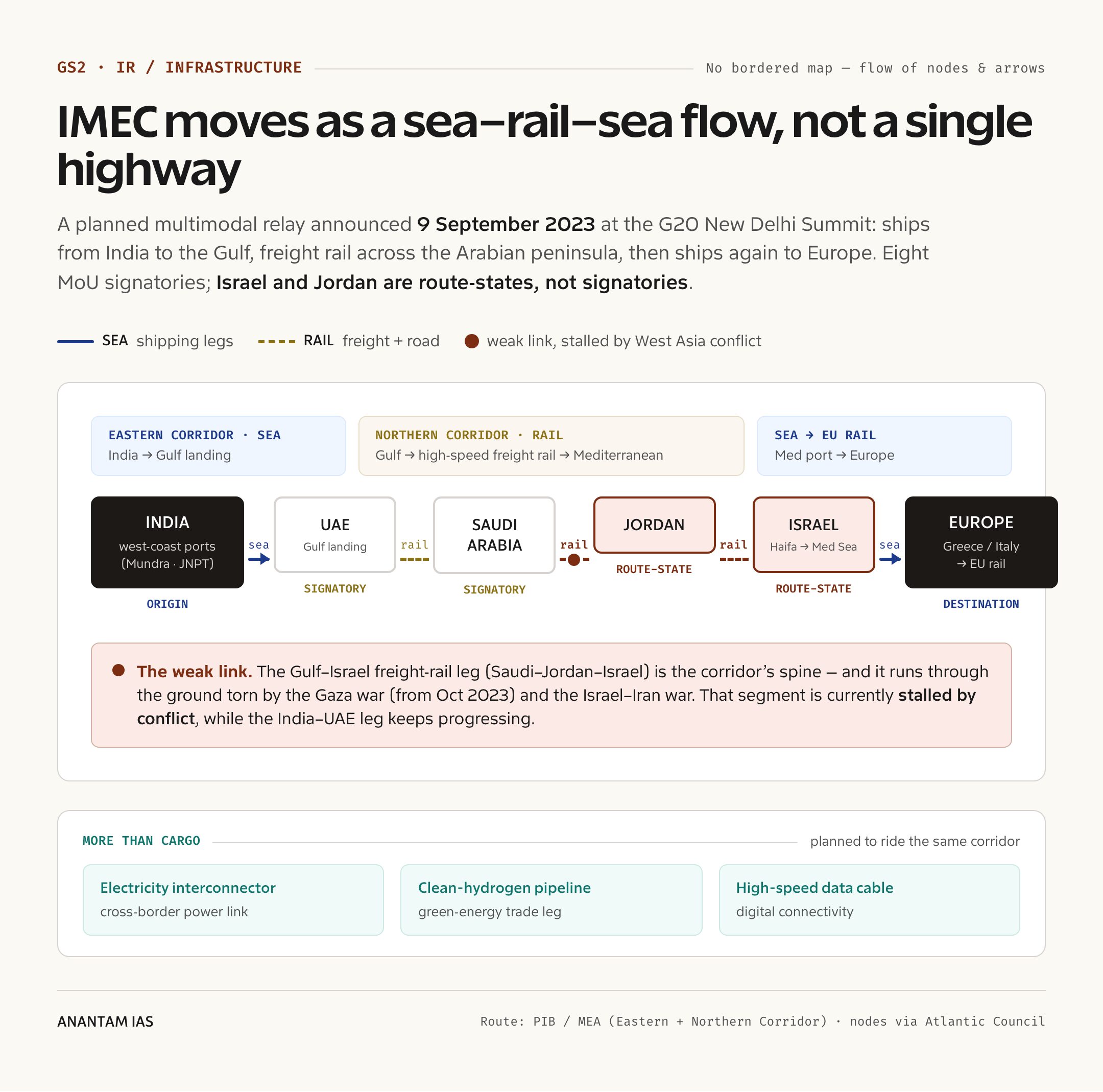
Let’s fix the vocabulary first, because most of the confusion around this topic comes from people using grand acronyms without unpacking them. The India-Middle East-Europe Economic Corridor (IMEC) is a planned multimodal trade route announced on 9 September 2023 at the G20 New Delhi Summit. Think of it as a relay: ships carry Indian cargo from west-coast ports to the Gulf, freight rail then runs across the Arabian peninsula to a Mediterranean port, and ships again carry it on to Europe. Sea, then rail, then sea. It was signed as a Memorandum of Understanding by eight parties: India, the United States, Saudi Arabia, the UAE, the European Union, France, Germany, and Italy. And here’s a fact people routinely get wrong: Israel and Jordan sit on the route but are not formal MoU signatories. The corridor crosses their land without their signature on the founding document.
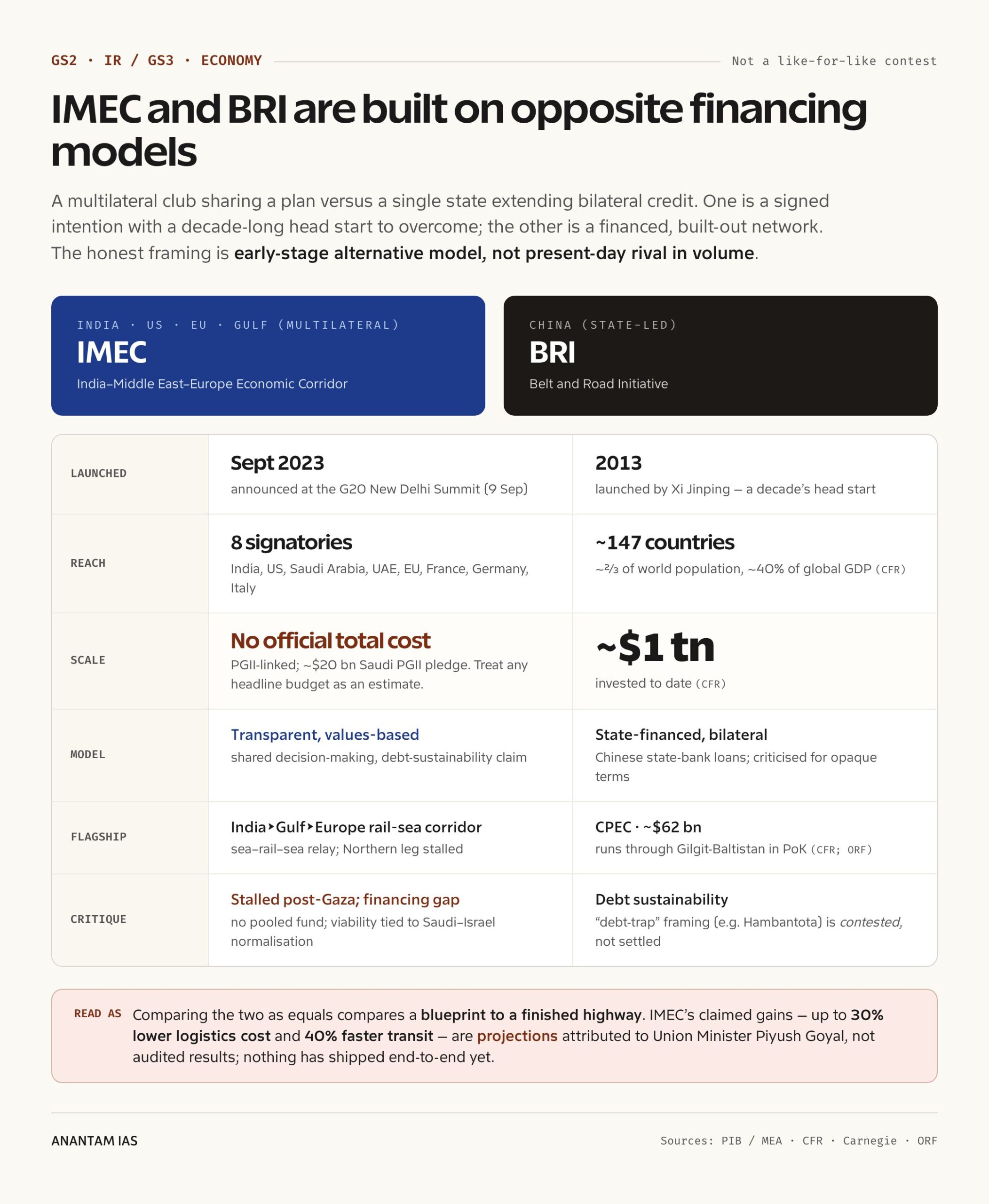
The Belt and Road Initiative (BRI) is the thing IMEC is implicitly set up against. It’s China’s global infrastructure programme, launched in 2013 by President Xi Jinping, a sprawling web of ports, railways, and roads financed largely through Chinese state-bank loans. Where IMEC is a club of governments sharing a plan, BRI is one state extending bilateral credit across roughly 147 countries. That difference, multilateral club versus single-lender network, is the entire philosophical divide.
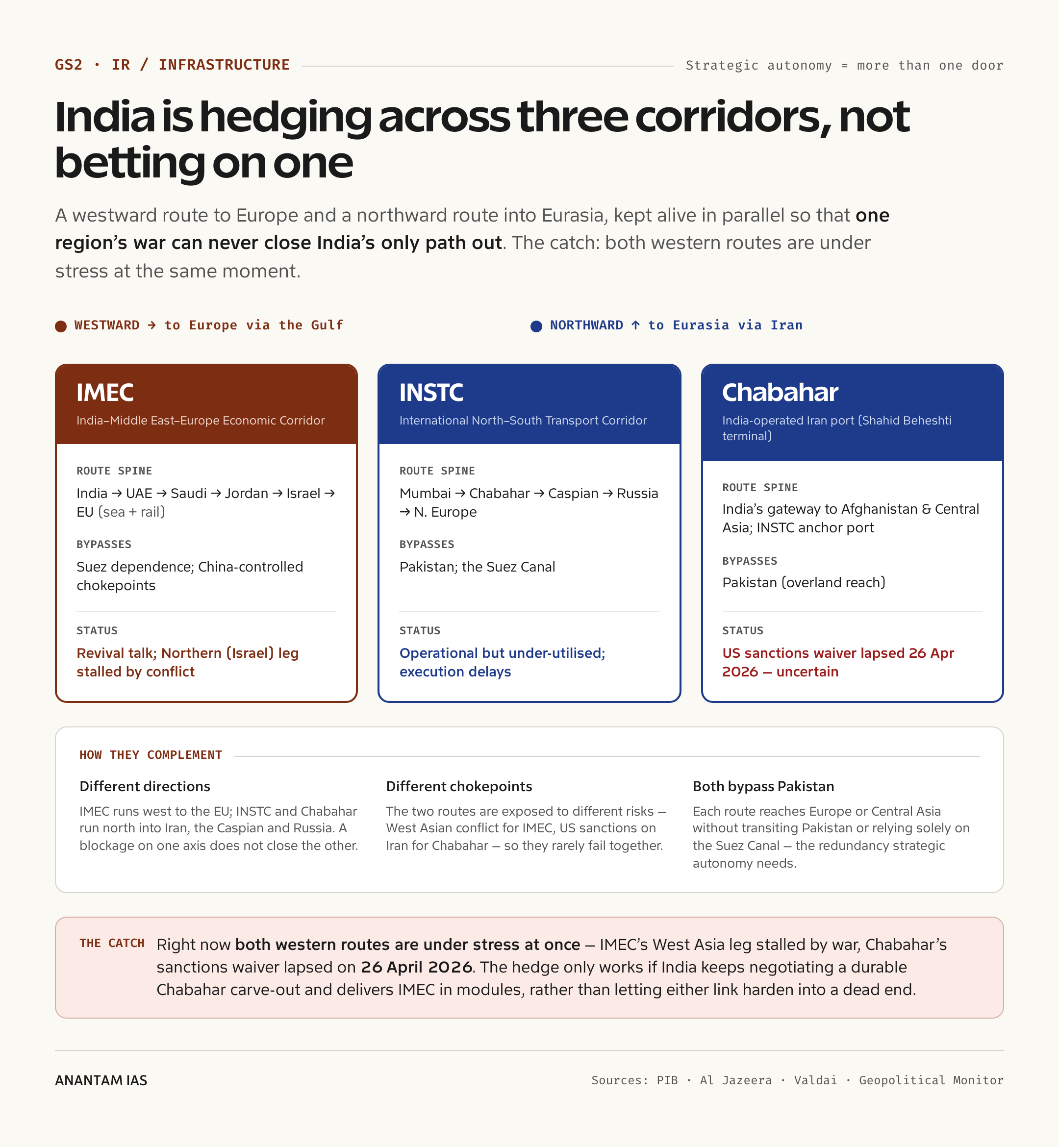
India also runs its own parallel routes, and you need both names. The International North-South Transport Corridor (INSTC) is a multimodal line that moves goods from Mumbai through Iran’s Chabahar port, across the Caspian, into Russia and onward to northern Europe, bypassing Pakistan and the Suez Canal. Chabahar itself is the Iranian port where India operates a terminal as its gateway to Afghanistan and Central Asia. Then there’s I2U2, the grouping of India, Israel, the UAE, and the US, sometimes called the “West Asian Quad,” which held its first leaders’ summit on 14 July 2022 to mobilise private capital for joint projects.
So the picture is this. India wants a connectivity model it can defend on principle, and IMEC is the showcase. But the showcase depends on a Saudi-Israel rail link in a region at war. That’s the seam the whole topic runs along.
What the Data Says
The numbers are where you have to slow down, because IMEC and BRI aren’t even the same kind of thing, and treating them as a straight contest gets the analysis wrong. Start with scale, because the asymmetry is the story. BRI launched in 2013 and China has invested an estimated ~$1 trillion across it to date, with lifetime estimates running far higher. IMEC launched in 2023, a full decade later, and has no published total project cost at all. One is a built-out, financed network with a ten-year head start. The other is a signed intention with a route map.
Reach tells the same lopsided story. BRI has roped in ~147 countries, covering about two-thirds of the world’s population and roughly 40 percent of global GDP. IMEC has eight MoU signatories. So when an answer frames this as “India’s corridor versus China’s corridor,” it’s quietly comparing a finished highway to a blueprint. The honest framing is that IMEC is an early-stage alternative model, not a present-day rival in volume.
Now the efficiency claim, because this one gets misquoted constantly. Union Minister Piyush Goyal has said IMEC could cut logistics costs by up to 30 percent and transit time by up to 40 percent. Read those as projections, not measured results. Nothing has shipped end-to-end across the full corridor yet, so there’s no audited saving to cite. Use the figures, but label them as what a minister expects, not what the route has delivered. That distinction is exactly what separates a careful answer from a credulous one.
China’s flagship gives the comparison its sharpest edge. The China-Pakistan Economic Corridor (CPEC) is BRI’s single largest project at an estimated ~$62 billion, and it runs through Gilgit-Baltistan in Pakistan-occupied Kashmir, territory India regards as its own. That’s not a side detail. It’s the doctrinal root of India’s refusal to join BRI. India has boycotted Belt and Road forums since 2017, calling such activity on its claimed territory “inherently illegal, illegitimate, and unacceptable”. So India’s objection isn’t envy of Chinese infrastructure. It’s a sovereignty line, and IMEC is the affirmative answer to it.
One more anchor tells you why the timing is live. The US sanctions waiver for Chabahar expired on 26 April 2026, putting India’s Iran route under a cloud at the same moment IMEC’s West Asia leg is stalled by conflict. So both of India’s western corridors are under stress at once. That’s the pressure the editorial is built on, and it’s why this stopped being a 2023 story.
The Case For
The case for IMEC is genuinely strong, and dismissing it as a paper corridor would make for a lazy answer. So let’s state it at full strength.
It’s a strategic counterweight that doesn’t compromise India’s principles. IMEC gives India and its partners a connectivity platform that runs nowhere near Chinese-controlled chokepoints and doesn’t require India to swallow CPEC’s passage through PoK. So India gets to back a real corridor while keeping its BRI refusal intact. The two positions stop being in tension. The “no” to Belt and Road and the “yes” to a trade spine become the same coherent stance.
The model itself is the pitch, not just the route. IMEC is sold as a “values-based” corridor, meaning shared decision-making among governments, transparent financing, and debt sustainability, set deliberately against the criticism that BRI loaded poorer states with opaque loans. Whether IMEC lives up to that is a separate question. But the design intent is a direct answer to BRI’s biggest reputational wound. For a country that wants to shape global norms rather than just consume infrastructure, that framing matters.
It anchors India to two premium markets in one stroke. The corridor shortens the trade path between India and Europe while routing it through the Gulf, so India deepens ties with both the EU and the Gulf states simultaneously. That dovetails with the India-UAE economic partnership push and an EU-India trade deal concluded in January 2026, which gave the corridor fresh diplomatic momentum. So IMEC isn’t only about containers. It’s connective tissue across three of India’s most important economic relationships.
And it’s more than freight. Alongside the rail and shipping, the corridor envisions an electricity interconnector, a clean-hydrogen pipeline, and a high-speed data cable. That’s the part analysts find genuinely novel: a single corridor carrying energy and data, not just cargo. So the upside isn’t just faster shipping. It’s a stake in green-energy trade and digital connectivity, where India has a real comparative case to make.
So the case for is layered, and it’s not naive. IMEC is a counterweight, a norm-setting model, a market bridge, and an energy-plus-data play, all at once.
The Case Against
Here’s what the optimism walks past. A corridor is only as reliable as its weakest physical link, and IMEC’s weakest link sits in a war zone. On that test, the bet has real holes.
The spine depends on a Saudi-Jordan-Israel rail leg that conflict has paralysed. The Northern Corridor, the rail-and-sea stretch from the Gulf to Europe, runs through exactly the ground torn up by the Gaza war that began in October 2023 and the Israel-Iran war of 2025-26. The Gaza conflict “significantly stalled the project” within weeks of its launch, and Haifa, the corridor’s intended Mediterranean exit, has been hit in reporting on the later fighting. So the headline-grabbing leg isn’t slow. It’s switched off by violence India can’t control.
It quietly assumes a normalisation that isn’t happening. IMEC’s Gulf-to-Israel rail only works if Saudi Arabia and Israel are cooperative enough to run freight between them. Carnegie’s analysis put it bluntly: normalisation talks between Riyadh and Tel Aviv have been “paused for the foreseeable future,” and after October 2023 it became hard for Arab states to even sit at a table with Israel. So a corridor presented as economic infrastructure rests on a political breakthrough that the region has, for now, walked away from.
The financing gap is real and unflattering next to BRI. There’s no agreed total budget, no pooled fund, nothing resembling the state-bank firehose that built Belt and Road. Carnegie warned that IMEC’s details remained “scant” and that the project risked being “dead on arrival”. So the transparency that IMEC advertises as a virtue cuts both ways. Shared, transparent, consensus financing is slower and thinner than one state writing cheques.
And China already shaped the ground IMEC wants to cross. Beijing’s COSCO has held a majority stake in Greece’s Piraeus port since 2016, one of IMEC’s natural European gateways, and China-Saudi trade reached roughly $106 billion in 2022. So IMEC isn’t entering an empty field. It’s competing on terrain where China arrived a decade earlier with money already on the table.
There’s also the matter of India’s own delivery record, which over-promising can’t paper over. India’s flagship overseas connectivity projects have a history of slow execution, Chabahar’s drawn-out ramp-up being the obvious example. So when the rhetoric runs to “greatest trade route in history,” the gap between announcement and asphalt becomes a credibility risk in itself.
The Deeper Structural Read
Step back from the IMEC-versus-BRI scorecard and the real fault line shows up. It isn’t “whose corridor is bigger.” It’s that India is trying to do connectivity by geo-economics, using trade and infrastructure as instruments of strategy, in a world where the routes themselves have become hostages of geopolitics.
That’s the structural trap. A trade corridor is supposed to be the calm, technical layer beneath politics, the plumbing that keeps flowing while diplomats argue. IMEC inverts that. Its viability is downstream of the single most volatile variable in the system: peace between Israel and its Arab and Iranian neighbours. So India has, in effect, tied a piece of its economic future to a regional reconciliation it can encourage but cannot deliver. That’s a category error worth naming in an answer: treating a political precondition as if it were an engineering one.
The BRI contrast sharpens the point rather than settling it. China’s model is criticised on debt sustainability, the worry that borrowing states can’t repay and lose leverage, and the emblematic case is Hambantota port in Sri Lanka, where in 2017 a Chinese firm took an 85 percent stake for $1.12 billion on a 99-year lease after Sri Lanka struggled with its debts. The “debt-trap diplomacy” label gets attached to it almost reflexively. But be careful here, because this is a contested framing, not a settled fact. Scholars and Britannica note it was not a debt-for-equity swap, that Sri Lanka still owed its construction loans afterwards, and that the island’s wider distress had heavy domestic causes. So the honest line is that BRI’s debt risk is real in aggregate, with low-income borrowers genuinely struggling to repay, while the single most famous example of it is more complicated than the slogan.
That nuance matters for India’s own strategy, and here’s why it should bother you as a future policymaker. IMEC’s whole brand is “we’re the transparent, debt-sustainable alternative.” But a brand built on contrast has to be earned in practice, not just asserted in contrast to a caricature. If IMEC stays a stalled MoU while BRI keeps laying track, the “values-based” framing starts to look like a way of explaining slowness rather than a genuine competitive edge. So the deeper read is neither pro-IMEC nor anti-BRI. It’s that India’s connectivity doctrine, sound on principle, has to survive contact with delivery, financing, and a region that won’t sit still.
And there’s a federal-to-global layer underneath even that. Connectivity has become statecraft: ports, rail, cables, and pipelines are now the currency of influence, the way alliances and basing rights once were. So India can’t opt out of the connectivity game just because its preferred corridor is hard. The alternative to building IMEC, or INSTC, or a Chabahar route isn’t neutrality. It’s ceding the map to whoever does build.
What Should Be Done
So what does a serious connectivity strategy actually look like, beyond cheering for the corridor? Not a plea for “balance,” but a set of moves a planner could act on this year. Five of them, and none of them require abandoning IMEC.
- De-risk by running parallel corridors, not betting on one. Keep INSTC and Chabahar alive as a northward, Eurasian hedge against an IMEC westward route that West Asian conflict can switch off, and negotiate hard with Washington for a durable Chabahar sanctions carve-out before the lapsed waiver hardens into a dead link. The whole logic of strategic autonomy is having more than one door, an argument explored in our note on India’s strategic autonomy. One war should never be able to close India’s only route to Europe.
- Deliver IMEC in modules, banking what works now. Build and commission the India-UAE “foundational leg”, the ports, the digital Virtual Trade Corridor, the logistics infrastructure, so there’s visible, bankable progress even while the Israel-dependent Northern leg waits for peace. So-called “day-after” segmentation lets the corridor show results without hostage to a ceasefire. A corridor that ships something beats a corridor that announces everything.
- Hedge the normalisation bet with patient, plural diplomacy. Keep warm ties with Israel and the Gulf and Iran all at once, and refuse to make India’s corridor hostage to a single Saudi-Israel breakthrough. So if normalisation comes, India gains; if it doesn’t, India isn’t left holding a route to nowhere. This is the connectivity face of India’s wider West Asia balancing act, and it’s the opposite of picking a side.
- Close the financing gap with credible, transparent instruments. Use the G7-linked infrastructure partnership, multilateral development banks, and blended finance to put real money behind the model, and make “transparent and debt-sustainable” a demonstrable practice rather than a slogan aimed at BRI. So the values framing earns its keep. A model that’s cleaner than BRI but never gets funded loses to the one that gets built.
- Lead where India is least exposed: the digital and green layer. Prioritise the data cable and the clean-hydrogen and electricity components, which are less hostage to the Israel rail bottleneck and play to India’s comparative strengths in digital infrastructure and renewables. So even a corridor whose rail leg is stalled can advance on the parts that don’t run through the war zone. Progress on the cable is still progress on IMEC.
Every one of these strengthens the bet rather than hedging it to death. A corridor pursued with redundancy, modular delivery, plural diplomacy, real money, and a digital-green tilt is a corridor that can survive a bad decade in West Asia. That’s the entire point of building it well.
For Your Mains Answer
This is a GS2-GS3 crossover gift. It touches India’s foreign relations, regional groupings, sovereignty, infrastructure, financing models, and supply-chain security in one frame.
GS paper mapping: GS2: India’s bilateral, regional, and global groupings; effect of policies of developed and developing countries on India’s interests; India and its neighbourhood. GS3: infrastructure (ports, railways, energy, digital); investment and financing models; supply-chain and energy security.
Likely question frames:
- IMEC has been described as a values-based alternative to the BRI. Examine its promise and its vulnerabilities in light of instability in West Asia.
- “Connectivity has become an instrument of statecraft.” Discuss with reference to India’s IMEC, INSTC, and Chabahar initiatives.
- India’s refusal to join the BRI rests on a question of sovereignty. Critically analyse, and assess whether IMEC offers a credible alternative.
Quotable data points:
- IMEC announced 9 September 2023 at the G20 New Delhi Summit; 8 MoU signatories (India, US, Saudi Arabia, UAE, EU, France, Germany, Italy); Israel and Jordan are route-states, not signatories.
- IMEC efficiency: up to 30% lower logistics cost, up to 40% faster transit, a projection attributed to Piyush Goyal, not a measured result.
- No official total cost for IMEC has been published; any headline budget is an estimate.
- BRI launched 2013; ~147 countries, ~two-thirds of world population, ~40% of global GDP; ~$1 trillion invested to date.
- CPEC ~$62 billion, BRI’s largest project, runs through PoK/Gilgit-Baltistan, the root of India’s sovereignty objection.
- India has boycotted Belt and Road forums since 2017.
- Hambantota (2017): 85% stake for $1.12 billion on a 99-year lease, the emblematic but contested “debt-trap” case.
- I2U2 first leaders’ summit 14 July 2022 (India, Israel, UAE, US).
- China’s COSCO has controlled Greece’s Piraeus port since 2016; China-Saudi trade ~$106 billion in 2022.
- Chabahar sanctions waiver expired 26 April 2026, straining India’s Iran/INSTC route.
Keywords to use: connectivity diplomacy, geo-economics, multimodal corridor, ship-rail transit, values-based infrastructure, debt sustainability, supply-chain resilience, chokepoint risk, strategic autonomy, normalisation, blended finance, digital and green corridor.
Syllabus linkages: India’s foreign relations; bilateral, regional, and global groupings and agreements involving India; sovereignty and territorial integrity; infrastructure and investment models; effects of globalisation on the economy; energy and supply-chain security.
Balanced conclusion line: IMEC’s value lies less in beating BRI on volume, which it can’t soon do, than in proving that transparent, sovereignty-respecting connectivity can actually be built; the bet pays off only if India delivers in modules, hedges with INSTC and Chabahar, and refuses to let one region’s war decide whether it reaches Europe.
How to Build the Answer
Open with the tension, not a definition dump. The hook here is that IMEC moved from “dead on arrival” to “revival” while the ground it needs went to war. That first sentence signals you’ve grasped both the strategy and the contradiction inside it. A one-line definition of IMEC can follow in the second sentence. The opening should frame the bet, not recite a glossary.
Bring data in early, but ration it. A strong first body paragraph can carry three figures: BRI’s ~$1 trillion and ~147 countries against IMEC’s 8 signatories and no published cost. Then say what those numbers prove, that this is an early model versus a built network, not a like-for-like contest. UPSC rewards the move from fact to inference. The figure is the anchor; the “this means” is the mark.
The second body paragraph should steelman the corridor. If your stance is cautious, first state honestly why IMEC is attractive: the counterweight logic, the values-based model, the energy-plus-data layer. That’s how an answer reads balanced rather than dismissive.
The way forward must be grouped, not scattered. Cluster the moves: parallel corridors, modular delivery, plural diplomacy, transparent financing, a digital-green tilt. Use the topic’s own vocabulary, geo-economics, chokepoint risk, strategic autonomy, debt sustainability, so the answer reads like strategic analysis, not a news recap.
Close on the syllabus link, India’s groupings and supply-chain security, with judgment. The last line shouldn’t echo the introduction. The reliable pattern is “the value is not X alone, but X delivered with Y,” which lets you balance ambition with realism.
Common Mistakes to Avoid
- Don’t treat IMEC and BRI as a fair fight. One is a decade-old, financed network; the other is a two-year-old MoU. Comparing them as equals is the most common error on this topic.
- Don’t state the 30%/40% savings as fact. They’re projections attributed to a minister. Attribute them, or lose credibility.
- Don’t assert the Hambantota “debt trap” as settled. Present the critique and the scholarly rebuttal. UPSC rewards the nuance.
- Don’t draw a bordered India map showing the corridor. Present IMEC as a flow of nodes and arrows. Any map touching Kashmir’s lines invites avoidable error.
- Don’t end on a slogan. Close with an implementable principle, redundancy and modular delivery, not a flourish about “great trade routes.”
A Compact Answer Spine
- Introduction: Open with the “dead on arrival to revival” arc against the West Asia war; define IMEC in the next line.
- Evidence: Use two or three attributed figures and tie each to an implication (scale gap, projection caveat, sovereignty root).
- Arguments: The case for IMEC (counterweight, values-based model, energy-digital layer), then the case against over-optimism (stalled spine, normalisation dependence, financing gap). Keep both fair.
- Structural diagnosis: Connectivity as geo-economics, with corridors held hostage by geopolitics; the values-based brand must be earned in delivery.
- Way forward: Four to five grouped moves, each with a clear actor, MEA, infrastructure financiers, India-UAE delivery teams.
- Conclusion: Adapt the balanced conclusion line to the exact question wording.
Diagram or Flowchart Idea
For a 15-marker, draw the corridor as a left-to-right flow, never a territorial map. The cleanest format: India (west-coast ports) → [sea] → UAE → Saudi Arabia → Jordan → Israel (Haifa) → [sea] → Greece/Italy → EU rail, with the Gulf-to-Israel rail segment marked “stalled by conflict.” That single line shows the relay and its weak link in five seconds.
For a 10-marker, skip the diagram and use a two-column table, “IMEC (multilateral, values-based, stalled spine)” against “BRI (state-led, ~$1 tn, debt-sustainability critique).” It does more work and evaluates faster under time pressure.
Ethics and Governance Angle
Add one governance line even in an IR-economics answer. Connectivity isn’t only about efficiency. It’s about who sets the rules of global infrastructure and on what terms. India’s pitch, sovereignty-respecting, transparent, debt-sustainable, is a normative claim about how development finance should work, not just a trade calculation. Naming that elevates the answer from logistics to statecraft.
Then convert principle into practice. Don’t merely say “IMEC is more transparent than BRI.” Say how India makes that real: published financing terms, multilateral oversight, no creditor capturing strategic assets. That’s the move from moral language to administrative maturity, and it’s also the honest test of whether the “values-based” label means anything.
A sentence pattern that travels across IR topics: “The initiative is sound in principle, but its legitimacy depends on delivery, financing, and not outsourcing strategic risk.” It accepts India’s objective without handing the strategy a blank cheque, which is exactly what an examiner wants on a balance question.
How to Use Data Without Sounding Mechanical
Use fewer numbers than you know. Three well-explained figures beat ten scattered ones. Lead with one scale contrast (BRI’s ~$1 trillion against IMEC’s no-official-cost), use a second for the sovereignty root (CPEC ~$62 billion through PoK), and use a third for the live peg (Chabahar waiver expired 26 April 2026). One scale gap, one principle anchor, one timeliness marker is usually enough.
Never leave a statistic standing alone. Follow it with “this means” or “the implication is.” That small move turns a fact sheet into analysis. In Mains, facts are raw material; judgment is the finished answer.
Finish by asking one question: can a tired examiner follow this in a single pass? If it needs rereading, simplify. Short introduction, data early, two sides marked cleanly, grouped way forward. Clarity isn’t a lower standard than depth. For UPSC, clarity is how depth becomes visible. One last sweep: cut any line that sounds impressive but does no work, and replace it with a fact, a cause, a consequence, or a reform.
FAQ
What is the difference between IMEC and BRI?
IMEC is a multilateral, eight-signatory trade corridor announced in 2023, led jointly by India, the US, the EU, and Gulf states, and pitched as transparent and debt-sustainable. BRI is China’s single-state infrastructure network launched in 2013, spanning roughly 147 countries with ~$1 trillion invested, financed mainly through Chinese state-bank loans. The core contrast is multilateral club versus single-lender network.
Why does India refuse to join the BRI?
India’s objection is rooted in sovereignty. The China-Pakistan Economic Corridor, BRI’s largest project at ~$62 billion, runs through Gilgit-Baltistan in Pakistan-occupied Kashmir, territory India regards as its own. India has called such activity “inherently illegal, illegitimate, and unacceptable” and has boycotted Belt and Road forums since 2017.
How has the West Asia conflict affected IMEC?
IMEC’s Northern Corridor depends on a Saudi-Jordan-Israel freight rail link, and that segment runs through the region torn by the Gaza war (from October 2023) and the Israel-Iran war (2025-26). The Gaza conflict significantly stalled the project within weeks of its launch, and the corridor’s Mediterranean exit at Haifa has been hit in reporting on the later fighting.
Does IMEC replace India’s other corridors like INSTC and Chabahar?
No, and it shouldn’t. INSTC and Chabahar give India a northward, Eurasian route through Iran that bypasses Pakistan and the Suez Canal, hedging against an IMEC westward leg that conflict can switch off. With the Chabahar sanctions waiver having expired on 26 April 2026, both routes are under pressure at once, which is exactly why running them in parallel, not picking one, is the prudent strategy.