The Group of Twenty (G20) is the premier forum for international economic cooperation, bringing together the world’s largest advanced and emerging economies. Collectively, G20 members account for approximately 85 per cent of global GDP, 75 per cent of international trade, and about two-thirds of the world’s population. For UPSC aspirants, the G20 is a recurring topic across Prelims, Mains, and interviews, touching international relations, economics, and governance.
Origin and Evolution of the G20
The G20 was established in 1999 in the aftermath of the Asian Financial Crisis (1997-98). Initially, it functioned as a meeting of Finance Ministers and Central Bank Governors to discuss global financial stability. The forum was elevated to a Leaders' Summit in 2008 during the global financial meltdown, with the first Leaders' Summit held in Washington, D.C. Since then, annual summits have become the centrepiece of G20 activity.
The G20 does not have a permanent secretariat. Instead, the presidency rotates annually among members, and the host country organises the summit along with numerous ministerial and working group meetings throughout the year.
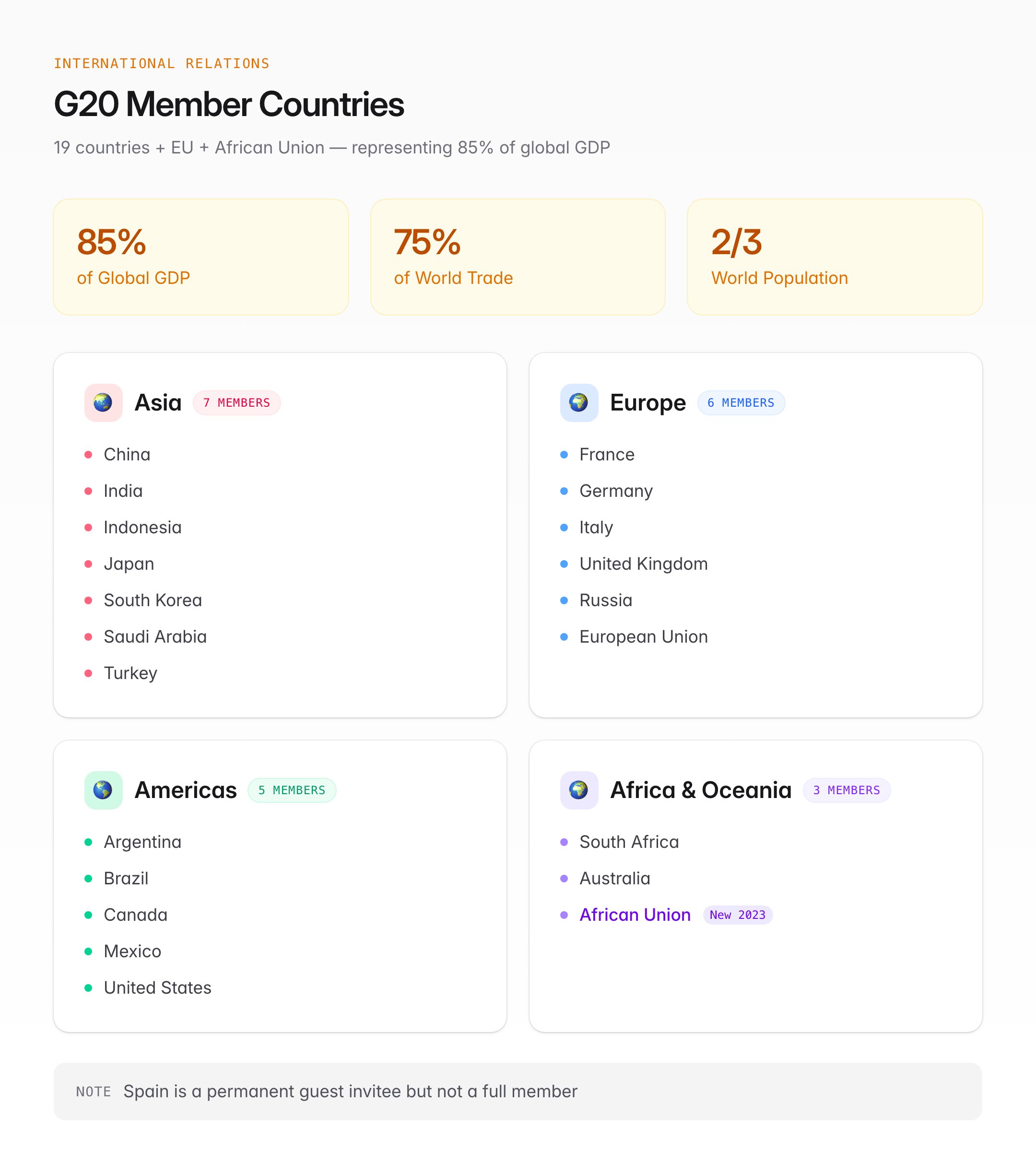
G20 Member Countries
The G20 comprises 19 countries and the European Union (EU). In 2023, the African Union (AU) was admitted as a permanent member, making the grouping effectively G21 in composition.
| Region | Members |
|---|---|
| Asia | China, India, Indonesia, Japan, South Korea, Saudi Arabia, Turkey |
| Europe | France, Germany, Italy, United Kingdom, Russia, European Union |
| Americas | Argentina, Brazil, Canada, Mexico, United States |
| Africa-Oceania | South Africa, Australia, African Union |
Key fact: Spain is a permanent guest invitee but not a full member.
How the Presidency Rotates
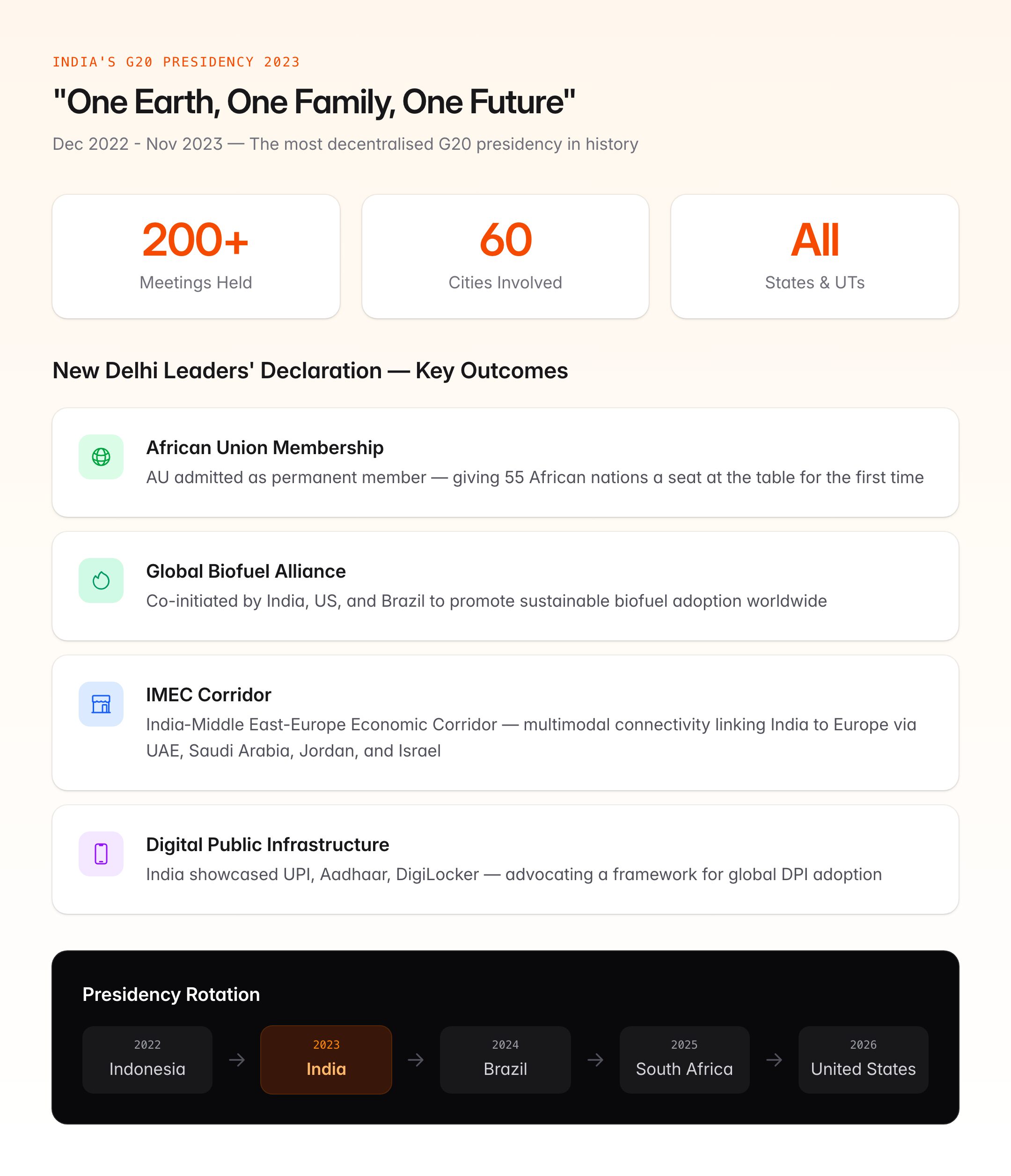
The G20 presidency rotates among members grouped into five regional groups. Each year, the presidency passes to a country from a different group to ensure geographic balance. The outgoing, current, and incoming presidents form the Troika, which provides continuity across presidencies.
| Year | Presidency |
|---|---|
| 2022 | Indonesia |
| 2023 | India |
| 2024 | Brazil |
| 2025 | South Africa |
| 2026 | United States |
India's G20 Presidency (2023)
India held the G20 presidency from 1 December 2022 to 30 November 2023, hosting the Leaders' Summit in New Delhi on 9-10 September 2023. The presidency was a watershed moment for Indian diplomacy.
Theme and Logo
India adopted the theme "One Earth, One Family, One Future" (Vasudhaiva Kutumbakam). The logo featured a lotus atop the Earth in the colours of the Indian flag, symbolising India's ethos of inclusivity and environmental consciousness.
Scale of Engagement
India organised over 200 meetings across 60 cities in all states and Union Territories, making it the most decentralised G20 presidency in the forum's history. This "whole-of-nation" approach was designed to showcase India's diversity and take the G20 beyond capital-city diplomacy.
New Delhi Leaders' Declaration
The New Delhi Leaders' Declaration was adopted by consensus, a significant achievement given the geopolitical tensions surrounding the Russia-Ukraine conflict. Key highlights include:
- Language on Ukraine: The declaration avoided direct condemnation of Russia but acknowledged that "the war in Ukraine has caused immense human suffering" and noted differing national positions on the conflict.
- African Union membership: The AU was formally admitted as a permanent member, a move championed by India to give Africa a seat at the table.
- Global Biofuel Alliance: India launched the Global Biofuel Alliance with co-initiators the US and Brazil to promote sustainable biofuel use.
- India-Middle East-Europe Economic Corridor (IMEC): Announced on the sidelines, this multimodal connectivity corridor aims to link India to Europe via the UAE, Saudi Arabia, Jordan, and Israel.
- Digital Public Infrastructure (DPI): India highlighted its success with UPI, Aadhaar, and DigiLocker, advocating a framework for global DPI adoption.
- Sustainable Development Goals (SDGs): The declaration re-committed to accelerating progress on the 2030 Agenda, with new language on climate finance and green development.
Institutional Structure of the G20
The G20 functions through two parallel tracks:
Finance Track: Led by Finance Ministers and Central Bank Governors, it addresses macroeconomic policy, financial regulation, international taxation, and infrastructure investment.
Sherpa Track: Led by Sherpas (personal envoys of leaders), it handles broader issues such as climate, health, education, digital economy, and anti-corruption. India’s Sherpa for the 2023 presidency was Amitabh Kant, former CEO of NITI Aayog.
There are also Engagement Groups representing civil society, business, youth, women, labour, think tanks, science, and urban stakeholders (C20, B20, Y20, W20, L20, T20, S20, U20 respectively).
African Union's Inclusion
India's push to include the African Union as a permanent G20 member was a defining achievement of its presidency. The AU, representing 55 African nations, had long been absent from the premier economic forum despite the continent's growing economic significance and demographic weight. The inclusion was unanimously supported and came into effect during the New Delhi Summit.
This move is compared to the inclusion of the EU in the G20 and raises Africa's voice on issues such as debt relief, climate finance, and trade access.
Significance of the G20
- Economic governance: The G20 shapes global financial regulation, tax policy (including the global minimum tax framework), and crisis response mechanisms.
- Agenda setting: While G20 decisions are not legally binding, they carry immense political weight and often translate into policy action through bodies like the IMF, World Bank, and WTO.
- North-South bridge: The G20 includes both developed and developing economies, making it a unique platform where emerging voices like India, Brazil, and South Africa can shape global rules.
- Climate and sustainability: The G20 collectively accounts for about 80 per cent of global carbon emissions, making its climate commitments critical to Paris Agreement targets.
Criticism and Limitations
- Legitimacy concerns: The G20 excludes most of the world's countries, raising questions about representativeness.
- No enforcement mechanism: Commitments are voluntary and lack binding legal force.
- Geopolitical divisions: The Russia-Ukraine conflict and US-China tensions have made consensus increasingly difficult.
- Overlap with other forums: The G7, BRICS, and UN compete for attention on similar issues.
UPSC Relevance
GS Paper II: International relations, bilateral and multilateral groupings, India’s foreign policy. GS Paper III: Indian economy, international trade, climate change.
Key Prelims facts:
- G20 was established in 1999 as a Finance Ministers' forum, elevated to Leaders' Summit in 2008.
- It has 19 member countries + EU + African Union (since 2023).
- India hosted the G20 summit in September 2023 in New Delhi with the theme “One Earth, One Family, One Future.”
- The presidency rotates annually; the Troika comprises outgoing, current, and incoming presidents.
- The New Delhi Leaders' Declaration was adopted by consensus.
- The Global Biofuel Alliance and IMEC corridor were key India-led initiatives.
- The G20 does not have a permanent secretariat.
- G20 members account for approximately 85% of global GDP and 75% of world trade.
Tell Google you want more of this.
Add Anantam IAS as a preferred sourceOne tap, and this site shows up more often in your own Top Stories, AI Overviews and AI Mode. Remove it any time.