In-Situ Conservation: Meaning, Types, Examples & UPSC Notes
In-situ conservation protects species in their natural habitat through national parks, sanctuaries, biosphere reserves, and sacred groves. Full UPSC notes.
In-situ conservation is the protection of plant and animal species in their natural habitat, allowing ecosystems and evolutionary processes to function intact, in contrast to ex-situ conservation which preserves organisms outside their natural setting in zoos, botanical gardens, and gene banks. Under the Convention on Biological Diversity (CBD), 1992, in-situ conservation is treated as the primary strategy for conserving biological diversity. In India, it is operationalised through national parks, wildlife sanctuaries, biosphere reserves, tiger and elephant reserves, conservation and community reserves, and sacred groves, under the Wildlife (Protection) Act, 1972, Biological Diversity Act, 2002, and Environment Protection Act, 1986. For UPSC, in-situ conservation is foundational to GS-III biodiversity questions.
What Is In-Situ Conservation
In-situ means "on site". The approach ensures that:
- Species remain in the ecosystem they evolved in.
- Ecological interactions — predator-prey, pollination, nutrient cycling — continue.
- Genetic diversity within and across populations is preserved.
- Evolution in response to environmental changes is not frozen.
- Cultural and livelihood ties of local communities with biodiversity are retained.
CBD Article 8 obliges signatories to create protected area systems, regulate biological resources outside protected areas, promote ecosystem-based management, rehabilitate degraded ecosystems, and control alien invasive species.
In-Situ vs Ex-Situ Conservation
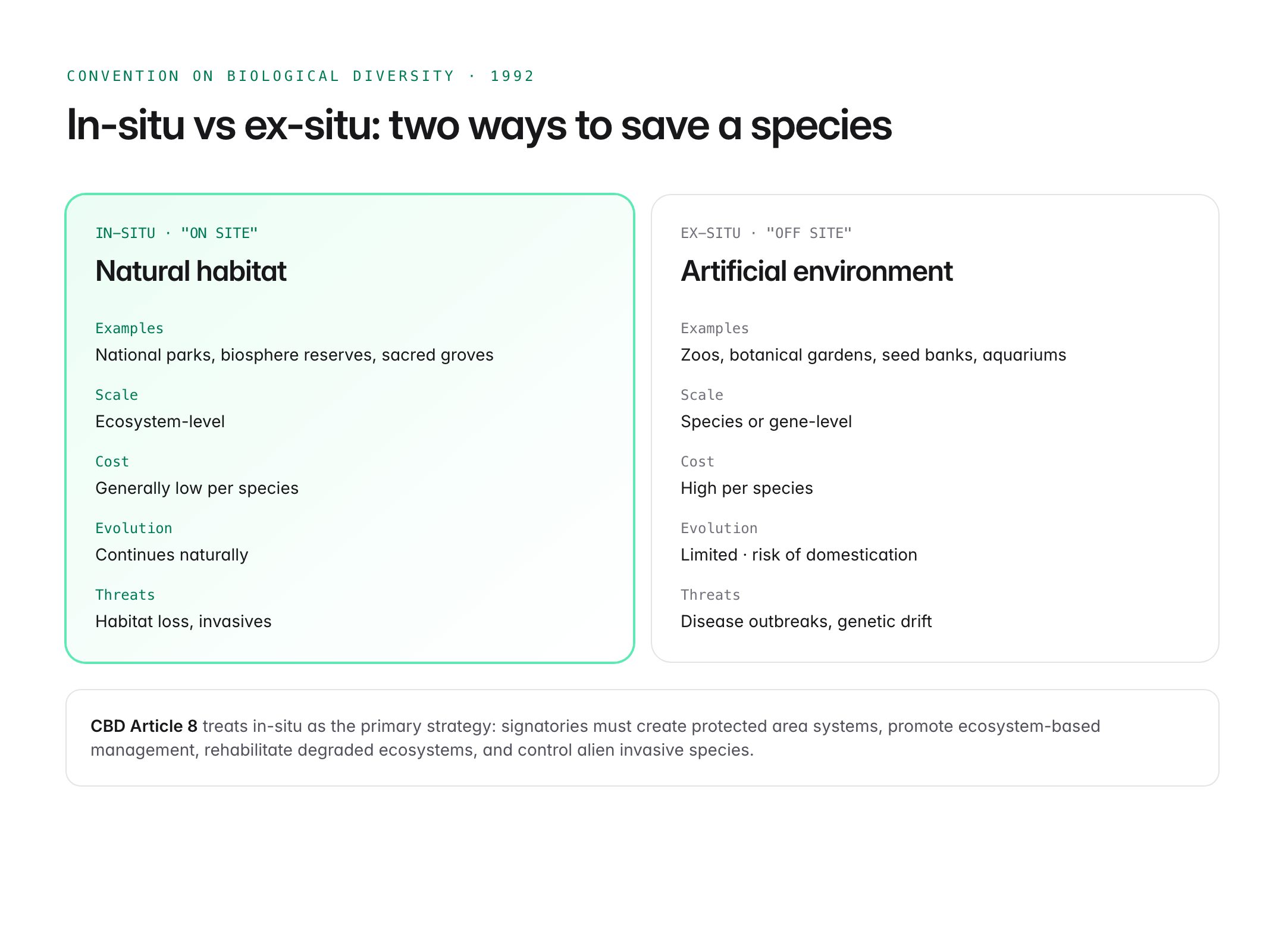
| Feature | In-Situ | Ex-Situ |
|---|---|---|
| Location | Natural habitat | Artificial/controlled environment |
| Examples | National parks, biosphere reserves, sacred groves | Zoos, botanical gardens, seed banks, aquariums |
| Scale | Ecosystem-level | Species or gene-level |
| Cost | Generally low per species | High per species |
| Evolution | Continues naturally | Limited; risk of domestication |
| Reintroduction | Not needed for core range | Needed to restore wild populations |
| Threats | Habitat loss, invasives | Disease outbreaks, genetic drift |
Most countries use a complementary strategy: in-situ as the backbone, with ex-situ as backup for critically endangered species.
In-Situ Conservation Methods in India
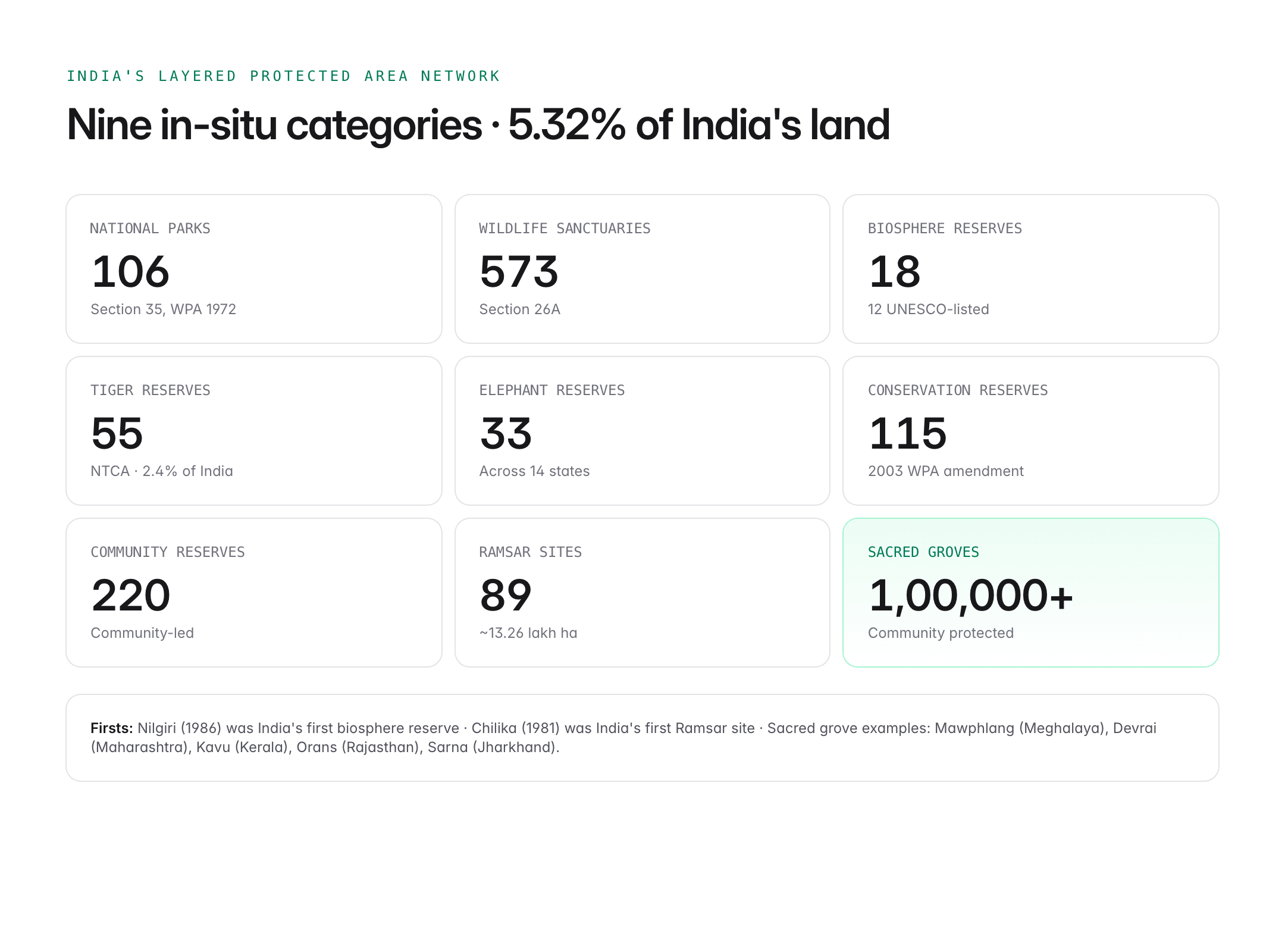
India protects nearly 5.32% of its geographical area under a layered network of protected areas.
1. National Parks (Section 35, Wildlife Protection Act, 1972)
- 106 national parks, ~44,400 sq km (~1.35% of India).
- No human activity except as permitted; highest level of protection.
- Examples: Jim Corbett, Kaziranga, Gir, Hemis, Sundarbans, Keoladeo.
2. Wildlife Sanctuaries (Section 26A, Wildlife Protection Act, 1972)
- 573 sanctuaries.
- Human activities regulated, not banned.
- Examples: Asola Bhatti, Tipeshwar, Chilika, Dandeli.
3. Biosphere Reserves (MAB Programme of UNESCO)
- 18 biosphere reserves in India; 12 recognised by UNESCO.
- Zones: Core (strict), Buffer (restricted), Transition (sustainable use).
- Examples: Nilgiri (1986 — first), Nanda Devi, Sundarbans, Gulf of Mannar, Great Nicobar, Simlipal, Nokrek, Agasthyamalai, Panna.
4. Tiger Reserves (Project Tiger, 1973; NTCA under WPA amendment 2006)
- 55 tiger reserves covering over 2.4% of India.
- Example: Jim Corbett, Ranthambore, Bandipur, Sundarbans, Melghat.
5. Elephant Reserves (Project Elephant, 1992)
- 33 elephant reserves across 14 states.
- Corridor-based conservation.
6. Conservation and Community Reserves (2003 amendment to WPA)
- 115 Conservation Reserves, 220 Community Reserves (approx.).
- Community-led protection, bridging national parks/sanctuaries and human landscapes.
7. Sacred Groves
- Traditional forest patches protected by communities for religious reasons.
- Examples: Mawphlang (Meghalaya), Devrai (Maharashtra), Kavu (Kerala), Orans (Rajasthan), Sarna (Jharkhand).
- Estimated 100,000+ sacred groves in India.
8. Ramsar Sites (Wetlands)
- India has 89 Ramsar sites (2024), with total area of ~13.26 lakh hectares.
- Notable sites: Chilika (first in 1981), Keoladeo, Loktak, Sambhar, Wular, Harike, Sundarbans.
9. Marine Protected Areas
- Gulf of Mannar, Gulf of Kachchh, Sundarbans, Mahatma Gandhi Marine NP (A&N).
Flagship Projects and Programmes
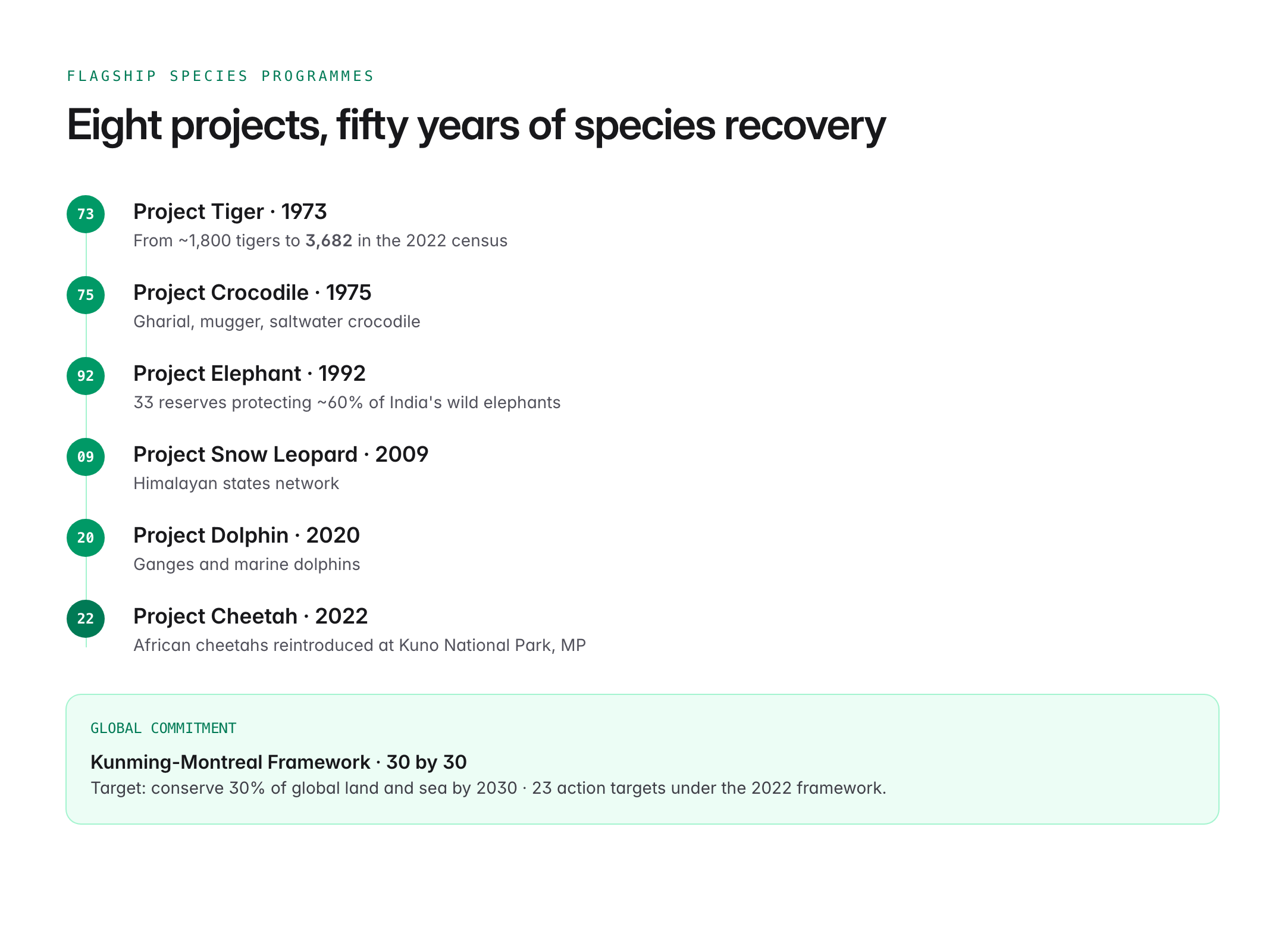
- Project Tiger (1973) — brought tigers back from around 1,800 to ~3,682 (2022 census).
- Project Elephant (1992) — 33 reserves protecting ~60% of India's wild elephants.
- Project Crocodile (1975) — gharial, mugger, saltwater crocodile.
- Project Snow Leopard (2009) — Himalayan states.
- Project Dolphin (2020) — Ganges and marine dolphins.
- Project Cheetah (2022) — African cheetahs reintroduced at Kuno National Park, Madhya Pradesh.
- Project Lion — Asiatic lion beyond Gir (proposed).
- Project Great Indian Bustard (GIB) — Rajasthan.
Legal and Institutional Framework
- Wildlife (Protection) Act, 1972 — the core in-situ law.
- Forest (Conservation) Act, 1980 — regulates diversion of forests.
- Environment (Protection) Act, 1986 — basis for Eco-Sensitive Zones.
- Biological Diversity Act, 2002 — sets up National Biodiversity Authority (NBA), State Biodiversity Boards, and Biodiversity Management Committees (BMCs).
- CAMPA (2016) — compensatory afforestation fund.
- Scheduled Tribes and Other Traditional Forest Dwellers (Recognition of Forest Rights) Act, 2006 — recognises community forest rights that intersect with in-situ conservation.
Major institutions: MoEFCC, NBWL, NTCA, WII (Wildlife Institute of India, Dehradun), ZSI, BSI, Central Zoo Authority.
International Context
- Convention on Biological Diversity (CBD), 1992 — primary treaty; India ratified in 1994.
- Kunming-Montreal Global Biodiversity Framework, 2022 — 23 targets including the "30 by 30" target (conserve 30% of land and sea by 2030).
- CITES (trade in endangered species), Ramsar Convention, CMS (Convention on Migratory Species), UNESCO MAB.
- IUCN Red List — global threat status; informs in-situ priorities.
Challenges
- Habitat loss and fragmentation from infrastructure.
- Human-wildlife conflict, especially in buffer zones.
- Climate change shifting species ranges faster than protected areas can adjust.
- Invasive species (Lantana, Prosopis juliflora, Parthenium).
- Underfunding of sanctuaries relative to national parks.
- Displacement and rights conflicts with forest-dwelling communities.
- Poaching and illegal wildlife trade.
UPSC Relevance
Prelims focus:
- Definition of in-situ vs ex-situ conservation.
- Categories under the Wildlife (Protection) Act, 1972: national park, wildlife sanctuary, conservation reserve, community reserve.
- 18 biosphere reserves, 12 under UNESCO MAB.
- 89 Ramsar sites, 106 national parks, 573 sanctuaries, 55 tiger reserves.
- First biosphere reserve (Nilgiri, 1986), first Ramsar site (Chilika, 1981).
- Kunming-Montreal 30 by 30 target.
Mains GS-III angle:
- Strategies India has adopted for in-situ conservation and their effectiveness.
- Balancing protected areas with tribal rights under the FRA 2006.
- Role of community-led conservation — sacred groves, community reserves, BMCs.
- Emerging issues — climate change, Eco-Sensitive Zones, linear infrastructure.
Sample PYQ angle: "How does biodiversity vary in India? How is the Biological Diversity Act, 2002 helpful in conservation?" and "Discuss the key strategies adopted by India for in-situ conservation of biodiversity." — build your answer around the layered protected area network, flagship species programmes, legal framework, and international commitments, and conclude with gaps that must be addressed to meet the 30 by 30 target.