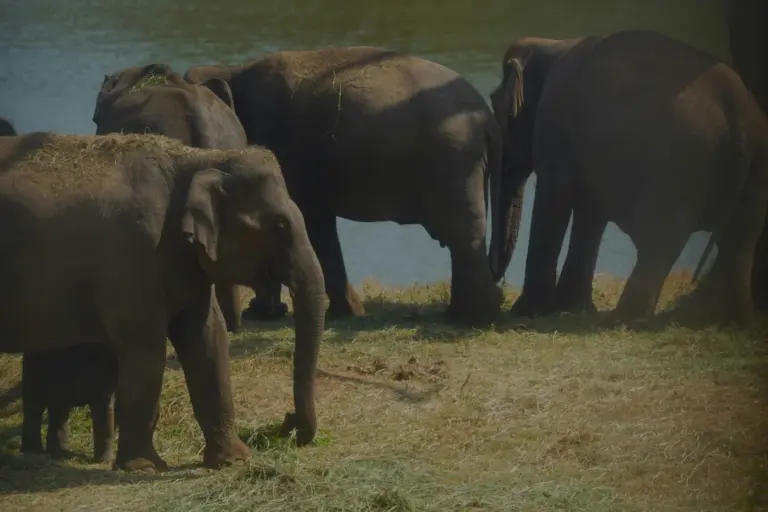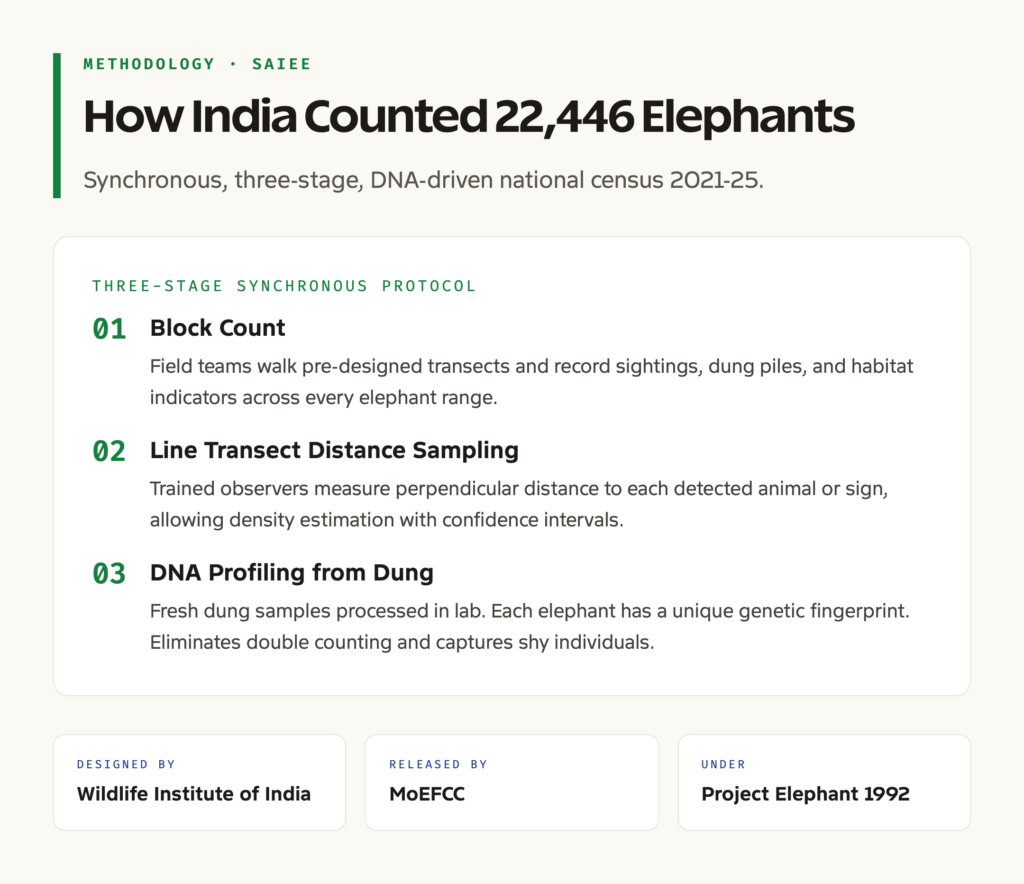
The Synchronous All India Elephant Estimation, SAIEE for short, is the most ambitious wild elephant census ever attempted in India. Conducted between 2021 and 2025 by the Wildlife Institute of India for the Ministry of Environment, Forest and Climate Change, it combines direct sampling with genetic analysis of dung to produce a country-wide population estimate of 22,446 wild Asian elephants. The exercise replaces the old block count tradition that the country had used for nearly four decades and brings India’s elephant counting into line with the standards already used for tigers under the All India Tiger Estimation.
For a UPSC aspirant, SAIEE matters for three reasons. It changes the methodological gold standard for large mammal censuses in India. It updates the population baseline that every subsequent conservation decision will reference. And it surfaces a new layer of policy concerns, from human-elephant conflict to corridor connectivity, that link wildlife management to land use, infrastructure, and climate adaptation in ways the old census never did.
Quick Facts on SAIEE 2021-25
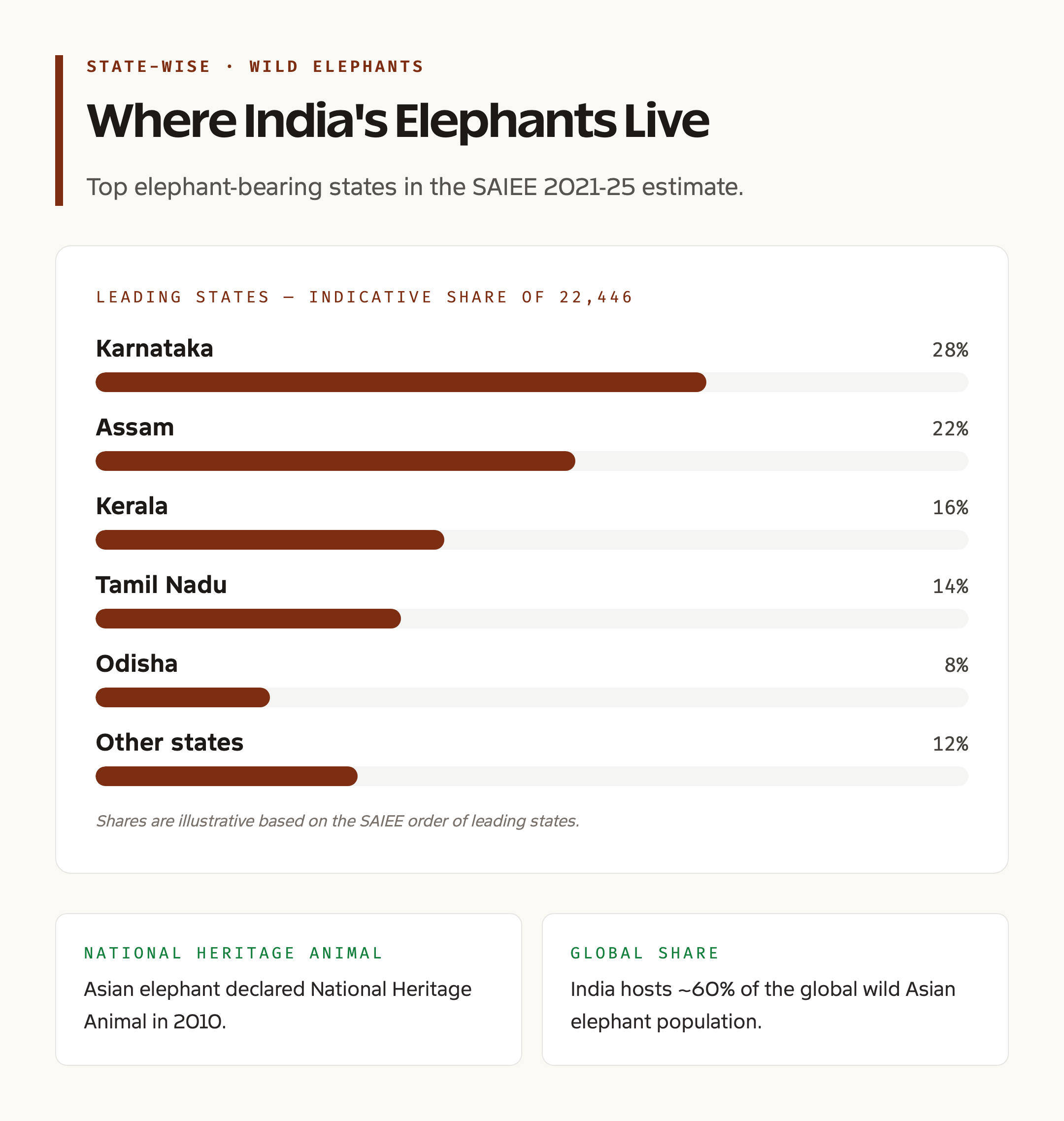
The Synchronous All India Elephant Estimation was conducted between 2021 and 2025 across all elephant-bearing states. The Wildlife Institute of India in Dehradun designed the protocol and analysed the data, while State Forest Departments collected the field samples under the umbrella of Project Elephant. The total population reported is 22,446 wild Asian elephants, with the largest sub-populations in Karnataka, Assam, Kerala, and Tamil Nadu in that order.
The release of SAIEE coincided with the publication of Elephant Corridors of India 2023, a separate but linked report from the Ministry that mapped 150 active elephant corridors across the country. Together the two documents form the backbone of contemporary elephant policy in India, replacing the patchwork of state-level estimates that had grown stale since the 2017 census.
What SAIEE Actually Is
Background and Historical Context
India has counted its wild elephants since the early 1990s, soon after Project Elephant was launched in 1992 as a Centrally Sponsored Scheme to protect elephants, their habitats, and corridors. The earlier counts were largely block-based direct enumerations, in which forest staff swept demarcated blocks of habitat on foot or from elephant-back and recorded sightings, dung piles, and tracks. The method was simple and cheap but suffered from three persistent problems. It double-counted the same animal across blocks. It missed shy individuals in dense canopy. And it gave wildly different totals depending on who counted and when.
By 2017, the year of the previous nationwide census, the country had a working estimate of around 27,000 wild elephants but the figure carried a wide and acknowledged margin of error. The Wildlife Institute of India had already proven the value of camera-trap mark-recapture and genetic methods for tigers, and policy-makers concluded that the same scientific rigour was overdue for the country’s keystone megaherbivore. SAIEE is the result. It applies a tiered, statistically defensible protocol designed to be repeated every four to five years.
The exercise also draws on India’s broader engagement with biodiversity conservation and the wider framework of environmental laws in India, under which the Asian elephant enjoys the highest level of statutory protection.
Key Provisions and Methodology
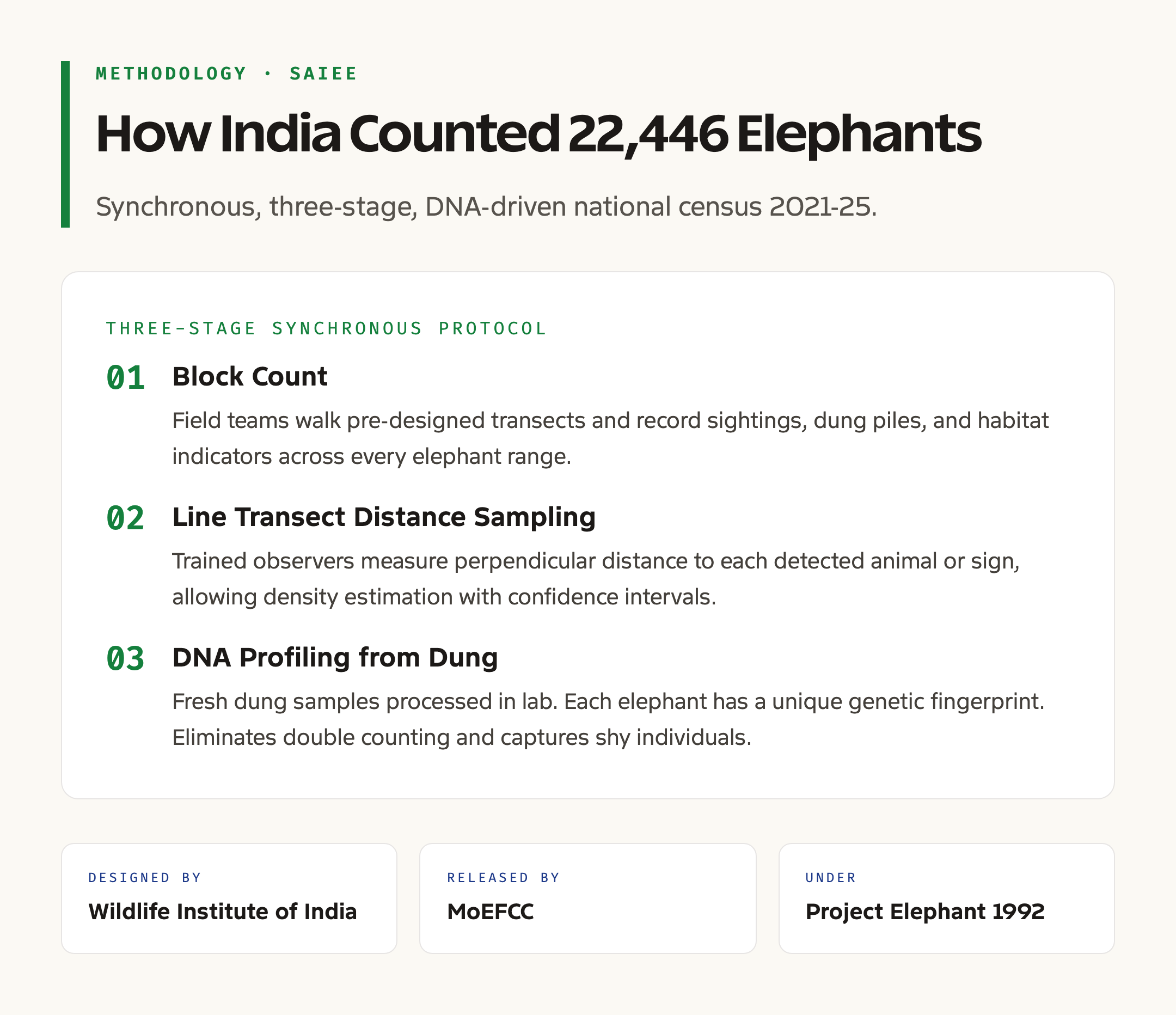
SAIEE rests on a three-stage protocol that runs in synchrony across every elephant landscape in the country. Synchrony here means the same days, the same field sheets, and the same analytical pipeline, so that no two states are counting different things at different times.
The first stage is the Block Count. Field teams walk pre-designed transects across every elephant range and record direct sightings, dung pile densities, and habitat indicators. The second stage is the Distance Sampling and Line Transect phase, in which trained observers measure the perpendicular distance to each detected animal or sign, allowing density to be estimated using standard sampling theory. The third and most important stage is DNA Profiling from Dung Samples. Fresh dung is collected, refrigerated, and processed in a laboratory to extract elephant DNA. Each individual elephant has a unique genetic fingerprint, so the dung samples can be matched to identify how many distinct elephants are using a given area without any animal ever being sighted, captured, or disturbed.
This non-invasive genetic approach is the core methodological shift. It eliminates double counting, captures shy and forest-dwelling individuals, and produces an absolute number with statistically defensible confidence intervals rather than a forest officer’s best guess.
Why SAIEE Matters
The 22,446 figure matters because it sets the baseline for everything else. Conservation funding, Wildlife Protection Act, 1972 policy, eco-sensitive zone notifications, and infrastructure project clearances all reference the official elephant population. If the number is unreliable, every downstream decision is unreliable too.
It also matters because it reveals decline. The previous estimate of around 27,000 in 2017 was almost certainly inflated by the block count’s tendency to double-count, but the new figure of 22,446 is closer to a true number and signals that the country has likely lost real elephants over the last decade. The losses are concentrated in landscapes where corridors have been severed by highways, railways, plantations, and mining leases. SAIEE thus becomes both an audit of past policy and a brief for future action on corridor protection.
Detailed Analysis: State-wise Distribution
Karnataka emerged as the state with the largest wild elephant population, followed by Assam, Kerala, and Tamil Nadu. The South Indian elephant population is concentrated in the Western Ghats complex spanning Karnataka, Kerala, and Tamil Nadu, which together form a single contiguous landscape protected by overlapping tiger reserves and national parks.
The North-East has Assam at the centre, with elephant populations spilling into Arunachal Pradesh, Meghalaya, and Nagaland. The Central Indian belt, including Odisha, Chhattisgarh, and Jharkhand, holds smaller but ecologically important sub-populations that connect to West Bengal and the Northeast through fragile corridors. North India has elephants in the foothills of Uttarakhand and along the Terai, with the Rajaji-Corbett landscape forming the western anchor of the species range.
The 2010 declaration of the Asian elephant as India’s National Heritage Animal recognised this geographic spread. SAIEE confirms that all four major populations remain genetically and demographically active but face different pressures.
Comparative Look: 2017 Block Count vs 2025 SAIEE
| Feature | 2017 Census | SAIEE 2021-25 |
|---|---|---|
| Method | Direct block count | Block count + line transect + DNA dung |
| Synchrony | State-by-state, asynchronous | Same days nationwide |
| Double counting | Likely | Eliminated by genetic matching |
| Uncertainty | Wide and unreported | Reported confidence intervals |
| Total estimate | ~27,000 | 22,446 |
| Reproducibility | Low | High, designed for 4-5 year repeat |
The reduction from 27,000 to 22,446 is partly methodological correction and partly real decline. Disentangling the two will require the next round of SAIEE around 2029-30. What is already clear is that the Asian elephant cannot be assumed to be safe simply because some habitats look full.
Elephant Corridors and Conservation Initiatives
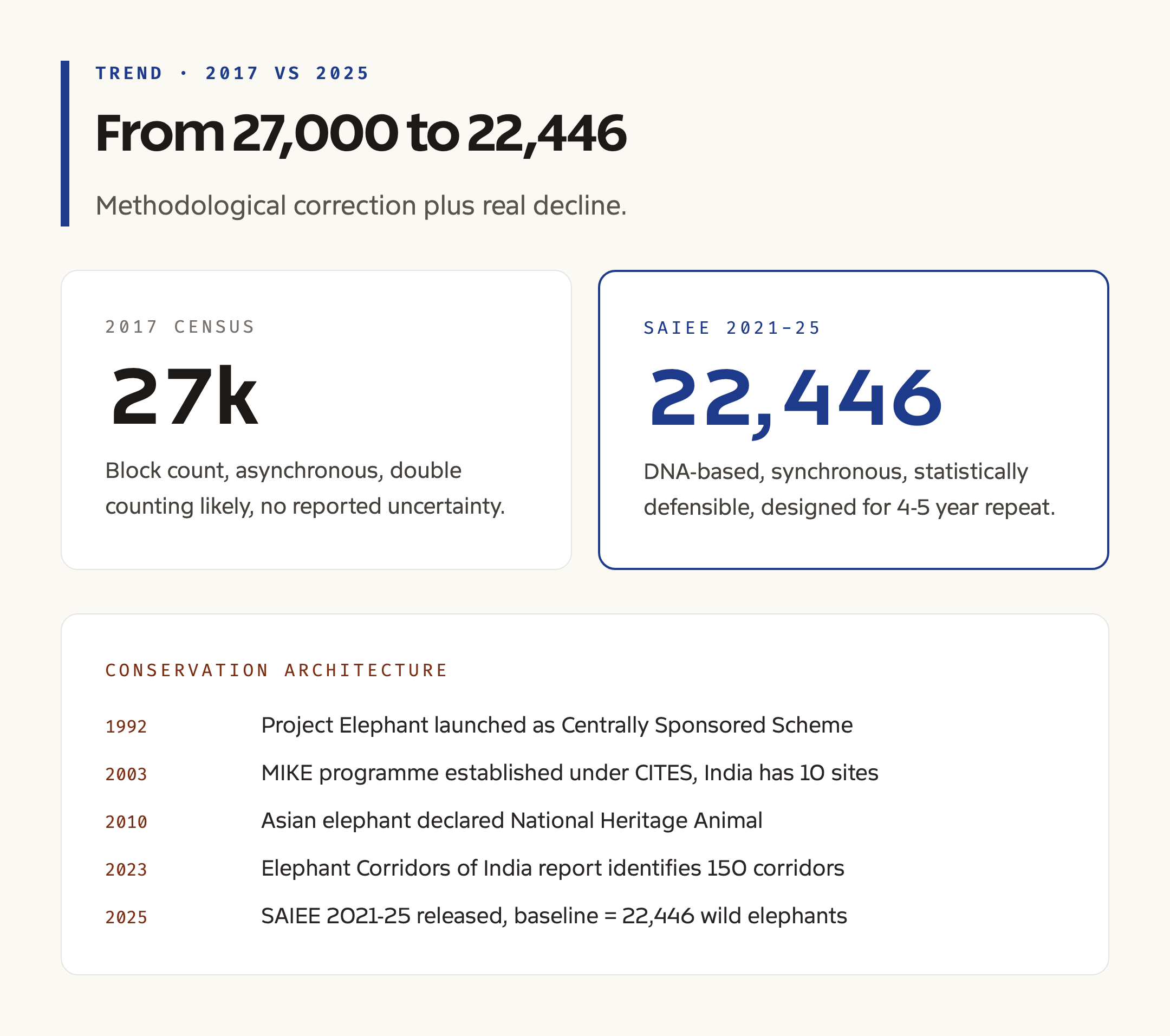
The Elephant Corridors of India 2023 report identifies 150 corridors across the country, up from 101 in the 2010 inventory. A corridor is a narrow strip of land that connects two larger elephant habitats and allows herds to move between them in search of food, water, and mates. Corridors are not legal protected areas under the Wildlife Protection Act, but their loss is the single largest driver of human-elephant conflict and of long-term genetic isolation of sub-populations.
Project Elephant, launched in 1992, is the umbrella scheme. The MIKE programme, short for Monitoring the Illegal Killing of Elephants, was established under CITES in 2003, and India has ten MIKE sites that report poaching and mortality data to the global secretariat. Plan Bee, an initiative of the Northeast Frontier Railway, uses devices that emit the buzz of bees to keep elephants off railway tracks, and has measurably reduced train-elephant collisions in Assam. Gaj Yatra is a nationwide awareness campaign for corridor protection. Gaj Utsav celebrates the cultural and ecological role of the elephant.
Challenges Ahead
The first challenge is corridor mapping that translates into corridor protection. Identifying 150 corridors is useful only if state and central authorities prevent further fragmentation. The second is human-elephant conflict, which kills around 500 people and 100 elephants every year, mostly in areas where corridors have been broken. The third is the strategic exemptions added by the 2023 amendment to the Forest Conservation Act, which could ease infrastructure clearance in border landscapes that overlap with elephant range in the Northeast.
A fourth challenge is funding. SAIEE requires laboratory infrastructure, trained geneticists, and synchronised field operations. Continuing the protocol every four to five years will demand a steady budget that does not depend on year-on-year political prioritisation.
Prelims Pointers
The Synchronous All India Elephant Estimation was conducted between 2021 and 2025 by the Wildlife Institute of India for the Ministry of Environment, Forest and Climate Change. The total population estimate is 22,446 wild Asian elephants. The largest state populations, in order, are Karnataka, Assam, Kerala, and Tamil Nadu. The methodology combines block counts, line transects, and DNA profiling from dung samples.
Project Elephant is a Centrally Sponsored Scheme launched in 1992. The MIKE programme was established under CITES in 2003 and India has ten MIKE sites. Plan Bee is a Northeast Frontier Railway initiative. The Asian elephant was declared India’s National Heritage Animal in 2010. The Elephant Corridors of India 2023 report identifies 150 corridors.
Mains Questions on SAIEE and Elephant Conservation
Critically examine how the methodological shift in the Synchronous All India Elephant Estimation alters our understanding of the Asian elephant population in India. Discuss the relationship between elephant corridor protection and human-elephant conflict, with reference to recent policy reports. Evaluate the role of Project Elephant and MIKE in the conservation of the Asian elephant.
A strong answer would distinguish between the methodological correction in the new figure and the underlying ecological decline, would link corridor loss to specific infrastructure pressures, and would acknowledge the institutional gap between the Forest Department and the Ministry of Road Transport and Highways in clearing linear projects through elephant landscapes.
Way Forward
The route forward involves four reforms. The first is statutory protection for the 150 identified corridors, ideally through the Eco-Sensitive Zone framework or through binding conditions on linear infrastructure clearance. The second is integration of SAIEE genetic data into a national elephant database that tracks individual movements over time. The third is community engagement around fringe villages that bear the brunt of conflict, with fast-track ex-gratia payments and crop insurance. The fourth is institutional, ensuring that the Wildlife Institute of India has the laboratory and field capacity to repeat SAIEE on a four to five year cycle.
The Asian elephant cannot be saved in pockets. It moves across district borders, state boundaries, and even international frontiers. SAIEE finally gives India the data to plan at that scale. Whether the data is used or shelved is the next question.
Frequently Asked Questions
What is the Synchronous All India Elephant Estimation?
SAIEE is India’s first nationally synchronised, scientifically standardised wild elephant census, conducted between 2021 and 2025. It uses block counts, line transects, and DNA profiling of dung samples to produce a country-wide population estimate.
Who conducted SAIEE?
The Wildlife Institute of India in Dehradun designed the protocol and analysed the data on behalf of the Ministry of Environment, Forest and Climate Change. Field collection was carried out by State Forest Departments under the umbrella of Project Elephant.
What is the total wild elephant population in India according to SAIEE?
The estimate is 22,446 wild Asian elephants. Karnataka has the largest state population, followed by Assam, Kerala, and Tamil Nadu.
How is SAIEE different from the 2017 elephant census?
The 2017 census relied mainly on block counts and produced a single number of around 27,000 with no reported uncertainty. SAIEE uses synchronised sampling and DNA matching of individual elephants, which eliminates double counting and produces a statistically defensible figure with confidence intervals.
What is an elephant corridor?
An elephant corridor is a narrow strip of land that connects two larger elephant habitats and allows herds to move freely between them. The Elephant Corridors of India 2023 report identifies 150 such corridors across the country.
What is Project Elephant?
Project Elephant is a Centrally Sponsored Scheme launched in 1992 to protect elephants, their habitats, and corridors, and to address human-elephant conflict. It is the umbrella programme under which SAIEE was conducted.
What is the MIKE programme?
MIKE stands for Monitoring the Illegal Killing of Elephants. It was established under CITES, the Convention on International Trade in Endangered Species, in 2003. India hosts ten MIKE sites that report poaching and mortality data to the global secretariat.
What is Plan Bee?
Plan Bee is a Northeast Frontier Railway initiative that uses devices emitting the sound of buzzing bees to keep elephants away from railway tracks. It has measurably reduced train-elephant collisions in the Assam landscape.
Why is the Asian elephant called a keystone species?
A keystone species shapes the ecological community out of proportion to its numbers. Elephants disperse seeds, create water holes, and maintain forest clearings that other species depend on. Their loss cascades through the ecosystem.
Why did India declare the Asian elephant a National Heritage Animal?
The 2010 declaration recognises the cultural, ecological, and economic importance of the elephant in India and was intended to focus public attention on its conservation. It was followed by the strengthening of Project Elephant and the formation of the Elephant Task Force.
Tell Google you want more of this.
Add Anantam IAS as a preferred sourceOne tap, and this site shows up more often in your own Top Stories, AI Overviews and AI Mode. Remove it any time.