India–US Bilateral Trade Agreement: Stakes, Tariffs and Strategic Calculus (UPSC IR)
The India–US Bilateral Trade Agreement is the biggest test yet of whether two large, proud economies can turn a tariff fight into a durable deal. Here is what is on the table, what each side wants, and how to write it for UPSC.
Trade deals don’t usually trend on Indian phones. This one did. For most of late 2025 the India-US relationship was running on a fifty-percent American tariff wall — among the steepest Washington had aimed at any partner — and a Mumbai exporter of cotton shirts or cut diamonds could watch a year’s margin vanish in a single customs line. So when the two governments announced an interim trade framework in February 2026 that pulled that wall down to eighteen percent, and when a US negotiating team flew into New Delhi in early June 2026 to nail down the fine print, it was not abstract diplomacy. It was the difference between a factory floor in Tiruppur staying lit and going dark.
And that is exactly why the India-US Bilateral Trade Agreement matters for an aspirant. It sits at the precise junction your syllabus cares about: a GS2 question about India’s relationship with a major power, and a GS3 question about trade, tariffs, agriculture and the economy, fused into one live case study. It tests whether you can hold two ideas at once — that the United States is India’s largest trading partner and a vital strategic counterweight, and that it is also the country that just spent six months squeezing Indian exporters. The BTA is where that tension gets negotiated, line by line. Let’s walk through what it actually is, before the headlines harden into half-remembered slogans.
What the BTA Is and Why It Landed Now
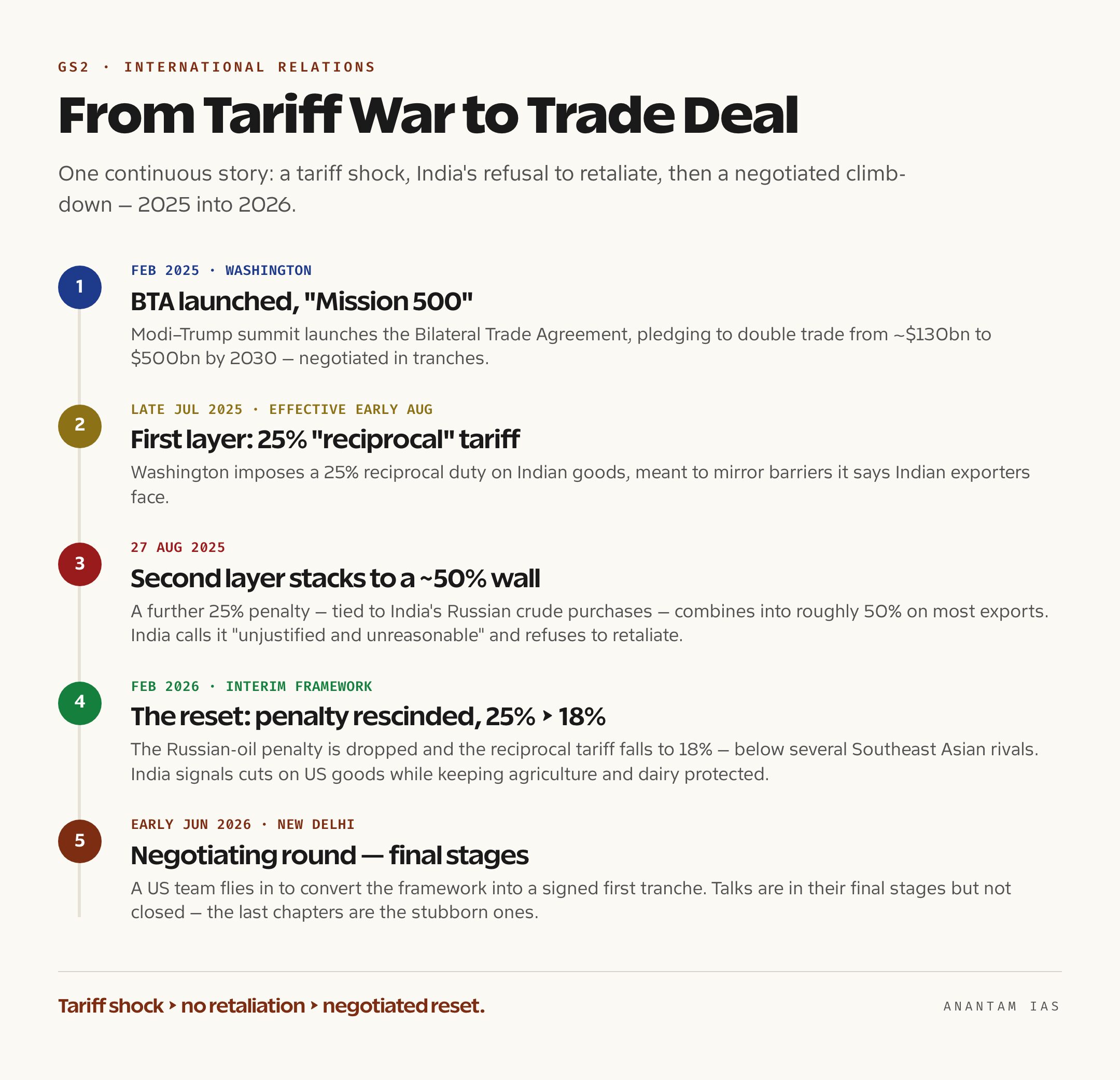
Start with the thing itself. The Bilateral Trade Agreement — BTA — is the formal, multi-sector trade pact India and the United States agreed to negotiate, launched when Prime Minister Narendra Modi met President Donald Trump in Washington in February 2025. The headline ambition got a memorable label: “Mission 500,” a pledge to roughly double two-way trade from around $130 billion to $500 billion by 2030. The same summit folded this into a broader umbrella the two sides called COMPACT — Catalyzing Opportunities for Military Partnership, Accelerated Commerce and Technology — so trade, defence and technology would move as a package, not in separate silos.
Here’s the structure that trips up most candidates, so fix it now. The BTA was never meant to arrive as one giant signed document. It was designed in tranches. The plan announced in 2025 was to conclude a “first tranche” — an interim agreement covering the easier, higher-value wins — and then keep negotiating the harder chapters of a comprehensive deal afterwards. So when you read about an “interim deal” and a “comprehensive BTA,” they are two stages of the same project, not two rival agreements.
Now the reason it landed with such force in 2025-26: a tariff war got there first. Through the year, Washington moved India from a trade partner to a tariff target, and the BTA became the tool meant to clean up the wreckage. To understand the deal, you have to understand the fight that made it urgent — and that fight is worth getting exactly right, because vague gestures at “Trump tariffs” won’t survive an examiner who follows the news.
The 2025 Tariff Turbulence and the Interim Reset
The squeeze came in two layers, and the dates matter. In late July 2025 the US announced a twenty-five-percent “reciprocal” tariff on Indian goods — Washington’s term for a duty meant to mirror the barriers it said Indian exporters faced — which took effect in the first week of August. Then, in August, the administration stacked a second twenty-five-percent penalty on top, this one explicitly tied to India’s continued purchases of discounted Russian crude oil, invoking emergency economic powers. By 27 August 2025 the two layers combined into a roughly fifty-percent wall on most Indian exports to the United States — one of the highest rates applied to any major economy.
India’s response set the tone for the whole negotiation. The Ministry of External Affairs called the move “unjustified and unreasonable,” and pointed to the obvious double standard — that the United States and the European Union had themselves kept trading with Russia even as they penalised India for doing the same. New Delhi refused to retaliate with mirror tariffs, choosing instead to talk while it diversified: it leaned harder into other markets and other trade deals. The stakes were not small. Indian estimates put the exports exposed to the new tariffs in the tens of billions of dollars, with research bodies warning that a large share of India’s shipments to America were in the firing line — textiles, gems and jewellery, leather, shrimp and engineering goods most of all, the labour-intensive sectors where margins are thin and jobs are many.
The reset came in February 2026. After months of talks, the two governments announced an interim framework — and the numbers moved fast. The additional twenty-five-percent “Russian oil” penalty was rescinded, and the reciprocal tariff was brought down from twenty-five to eighteen percent, which Washington framed as a reward for India aligning more closely on trade and security. Eighteen percent still stings, but it is below the rate facing several Southeast Asian competitors, which is the comparison Indian exporters actually care about — it restores a sliver of edge over Vietnam and others in the US market. In exchange, India signalled it would cut tariffs on a wide range of American industrial and farm goods, address non-tariff barriers, and lean toward US energy. Commerce Minister Piyush Goyal’s repeated public line — that agriculture, dairy and other sensitive sectors were protected — tells you precisely where India drew its hardest boundary. The June 2026 round in New Delhi, with the US side led by chief negotiator Brendan Lynch and the Indian side by Commerce Department official Darpan Jain, was about converting that framework into a signed first tranche. As of early June the talks were in their final stages but not closed — the last few chapters were the stubborn ones.
What Each Side Actually Wants
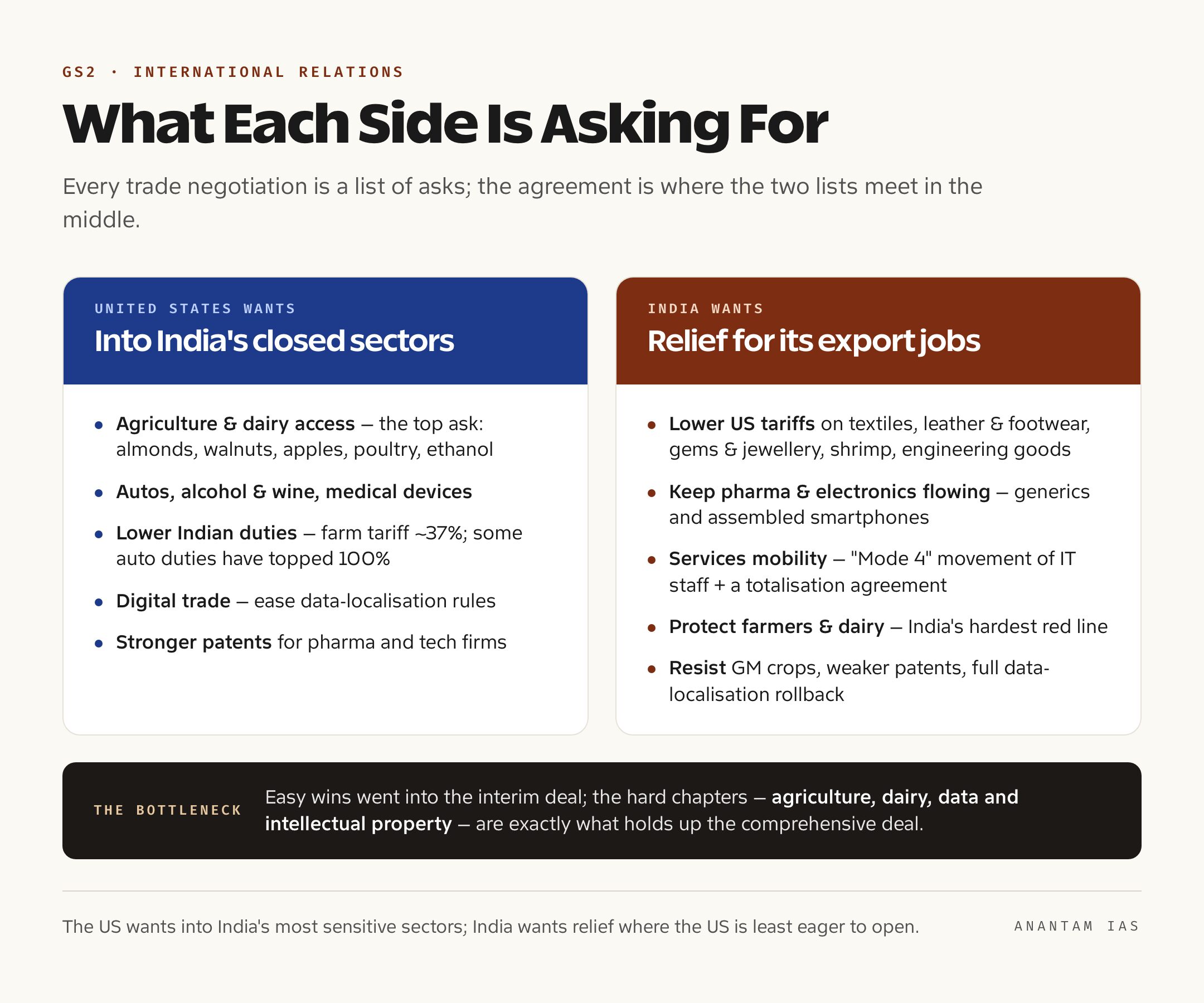
A trade deal is just two lists of demands meeting in the middle, so learn both lists and you’ll never be caught short in an answer. Take Washington first. The United States wants market access for the sectors where it is strong and India is closed: agriculture and dairy above all, plus autos, alcohol and wine, medical devices, ethanol, and a long tail of farm produce like almonds, walnuts, apples and poultry. It wants India to drop its high duties — India’s average agricultural tariff runs near thirty-seven percent, and some auto duties have historically exceeded one hundred percent. Beyond goods, the US presses on digital trade: it dislikes India’s data-localisation rules, which require companies to store Indian users’ data inside the country, and it pushes for stronger patent protection to shield its pharmaceutical and tech firms.
Now India’s list, which is the one your syllabus rewards you for knowing in detail. India wants lower US tariffs on the labour-intensive exports that employ millions — textiles and garments, leather and footwear, gems and jewellery, shrimp, and engineering goods — because these are the sectors that the fifty-percent wall hit hardest and that a return to eighteen percent partly rescues. It wants its pharmaceutical and electronics exports to keep flowing; generic drugs and assembled smartphones are genuine Indian strengths in the US market. On services, India pushes for easier mobility for its professionals — what trade jargon calls “Mode 4,” the temporary movement of engineers and IT staff to client sites — and for a totalisation agreement so its workers in the US don’t pay social-security contributions there that they can never reclaim, a cost Indian industry pegs in the billions.
But the real story is India’s defensive list — the things it is fighting to keep off the table. New Delhi is determined to protect its small and marginal farmers and its dairy sector, where hundreds of millions of livelihoods are at stake and where opening up to subsidised, large-scale American agribusiness could be politically and socially explosive. It is resisting pressure on genetically modified crops, on weakening its patent law in ways that would raise medicine prices, and on full data localisation rollback. So the negotiation is asymmetric in an awkward way: the US wants into India’s most sensitive sectors, while India wants relief in exactly the sectors the US is least eager to fully open. That is why the easy wins went into the interim deal and the hard ones — agriculture, dairy, data and intellectual property — are precisely the bottlenecks that kept the comprehensive deal from closing.
The Strategic Calculus Behind the Numbers
Step back from the tariff schedules, because the BTA is never only about commerce — and this is where a GS2 answer separates itself from a pure economics note. The deeper driver is the China factor. As global firms hunt for a “China-plus-one” manufacturing base to reduce dependence on Beijing, India wants to be that destination, and a stable, lower-tariff relationship with the US — its largest single export market — is central to winning that race against Vietnam, Mexico and others. For Washington, the logic runs in parallel: India is a key Indo-Pacific partner and a pillar of the Quad, the grouping of the US, India, Japan and Australia that functions as a strategic counterweight to China. Letting a tariff dispute sour that partnership would have been self-defeating, which is part of why the climb-down happened.
The trade track also rides alongside a thickening technology and defence relationship. The two countries elevated their tech cooperation from the earlier iCET — the Initiative on Critical and Emerging Technology — into a successor framework called TRUST, short for Transforming the Relationship Utilizing Strategic Technology, covering semiconductors, artificial intelligence, quantum computing, biotechnology, space, and crucially the critical-minerals supply chains that both sides want to wean off Chinese dominance. Defence ties — co-production, technology transfer, major platform purchases — form the third leg. So the BTA is one chapter in a much larger book whose title is, roughly, “how India and the US manage their convergence without surrendering their independence.”
And independence is the word India keeps returning to. Through the whole episode, New Delhi practised what it calls strategic autonomy — refusing to retaliate, refusing to abandon Russian oil on Washington’s timetable, and refusing to put farmers on the table, while still negotiating in good faith. It backed that posture with a flurry of other trade agreements that gave it leverage and alternatives: the UAE CEPA already in force, the Australia ECTA, the EFTA TEPA with Iceland, Liechtenstein, Norway and Switzerland which entered into force in October 2025, the landmark India-UK CETA signed in 2025, and the India-EU FTA concluded in early 2026. A country with that many doors open is harder to corner at any single one. The BTA, in other words, is being negotiated by an India that is no longer a supplicant — and that changes the tone of the room.
Concerns, Criticisms and What to Watch
A good answer never ends on applause, so weigh the criticisms honestly. The loudest concern is the pressure on Indian farmers. Critics warn that even a partial opening to American agriculture and dairy — heavily mechanised, often subsidised, and vast in scale — could undercut Indian producers who farm tiny plots, and they read every US demand on this front as a line India simply cannot afford to cross. The government’s repeated insistence that these sectors are “protected” is itself an admission of how live the fear is.
The second worry is asymmetry and the drift toward “managed trade.” When a deal is built around a partner buying a fixed dollar figure of your goods — the $500 billion energy-and-products commitments floated by Washington, for instance — and around tariffs negotiated bilaterally rather than under multilateral rules, economists ask whether this is free trade at all or a politically managed bargain dressed as one. There is a genuine question about whether such arithmetic targets are realistic: India bought roughly $40 billion of US goods in a recent year, so a leap to the headline numbers strains belief on any normal timeline. Linked to that is the WTO-consistency problem — country-specific “reciprocal” tariffs and managed purchase commitments sit awkwardly with the most-favoured-nation principle that is supposed to anchor the global trading system, and a deal that quietly normalises bilateral arm-twisting weakens the rules India has long relied on as a shield. Finally there is the simple matter of durability: a framework reached under tariff pressure can be reopened under fresh pressure, and the safeguard clauses built into it cut both ways.
So what should you watch? Whether the interim first tranche is actually signed and what it covers; whether agriculture and dairy stay walled off or get cracked open; whether the comprehensive BTA ever clears the data-localisation and patent disputes; and whether two-way trade moves anywhere near the Mission 500 trajectory or quietly slips. The honest verdict for now is that India has converted a damaging tariff shock into a workable, if incomplete, reset — and held its sensitive lines while doing it. Whether that becomes a genuine partnership of equals or settles into lopsided dependence is the open question the next two years will answer.
For Your Mains Answer
This topic is a rare two-for-one. It maps cleanly onto GS Paper 2 — “bilateral, regional and global groupings and agreements involving India and/or affecting India’s interests,” and “effect of policies and politics of developed countries on India” — and just as cleanly onto GS Paper 3, on the Indian economy, trade, and the effects of liberalisation. It is also prime Essay material on globalisation, strategic autonomy, or “interdependence in an age of economic nationalism.” Treat it as a case study that lets you argue something larger about how a rising India manages a great power.
How to Build the Answer
Open with the tension, not the chronology. One crisp line — that the US is simultaneously India’s largest trading partner and the source of a punishing 2025 tariff, and the BTA is how that contradiction gets resolved — frames the whole answer in the examiner’s mind. Then move in a logical arc: what the BTA is (Mission 500, the tranche structure) → the tariff turbulence and the interim reset → what each side wants → the strategic calculus (China-plus-one, the Quad, TRUST) → balanced concerns → a forward-looking close. Anchor every claim in something concrete: the fifty-to-eighteen-percent tariff move, the $130 billion-to-$500 billion target, agriculture and dairy as India’s red line.
Common Mistakes to Avoid
Don’t claim a final, signed comprehensive deal exists — describe it accurately as a multi-phase negotiation with an interim framework agreed and a first tranche being finalised. Don’t reduce it to “Trump tariffs are bad”; an examiner wants the structure, the dates and India’s strategic response, not a complaint. Don’t forget the economics in a GS2-flavoured answer, or the strategy in a GS3 one — the whole value of this topic is that it joins both. And don’t ignore the criticisms; an answer that only celebrates the tariff cut reads as naive.
A Compact Answer Spine
US = largest trading partner + strategic counterweight, yet source of the 2025 tariff shock → BTA launched Feb 2025, “Mission 500” to double trade to $500 bn by 2030, negotiated in tranches → 2025: 25% reciprocal + 25% Russia-oil penalty = ~50% wall; India calls it “unjustified,” refuses to retaliate → Feb 2026 interim reset: penalty rescinded, reciprocal cut to 18% → US wants agriculture, dairy, autos, digital; India wants lower tariffs on textiles/leather/gems/pharma, services mobility, farmer protection → strategic frame: China-plus-one, Quad, TRUST, strategic autonomy, India’s other FTAs → concerns: farmer pressure, asymmetry, managed trade, WTO consistency → verdict: damage controlled, sensitive lines held, durability still open.
Diagram or Flowchart Idea
Draw a simple flow: a box “2025 Tariff Shock (~50%)” → arrow “India: no retaliation, diversify + negotiate” → box “Feb 2026 Interim Framework (tariff → 18%)” → arrow → box “First Tranche / Comprehensive BTA (in progress).” Underneath, two short columns headed “US wants” and “India wants.” It is fast to draw and shows the examiner you grasp the sequence, not just the slogans.
A Balanced-Conclusion Line
“The India-US Bilateral Trade Agreement is less a finished treaty than a test of mature interdependence — proof that two large economies can turn a tariff confrontation into a negotiated reset, provided India keeps protecting its sensitive sectors while it harvests the gains.” That sentence concedes the limits and still lands a verdict.
How to Use Data Without Cramming
You need only a handful of anchors, deployed with confidence: tariffs that climbed to roughly fifty percent in August 2025 and fell to eighteen percent in February 2026; the Mission 500 goal of $500 billion in two-way trade by 2030 from a base near $130 billion; India’s average farm tariff near thirty-seven percent; and one named red line — agriculture and dairy. Drop those precisely and skip the rest. Naming the source in passing — “the February 2026 framework,” “the Commerce Ministry’s stated position” — reads as command of the file, not memorisation.
FAQ
What is the India-US Bilateral Trade Agreement (BTA)? It is the multi-sector trade pact India and the United States agreed to negotiate after Prime Minister Modi and President Trump met in February 2025. Its flagship goal, “Mission 500,” is to roughly double two-way trade to $500 billion by 2030. It is being negotiated in stages — an interim “first tranche” first, then a wider comprehensive agreement — rather than as a single document, and as of mid-2026 the interim deal was in its final stages.
Why did the US put a fifty-percent tariff on India in 2025? In two layers. In late July 2025 Washington imposed a twenty-five-percent “reciprocal” tariff, and in August it added a further twenty-five-percent penalty tied specifically to India’s purchases of Russian oil, taking the combined rate on most Indian goods to about fifty percent by 27 August 2025. India’s Ministry of External Affairs called it “unjustified and unreasonable” and declined to retaliate, choosing to negotiate instead.
What did the February 2026 interim deal change? The additional twenty-five-percent Russian-oil penalty was rescinded and the reciprocal tariff was lowered from twenty-five to eighteen percent, easing the pressure on Indian exporters and restoring some advantage over Southeast Asian competitors. In return India signalled tariff cuts on a range of American industrial and farm goods and moves on non-tariff barriers and energy — while insisting its agriculture and dairy sectors stayed protected.
What are the main sticking points still holding up the full deal? The hardest chapters are agriculture and dairy (India shields its small farmers and resists large-scale US farm access), digital trade and data localisation (the US wants India’s storage rules eased), and intellectual property (the US wants stronger patents; India guards its low-cost generic-medicine industry). These are exactly the sensitive sectors the interim deal left for the comprehensive phase.
Practice Questions
Prelims MCQs
- With reference to the India-US Bilateral Trade Agreement (BTA), consider the “Mission 500” target.
Which of the following best describes it?
(a) Reducing US tariffs on Indian goods to 5 percent
(b) Doubling two-way trade to about $500 billion by 2030
(c) India importing 500 American defence platforms
(d) Cutting India’s tariff lines to 500 by 2030.
Answer: (b) Mission 500 is the pledge announced in February 2025 to roughly double bilateral trade to $500 billion by 2030. - In 2025, the United States imposed a roughly fifty-percent tariff on most Indian goods. This figure was made up of:
(a) a single fifty-percent reciprocal tariff
(b) a twenty-five-percent reciprocal tariff plus a twenty-five-percent penalty linked to Russian oil purchases
(c) a thirty-percent reciprocal tariff plus a twenty-percent anti-dumping duty
(d) tariffs imposed entirely under WTO safeguard rules.
Answer: (b) A 25 percent “reciprocal” tariff was stacked with a further 25 percent penalty tied to India’s Russian-oil imports, reaching about 50 percent by 27 August 2025. - Consider the following sectors:
- Textiles and garments
- Leather and footwear
- Gems and jewellery In the India-US trade negotiations, which of these does India primarily seek lower US tariffs for?
(a) 1 and 2 only
(b) 2 and 3 only
(c) 1 and 3 only
(d) 1, 2 and 3.
Answer: (d) All three are labour-intensive Indian exports hit hardest by the 2025 tariffs, and securing lower US duties on them is a core Indian demand. - The “TRUST” initiative between India and the United States is best described as:
(a) a defence procurement fund
(b) a successor to iCET focused on critical and emerging technologies
(c) a currency-swap arrangement
(d) a tariff-dispute settlement body.
Answer: (b) TRUST — Transforming the Relationship Utilizing Strategic Technology — succeeded iCET and covers semiconductors, AI, quantum, biotech, space and critical minerals. - Which of the following is correctly matched as an India trade agreement and its partner?
(a) CEPA — Australia
(b) ECTA — UAE
(c) TEPA — EFTA (Iceland, Liechtenstein, Norway, Switzerland)
(d) CETA — European Union.
Answer: (c) TEPA is the Trade and Economic Partnership Agreement with the EFTA bloc; the UAE deal is a CEPA, the Australia deal an ECTA, and CETA is the agreement with the UK.
Mains Practice Questions
- “The India-US Bilateral Trade Agreement is as much an exercise in strategic management as in economics.” Critically examine this statement in light of the 2025 tariff dispute and its 2026 reset. (15 marks, 250 words)
- Discuss the key demands of India and the United States in their bilateral trade negotiations. Why have agriculture, dairy and data emerged as the principal sticking points? (15 marks, 250 words)
- Examine how India’s principle of strategic autonomy shaped its response to the 2025 US tariffs. To what extent did India’s other free trade agreements strengthen its negotiating position? (15 marks, 250 words)
- “Tariff-driven bilateral bargains risk weakening the rules-based multilateral trading order.” Evaluate this concern with reference to the India-US trade framework and the WTO. (10 marks, 150 words)
- The India-US partnership spans trade, technology and defence. Analyse how initiatives like Mission 500, TRUST and the Quad fit together in India’s calculus toward a major power. (15 marks, 250 words)