The Quad Summit 2025 marked the seventh leader-level meeting of the Quadrilateral Security Dialogue — the grouping of the United States, Japan, India and Australia — and the first under the second Donald Trump administration in Washington. Hosted on 21 January 2025 immediately after the US presidential inauguration, the meeting opened with a Quad foreign ministers’ meeting and was followed through the year by a leaders’ summit hosted by India in late 2025 in New Delhi. Together, these two engagements re-anchored the Quad’s working agenda around supply-chain resilience, critical and emerging technologies, maritime domain awareness, undersea cables, climate-resilient infrastructure and humanitarian assistance and disaster relief (HADR).
The Quad Summit 2025 took place against a backdrop of intensifying strategic competition in the Indo-Pacific, a partial restoration of working-level military communication between the US and China, India’s continued engagement with the BRICS+ format, and Japan’s transition to a new prime minister. The summit’s outcome documents emphasised what the four leaders called a “free, open, stable and prosperous Indo-Pacific” — language now standard but with sharper operational annexes than in previous years.
Origin and Evolution of the Quad
The Quad’s roots lie in the humanitarian response to the 2004 Indian Ocean tsunami, when the United States, Japan, India and Australia formed an informal Tsunami Core Group that coordinated naval logistics and relief. The grouping was formalised in 2007 as the Quadrilateral Security Dialogue at the initiative of then–Japanese Prime Minister Shinzo Abe, but lapsed after Australia withdrew under domestic political pressure in 2008.
Quad 2.0
The Quad was revived in November 2017 on the sidelines of the East Asia Summit in Manila, initially at senior official level. It was upgraded to foreign ministers in 2019 and to leaders in March 2021, when the first virtual leaders’ summit took place under US President Joe Biden, Indian Prime Minister Narendra Modi, Japanese Prime Minister Yoshihide Suga and Australian Prime Minister Scott Morrison. Subsequent leaders’ meetings were held in Washington (2021), Tokyo (2022), Hiroshima (on the margins of G7 in 2023) and Wilmington, Delaware (2024).
What the Quad Is Not
The Quad is not a treaty alliance. It has no secretariat, no headquarters and no mutual-defence clause. Its working method is consensus-based and project-driven. India has consistently described it as a “force for global good” rather than a military alignment, an emphasis that helps reconcile membership with its commitment to strategic autonomy.
Why the Quad Matters
The Indo-Pacific accounts for roughly 60 percent of the global economy, more than half of global maritime trade by value, and the world’s largest concentration of military capability and economic dynamism. The Quad framework allows four democratic, market-oriented powers to coordinate without the rigidity of an alliance and without forcing a binary choice on smaller Indo-Pacific states.
The China Context
The Quad’s revival, agenda and language are widely read as a hedge against China’s assertive behaviour — the militarisation of features in the South China Sea, coercive economic statecraft, the 2020 standoff along the India–China Line of Actual Control, intrusions in the East China Sea around the Senkaku Islands, and pressure on Taiwan. The Quad does not name China in its summit communiqués; it consistently invokes “rules-based order”, “freedom of navigation”, “unimpeded commerce” and “respect for sovereignty and territorial integrity”. The omission of the name and the inclusion of the principles is itself the message.
Outcomes of the Quad Summit 2025
The January 2025 foreign ministers’ statement and the subsequent leaders’ meeting in New Delhi laid out a working agenda across six baskets.
Supply Chain Resilience
The Quad committed to expanding the Critical Minerals Supply Chain Resilience Initiative, mapping vulnerabilities in lithium, cobalt, nickel, rare earth elements and graphite — the inputs for batteries, semiconductors, defence systems and renewable energy. India’s role as a partner under the US–India iCET (initiative on Critical and Emerging Technology) and the Australia–India Critical Minerals Investment Partnership feeds directly into this basket.
Critical and Emerging Technologies
The Quad reaffirmed its work on:
- Semiconductors — supply-chain coordination, talent exchanges and design-fab linkages, building on the US CHIPS Act, Japan’s Rapidus initiative, India’s Semiconductor Mission and Australia’s National Quantum Strategy.
- 5G and Open RAN — joint commercial deployments and trusted-vendor frameworks.
- Artificial intelligence — alignment on safety, evaluation and governance, including coordination with the AI Safety Institutes of the four countries.
- Quantum technologies — research consortia and shared testbeds.
- Biotechnology — pandemic preparedness and biomanufacturing.
Maritime Security and Domain Awareness
The Indo-Pacific Partnership for Maritime Domain Awareness (IPMDA), launched at the 2022 Tokyo summit, was expanded at the 2025 summit. IPMDA uses commercial space-based radio frequency data to give partner states a near real-time picture of dark shipping — vessels that switch off their Automatic Identification System to evade detection. Coverage now extends across the Pacific Islands, Southeast Asia and the Indian Ocean. The Quad also announced a new Quad-at-Sea Ship Observer Mission placing coast guard officers aboard a US Coast Guard cutter for joint operations.
Undersea Cables and Digital Infrastructure
The Quad’s Cable Connectivity and Resilience Centre, announced in 2024, became operational in 2025. Undersea cables carry over 95 percent of global digital traffic. The Quad’s interest is to ensure cable manufacturing, laying and repair capacity is distributed across trusted providers — implicitly reducing dependence on a small number of Chinese firms.
Climate and Clean Energy
The Quad reaffirmed support for the Indo-Pacific Climate Resilience Initiative, the Climate Information Services Initiative and clean hydrogen partnerships. India’s leadership of the International Solar Alliance and the Coalition for Disaster Resilient Infrastructure aligns with this basket. For broader climate context, see the IPCC AR6 report and COP-28 of the UNFCCC.
HADR and Public Health
Building on COVID-era cooperation under the Quad Vaccine Partnership — which supported manufacturing in India for distribution in the Indo-Pacific — the 2025 outcomes included pandemic preparedness drills, joint stockpiles and the Quad Cancer Moonshot announced in 2024 for cervical cancer screening in the Pacific Islands.
India’s Stake in the Quad
For India, the Quad sits at the intersection of three foreign-policy objectives: deterring coercion along its land and maritime frontiers, accessing capital and technology for its industrial upgrade, and shaping the rules of the emerging Indo-Pacific order.
Strategic Autonomy and the Quad
Indian commentary on the Quad has emphasised four guardrails:
- No mutual-defence clause. The Quad is not Asian NATO; India retains independent decision-making on conflict.
- Issue-based coalition. India participates on specific deliverables — vaccines, critical minerals, IPMDA, semiconductors — rather than open-ended security commitments.
- Bilateral hedge. India maintains separate dialogues with Russia, the European Union, ASEAN partners and the BRICS+ grouping.
- South Asian primacy. India sees the Quad as complementary, not substitutive, to its Neighbourhood First and SAGAR (Security and Growth for All in the Region) policies.
Economic and Technology Dividend
The Quad framework has accelerated several Indian initiatives:
- US semiconductor investments under iCET, including memory packaging announced in Gujarat.
- The Australia–India Economic Cooperation and Trade Agreement (ECTA) and ongoing Comprehensive Economic Cooperation Agreement (CECA) negotiations.
- Japan’s continued infrastructure financing in the North-East, the Mumbai–Ahmedabad bullet train and a Quad-aligned manufacturing partnership.
- US–India INDUS-X initiative on defence innovation, parallel to broader Quad technology baskets.
Maritime Imperative
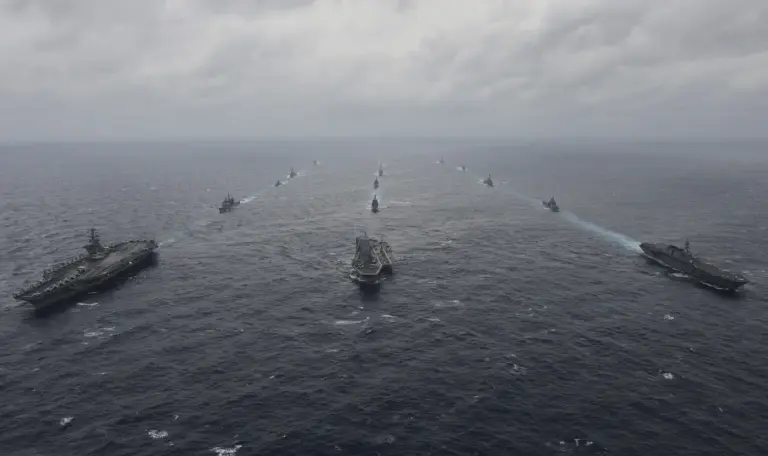
For India, with a 7,500-km coastline, two island chains and a navy in the middle of a long modernisation cycle, IPMDA and joint exercises with Quad partners are an operational gain. The annual Malabar Exercise — now a Quad-format naval exercise involving all four navies — held its 2025 edition off the eastern Indian coast. See also India and the Indo-Pacific for the broader strategic frame.
Critiques and Constraints
The Quad’s trajectory faces several constraints.
Political Cycles
Each Quad capital faces its own electoral cycle. The change in US administration in January 2025, Australia’s federal election, and Japan’s leadership transition all shape Quad rhythm. The grouping has so far weathered these transitions — evidence of underlying bipartisan support in all four capitals.
Implementation Gap
Critics point to a gap between summit communiqués and on-the-ground delivery, particularly in the Pacific Islands. The Quad’s principal competitor for influence in the islands — China — has offered more visible, immediate infrastructure financing. The Quad’s response has been to bundle smaller, climate- and digital-relevant projects.
Strategic Autonomy Tensions
India’s continued energy and defence trade with Russia, its participation in BRICS+, and its non-alignment with several US-led sanctions regimes generate periodic friction. The Quad accommodates this difference, but each cycle of escalation — Russia–Ukraine, US–China trade measures, sanctions on Iran — tests the bandwidth.
China’s Reaction
Beijing has consistently labelled the Quad an “Asian NATO” and a Cold War remnant. Chinese diplomacy has invested in counter-balancing structures: tighter coordination with Russia, deeper engagement with ASEAN through RCEP, and bilateral inducements to Pacific Island states. The Quad’s task is to remain attractive as a positive offer, not merely a hedge.
Way Forward
The Quad Summit 2025 confirmed three trends. First, the grouping’s centre of gravity is shifting from declaratory statements to operational mechanisms — IPMDA, the cable centre, the critical minerals partnership and AI safety coordination. Second, deliverables are increasingly woven into bilateral roadmaps (US–India iCET, Australia–India CMIP, Japan–India CEPA), reducing the dependence on summit-cycle theatre. Third, the Quad is consciously expanding its outreach to ASEAN, the Pacific Islands and select Indian Ocean partners through “Quad-Plus” formats without diluting its core membership.
For India, the strategic logic of the Quad remains compelling: a calibrated platform for technology, capital, maritime cooperation and rule-shaping in a region central to its security and prosperity. The challenge is to deliver — through visible projects, predictable funding and consistent diplomacy — what summit communiqués promise.
Frequently Asked Questions
What is the Quad?
The Quadrilateral Security Dialogue is an informal strategic grouping of the United States, Japan, India and Australia, focused on a free and open Indo-Pacific. It is not a treaty alliance and has no secretariat or mutual-defence clause.
When and where was the Quad Summit 2025 held?
The Quad foreign ministers met in Washington on 21 January 2025, immediately after the US presidential inauguration. A leaders’ summit followed in New Delhi later in 2025.
Who attended the Quad Summit 2025?
US President Donald Trump, Indian Prime Minister Narendra Modi, Japanese Prime Minister Shigeru Ishiba (and his successor) and Australian Prime Minister Anthony Albanese, with their foreign ministers and senior officials.
What were the main outcomes of the Quad Summit 2025?
The summit advanced work across six baskets: critical minerals and supply chains, critical and emerging technologies, maritime domain awareness, undersea cables, climate and clean energy, and humanitarian assistance with public health.
How did the Quad originate?
It began as the Tsunami Core Group coordinating relief after the 2004 Indian Ocean tsunami. It was formalised in 2007, lapsed in 2008, revived in 2017 and elevated to leader level in 2021.
Is the Quad an Asian NATO?
No. It has no mutual-defence obligations, no integrated military command and no treaty basis. India in particular emphasises that the Quad is an issue-based coalition, not an alliance.
What is IPMDA?
The Indo-Pacific Partnership for Maritime Domain Awareness, launched at the 2022 Tokyo summit, uses commercial satellite data to detect u0022dark shippingu0022 and share a near real-time maritime picture with partner states across the Pacific Islands, Southeast Asia and the Indian Ocean.
How does the Quad relate to China?
The Quad does not name China in its statements but addresses concerns about coercive behaviour, maritime claims and supply-chain dependency. China characterises the Quad as a Cold War-style bloc; the Quad characterises itself as a positive offer for the Indo-Pacific.
Tell Google you want more of this.
Add Anantam IAS as a preferred sourceOne tap, and this site shows up more often in your own Top Stories, AI Overviews and AI Mode. Remove it any time.