Indian Ocean Diplomacy: Geopolitics & Security
Comprehensive analysis of Indian Ocean geopolitics — maritime security, Indo-Pacific strategy, String of Pearls, QUAD, and India's SAGAR vision for UPSC.
Indian Ocean Diplomacy: Geopolitics & Security
The Indian Ocean Region (IOR) is the world’s most contested maritime space in the 21st century. Home to critical chokepoints carrying 80% of global oil trade, it sits at the intersection of great-power competition between India, China, and the United States. For UPSC, Indian Ocean diplomacy is a high-yield topic that spans GS-II (International Relations) and GS-III (Security) — covering maritime strategy, multilateral forums, and India’s evolving role as a net security provider.
Why the Indian Ocean Matters Geopolitically
The Indian Ocean connects three continents and carries the trade lifelines of the global economy. Control over its sea lanes determines access to energy, raw materials, and markets.
Strategic Significance in Numbers
| Parameter | Value |
|---|---|
| Global seaborne oil trade through IOR | ~80% |
| World’s container shipments through IOR | ~50% |
| Share of global fish catch | ~15% |
| Littoral and island states | 38+ |
| Chokepoints controlling global trade | 6 major |
| Undersea communication cables | ~75% of global internet traffic transits IOR cables |
The Persian Gulf alone holds about 48% of proven global oil reserves, and virtually all of it must transit through Indian Ocean chokepoints to reach consumers in Asia and Europe.
Great Power Competition in the Indian Ocean
India’s Position
India’s geographic centrality gives it a natural advantage. The Deccan Peninsula projects 1,600 km into the Indian Ocean, providing India a 7,516 km coastline and island territories (Andaman & Nicobar, Lakshadweep) that straddle major sea lanes.
India’s strategic doctrine has evolved from a defensive, continental orientation to an increasingly maritime posture. The 2015 Indian Maritime Security Strategy — titled “Ensuring Secure Seas” — defines India’s areas of maritime interest extending from the Persian Gulf to the Strait of Malacca and from the East African coast to the approaches of the South China Sea.
China’s Expanding Presence
China’s presence in the Indian Ocean has grown rapidly since the 2000s, driven by:
- String of Pearls — network of Chinese-funded ports and facilities around the IOR
- Belt and Road Initiative (BRI) — includes the Maritime Silk Road through the Indian Ocean
- PLA Navy — established its first overseas military base in Djibouti (2017)
- Debt-trap diplomacy — strategic ports acquired through unsustainable lending (Hambantota model)
The String of Pearls: Key Nodes
| Location | Country | Nature of Chinese Presence |
|---|---|---|
| Gwadar | Pakistan | Port built under CPEC; potential naval use |
| Hambantota | Sri Lanka | 99-year lease after Sri Lanka defaulted on Chinese loans |
| Chittagong | Bangladesh | Deep-sea port development assistance |
| Kyaukphyu | Myanmar | Port and Special Economic Zone; oil/gas pipeline terminus |
| Djibouti | Djibouti | China’s first overseas military base |
| Marao | Maldives | Rumoured Chinese interest (denied by Maldives) |
United States’ Strategy
The US maintains its largest forward-deployed naval presence in the Indian Ocean through the 5th Fleet headquartered in Bahrain and the base at Diego Garcia (British Indian Ocean Territory). The US conceptualised the Indo-Pacific framework to counter China, linking the Indian Ocean strategy with Pacific theatre operations.
India’s Maritime Strategy Frameworks
SAGAR (Security and Growth for All in the Region)
Articulated by Prime Minister Modi in 2015 during a visit to Mauritius, SAGAR outlines India’s vision for cooperative maritime governance. Its pillars include:
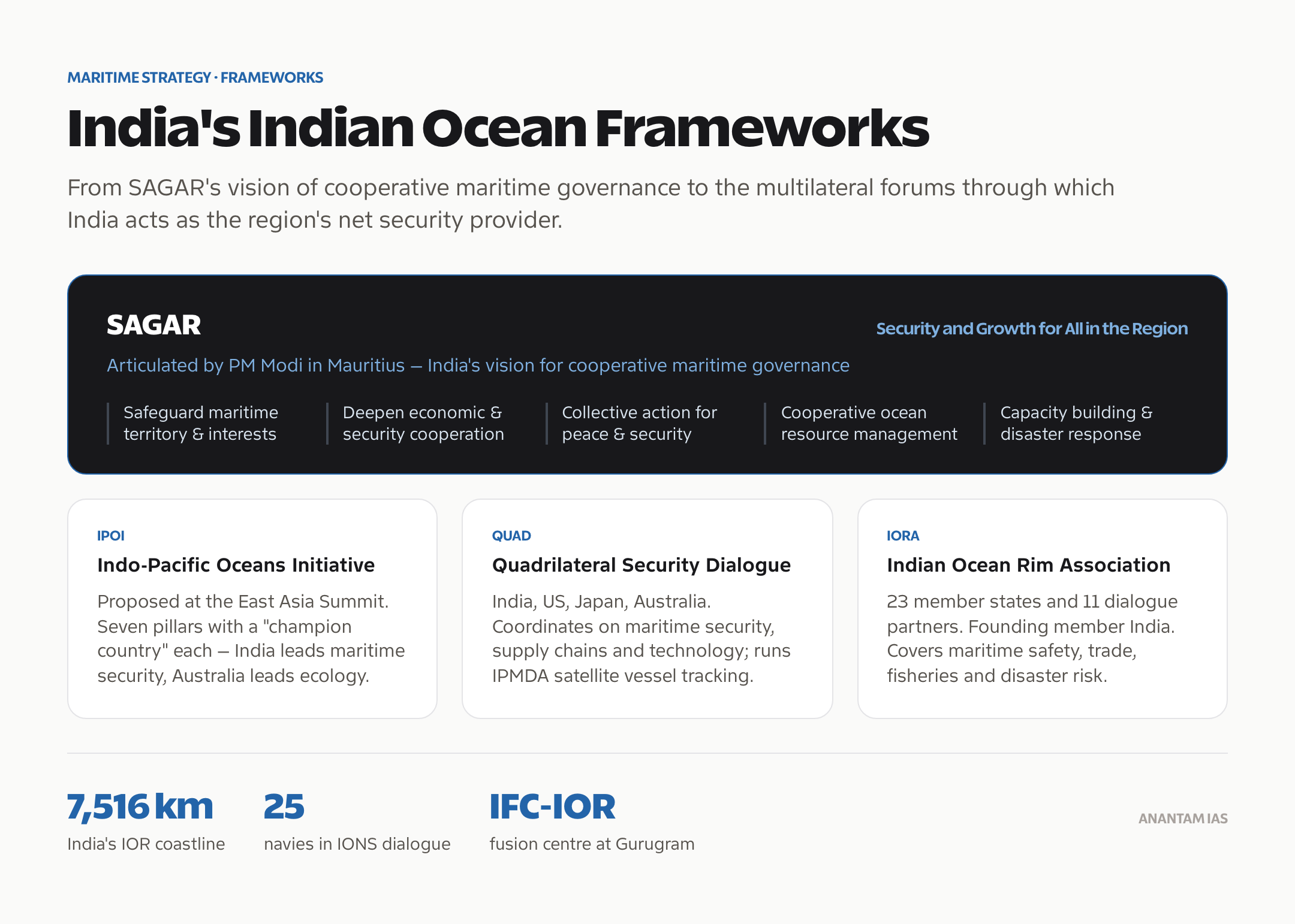
- Safeguarding India’s maritime territory and interests
- Deepening economic and security cooperation with maritime neighbours
- Collective action for peace and security
- Cooperative management of ocean resources
- Capacity building and disaster response collaboration
Indo-Pacific Oceans Initiative (IPOI)
Proposed by India at the East Asia Summit in 2019, IPOI focuses on seven pillars: maritime security, maritime ecology, maritime resources, capacity building, disaster risk reduction, technology cooperation, and trade connectivity. Each pillar has a “champion country” — India leads maritime security, Australia leads maritime ecology.
Net Security Provider
India positions itself as the “preferred security partner” and “first responder” in the IOR. This translates into:
- Humanitarian assistance and disaster relief (HADR) — India was the first responder during the 2004 Tsunami, Cyclone Idai (Mozambique), and COVID-19 vaccine distribution
- Anti-piracy operations — continuous Indian Navy deployment in the Gulf of Aden since 2008
- Hydrographic surveys — for island neighbours like Mauritius, Seychelles, and Maldives
- Maritime domain awareness — sharing real-time shipping data through the Information Fusion Centre (IFC-IOR) at Gurugram
Multilateral Maritime Frameworks
QUAD (Quadrilateral Security Dialogue)
The QUAD — comprising India, the US, Japan, and Australia — is the most significant minilateral in the Indo-Pacific. While not a military alliance, it increasingly coordinates on maritime security, supply chains, technology, and climate.
QUAD maritime initiatives:
- Indo-Pacific Maritime Domain Awareness (IPMDA) — satellite-based vessel tracking
- QUAD fellowship for STEM students
- Vaccine diplomacy through QUAD partnership
- Critical and emerging technology cooperation
Indian Ocean Rim Association (IORA)
IORA has 23 member states and 11 dialogue partners. It focuses on maritime safety, trade facilitation, fisheries management, disaster risk reduction, and academic cooperation. India has been a founding member since 1997.
Indian Ocean Naval Symposium (IONS)
Founded in 2008 on India’s initiative, IONS brings together navies of 25 Indian Ocean littoral states for dialogue and cooperation. It organises the biennial MILAN exercise hosted by India at Port Blair.
Other Key Forums
| Forum | Members | Focus |
|---|---|---|
| BIMSTEC | 7 Bay of Bengal states | Economic and security cooperation |
| Colombo Security Conclave | India, Sri Lanka, Maldives, Mauritius | Maritime security, counterterrorism |
| Djibouti Code of Conduct | 20 signatories | Anti-piracy in western Indian Ocean |
| Combined Maritime Forces (CMF) | 34+ nations | Counter-piracy, counter-narcotics |
| MALABAR Exercise | India, US, Japan, Australia | Advanced naval interoperability |
India’s Island and Base Strategy
India’s island territories — the Andaman & Nicobar Islands (ANI) and Lakshadweep — are strategic assets of the first order.
Andaman & Nicobar Islands
Located just 90 km from Indonesia’s Sumatra, the ANI chain guards the western approach to the Strait of Malacca. India established the Andaman and Nicobar Command in 2001 — its only tri-service theatre command. Recent developments include:
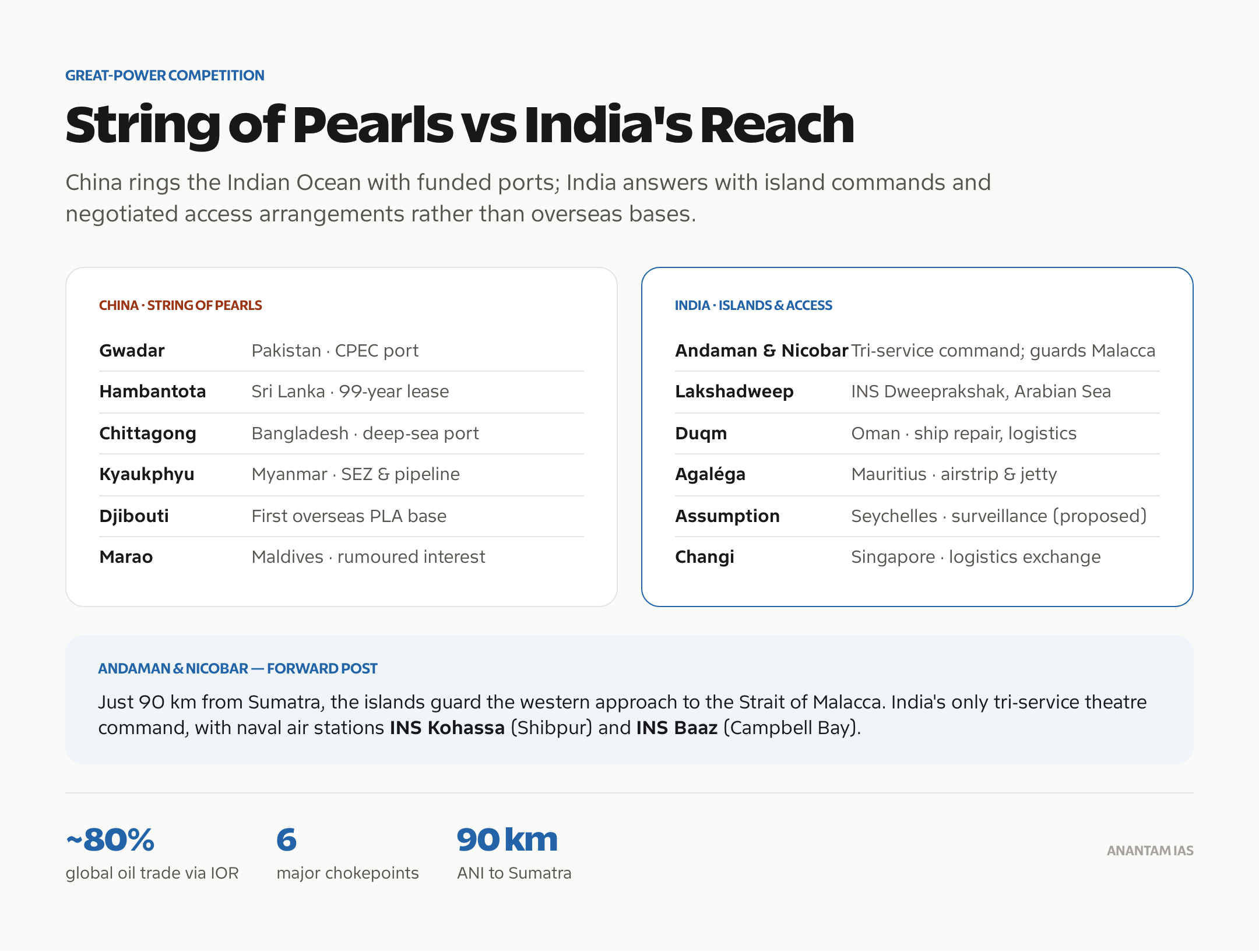
- INS Kohassa — naval air station in Shibpur
- INS Baaz — India’s southernmost air base at Campbell Bay
- Expansion of Port Blair as a forward operating base
- Plans for a container transshipment terminal at Car Nicobar
Lakshadweep
Located in the Arabian Sea, Lakshadweep sits astride sea lanes connecting the Persian Gulf to Southeast Asia. INS Dweeprakshak at Kavaratti serves as a base for monitoring the western Arabian Sea.
Overseas Access and Facilities
India doesn’t maintain overseas military bases in the traditional sense but has negotiated access arrangements:
| Country | Facility/Arrangement | Purpose |
|---|---|---|
| Oman | Duqm port access | Ship repair, logistics |
| France (Reunion) | Logistics agreement | Indian Ocean patrol support |
| Seychelles | Assumption Island (proposed) | Maritime surveillance station |
| Mauritius | Agaléga Island | Airstrip and jetty development |
| Singapore | Changi Naval Base access | Logistics exchange |
| Madagascar | Logistics agreement | Anti-piracy operations |
Maritime Security Challenges
Piracy and Armed Robbery
While Somali piracy has declined since its 2011 peak (due to international naval patrols), armed robbery at sea remains a concern. The 2024 Houthi attacks on shipping in the Red Sea and Gulf of Aden created a new dimension of maritime insecurity affecting Indian Ocean trade.
Illegal, Unreported, and Unregulated (IUU) Fishing
IUU fishing depletes fish stocks on which millions of coastal communities depend. China’s distant-water fishing fleet — the world’s largest — operates extensively in the Indian Ocean, often in the exclusive economic zones of African and South Asian nations.
Maritime Terrorism
The 2008 Mumbai attacks demonstrated the vulnerability of India’s coastline to sea-borne terrorism. Post-2008 reforms include the establishment of the National Committee for Strengthening Maritime and Coastal Security (NCSMCS) and coastal radar chains.
Drug Trafficking
The “southern route” for Afghan heroin — through the western Indian Ocean to East Africa and beyond — represents a significant narcotics trafficking corridor. Indian and regional navies regularly intercept drug-laden dhows in the Arabian Sea.
India’s Blue Economy Vision
Beyond security, India’s Indian Ocean diplomacy increasingly focuses on the blue economy — sustainable use of ocean resources for economic growth.
Key Dimensions
- Deep Ocean Mission — Rs 4,077 crore programme for deep-sea exploration, including the Samudrayaan manned submersible
- Sagarmala Programme — port-led development leveraging India’s coastline
- Polymetallic Nodule Mining — India holds exploration rights in the Central Indian Ocean Basin (75,000 sq km)
- Marine Biotechnology — research into pharmaceuticals, enzymes, and biofuels from marine organisms
Indian Ocean: Geography, Significance & UPSC Notes Major Ports of India: Complete List & Map
India vs China: Indian Ocean Comparison
| Parameter | India | China |
|---|---|---|
| Coastline in IOR | 7,516 km | None (external actor) |
| Naval bases in IOR | Multiple (domestic) | Djibouti (1 overseas base) |
| Aircraft carriers | INS Vikramaditya, INS Vikrant | None deployed permanently in IOR |
| Port partnerships | Duqm, Chabahar, Assumption | Gwadar, Hambantota, Djibouti |
| Strategic advantage | Geographic centrality | Economic leverage (BRI loans) |
| Alliance framework | QUAD, IONS, IORA | Bilateral arrangements |
| Submarine capability | Nuclear + conventional | Increasing SSN/SSBN presence in IOR |
Frequently Asked Questions
What is the String of Pearls strategy?
The String of Pearls refers to China’s network of commercial port projects and military access points encircling the Indian Ocean — including Gwadar (Pakistan), Hambantota (Sri Lanka), Chittagong (Bangladesh), Kyaukphyu (Myanmar), and a naval base in Djibouti. India views this as strategic encirclement and has responded with its own maritime partnerships.
How does QUAD address Indian Ocean security?
The QUAD — India, US, Japan, Australia — coordinates on maritime domain awareness through the IPMDA initiative, conducts joint naval exercises (MALABAR), and promotes a rules-based Indo-Pacific order. While not a formal military alliance, the QUAD provides a framework for countering China’s expanding influence in the Indian Ocean region.
What is India’s SAGAR vision?
SAGAR (Security and Growth for All in the Region) is India’s overarching Indian Ocean policy announced in 2015. It emphasises cooperative maritime security, economic partnerships with island nations, collective disaster response, and sustainable ocean resource management. SAGAR positions India as a benign net security provider rather than a hegemonic power.
What is the significance of the Andaman & Nicobar Islands?
The Andaman & Nicobar Islands sit 90 km from Indonesia, guarding the western approach to the Strait of Malacca — the world’s busiest shipping lane. India’s tri-service command at Port Blair, air stations at Shibpur and Campbell Bay, and proposed transshipment terminals make ANI the most forward-deployed Indian military asset in the eastern Indian Ocean.
What is the Information Fusion Centre for the Indian Ocean Region?
The IFC-IOR, established in Gurugram in 2018, is a maritime domain awareness hub that collects and shares real-time shipping information with partner nations. It operates under the Indian Navy and has linkages with similar centres worldwide. The IFC-IOR enhances regional maritime security by enabling early warning of suspicious activities.