Integrity Pacts, Beneficial Ownership and UNCAC: How the World Fights Bribery (UPSC Ethics — GS IV)
An integrity pact works because it converts a collective-action problem into a contract: a bidder who would not refuse a bribe alone will accept a rule that binds every competitor too. The international architecture built on the same logic recovers a fraction of what it estimates is stolen.
Most anti-corruption instruction stops at domestic criminal law, which is a mistake, because the largest corruption transactions are not domestic. A bribe paid to win an infrastructure contract may be negotiated in one country, paid from a second, routed through a company registered in a third, and spent on property in a fourth. Each of those steps is designed to defeat a national investigator working alone.
The international architecture exists to close that gap, and it does so through a small number of mechanisms that are worth knowing precisely rather than as a list of acronyms. Two of them are conceptually elegant: the integrity pact, which solves a collective-action problem by contract, and the beneficial-ownership register, which attacks the one element grand corruption cannot do without — the ability to hold wealth without being named as its owner.
The Integrity Pact as an Instrument
An integrity pact is a written agreement, executed at the start of a procurement, between the procuring authority and every bidder. The bidders undertake not to offer or pay bribes, commissions or inducements to secure the contract, and not to collude with each other; the authority undertakes that its officials will not demand them and that the process will be run on published criteria. The instrument was developed by Transparency International in the 1990s specifically for public procurement, which is where the largest share of government money passes through the largest number of discretionary decisions.
Three design features carry the weight.
Sanctions are contractual, not only criminal. A breach can trigger forfeiture of the bid security or performance guarantee, cancellation of the contract, recovery of damages and debarment from future tenders. None of that requires a conviction, which matters when criminal proof takes a decade.
Monitoring is external. The pact provides for Independent External Monitors with a right of access to project documents and a channel through which any bidder or citizen may raise a complaint. In India the Central Vigilance Commission has recommended adoption of integrity pacts in major procurements and has issued standard-operating guidance, and monitors are drawn from names the Commission approves rather than chosen freely by the procuring organisation.
Every competitor is bound at once. This is the part that makes the instrument work, and it is a point about incentives rather than about ethics. A firm that unilaterally refuses to pay a bribe in a market where others pay simply loses the contract; virtue is punished. That is a classic collective-action problem, in which the outcome everyone would prefer is unreachable by individual action. An integrity pact changes the payoff by binding all bidders simultaneously and giving each of them a means of complaining about the others. A bidder who would never refuse alone will happily accept a rule that constrains competitors too — the same logic that makes firms lobby for common disclosure standards they would not adopt individually, discussed in corporate governance and business ethics.
What Integrity Pacts Cannot Do
The instrument has a specific and predictable failure mode, and stating it is more useful than praising the design.
An integrity pact disciplines the bidders. Where the buyer is the problem — where the specification itself was written to fit one supplier, where the tender is split to stay under a threshold, or where the decision has already been taken above the procurement officer’s head — the pact adds a signature and no more. Its usefulness varies almost entirely with the independence and access of the monitor, and monitors are appointed, paid and given information by the organisation being monitored. A monitor who is dependent on the procuring entity for renewal is in the same structural position as a regulator hoping for a job in the industry.
Two secondary limitations follow. Pacts typically apply above a value threshold, so the numerous small contracts that make up much of everyday extraction are outside them. And a monitor’s finding is a recommendation, not an order.
UNCAC: The Framework Convention
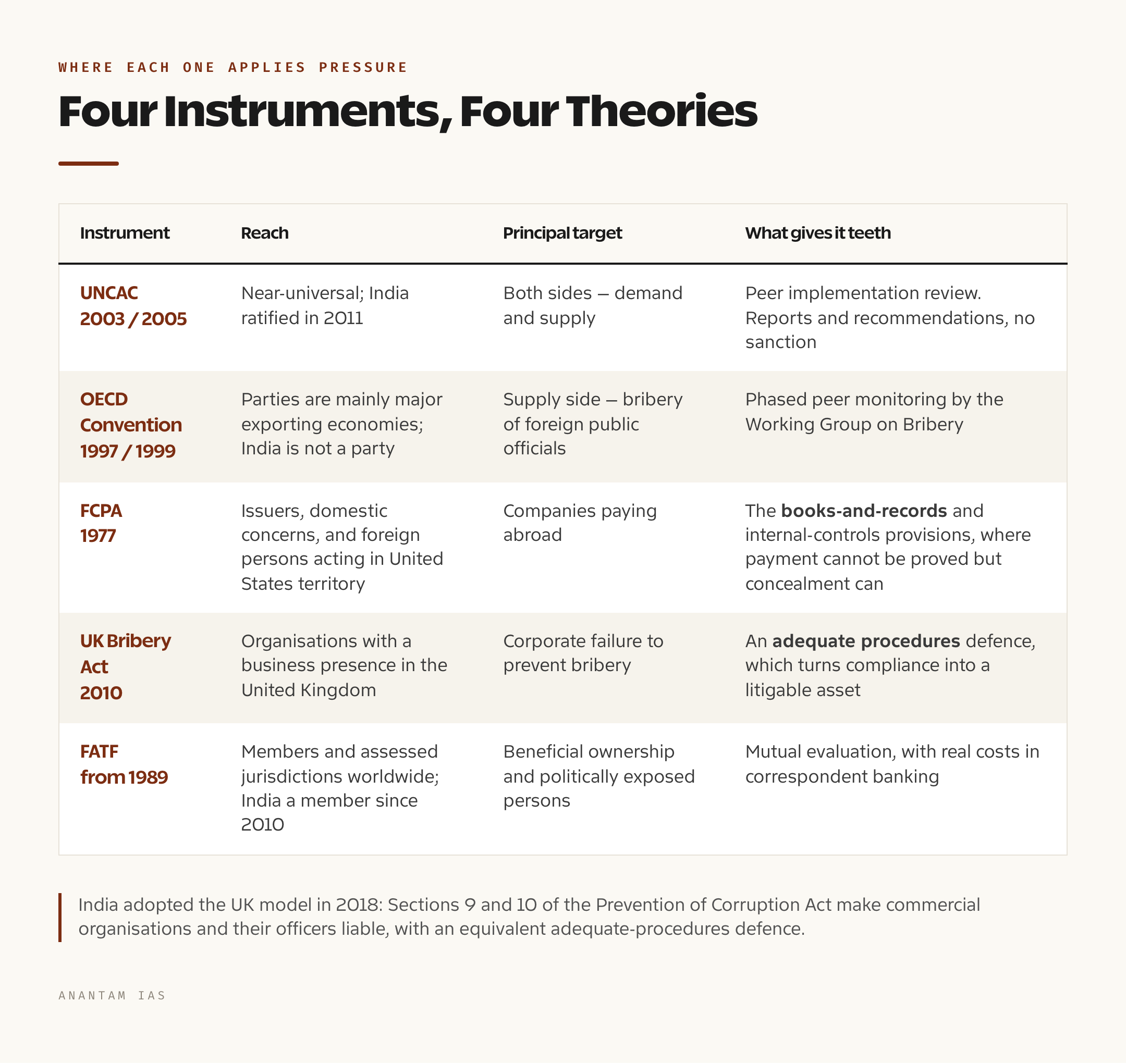
The United Nations Convention against Corruption was adopted by the General Assembly in 2003, opened for signature at Mérida in December that year, and entered into force in December 2005. India ratified it in 2011, which is the immediate reason several of India’s later statutory changes took the shape they did. It is the only anti-corruption instrument with near-universal membership, and its significance is that it treats corruption as a single phenomenon with prevention, punishment, cooperation and recovery as parts of one problem.
Prevention. Preventive policies, an anti-corruption body, merit-based recruitment and codes of conduct for public officials, transparent procurement and public financial management, public reporting, and measures for the private sector including accounting standards. The convention’s preventive chapter is the part most often ignored in summaries and the part that most closely resembles ordinary administrative reform.
Criminalisation and law enforcement. Bribery of national and foreign public officials, embezzlement, trading in influence, abuse of function, illicit enrichment, private-sector bribery, laundering of proceeds and obstruction of justice. Some obligations are mandatory and others are to be considered, which is why implementation varies.
International cooperation. Mutual legal assistance, extradition, joint investigations, and the removal of bank secrecy as a ground for refusing assistance. This is the operative chapter for a country trying to trace money that has left.
Asset recovery. Chapter V, which the convention itself describes as a fundamental principle — the first treaty to say so. It provides for direct recovery of property, confiscation through international cooperation, and return of confiscated property, with proceeds of embezzled public funds to be returned to the requesting State.
Compliance is reviewed through a peer Implementation Review Mechanism agreed by the Conference of the States Parties, in which each country is assessed by two others against the convention’s chapters. It produces reports and recommendations. It has no sanction.
Supply-Side Instruments: The OECD Convention and the FCPA
UNCAC addresses both sides of the transaction. Three other instruments deliberately concentrate on the payer, on the theory that companies from a small number of exporting economies pay a large share of transnational bribes and are easier to reach than officials in the countries where the bribes land.
The OECD Convention on Combating Bribery of Foreign Public Officials in International Business Transactions, adopted in 1997 and in force from 1999, obliges parties to criminalise the bribery of foreign public officials and submits them to phased peer monitoring by the Working Group on Bribery. India is not a party to it, which matters as Indian firms bid abroad.
The Foreign Corrupt Practices Act, 1977 of the United States is the oldest of these. Its reach comes less from the anti-bribery provision than from the books-and-records and internal-controls provisions, which allow enforcement where a payment cannot be proved but its concealment can. Its jurisdiction extends to issuers listed in the United States, domestic concerns, and foreign persons acting within United States territory, which is why the Act shapes the compliance behaviour of companies with no American operations to speak of.
The UK Bribery Act and What “Adequate Procedures” Does
The Bribery Act, 2010 of the United Kingdom is the most instructive for India. Alongside the offences of bribing, being bribed and bribing a foreign public official, it creates a corporate offence of failure to prevent bribery by an associated person, with a defence that the organisation had adequate procedures in place. Guidance built that defence out into six principles — proportionate procedures, top-level commitment, risk assessment, due diligence, communication and training, and monitoring and review. India adopted the same architecture in 2018 when Sections 9 and 10 of the Prevention of Corruption Act made commercial organisations and their officers liable with an equivalent adequate-procedures defence.
The effect of a defence of this kind is worth stating plainly, because it is the mechanism by which extraterritorial law changes behaviour. It converts compliance from a moral preference into a litigable asset. A firm that has run a documented risk assessment and trained its agents has something to plead; a firm that has not, does not. That is a stronger driver of corporate conduct than exhortation has ever been.
Anonymous Ownership Is the Load-Bearing Element
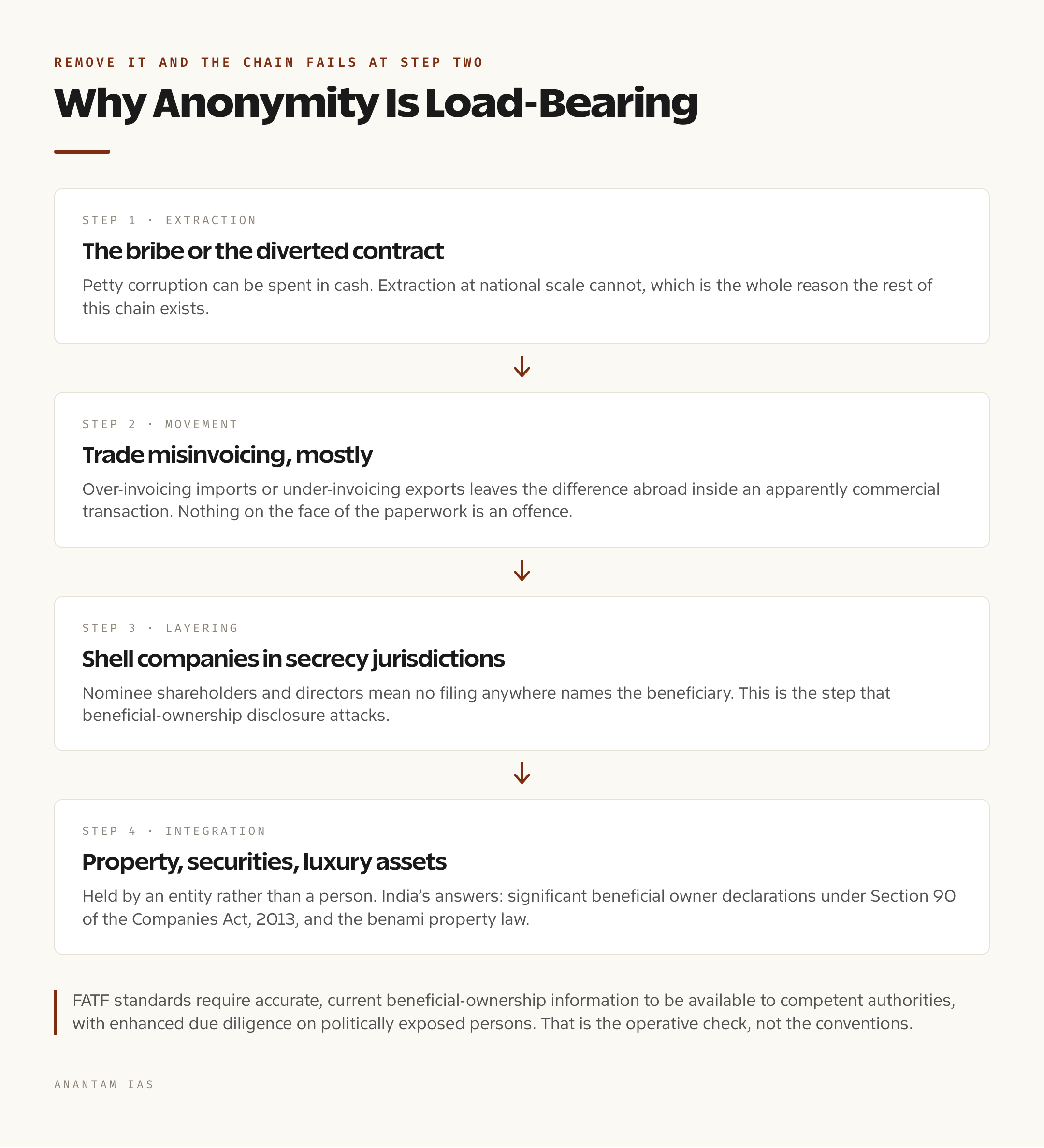
Grand corruption has a requirement that petty corruption does not: somewhere to put the money. A district official can spend a bribe in cash. A person extracting sums at national scale cannot, and the entire apparatus of shell companies, nominee directors and secrecy jurisdictions exists to solve that problem.
The chain has a standard shape. Value is moved out of the country, often by trade misinvoicing — over-invoicing imports or under-invoicing exports so that the difference accumulates abroad in an apparently commercial transaction. It is then layered through companies in jurisdictions that do not require disclosure of the natural person behind the entity, using nominee shareholders and directors so that no filing anywhere names the beneficiary. It is finally integrated into visible assets — property, listed securities, luxury goods — held by an entity rather than a person.
Remove anonymity and the chain fails at the second step, which is why beneficial-ownership transparency has become the central preventive project of the last two decades. The Financial Action Task Force, established in 1989, sets the standards: its recommendations require countries to ensure that accurate and current information on the beneficial ownership of companies and trusts is available to competent authorities, and to apply enhanced due diligence to politically exposed persons. Compliance is assessed through mutual evaluation by other members, and the consequences are real in a way UNCAC review is not — a jurisdiction placed under increased monitoring finds its banks facing higher correspondent-banking costs. India has been a member since 2010.
India’s own regime runs through company law. Section 89 of the Companies Act, 2013 requires a registered holder who is not the beneficial owner to declare the fact, and Section 90 creates the concept of the significant beneficial owner — broadly, an individual who, acting alone or together with others, holds not less than ten per cent of shares, voting rights or the right to a share of distributable dividend, or who exercises significant influence or control, whether directly or indirectly. Declarations are filed with the company, the company files with the registrar, and a register is maintained. Anti-money-laundering rules impose a parallel obligation on banks and other reporting entities to identify the beneficial owner behind an account. The domestic analogue on the asset side is the Prohibition of Benami Property Transactions Act, 1988, substantially strengthened in 2016, which targets exactly the arrangement in which the holder of record is not the owner in substance.
Debarment, Disclosure and the Preventive Layer
Three further pieces complete the picture, and each carries a cost worth naming.
Debarment and blacklisting are the sharpest sanctions available to a procuring authority, because exclusion from public contracts can be more damaging than a fine. Multilateral development banks operate their own sanctions systems, and a cross-debarment arrangement among the major banks means exclusion by one is recognised by the others. The difficulty is due process. Blacklisting is imposed administratively, often on the basis of an internal finding, and its consequences extend to employees who did nothing. Indian courts settled the principle early — in Erusian Equipment and Chemicals v. State of West Bengal (1975) the Supreme Court held that blacklisting without notice and an opportunity to be heard offends Article 14 — and later decisions have insisted that the period of debarment be proportionate rather than indefinite. A sanction with severe economic effect and no fixed evidentiary standard is a standing temptation to use it against the inconvenient rather than the corrupt.
Whistleblower channels matter in procurement more than anywhere else, because the person who knows the specification was rigged is usually a losing bidder or a junior officer on the file. India’s arrangement for public-sector disclosures runs through the Central Vigilance Commission under a 2004 resolution, while the statute passed in 2014 remains substantially unimplemented — the position set out in whistleblowing in India.
E-procurement and publication are the least glamorous and probably the most effective preventive measures. Publishing tenders on a common portal, requiring electronic submission above stated thresholds under the General Financial Rules, running reverse auctions where the item is standardised, and publishing award details all reduce the number of points at which a human being can be approached. The gain is not moral improvement. It is the removal of discretion from places where discretion was never necessary — the design principle the second ARC applied across its recommendations in the Second ARC on ethics in governance.
The Honest Assessment
The architecture described above is impressive on paper and thin in results, and an answer that says so is stronger than one that recites the pillars.
Integrity pacts depend on the monitor. Where the monitor is independent, informed and willing to embarrass the buyer, the pact works. Where the monitor is a retired official appointed by the entity being monitored, the pact is a formality that raises the paperwork cost of a rigged tender without changing the outcome. The instrument is also structurally weak against buyer-side manipulation, which is the more common form.
Asset recovery has underperformed its own billing. UNCAC calls return of assets a fundamental principle, and the widely cited estimate of funds lost to bribery and embezzlement in developing countries runs to tens of billions of dollars a year, against which documented returns over the whole period since the convention came into force are a small fraction. Both figures should be treated as estimates rather than measurements: the outflow is inferred, and returns are recorded inconsistently. What can be said is that the direction of the gap is not in dispute, and that recovery fails for reasons the convention cannot fix — the requesting State often cannot produce a conviction the holding State will act on, and the legal costs of tracing fall on the poorer party.
Measurement itself is contested. The most-quoted indicator of corruption is a composite of expert and business assessments — a measure of perception, which responds to news coverage and to political change as much as to conduct, and which cannot distinguish a country that has become cleaner from one that has become quieter. Experience-based surveys asking people whether they actually paid a bribe measure something narrower and more real, and they capture only the petty end. The construction and limits of the standard index are set out in the Corruption Perceptions Index.
None of this argues for abandoning the architecture. It argues for locating the parts that bite — extraterritorial corporate liability with a documented-procedures defence, beneficial-ownership disclosure backed by mutual evaluation, and the removal of discretion through publication — and being candid that peer review without sanction and conventions without recovery are aspiration rather than enforcement.
FAQ
What is an integrity pact? A written agreement executed at the start of a procurement between the procuring authority and all bidders, under which bidders undertake not to pay bribes or collude and the authority undertakes that officials will not demand them, enforced through contractual sanctions and independent external monitors.
Why does an integrity pact work better than a code of conduct? Because it binds every competitor simultaneously. A firm that refuses to pay a bribe alone loses the contract, so unilateral virtue is punished; a rule that constrains all bidders at once removes that disadvantage and gives each of them a reason to report the others.
What are the pillars of UNCAC? Prevention, criminalisation and law enforcement, international cooperation, and asset recovery, supported by chapters on technical assistance and implementation. The convention describes the return of assets as a fundamental principle.
When did India ratify UNCAC? India signed the convention in 2005 and ratified it in 2011. Several later statutory changes, including the 2018 amendments to the Prevention of Corruption Act, reflect obligations under it.
What is a significant beneficial owner? Under Section 90 of the Companies Act, 2013 and the rules under it, an individual who alone or together with others holds not less than ten per cent of shares, voting rights or rights to distributable dividend in a company, or exercises significant influence or control, whether held directly or indirectly.
Why is beneficial ownership central to fighting grand corruption? Because large-scale corruption requires a way to hold wealth without being named as its owner. Anonymous companies in secrecy jurisdictions provide it, so requiring disclosure of the natural person behind an entity attacks the step on which the whole chain depends.
Practice Questions
Prelims MCQs
- The concept of the integrity pact in public procurement was developed by: (a) The World Bank (b) Transparency International (c) The Financial Action Task Force (d) The OECD Working Group on Bribery — Answer: (b) it was designed in the 1990s as a procurement-specific instrument binding the authority and all bidders simultaneously.
- Which of the following does the United Nations Convention against Corruption describe as a fundamental principle of the convention? (a) Criminalisation of illicit enrichment (b) Merit-based recruitment of officials (c) The return of assets (d) Protection of whistleblowers — Answer: (c) the asset-recovery chapter expressly states that return of assets is a fundamental principle, the first treaty provision of its kind.
- The corporate offence of failure to prevent bribery, with a defence of adequate procedures, is a feature of: (a) The FCPA, 1977 (b) The OECD Anti-Bribery Convention, 1997 (c) The UK Bribery Act, 2010 (d) The FATF Recommendations — Answer: (c) India adopted the same architecture in Sections 9 and 10 of the Prevention of Corruption Act through the 2018 amendment.
- Under the Companies Act, 2013, a significant beneficial owner is broadly an individual holding, directly or indirectly, not less than: (a) Five per cent (b) Ten per cent (c) Twenty-five per cent (d) Fifty-one per cent — Answer: (b) the threshold applies to shares, voting rights or the right to a share of distributable dividend, and also covers significant influence or control.
- Blacklisting of a contractor by a public authority without notice and hearing was held contrary to Article 14 in: (a) Erusian Equipment and Chemicals v. State of West Bengal (b) Vineet Narain v. Union of India (c) Subramanian Swamy v. Director, CBI (d) Neeraj Dutta v. State — Answer: (a) the 1975 decision established that the State cannot act arbitrarily in excluding a person from public contracting.
Mains Practice Questions
- “An integrity pact converts a collective-action problem into a contract.” Explain this claim and identify the conditions under which the instrument fails. (250 words)
- Examine the four pillars of UNCAC and assess why its asset-recovery provisions have delivered less than intended. (250 words)
- What does an “adequate procedures” defence do to corporate behaviour that criminal prohibition alone does not? (150 words)
- “Anonymous ownership is the load-bearing element of grand corruption.” Discuss with reference to beneficial-ownership disclosure and India’s legal framework. (250 words)
- Debarment is an effective sanction and a due-process hazard. Discuss how both can be true, and what safeguards follow. (150 words)