Intergenerational Equity and Climate Ethics: Our Duty to Future Generations (UPSC Ethics)
We did not inherit the Earth from our ancestors; we are borrowing it from our children. Intergenerational equity turns that idea into a moral and legal duty — to hand the planet on no worse than we found it. Here is the full picture: Edith Brown Weiss's three principles, the precautionary and public-trust doctrines, the hard ethical puzzles, and how to use it all in a UPSC GS4 answer.
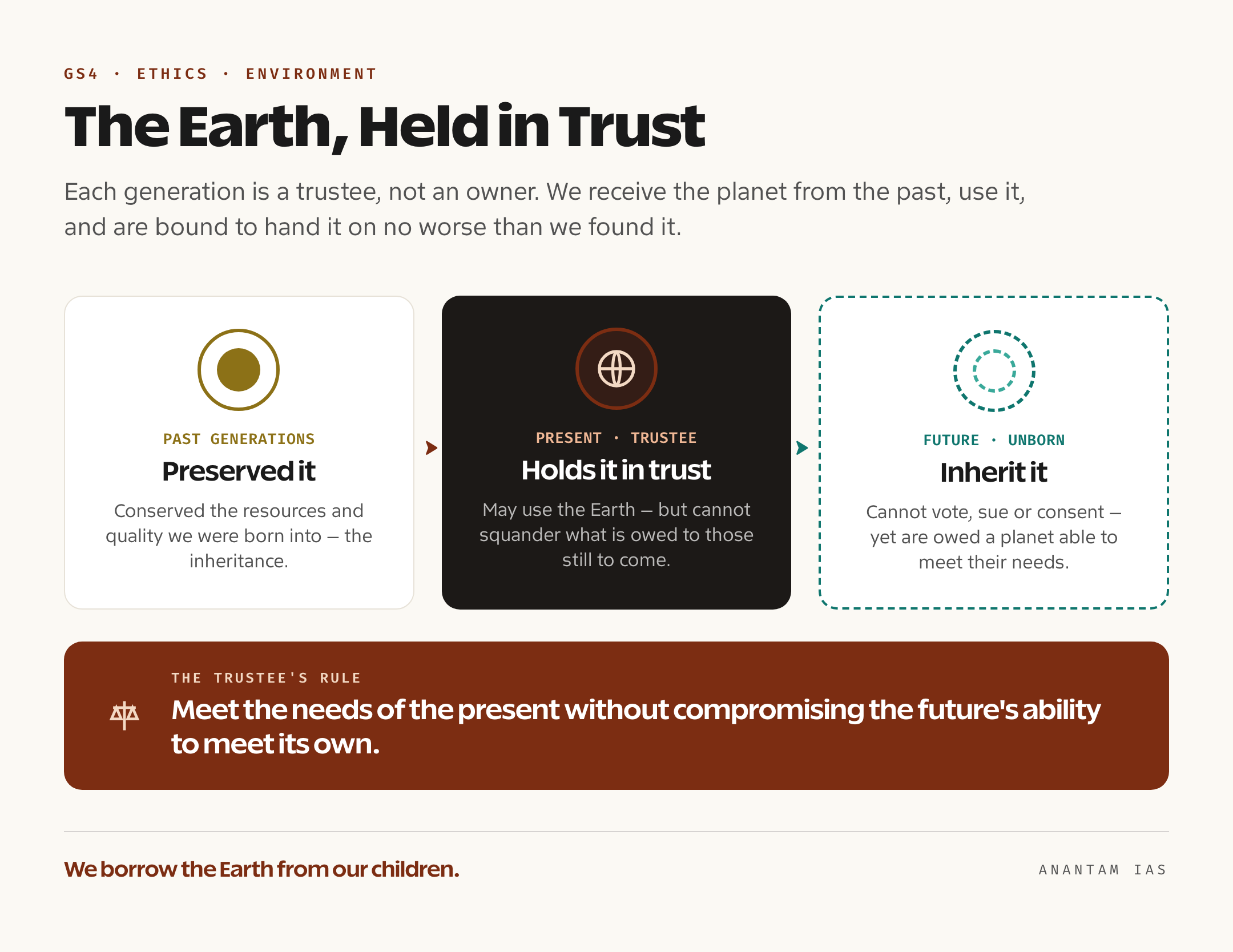
There is an old saying, often attributed to a Native American proverb, that runs through almost every speech on the environment: we did not inherit the Earth from our ancestors, we are borrowing it from our children. It sounds like a greeting-card sentiment until you take it literally. If the planet is borrowed, then it is not ours to spend. We are tenants, not owners — and a tenant who burns down the house before the next family moves in has done something more than careless. That single shift in framing, from owner to trustee, is the whole moral core of intergenerational equity: the principle that the present generation holds the Earth in trust for those who come after, and must not buy its own comfort by mortgaging their survival.
For a UPSC aspirant, this is not a soft, decorative idea. It is one of the sharpest tools in the GS4 ethics kit and a recurring theme across environment, governance and the Essay paper. Climate change has turned an abstract philosophical worry into a dated, measurable debt: every tonne of carbon we emit today narrows the choices of a child born in 2050. Courts on three continents are now hearing cases brought in the name of people who do not yet exist. And a candidate who can name the principle, trace its thinkers, and apply a clean ethical framework to it will stand out from the crowd that simply writes “we must save the environment for our children.” This page builds that toolkit from the ground up.
What Intergenerational Equity Means and Where It Comes From
Strip away the jargon and intergenerational equity says one thing: fairness across time. The word equity here means fairness, and intergenerational means between generations — so the principle asks whether it is fair for one generation to enjoy the planet’s bounty while leaving the next a depleted, polluted, destabilised version of it. The answer it gives is no. Each generation, on this view, is at once a beneficiary of what earlier generations preserved and a trustee for those still to come. We receive the Earth, use it, and are obliged to pass it on in no worse condition than we found it.
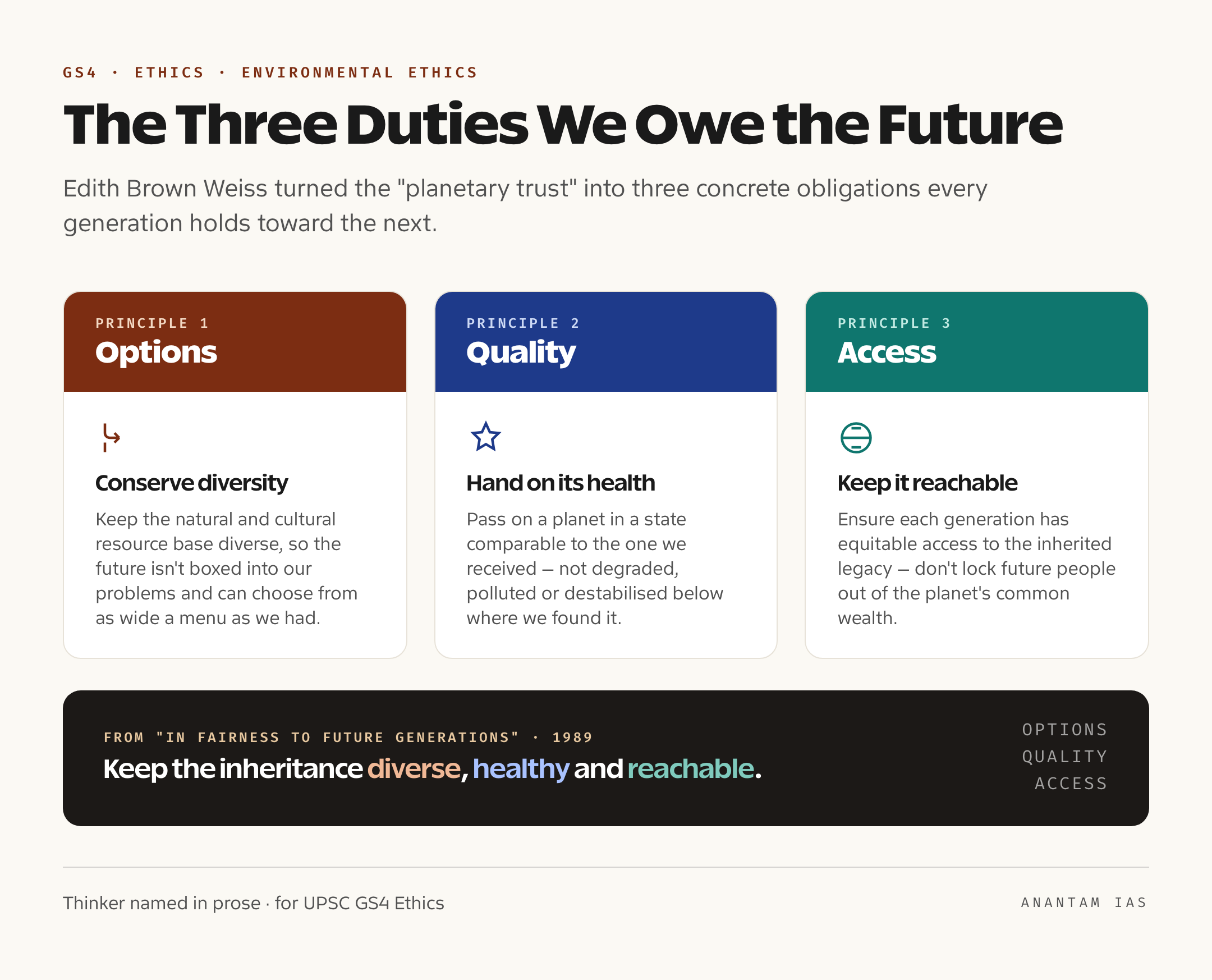
The clearest articulation of this comes from the American international lawyer Edith Brown Weiss, whose 1989 book In Fairness to Future Generations turned a vague intuition into a working doctrine. Her metaphor was the “planetary trust.” Just as a trustee manages property for a beneficiary and cannot squander it, the living generation manages the planet’s natural and cultural inheritance for generations unborn. From this she drew three duties that every generation owes the next, and they are worth memorising as a set because they map cleanly onto any answer. The first is conservation of options — preserving the diversity of the natural and cultural resource base, so that future people are not boxed into our problems and can solve theirs with as wide a menu of choices as we had. The second is conservation of quality — handing on a planet in a state of health comparable to the one we received, not a degraded one. The third is conservation of access — ensuring that the members of each generation have reasonable and equitable access to the legacy of the past, and that we do not lock future people out of it. Options, quality, access: keep the inheritance diverse, keep it healthy, keep it reachable.
Brown Weiss did not invent the instinct; she gave it a structure. The same idea echoes through the Brundtland Commission’s landmark 1987 report, Our Common Future, which defined sustainable development in a sentence almost everyone in this field can recite: development that meets the needs of the present without compromising the ability of future generations to meet their own needs. That definition is intergenerational equity in disguise — the words “future generations” sit right in the middle of it. And the instinct is far older still. The Iroquois Confederacy is said to have judged its decisions by their effect seven generations ahead. Gandhi captured it for India when he observed, in his own words, that Nature produces enough for everyone’s need but not for everyone’s greed — a moral economics of restraint that treats the Earth’s capacity as a shared, inherited limit rather than a private resource to be raced through.
The Legal and Ethical Scaffolding: Trust, Precaution and Sustainable Development
A principle becomes powerful when it stops being a sentiment and starts shaping rules. Intergenerational equity rests on three load-bearing ideas that turn it from poetry into policy, and an examiner rewards a candidate who can name all three.
The first is the public-trust doctrine. Its logic is ancient — Roman law held that some things, like the air, running water, the sea and the shores, are by their nature common to all and cannot be owned by anyone. Modern environmental law revived it to say that the State does not own a nation’s rivers, forests and coasts outright; it holds them in trust for the public, present and future, and cannot hand them over to private exploitation that betrays that trust. India’s Supreme Court adopted the doctrine squarely in M.C. Mehta v. Kamal Nath in 1996, when it struck down a lease of fragile riverbank forest on the Beas to a private motel, holding that the State as trustee had committed a “patent breach of public trust.” That case yoked the public-trust idea directly to intergenerational equity: the resources held in trust are held for generations yet to come, not just today’s voters. The second pillar is the precautionary principle — the rule that where an activity threatens serious or irreversible harm, the absence of full scientific certainty must not be used as a reason to postpone action. It exists precisely because the victims of environmental harm are often in the future, unable to sue, unable to vote, unable to wait for proof; precaution shifts the benefit of the doubt toward them. The third is sustainable development itself, which the Indian Supreme Court, in Vellore Citizens Welfare Forum v. Union of India in 1996, declared part of the law of the land and built out of several salient principles — including intergenerational equity, the precautionary principle and the polluter-pays rule. So the principle is not floating free; it is stitched into India’s environmental jurisprudence.
Underneath the law sit genuinely hard ethical questions, and GS4 is the paper that wants you to wrestle with them rather than wave them away. The deepest is this: what exactly do we owe people who do not yet exist, and who may never exist at all? You cannot harm a person who is not born; they have no present claims, cannot consent, cannot bargain. The British philosopher Derek Parfit sharpened this into what he called the non-identity problem. Our choices today — whether we burn fossil fuels or not — change not only the world future people inherit but which future people are even born, because different policies alter who marries whom, who is conceived when. So a child born into a damaged world cannot complain that our pollution made her worse off, because under cleaner policies that particular child would never have existed at all. It is a genuine philosophical knot, and Parfit’s own answer is the one to carry into an exam: the wrong of wrecking the planet is not a wrong against specific named individuals but against whoever will live there — a duty owed to future humanity as such, not to a list of plaintiffs. Tied to this is the ethics of discounting. Economists routinely “discount” future costs, treating harm a century from now as worth a fraction of the same harm today; at a normal discount rate, preventing a million dollars of climate damage two centuries from now might be judged worth less than nine dollars today. Parfit argued, and many ethicists agree, that discounting the very well-being of future people — as opposed to discounting money — is morally indefensible on its face. A child’s suffering in 2120 is not worth less than a child’s suffering in 2026 simply because it is far away in time.
Climate Change as the Ultimate Test of Fairness Across Time
If intergenerational equity were only about a depleted fishery or a felled forest, it would be a niche concern. Climate change makes it the moral question of the age, because greenhouse gases do something almost uniquely cruel across time: carbon dioxide released today lingers in the atmosphere for centuries, so the warming we cause is paid for largely by people not yet born, while the benefits — cheap energy, growth, convenience — are banked by us. It is a near-perfect engine of intergenerational injustice: present gains, future bills, and the future cannot send back a complaint.
Climate ethics adds a second axis of unfairness that an answer must hold alongside the first. There is justice between generations — what we owe the future — and there is justice between nations — what the rich, high-emitting world owes the poor, low-emitting world that suffers first and worst. The two interact. A poor child born in a low-lying delta inherits both a hotter planet and fewer resources to adapt to it, carrying a double disadvantage she did nothing to create. This is why the climate negotiations enshrine the principle of “common but differentiated responsibilities” — the recognition that all nations share the duty to act, but those who filled the atmosphere first and gained most must carry more of the load. Intergenerational equity and climate justice are not rival ideas; they are the time axis and the space axis of the same fairness.
What makes this newly concrete is that the future has begun to win in court. In March 2021, the German Federal Constitutional Court delivered a ruling that should be in every aspirant’s notebook. In Neubauer v. Germany, young plaintiffs argued that the country’s climate law, by setting soft near-term targets, would dump the harsh burden of emission cuts onto their adult lives — in effect spending the generation’s whole carbon budget now and leaving them the bill. The Court agreed, and in striking the law down it said something landmark: one generation must not be allowed to consume large portions of the carbon budget while bearing a relatively minor share of the effort, if that means leaving future generations a radical reduction burden and an existence of severe loss of freedom. It treated the freedom of unborn Germans as constitutionally protected today. Around the world a wave of youth-led cases echoes this logic, from the Juliana litigation in the United States to suits across Latin America and Asia, all built on the same claim — that a stable climate is part of the inheritance the young and the unborn are owed.
Turning the Principle into Institutions: Guardians for the Unborn
A duty no one is responsible for enforcing tends to evaporate, and the central design problem of intergenerational equity is brutally simple: future generations cannot vote, lobby, donate or protest. Every pressure in a democracy points toward the present — toward voters who are alive now, election cycles measured in years, and budgets that reward visible spending over invisible prevention. So the practical question is how to give the voiceless a voice inside institutions built for the living.
The boldest answer so far comes from Wales. Its Well-being of Future Generations (Wales) Act 2015 made it a legal duty for around forty-four public bodies to pursue seven long-term well-being goals and to weigh the long-term impact of their decisions, not just the next-quarter return. Crucially, it created the world’s first Future Generations Commissioner — an independent guardian whose entire job is to act as an advocate for people not yet born, scrutinising government policy through their eyes and challenging short-termism wherever it appears. It is, in effect, an ombudsman for the future, an institutional answer to the question of who speaks for those who cannot speak. Other proposals circle the same idea: parliamentary committees for future generations, “guardians” with the power to flag laws that mortgage the long term, and constitutional clauses obliging the State to protect the environment for posterity. India already has a thread of this in its Constitution — Article 48A directs the State to protect and improve the environment, and Article 51A(g) makes it a fundamental duty of every citizen to do the same, language the courts have repeatedly read as carrying an intergenerational charge.
India’s most visible contribution to the everyday side of this is Mission LiFE — Lifestyle for Environment — which Prime Minister Modi launched on the global stage and which reframes the climate duty as a matter of individual and collective restraint rather than only big-ticket policy. Its premise is that sustainable consumption — the “need not greed” ethic in modern dress — is itself a way of conserving options and quality for the next generation, by changing demand from the bottom up before it has to be changed by force from the top down. Whether nudging billions of small choices can move the needle is a fair debate, and a good answer notes the limits. But as an expression of the ethic — that ordinary citizens, not just governments and courts, are trustees of the future — it is squarely in the tradition this article describes.
For Your Mains Answer
This topic is a gift for GS Paper 4 (Ethics, Integrity and Aptitude), where it slots into environmental ethics, the discussion of human values, and any case study or quote about sustainability, the environment or our duty to the future. It also serves GS Paper 3 (environment, climate change, sustainable development) and is a rich seam for the Essay paper on themes of responsibility, the future, and fairness. The examiner’s reward goes to the candidate who treats it as an ethical question — naming thinkers and principles — rather than a general environmental one.
How to Build the Answer
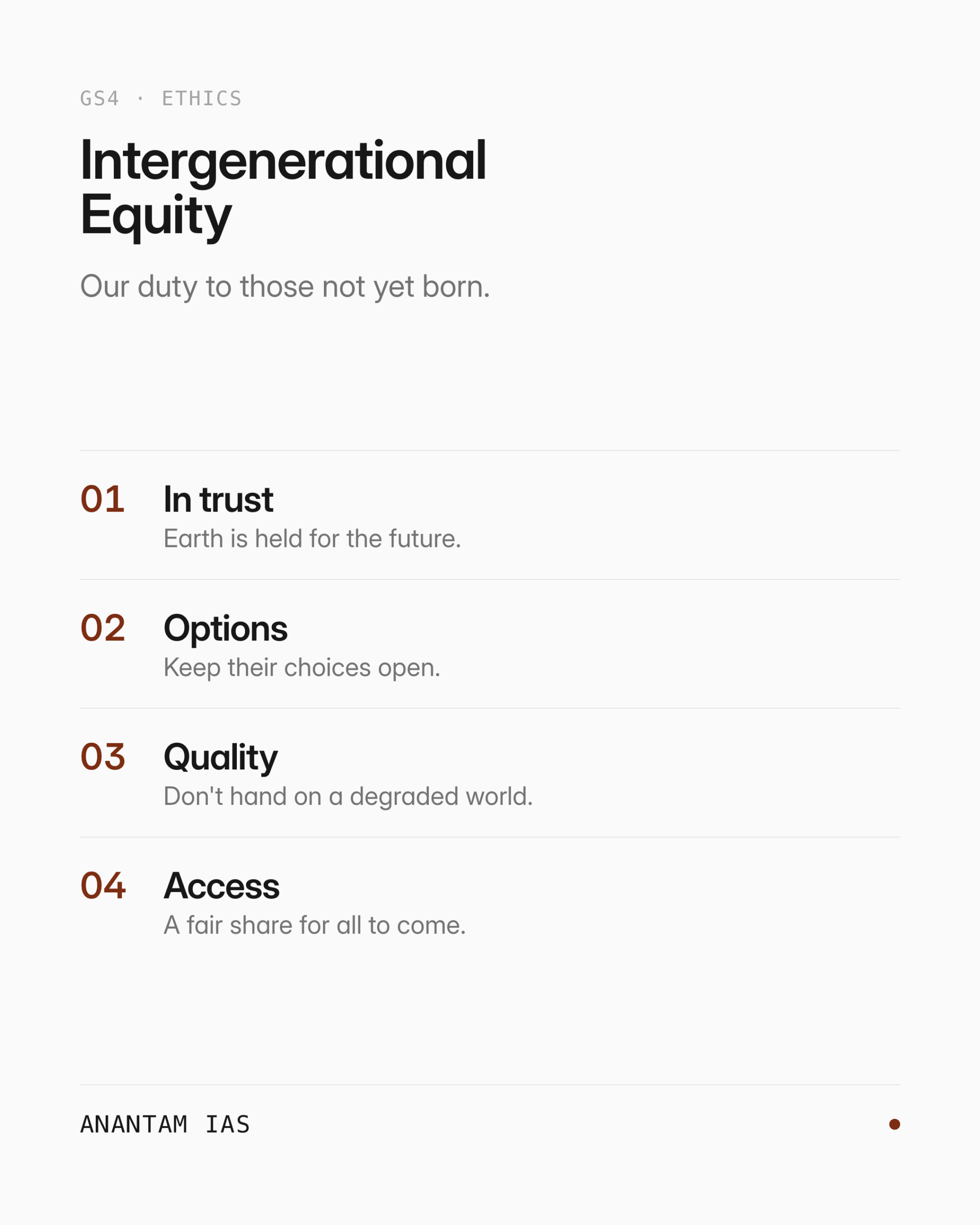
Move from principle to application. Open by defining intergenerational equity as fairness across time and the trustee idea — we hold the Earth in trust, to be handed on no worse than received. Bring in Edith Brown Weiss’s three duties (options, quality, access) and anchor it in the Brundtland definition of sustainable development. Then show the scaffolding: the public-trust doctrine, the precautionary principle, and Indian jurisprudence (M.C. Mehta, Vellore Citizens). Acknowledge the hard ethics — Parfit’s non-identity problem and the wrongness of discounting future well-being — to show depth. Apply it to climate change as the supreme test, with Neubauer v. Germany as the live example, and close with the institutional fix (Wales’ Future Generations Commissioner) and India’s own threads (Articles 48A and 51A(g), Mission LiFE).
Common Mistakes to Avoid
Don’t reduce it to “save the environment for our children” — that is the answer everyone writes. Name the principle and at least one thinker. Don’t confuse intergenerational equity (fairness across time) with intragenerational equity (fairness within the present generation, rich versus poor) — strong answers distinguish the two and then link them. Don’t ignore the genuine philosophical difficulty of owing duties to the non-existent; acknowledging it and resolving it (duty to future humanity as such) earns marks. And don’t present it as purely Western — Gandhi’s “need not greed,” the seven-generations idea, and Indian constitutional duty all give it deep roots here.
A Compact Answer Spine
Intergenerational equity = fairness across time → we are trustees, not owners, of a planetary inheritance (Edith Brown Weiss: conserve options, quality, access) → echoed in Brundtland’s sustainable-development definition and Gandhi’s “need not greed” → legal scaffolding: public-trust doctrine (M.C. Mehta v. Kamal Nath), precautionary principle, sustainable development (Vellore Citizens) → hard ethics: Parfit’s non-identity problem, the injustice of discounting future well-being → climate change is the ultimate test (present gains, future bills) and links to climate justice between nations → courts now enforce it (Neubauer v. Germany, youth climate cases) → institutional answer: a guardian for the future (Wales’ Future Generations Commissioner; India’s Articles 48A, 51A(g); Mission LiFE) → verdict: a binding moral and increasingly legal duty, not a slogan.
Diagram or Flowchart Idea
Draw a horizontal arrow of time with three figures — past, present, future — and the Earth being passed from hand to hand, with the present figure labelled “trustee.” Beneath it, list Brown Weiss’s three duties as a small column (options, quality, access). A clean trustee-and-inheritance sketch communicates the whole ethic in one glance and is fast to draw.
A Balanced-Conclusion Line
A line that lands the marks: “Intergenerational equity asks us to govern as ancestors, not just as citizens — to treat the unborn as silent stakeholders in today’s decisions, holding the Earth in trust so that those who inherit it may meet their needs as fully as we met ours.” For balance, add that the duty must be weighed against the present poor’s right to development — fairness across time cannot mean injustice within the present.
How to Use Data Without Cramming
You need anchors, not statistics: Edith Brown Weiss’s three principles (1989), the Brundtland definition (1987), Neubauer v. Germany (2021), the Wales Act (2015), and India’s M.C. Mehta and Vellore Citizens cases (1996). Drop these into the right sentences and the answer reads as informed. Attribute them plainly — “as Edith Brown Weiss argued” — rather than name-dropping without context.
Frequently Asked Questions
What is intergenerational equity in simple terms?
It is the principle of fairness across time — the idea that the present generation holds the Earth in trust for future generations and must not satisfy its own needs in a way that destroys their ability to meet theirs. We are trustees, not owners: we receive the planet from the past, use it, and are obliged to pass it on in no worse a state than we found it. The American lawyer Edith Brown Weiss captured this as the “planetary trust” and drew from it three duties — to conserve the diversity of resources (options), to maintain the planet’s quality, and to preserve equitable access to its legacy.
How is intergenerational equity linked to climate change?
Climate change is the sharpest test of the principle because greenhouse gases released today linger for centuries, so the warming we cause is paid for largely by people not yet born, while the benefits accrue to us — present gains, future bills. So it is, in effect, an engine of intergenerational injustice. It also overlaps with climate justice between nations, since poorer, low-emitting countries suffer first and worst. Courts have begun to enforce the link: in Neubauer v. Germany (2021) the German Constitutional Court struck down a climate law for unfairly loading the carbon-cutting burden onto future generations.
Why is it ethically hard to have duties to future generations?
Because the people we are talking about do not yet exist — they cannot consent, vote or sue, and our present choices even change which individuals will be born, a puzzle the philosopher Derek Parfit called the non-identity problem. A child born into a damaged world cannot say our pollution made her worse off, since under different policies that exact child would not exist. The usual resolution is that our duty is owed to future humanity as such — to whoever will live — rather than to a list of named individuals, and that discounting future people’s well-being (treating it as worth less than ours) is morally indefensible.
How does India express intergenerational equity?
Through its Constitution, its courts and its policy. Article 48A directs the State to protect and improve the environment, and Article 51A(g) makes environmental protection a fundamental duty of every citizen — both read by courts as carrying a duty to the future. The Supreme Court embedded intergenerational equity in environmental law through Vellore Citizens Welfare Forum (1996) and applied the public-trust doctrine in M.C. Mehta v. Kamal Nath (1996). Gandhi’s maxim that the Earth has enough for everyone’s need but not everyone’s greed expresses the same ethic, and Mission LiFE translates it into everyday sustainable consumption.
Practice Questions
Prelims MCQs
- The principle of intergenerational equity is most closely associated with which of the following thinkers and their work?
(a) Amartya Sen, Development as Freedom
(b) Edith Brown Weiss, In Fairness to Future Generations
(c) Garrett Hardin, The Tragedy of the Commons
(d) Rachel Carson, Silent Spring
Answer: (b) Edith Brown Weiss developed the “planetary trust” framework and the three principles of conservation of options, quality and access. - Edith Brown Weiss’s three principles of intergenerational equity are best described as the conservation of:
(a) land, water and air
(b) options, quality and access
(c) energy, forests and biodiversity
(d) capital, labour and resources
Answer: (b) The three duties are conservation of options (resource diversity), conservation of quality, and conservation of access to the planetary legacy. - With reference to the Brundtland Commission’s 1987 report Our Common Future, consider its definition of sustainable development. It defined sustainable development as development that:
(a) maximises present economic growth above all
(b) meets the needs of the present without compromising the ability of future generations to meet their own needs
(c) prioritises environmental protection over poverty reduction
(d) freezes resource use at current levels
Answer: (b) This widely cited definition embeds intergenerational equity at the heart of sustainable development. - The public-trust doctrine, as applied by the Indian Supreme Court, holds that:
(a) the State owns all natural resources absolutely and may dispose of them freely
(b) the State holds natural resources like rivers, forests and coasts in trust for the public, present and future
(c) only the judiciary may manage natural resources
(d) natural resources must be privatised for efficiency
Answer: (b) The doctrine was applied in M.C. Mehta v. Kamal Nath (1996), tying the State’s trusteeship to a duty toward future generations. - Neubauer v. Germany (2021) is significant in climate jurisprudence because the court held that:
(a) climate change is not a justiciable issue
(b) one generation must not consume most of the carbon budget and leave a radical reduction burden on future generations
(c) only the executive may set climate targets
(d) future generations have no constitutional standing
Answer: (b) The German Constitutional Court protected the freedom of future generations by requiring a fairer distribution of the carbon budget across time.
Mains Practice Questions
- “We do not inherit the Earth from our ancestors; we borrow it from our children.” Examine the ethical foundations of intergenerational equity and discuss its relevance to contemporary environmental governance. (15 marks, 250 words)
- Discuss Edith Brown Weiss’s three principles of intergenerational equity. How do the public-trust doctrine and the precautionary principle help translate this ethical idea into enforceable obligations? (15 marks, 250 words)
- Climate change has been called the ultimate test of fairness across time. Critically analyse the intergenerational dimension of climate ethics, and explain how it interacts with the demand for justice between rich and poor nations. (15 marks, 250 words)
- “Future generations cannot vote, yet democracies must answer to them.” Examine the institutional mechanisms — such as a commissioner or guardian for future generations — that can give the unborn a voice in present decision-making. (10 marks, 150 words)
- Evaluate India’s expression of intergenerational equity through its constitutional provisions, judicial pronouncements and policy initiatives such as Mission LiFE. To what extent does this ethic reconcile development with our duty to posterity? (15 marks, 250 words)