Kautilya: Arthashastra, Statecraft, Comparison with Plato and Machiavelli (UPSC GS IV)
Kautilya for UPSC GS IV — Arthashastra, role of state, statecraft and ethics, comparison with Plato and Machiavelli, and Indian governance applications.
Twenty-three centuries before modern political science was invented in Europe, an Indian thinker laid out a comprehensive theory of the state — its functions, its institutions, its taxation, its diplomacy, its intelligence services, and the ethical responsibilities of its ruler. That thinker was Kautilya (also called Chanakya, also called Vishnugupta), and his work is the Arthashastra. For the UPSC GS IV aspirant, Kautilya is the indispensable Indian counterpart to Western political philosophers — a thinker whose framework anticipates much of what later European thought would discover and whose practical insight remains startlingly contemporary.
This article works through Kautilya's life and times, his philosophical contributions, his major work, his comparison with Plato and Machiavelli, and his relevance to contemporary Indian governance.
Life and times
Kautilya is traditionally identified with the Brahmin scholar who, in the late fourth century BCE, played a decisive role in the founding of the Mauryan Empire. The traditional story has him discovering the young Chandragupta Maurya, training him, and helping him overthrow the Nanda dynasty to establish the empire that would eventually unify most of the Indian subcontinent.
Whether this exact biographical detail is accurate is debated by historians. What is uncontested is that the Arthashastra — whether composed by a single author or accumulated over generations — represents a sophisticated theory of statecraft from the period of the early Mauryan empire and its immediate aftermath. The text refers to itself as the work of Kautilya; the tradition treats Kautilya, Chanakya and Vishnugupta as the same person.
The setting matters. Kautilya wrote at a moment when north India was emerging from the small-republic, large-monarchy mosaic of the Mahajanapada period into the first great pan-Indian empire. The conditions invited theoretical reflection on what holds a large state together — and the Arthashastra responded.
Philosophical contributions
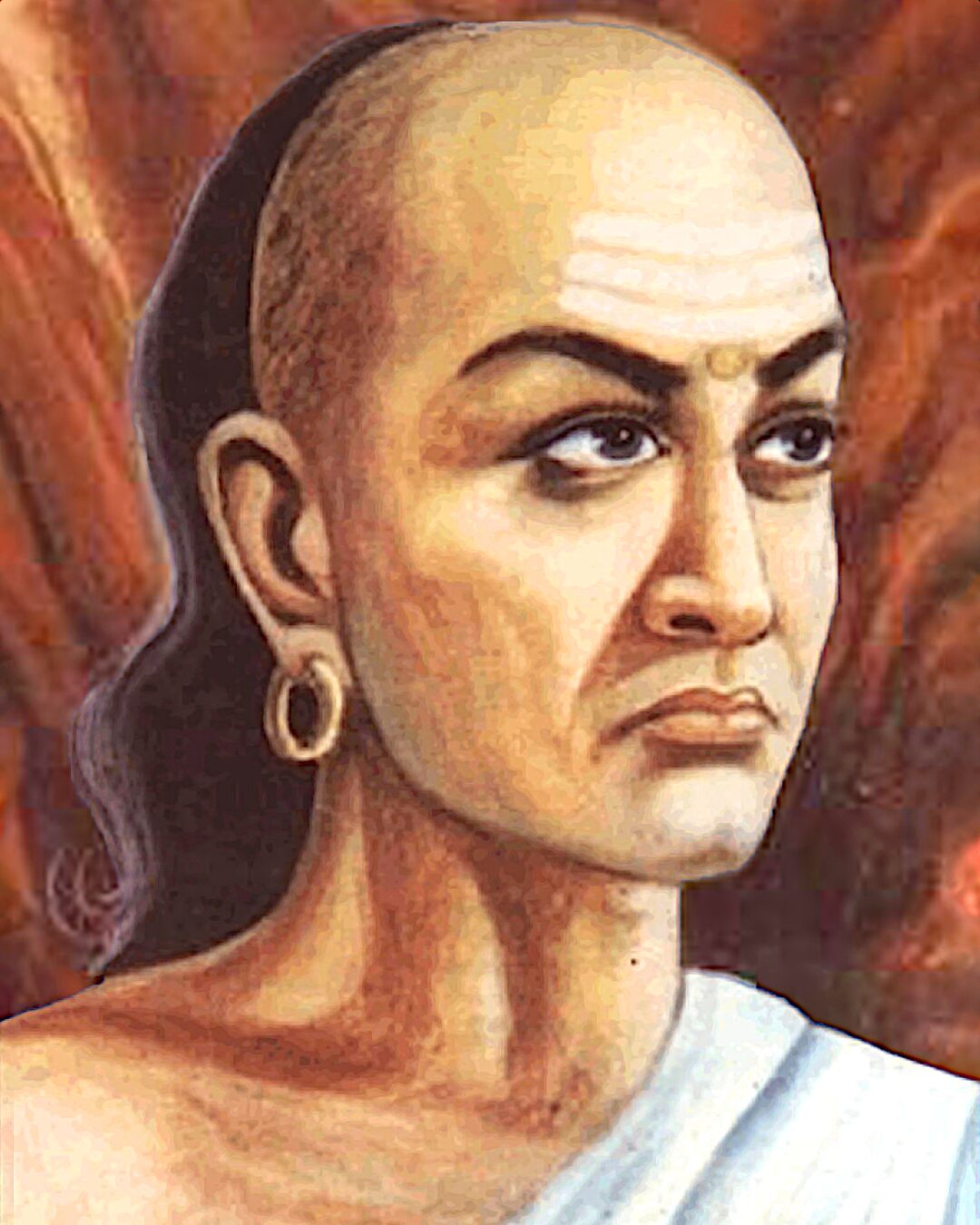
Kautilya's contributions span political philosophy, ethics, public administration, economic theory and military strategy. The most important for GS IV.
The role of the state
Kautilya identified four core functions of the state — functions that any government, ancient or modern, must perform.
- Protection — defence against external enemies and internal disorder.
- Maintaining the law — administration of justice, enforcement of contracts, punishment of wrongdoers.
- Preserving social order — sustaining the institutions and norms that hold society together.
- Promoting the welfare of people — yogakshema, the active responsibility of the state to citizens' material and moral well-being.
The fourth function is decisive. Kautilya did not see the state as merely a night-watchman; he saw it as actively responsible for the welfare of its subjects. Yogakshema — securing what people need (yoga) and protecting what they have (kshema) — is the foundational concept of the Kautilyan welfare state, anticipating by two thousand years the welfare-state thinking of modern social democracy.
The ethical king
Kautilya's king is bound by a strict ethical code. The famous formulation: In the happiness of his subjects lies the king's happiness; in their welfare his welfare. The king should not consider as good only that which pleases him but treat as beneficial to him whatever pleases his subjects.
This is not the Machiavellian prince who manipulates morality. The Kautilyan king is morally bound — to subjects, to dharma, to the long-term good of the state. His private appetites are subordinated to public duty. The sovereign is the servant of the people in a sense modern democratic theory would recognise.
Saptanga — the seven elements of the state
Kautilya's analysis of the state into seven essential elements (the saptanga theory) is foundational for Indian political thought.
| Element (Sanskrit) | English equivalent |
|---|---|
| Swami | The ruler |
| Amatya | The minister / civil servant |
| Janapada | The territory and people |
| Durga | Fortified capital / city |
| Kosha | Treasury / public finance |
| Danda | Force / coercive power |
| Mitra | Allies |
Each element has its own conditions of strength and weakness. A strong state requires all seven; weakness in any one degrades the whole. This is a structural-functional analysis of the state remarkably similar to what twentieth-century political science would call "state capacity."
Mandala theory of foreign policy
Kautilya's mandala (circle) theory holds that an immediate neighbour is a likely enemy, but the neighbour's neighbour is a likely friend. The state should cultivate distant allies to balance proximate adversaries. This is the conceptual ancestor of the modern theory of balance of power, and it has obvious applications in contemporary Indian foreign-policy thinking about the subcontinent and beyond.
Realism in international relations
Kautilya's account of statecraft is realist in the modern sense — he assumes states pursue their interests, that conflict is endemic, that morality applied to inter-state relations differs from morality applied to interpersonal life. The use of upayas (techniques) — sama (conciliation), dama (gifts), bheda (dissension), danda (force) — is presented matter-of-factly. This realism has been described as cold; defenders argue it is merely candid.
Key works
The principal text is the Arthashastra — a treatise of approximately 6,000 sutras (aphorisms) divided into 15 books covering kingship, administration, law, taxation, public works, foreign policy, military strategy, intelligence services, urban planning and much more. The work was lost for centuries and rediscovered in 1904 by R. Shamasastry, who translated it into English in 1915.
The Arthashastra is encyclopaedic. It addresses questions that modern public administration is still trying to systematise — how to design tax systems that are efficient and equitable, how to run an intelligence service without making it a threat to the state itself, how to balance discretionary administrative power with accountability.
Influence on ethical and political theory
Kautilya's influence has been continuous in the Indian tradition and is increasingly recognised in global political theory.
- Indian political tradition — the welfare-state ideal of yogakshema runs through Indian political thought, from the Asokan edicts to the Constitution's Directive Principles.
- Indian foreign policy — the mandala framework informs strategic thinking about the subcontinent.
- Public administration — the Arthashastra's institutional designs (regulated markets, audit systems, intelligence services) are studied as ancient precursors of modern administration.
- Comparative political theory — Kautilya is now standard reference in graduate political-theory programmes outside India.
Kautilya compared with Plato
| Ground of comparison | Kautilya | Plato |
|---|---|---|
| Social order | Favoured caste system as social organisation | Favoured slavery; rigid class structure |
| State | Welfare state and monarchy; held that democracy would result in anarchy | Welfare state and monarchy; held that democracy would result in anarchy |
| Ideal king | Virtuous, capable, well-trained | Virtuous philosopher-king |
| Favoured class | Brahmins | Aristocrats / philosophers |
| Orientation | Inclined to politics and statecraft | Pure philosopher with political theory |
| Method | Realism — empirical, practical | Idealism — abstract, theoretical |
| Core of state | Good governance | Common good |
The structural parallels are striking. Both were anti-democrats who believed virtuous rule by the few was preferable to popular rule. Both held the state responsible for citizen welfare. Both built rigid social hierarchies into their political theory. They differ most in method — Kautilya the practical adviser, Plato the abstract philosopher.
Kautilya compared with Machiavelli
| Ground of comparison | Kautilya | Machiavelli |
|---|---|---|
| Basis of thought | Indian myth, tradition, observation | Empiricism — close reading of Roman history and contemporary Italy |
| Imperialism | Supporter, in the form of imperial expansion | Supporter |
| Flexibility and treachery in war | Permitted, contextualised | Permitted, candidly endorsed |
| Secularism | Supporter — religion is one tool among many | Supporter — religion is a tool of governance |
| Approach | Utilitarian, realist | Utilitarian, realist |
| Differentiates morality of individual and state | Yes | Yes |
| Social order | Caste-based | Class-based |
The parallels are remarkable across two millennia. Both wrote handbooks for rulers. Both treated political ethics as distinct from interpersonal ethics. Both were realists about power. Both have been called cynical by critics and clear-eyed by defenders.
The crucial difference. Kautilya placed the king under a moral obligation to subject welfare. The Machiavellian prince has no such obligation — his standard of success is his own preservation in power. This makes Kautilya's realism a moral realism in a way Machiavelli's is not.
Two Indian case studies
Case study 1 — yogakshema and welfare-state policy
The Constitution's Directive Principles, the National Food Security Act, MGNREGA, public-distribution systems, universal-immunisation programmes — all express the Kautilyan principle that the state actively secures the welfare of its citizens. Reading contemporary welfare programmes through Kautilyan lens highlights the continuity of the Indian state-tradition.
Case study 2 — mandala thinking in subcontinental policy
India's strategic relationships — closer ties with Vietnam (a country to the east of an adversary), with Israel and Iran (despite their mutual hostility), with the broader Indian Ocean rim — reflect mandala-style thinking. The framework remains a working tool of Indian diplomacy.
Civil services application
Kautilya is more than historical curiosity. Direct applications.
- Welfare-state design. The yogakshema principle frames why welfare matters and how it should be conceived — not as charity but as state duty.
- Saptanga as state-capacity audit. Each of the seven elements maps onto a contemporary administrative function. A district's strength can be audited element-by-element.
- Anti-corruption and audit. Kautilya's elaborate systems of audit — testing officials with controlled situations, verifying accounts — anticipate modern integrity systems.
- Intelligence ethics. The Arthashastra's careful balancing of intelligence-service necessity with state integrity remains relevant to contemporary debates.
UPSC past-year question references
- 2018 GS IV: invocation of Indian thinkers in ethical reasoning.
- 2017 GS IV: ancient Indian wisdom as a resource for contemporary administration.
- GS Paper I: ancient Indian political thought; Mauryan administration.
- GS Paper II: comparison of Indian and Western political traditions.
Mains answer hook
Kautilya's Arthashastra, written around the fourth century BCE, lays out a comprehensive theory of the state that anticipates much of modern political science. The four functions of the state — protection, law, social order, and welfare (yogakshema) — define a thick, active state with strong moral obligations to its citizens. The saptanga theory analyses the state into seven essential elements; the mandala framework theorises foreign policy; the ethical code places the king under firm duty to subject welfare. Compared with Plato, Kautilya is the practical realist where Plato is the abstract idealist; compared with Machiavelli, Kautilya retains a moral foundation that Machiavelli abandons. For the contemporary Indian civil servant, Kautilya is not a museum exhibit but a working source of administrative thought.
Prelims pointers
- Kautilya / Chanakya / Vishnugupta — late fourth century BCE; Arthashastra.
- Arthashastra — 15 books; rediscovered 1904 by R. Shamasastry.
- Saptanga — seven elements of the state.
- Mandala theory — circle of states; foreign policy framework.
- Yogakshema — welfare obligation of the state.
- Four functions — protection, law, social order, welfare.
FAQ
Was Kautilya a real historical person?
The historicity of the figure named Kautilya / Chanakya is debated; some historians treat the Arthashastra as a multi-author compilation. What is not debated is the existence of the text and its profound influence.
Is Kautilya the Indian Machiavelli?
The comparison is useful but limited. Both wrote realist political handbooks. Kautilya, unlike Machiavelli, places the ruler under firm moral obligation to subject welfare.
What is yogakshema?
The compound concept of the state's duty to secure (yoga) and protect (kshema) the welfare of citizens. It is the conceptual ancestor of the welfare-state idea in Indian political thought.
Q. Does the Arthashastra approve of caste hierarchy? Yes — Kautilya operated within and endorsed varna-based social organisation. Modern readers must engage critically with this aspect of his thought, as one engages critically with Plato's defence of slavery.
Q. How is the Arthashastra relevant to modern public administration? Through its analysis of state functions, its institutional designs, its ethical framework for officials, and its theory of the welfare state — many of which remain working concepts in Indian administration.
Kautilya is not a relic. The themes he raised — what the state is for, what binds the ruler ethically, how to design administration that resists its own corruption, how to think about external relations realistically — are precisely the themes of contemporary public life. The civil servant who reads the Arthashastra finds, often to her surprise, a contemporary in a 2,300-year-old text.