Krishnadevaraya of Vijayanagara: The Tuluva King Who Built Hampi’s Golden Age
Krishnadevaraya of Vijayanagara (1509-1529) was the Tuluva dynasty's greatest ruler. His reign, campaigns, Hampi monuments, and Aamuktamalyada for UPSC.
Krishnadevaraya of Vijayanagara sits in the small group of Indian rulers who genuinely deserve the label “great.” He took a throne in 1509 that was hemmed in by Bahmani successor states, the Gajapatis of Orissa, and restless feudatories, and within a decade he turned the Vijayanagara Empire into the most powerful polity south of the Vindhyas. His twenty-year reign ended in 1529, but the temples, tanks, and Telugu verses he set in motion have outlasted every kingdom that competed with him.
For UPSC aspirants, Krishnadevaraya of Vijayanagara is one of those rare medieval figures who shows up in both Prelims (dynasty, battles, monuments) and Mains (administration, cultural synthesis, comparative greatness). The Tuluva dynasty produced several capable rulers, but Krishnadevaraya is the one whose name is engraved on the boulders at Hampi and on the colophons of the Telugu literary canon.
This piece walks through who he was, what he inherited, what he built, and why his court at Vijayanagara still anchors the way we read sixteenth-century peninsular India.
Quick Facts at a Glance
- Full name: Krishna Deva Raya (also spelled Krishnadevaraya)
- Dynasty: Tuluva (third ruling house of the Vijayanagara Empire)
- Reign: 1509 to 1529 CE
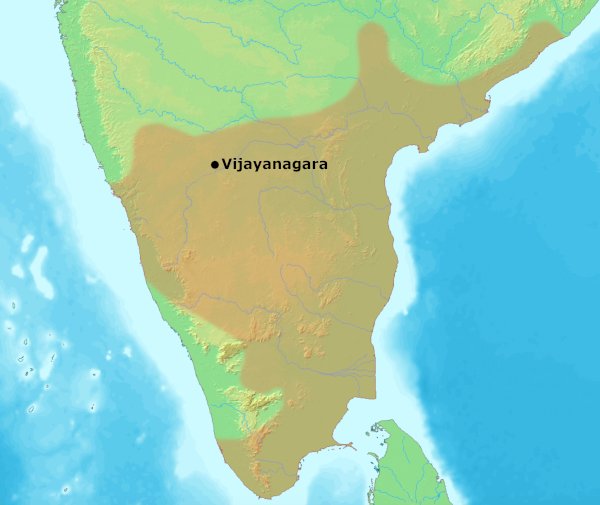
- Capital: Vijayanagara (modern Hampi, Karnataka, on the Tungabhadra River)
- Predecessor: Vira Narasimha Raya (half-brother)
- Successor: Achyuta Deva Raya
- Titles: Andhra Bhoja, Mooru Rayara Ganda, Yavanaraja Sthapanacharya, Karnatakaratnasimhasanadeeshwara
- Court language patronage: Telugu, Kannada, Sanskrit, Tamil
- Famous text authored: Aamuktamalyada (Telugu epic on Andal and Vishnuchitta)
- Key battle: Battle of Raichur, 1520, against the Adil Shahi of Bijapur
- Foreign visitors: Domingos Paes and Fernao Nuniz (Portuguese chroniclers)
Who Was Krishnadevaraya of Vijayanagara
Krishnadevaraya was the third ruler of the Tuluva dynasty, the line founded by Tuluva Narasa Nayaka after the collapse of the earlier Saluva house. He was the son of Tuluva Narasa Nayaka by his second wife Nagala Devi. His half-brother Vira Narasimha Raya took the throne first but died in 1509 after a short, troubled reign, and Krishnadevaraya was crowned on the festival of Krishna Janmashtami the same year, which was read by the court as an auspicious omen.
By contemporary accounts, including the Portuguese chronicler Domingos Paes who visited Vijayanagara around 1520, Krishnadevaraya was a striking, athletic ruler who personally led campaigns, sat through long administrative sessions, and patronized poets and architects on a scale rarely seen before. Paes described him as “the most feared and perfect king there could possibly be” and noted his open court, his daily exercise routine, and his attention to military detail.
Background and Historical Context
What Krishnadevaraya Inherited
By 1509 the Vijayanagara Empire was about 173 years old, founded in 1336 by Harihara I and Bukka I under the spiritual guidance of Vidyaranya. Three earlier dynasties (Sangama, Saluva, and the early Tuluvas) had ruled it. The empire’s reason for existence was clear from the start, to defend Hindu polity and revenue base south of the Krishna against the Bahmani sultanate to the north.
By the early sixteenth century the Bahmani sultanate had splintered into five Deccan states (Bijapur, Ahmadnagar, Golconda, Berar, and Bidar), often called the Deccan sultanates. The Gajapatis of Orissa controlled the eastern flank including parts of coastal Andhra. Internally, powerful Nayakas held provinces on long leashes. The fertile Raichur Doab between the Krishna and Tungabhadra rivers was the perennial flashpoint with Bijapur. This was the strategic map that Krishnadevaraya of Vijayanagara opened his reign on.
To understand the larger picture, see our background on the Vijayanagara Empire and the parallel northern situation under the Delhi Sultanate.
Military Campaigns
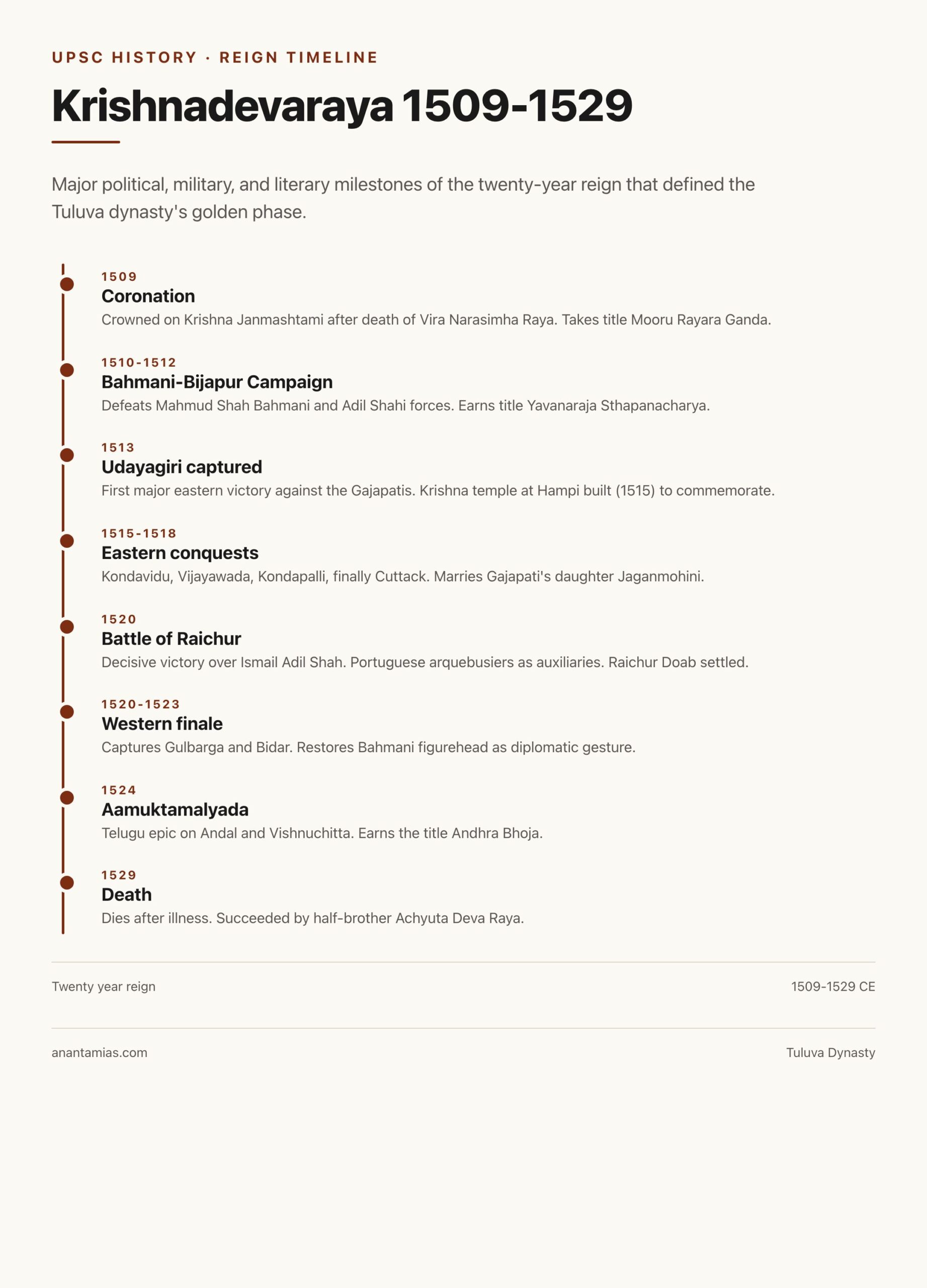
Krishnadevaraya fought a near-continuous sequence of wars across all four directions, and crucially he won almost every one of them.
- Campaigns against rebellious feudatories (1509-1512): First he disciplined the Ummattur chief Gangaraya in southern Karnataka, then secured the southern and western frontiers.
- Campaign against Bahmani and Bijapur (1510-1512): Defeated Mahmud Shah Bahmani and the Adil Shahi forces near Diwani; gained Raichur briefly and earned the title Yavanaraja Sthapanacharya (literally, the king who restores a Muslim ruler to his throne, since he later reinstated a defeated Bahmani figurehead as a diplomatic gesture).
- Eastern campaigns against the Gajapatis (1513-1518): A multi-year campaign through Udayagiri, Kondavidu, Vijayawada, Kondapalli and finally Cuttack. He captured Gajapati Prataparudra’s family at Kondavidu, took the strategic eastern Andhra forts, and concluded peace by marrying Prataparudra’s daughter Jaganmohini. Northern boundary of the empire pushed to the Krishna’s mouth at the Bay of Bengal.
- Battle of Raichur (1520): The decisive engagement against Ismail Adil Shah of Bijapur. Krishnadevaraya led roughly seven hundred thousand troops by contemporary chronicler counts, deployed Portuguese musketeers as auxiliaries, and captured Raichur after a hard-fought field battle. This was the single largest battle of his reign and effectively settled the Doab question for a generation.
- Final western campaign (1520-1523): Captured Gulbarga and Bidar; placed a Bahmani figurehead back on the Bidar throne. Did not annex these territories, preferring strategic suzerainty.
The pattern across all five theatres is the same. Krishnadevaraya of Vijayanagara fought offensive wars on his own terms, used cavalry, elephants and increasingly firearms, and almost always converted military victory into territorial gain or political leverage.
Administration and Statecraft
The Vijayanagara state under Krishnadevaraya was a layered military-revenue polity. At the apex sat the king, advised by a council of eight ministers (mantris) headed by the Pradhana Mantri. The realm was divided into provinces (rajyas) under viceroys, then into districts (nadus) and villages.
The Amaranayaka system was the empire’s defining feature. The Nayakas held assigned territories (amaram) in exchange for maintaining specified troop contingents and remitting a share of revenue. Krishnadevaraya tightened the system, demanded regular military musters, and built more direct ties between the throne and middle-tier commanders. He also strengthened the standing royal army with cavalry, war elephants, and the new arquebuses bought through the Portuguese at Goa.
Revenue was primarily land tax assessed on the kind of crop, soil and irrigation. Krishnadevaraya pushed irrigation investment, including the famous tank at Korragal and the canal from the Tungabhadra near the capital. Trade taxes, transit dues, and port revenues from the western coast (Bhatkal, Mangalore) and the eastern coast (Masulipatnam) added significant income. His Aamuktamalyada itself contains practical statecraft advice in chapter four, often called his “Rajaniti” testament.
Aamuktamalyada and the Literary Court
Krishnadevaraya was not only a patron of letters, he was a poet in his own right. His Telugu epic Aamuktamalyada, also called Vishnuchittiyam, narrates the story of the Tamil Alvar saint Andal and her foster father Vishnuchitta. The work belongs to the prabandha tradition and is considered one of the five great kavyas of Telugu literature. He also wrote the Sanskrit play Jambavati Kalyanam.
His court hosted the Ashtadiggajas, the eight literary “elephants of the directions” of Telugu letters. The most celebrated was Allasani Peddana, given the title Andhra Kavita Pitamaha (grandfather of Telugu poetry) and author of Manucharitra. Other Ashtadiggajas included Nandi Timmana, Madayyagari Mallana, Dhurjati, Ayyalaraju Ramabhadrudu, Pingali Surana, Ramaraja Bhushana, and Tenali Ramakrishna. The latter survives in popular memory as a witty courtier in Tenali Rama stories.
Kannada and Sanskrit literature also flourished. The Vaishnava acharyas, especially Vyasatirtha of the Madhva tradition, were close to the king and shaped court religious life.
Architecture and the Hampi Story
The capital city Vijayanagara, on the southern bank of the Tungabhadra, was the largest city in the world after Beijing in the early sixteenth century according to several modern reconstructions. Foreign visitors estimated its circumference at sixty miles or more, with markets, palaces, irrigation works and dozens of temple complexes.
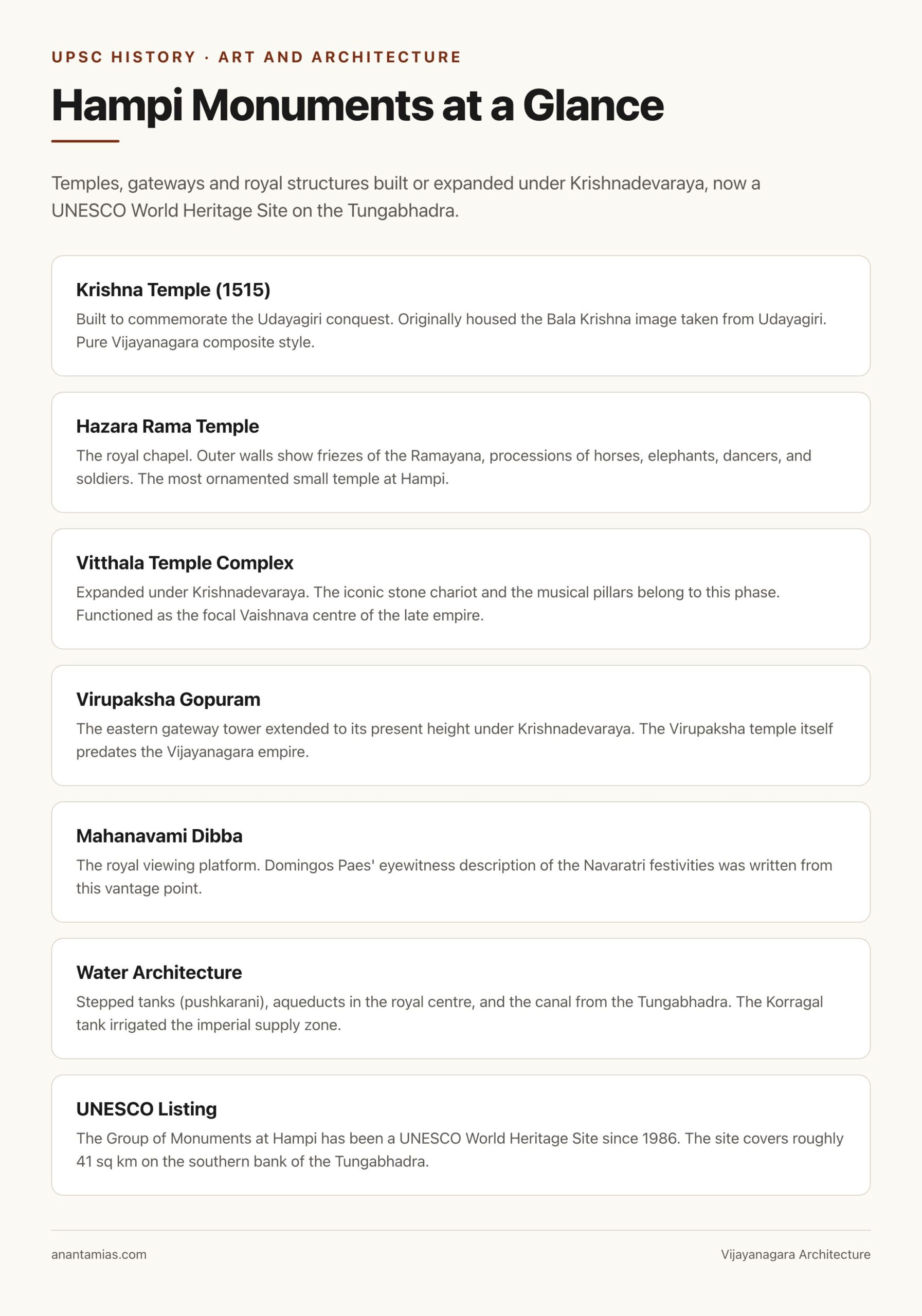
Krishnadevaraya either built or significantly extended several Hampi monuments that are now part of the UNESCO World Heritage Site:
- Krishna Temple (1515): Built to commemorate the conquest of Udayagiri, originally housed the image of Bala Krishna captured from there.
- Hazara Rama Temple: The royal chapel, decorated with intricate friezes of the Ramayana and processions of horses, elephants, dancers and soldiers.
- Vitthala Temple complex: Enlarged in his reign; the iconic stone chariot and the musical pillars belong to this phase though some elements were completed later.
- Virupaksha Temple gopuram: Extended the eastern gopuram to its present scale.
- Mahanavami Dibba additions: The royal viewing platform from where the Navaratri festivities, described by Paes in vivid detail, were watched by the king.
- Pushkarani and water systems: Stepped tanks and the aqueduct network in the royal centre.
For more context on the architectural traditions he drew on, see our explainer on temple architecture in India and the Chola dynasty which inspired several southern conventions.
Krishnadevaraya Compared to His Peers
Set Krishnadevaraya of Vijayanagara against his rough contemporaries and the scale of his achievement gets clearer.
| Ruler | Approximate reign | Region | Comparable note |
|---|---|---|---|
| Krishnadevaraya | 1509-1529 | Peninsular India | Peak of Vijayanagara; pan-southern hegemony |
| Babur | 1526-1530 (Delhi) | North India | Founded Mughal rule only in last three years of Krishnadevaraya’s life |
| Sikander Lodi | 1489-1517 | Delhi Sultanate | Last stable Lodi ruler |
| Ismail Adil Shah | 1510-1534 | Bijapur | Lost Raichur 1520 |
| Prataparudra Gajapati | 1497-1540 | Orissa | Lost coastal Andhra to Krishnadevaraya |
| Henry VIII | 1509-1547 | England | Exact contemporary; useful global anchor |
The point of the comparison is that Krishnadevaraya was not just locally important. He was the most consequential ruler of his decade anywhere in India, and arguably one of the three or four most powerful rulers in the world at the time.
Cultural Legacy
Krishnadevaraya’s reign left a cultural deposit that survived the empire itself. After his death in 1529 and the catastrophic defeat at Talikota in 1565, Vijayanagara as a state crumbled. But the temple architecture style he refined (with composite pillars and tall outer gopurams) was carried forward by the Nayaka successor states at Madurai, Tanjavur and Gingee. The Telugu literary norms set in his court remained canonical into the colonial period.
The image of Hampi today, that vast boulder-strewn city with its temples and bazaar streets, is largely the city he expanded and ruled. Modern Karnataka tourism, the UNESCO listing, and the standard secondary-school portrayal of Vijayanagara all flow from this twenty-year reign.
Prelims Pointers
- Tuluva is the third dynasty of Vijayanagara, after Sangama and Saluva. Krishnadevaraya is the third Tuluva ruler.
- He was crowned in 1509 and died in 1529.
- Aamuktamalyada is in Telugu, Jambavati Kalyanam is in Sanskrit.
- The Battle of Raichur was fought in 1520 against Ismail Adil Shah of Bijapur.
- The Ashtadiggajas were eight Telugu poets in his court, the foremost being Allasani Peddana.
- The Portuguese chroniclers who visited his court were Domingos Paes (around 1520) and Fernao Nuniz (around 1535, post-Krishnadevaraya but describes the reign).
- Krishnadevaraya married Jaganmohini, daughter of Gajapati Prataparudra, sealing the eastern peace.
- Hazara Rama temple was his royal chapel; the Krishna temple at Hampi commemorates Udayagiri.
Mains Practice Questions
- “Krishnadevaraya was as much a builder of culture as he was a builder of empire.” Discuss with reference to his administrative and literary contributions. (15 marks)
- Evaluate the strategic significance of the Battle of Raichur (1520) for the political balance of sixteenth-century Deccan. (10 marks)
- The Amaranayaka system under Krishnadevaraya combined military feudalism with revenue centralization. Examine this statement. (15 marks)
- Compare the temple architecture patronized by Krishnadevaraya with that of the Cholas. Highlight continuities and innovations. (10 marks)
Why Krishnadevaraya Still Matters
Krishnadevaraya of Vijayanagara is one of the few medieval rulers whose record can stand up to almost any modern test of greatness. He won wars, expanded revenue, secured frontiers, patronized multiple literary traditions, built or extended monuments that are now world heritage, and wrote a Telugu epic and a Sanskrit play in his spare time. That combination is rare in any century.
For UPSC, the reason he keeps reappearing is precisely this many-sidedness. He is the easiest single peg on which to hang sixteenth-century peninsular history, Telugu literary growth, post-Bahmani Deccan politics, and pre-Mughal southern administration. Knowing his reign well unlocks four or five different syllabus areas at once.
Frequently Asked Questions
Who was Krishnadevaraya of Vijayanagara?
Krishnadevaraya was the third ruler of the Tuluva dynasty of the Vijayanagara Empire and is widely regarded as its greatest king. He reigned from 1509 to 1529 CE from the capital Vijayanagara (modern Hampi).
Why is Krishnadevaraya called Andhra Bhoja?
The title Andhra Bhoja compares him to the eleventh-century Paramara king Bhoja of Dhara, who was famous for his patronage of letters. Krishnadevaraya earned the title because of his own Telugu and Sanskrit compositions and his patronage of poets like the Ashtadiggajas.
What is Aamuktamalyada?
Aamuktamalyada, also called Vishnuchittiyam, is a Telugu epic poem written by Krishnadevaraya himself. It narrates the story of the Tamil Vaishnava saint Andal and her foster father Vishnuchitta. The fourth canto contains his famous advice on kingship.
Who defeated Krishnadevaraya in any battle?
There is no record of a major defeat in his twenty-year reign. He won all his principal campaigns including Raichur (1520), the Gajapati wars, and the Bahmani-Bijapur campaigns. His military record is one of the most consistent for any medieval Indian ruler.
Who were the Ashtadiggajas in his court?
The Ashtadiggajas were eight celebrated Telugu poets at Krishnadevaraya’s court: Allasani Peddana, Nandi Timmana, Madayyagari Mallana, Dhurjati, Ayyalaraju Ramabhadrudu, Pingali Surana, Ramaraja Bhushana, and Tenali Ramakrishna.
Which Portuguese visitors described his court?
Domingos Paes visited Vijayanagara around 1520 and left a detailed eyewitness account. Fernao Nuniz visited slightly later, around 1535, and recorded the chronicle of the dynasty including the reign of Krishnadevaraya.
Which is the most famous temple built by Krishnadevaraya at Hampi?
The Krishna Temple, built in 1515 to commemorate his conquest of Udayagiri, is closely associated with him. He also commissioned the Hazara Rama temple as his royal chapel and significantly extended the Virupaksha gopuram and the Vitthala temple complex.
How did Krishnadevaraya die and who succeeded him?
Krishnadevaraya died in 1529, likely after an illness. He was succeeded by his half-brother Achyuta Deva Raya. His own designated heir, the young Tirumala, had died shortly before, reportedly by poisoning at the hands of a court official.
What was the Battle of Raichur and why is it important?
The Battle of Raichur in 1520 was the decisive engagement between Krishnadevaraya and Ismail Adil Shah of Bijapur over the fertile Raichur Doab. Krishnadevaraya’s victory, helped by Portuguese arquebusiers, gave Vijayanagara firm control of the contested zone and confirmed it as the dominant Deccan power.
Is Hampi the same as Vijayanagara?
Yes. Hampi is the modern name for the village and surrounding archaeological zone that sits on the ruins of the imperial city of Vijayanagara. The Hampi monuments are inscribed on the UNESCO World Heritage List as the Group of Monuments at Hampi.