Chola Dynasty: Administration, Art & Architecture
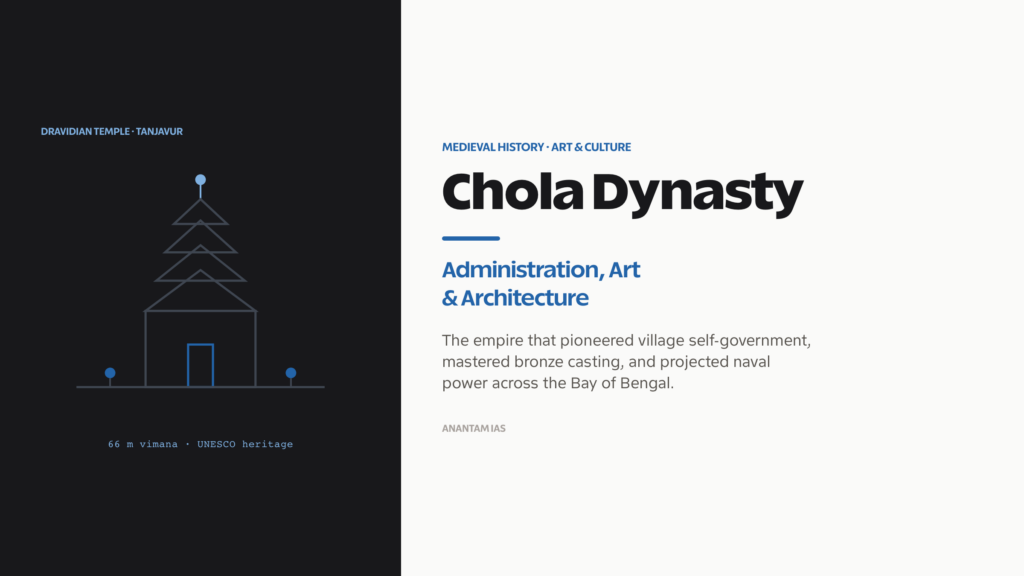
The medieval Chola dynasty — distinct from the early Cholas of the Sangam Age — was one of the most powerful and culturally sophisticated empires in Indian history. From the 9th to the 13th century CE, the Cholas dominated South India and sent their naval forces across the Bay of Bengal in one of the most ambitious maritime expeditions of the ancient world.
Their administrative system — particularly their self-governing village institutions — remains a model studied by historians of governance. Their temple architecture, culminating in the Brihadeshwara at Tanjavur, defined the Dravidian style for centuries. And the inscriptions they left behind are among the most detailed records of medieval Indian governance available anywhere.
For UPSC, the Cholas appear in Medieval History, Art and Culture, Polity (decentralisation/local government), and sometimes as a reference in governance essays. Know Rajaraja I, Rajendra I, the administrative system, the Brihadeshwara Temple, and the naval campaigns.
Origins and Revival: The Imperial Cholas
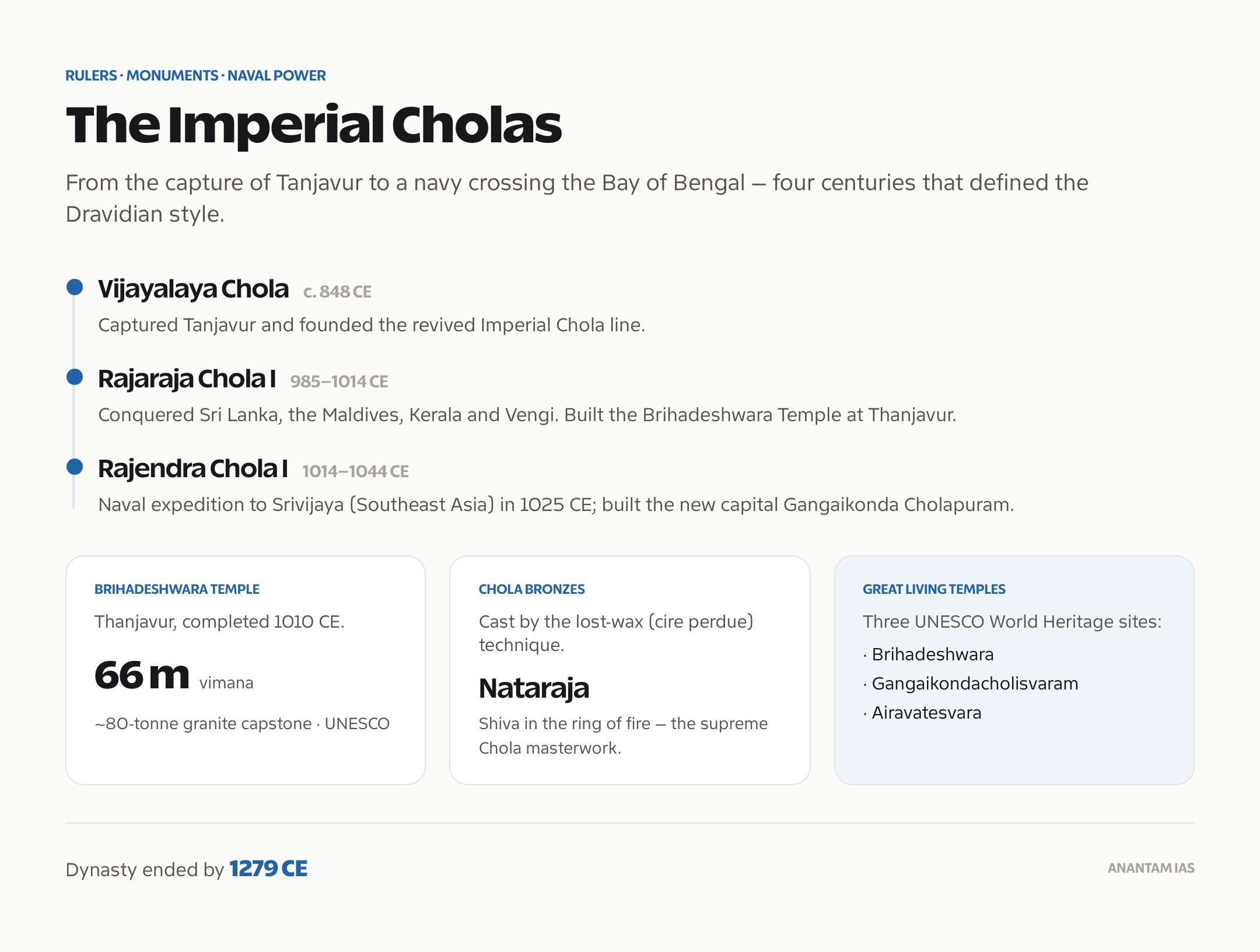
The early Cholas of the Sangam age (3rd century BCE to 3rd century CE) had declined. The Pallavas dominated the region for several centuries. The Imperial Chola dynasty emerged in the 9th century CE when Vijayalaya Chola (c. 848 CE) captured Tanjavur from the Muttaraiyars — subordinates of the Pallavas.
Key Imperial Chola Rulers
| Ruler | Reign | Major Achievement |
|---|---|---|
| Vijayalaya | c. 848–871 CE | Captured Tanjavur; founded Imperial Chola dynasty |
| Aditya I | 871–907 CE | Defeated Pallava Aparajita; Cholas become dominant |
| Parantaka I | 907–955 CE | Conquered Sri Lanka (temporarily); defeated Pandyas |
| Rajaraja I (the Great) | 985–1014 CE | Conquered Sri Lanka, Maldives; built Brihadeshwara Temple |
| Rajendra I (the Great) | 1014–1044 CE | Naval campaign to Southeast Asia; Gangaikonda Cholapuram |
| Kulottunga I | 1070–1120 CE | United Cholas and Eastern Chalukyas; long peaceful reign |
| Kulottunga III | 1178–1218 CE | Last major Chola ruler |
| Final decline | 13th century | Replaced by Pandyas |
Rajaraja Chola I (985–1014 CE)
Rajaraja I — who took the title Rajaraja (“king of kings”) — is the founder of the mature Chola imperial system. His reign combined extraordinary military achievement with administrative centralisation and architectural patronage that has no equal in South India.
Military Conquests
Rajaraja I conquered:
- Sri Lanka (northern Sri Lanka; established it as a Chola province under the name Mummudi Chola Mandalam)
- Maldives (Munnir islands)
- Kerala (much of the Chera kingdom)
- Vengi (eastern Deccan; through the Eastern Chalukya alliance)
- Gangavadi, Nulambapadi, Tadigaipadi — territories in present-day Karnataka and AP
He also destroyed the Kalabhra and Bana kingdoms and brought most of South India under direct or tributary Chola control.
The Brihadeshwara Temple (Thanjavur, 1010 CE)
The Brihadeshwara Temple at Thanjavur (also called Rajarajesvara or Peruvudaiyar Kovil) is Rajaraja I’s greatest legacy and the masterpiece of Dravidian temple architecture. It was completed in 1010 CE — marking the 25th year of his reign.
Architectural features:
- Vimana (tower over the sanctum): 66 metres tall — the tallest in India at the time of construction; the capstone (shikhara) at the top is a single granite block weighing approximately 80 tonnes
- Nandi mandapa: A monolithic Nandi (Shiva’s bull) about 6 metres long guards the entrance
- Corridor walls: Covered with paintings in two layers — Chola-era originals beneath Nayak-period overpainting; portions of the Chola originals have been uncovered
- Inscriptions: The walls contain 108 inscriptions — the famous Rajarajesvara inscriptions — recording donations of land, gold, jewellery, and temple servants. These are among the most important historical documents of medieval India.
- Devadasis: The temple employed 400 temple women (devadasis) — a significant institution of Chola cultural and religious life
UNESCO World Heritage Site — part of the “Great Living Chola Temples.”
Rajendra Chola I (1014–1044 CE)
Rajendra I was Rajaraja’s son and in many ways surpassed his father in the scale of his ambitions. He is one of the most remarkable rulers in Indian history — and almost entirely unknown outside specialist circles.
The Naval Expedition to Southeast Asia (1025 CE)
In 1025 CE, Rajendra I sent a massive naval expedition across the Bay of Bengal against the Srivijaya empire — a powerful maritime trading empire controlling the Malay Peninsula and the Strait of Malacca. The expedition targeted Kadaram (Kedah in present-day Malaysia) and ports along the Malayan and Sumatran coasts.
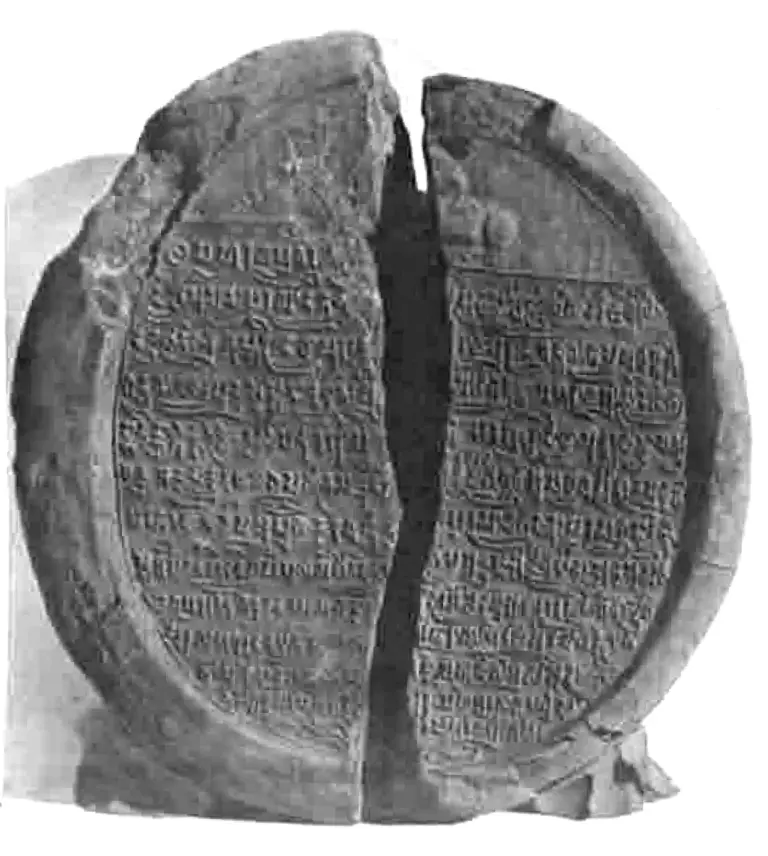
The Larger Leiden Plate grants list 14 ports captured — from Malay Peninsula to Sumatra. The expedition was not designed for permanent occupation but to break Srivijaya’s stranglehold on the trade route between India and China, opening direct access for Chola (and Indian) merchants.
This is one of very few examples of aggressive Indian naval power projection in ancient history — and it worked. Chola trade with Southeast Asia and China expanded dramatically. The Rajendra I naval expedition is regularly tested in UPSC as an example of medieval Indian maritime power.
Gangaikonda Cholapuram
Rajendra I celebrated his northern campaign — which reached the Ganges — by taking the title Gangaikonda Cholan (“the Chola who conquered the Ganga”) and building a new capital: Gangaikonda Cholapuram (literally “the city of the Chola who took the Ganga”).
He built a temple here — Gangaikondacholisvaram — that rivals the Brihadeshwara in its artistic sophistication, though it is slightly smaller. It contains some of the finest Chola bronze and stone sculpture. Like Thanjavur, it is a UNESCO World Heritage Site.
He also dug a large irrigation tank — Chola-Gangam — fed by waters brought from the Ganga by defeated kings in golden pots. The symbolic gesture made concrete the empire’s reach to the holy river.
The Chola Administrative System
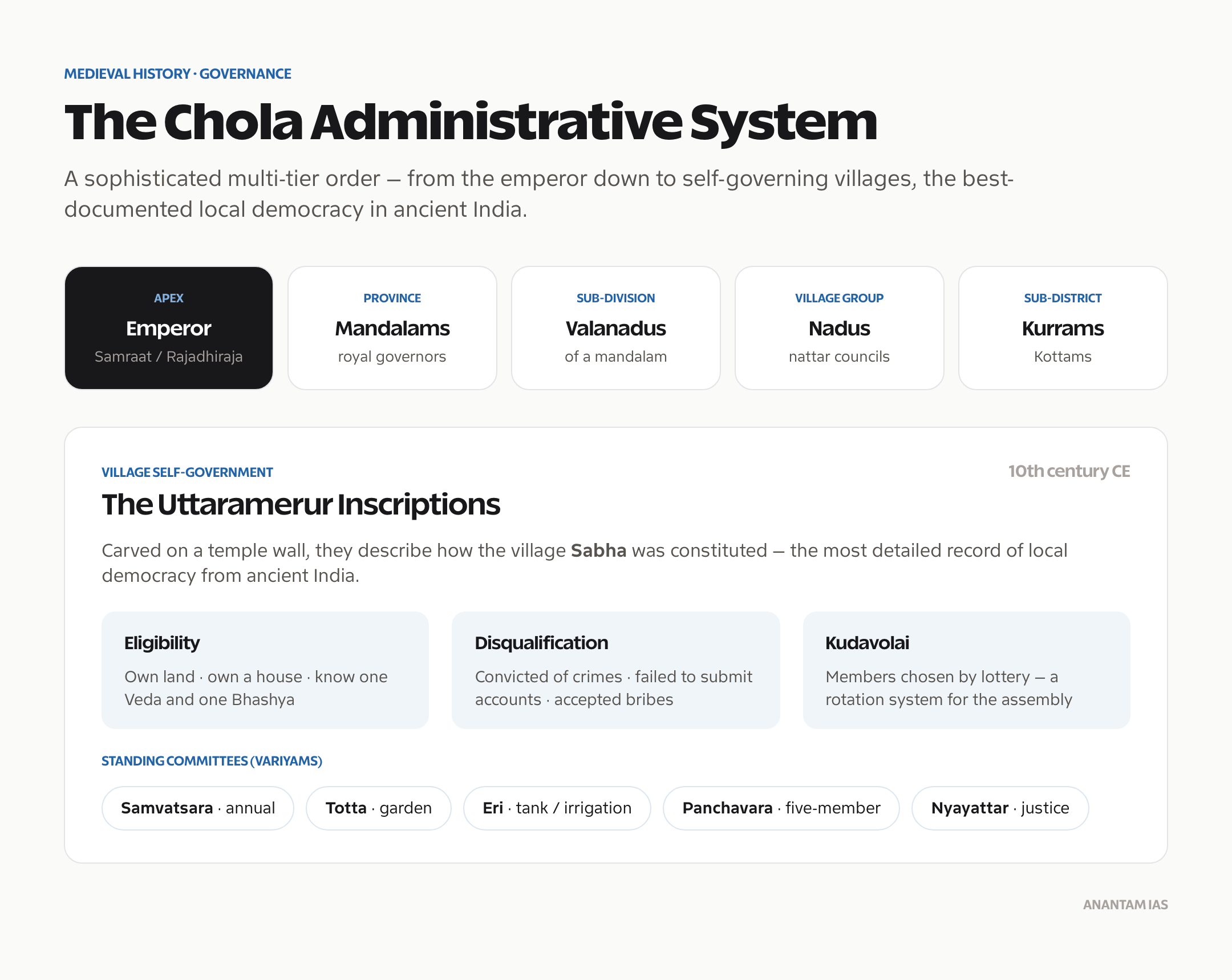
The Chola administrative system is one of the best-documented in ancient India — thanks primarily to the thousands of inscriptions left on temple walls across Tamil Nadu. It was a sophisticated multi-tier system with remarkable democratic elements at the village level.
Central Administration
- Emperor (Samraat or Rajadhiraja) at the apex
- Princes (Yuvarajas) served as governors of major provinces
- Central council of ministers (mantris/amaichyar)
- Revenue classified and recorded systematically — land surveys conducted under Rajaraja I are the first systematic revenue surveys in South India
Provincial Administration: Mandalams and Nadus
The empire was divided into:
- Mandalams (provinces) — each administered by a royally-appointed governor
- Valanadus — sub-divisions of mandalams
- Nadus — groups of villages; administered by local councils (nattar)
- Kurrams/Kottams — sub-district units
Village Administration: The Democratic Institutions
The most celebrated aspect of Chola administration is the self-governing village institutions. Three types of village assemblies are documented:
| Institution | Village Type | Composition | Functions |
|---|---|---|---|
| Ur | General village assembly | All adult male landholders | General village affairs, disputes, local order |
| Sabha (or Mahasabha) | Brahmin land-grant villages (Brahmadeya) | Adult male Brahmin landholders | Manage land, irrigation, temples, education |
| Nagaram | Merchant/trading town assembly | Merchants and traders | Commercial regulation, guild affairs |
The Uttaramerur inscriptions (Tamil Nadu, 10th century CE) — found on the walls of the Vaikuntaperumal Temple — give an extraordinarily detailed description of the Sabha’s functioning in a Brahmadeya village. They describe:
- Eligibility criteria for Sabha membership (must own land, have a house, know one Veda and one Bhashya)
- Disqualification criteria (those convicted of crimes, those who had not submitted accounts, those who had accepted bribes)
- Rotation system — members chosen by lottery (kudavolai system)
- Standing committees (variyams) with specific functions:
– Samvatsara Variyam — annual committee – Totta Variyam — garden/orchard committee – Eri Variyam — tank/irrigation committee – Panchavara Variyam — five-member general committee – Nyayattar/Justice committee
This is the best-documented ancient Indian example of local self-government — and is regularly cited as a precursor to modern local democracy.
Chola Art and Architecture
Temple Architecture
Chola temples define the Dravidian style of South Indian temple architecture. Key features:
- Vimana — the tall tower over the main shrine; in Chola temples, the vimana is the tallest structure (unlike later Vijayanagara temples where the gopuram — entrance tower — dominates)
- Mandapam — pillared hall in front of the shrine
- Prakaram — circumambulatory corridor around the shrine
- Gopuram — gateway tower; smaller than the vimana in Chola temples
- Garbhagriha — inner sanctum with the main deity
The Brihadeshwara (Thanjavur), Gangaikondacholisvaram (Gangaikonda Cholapuram), and Airavatesvara Temple (Darasuram) form the trio of Great Living Chola Temples — all UNESCO World Heritage Sites.
Chola Bronze Sculpture
The Chola period produced the finest bronze sculpture in Indian history. Using the lost-wax (cire perdue / mishram) casting technique — wax model covered in clay, then fired (wax melts out) and filled with molten metal — Chola craftsmen created bronzes of extraordinary naturalism and spiritual power.
The most famous: Nataraja — Shiva as the Lord of the Cosmic Dance (Tandava). The Chola Nataraja, with its ring of fire (prabhamandala), the four arms, the dwarf demon (Apasmara) crushed underfoot, the gesture of protection and liberation (abhaya and varada) — is both the greatest Indian bronze and one of humanity’s supreme artistic achievements.
Chola bronzes of Parvati, Ardhanarishvara, Vishnu, and the Alvars (Vaishnava saint-poets) are also masterworks.
Chola Naval Power and Trade
The Chola empire was the only major ancient Indian power to build and sustain a genuine naval military capability. Their navy:
- Controlled the Bay of Bengal trade routes
- Conducted the Southeast Asia expedition (1025 CE)
- Maintained Sri Lanka as a province for decades
- Enabled Chola merchants to dominate trade with China, Arabia, and Southeast Asia
The Malabar and Coromandel coast ports — particularly Nagapattinam (major port and Buddhist site) and Kaveripattinam — were key commercial nodes.
Chinese records mention Chola ambassadors visiting the Song Dynasty court. The Chola-China trade in silk, spices, and luxury goods was substantial.
The Chola Inscriptions
The Cholas left an extraordinary number of inscriptions — estimated at over 10,000. These are carved primarily on temple walls and copper plates (tamra patra). They record:
- Land grants and revenue assignments
- Temple endowments (land, gold, servants, lamps)
- Village Sabha proceedings and constitutions (Uttaramerur)
- Military campaigns and genealogies
The Leiden Plates (copper grants found in the Netherlands) record Rajendra I’s grant to a Buddhist institution in Nagapattinam — requested by a Sri Vijaya king and evidence of international diplomatic connections.
Decline of the Chola Dynasty
The Chola decline began in the late 12th century and accelerated in the 13th century. Causes:
- Pandya resurgence — the Pandyas of Madurai recovered and repeatedly invaded Chola territory from the south
- Hoysala pressure from the west (Karnataka)
- Telugu Choda and Kakatiya challenges in the north
- Internal succession disputes that weakened central authority
- Loss of Sri Lanka to Polonnaruwa Sinhalese kingdom
By 1279 CE, the Chola dynasty had ended, with the Pandyas becoming the dominant power in Tamil Nadu until the rise of Vijayanagara.
Frequently Asked Questions
Who were the greatest rulers of the Chola dynasty?
The two greatest Imperial Chola rulers were
Rajaraja Chola I (985–1014 CE), who built the Brihadeshwara Temple and conquered Sri Lanka and the Maldives, and Rajendra Chola I (1014–1044 CE), who launched a naval expedition to Southeast Asia, campaigned to the Ganga, and built Gangaikonda Cholapuram. Together they brought the Chola empire to its greatest extent.nnWhat is the significance of the Brihadeshwara Temple?
The Brihadeshwara Temple at Thanjavur, built by Rajaraja I (completed 1010 CE), is the masterpiece of Dravidian temple architecture. Its vimana stands 66 metres tall. The 108 inscriptions on its walls are a primary historical source for Chola governance. It is a UNESCO World Heritage Site, still an active place of worship, and houses some of the finest Chola paintings and sculpture.
What was the Chola village administration system?
The Chola village self-government system had three types of assemblies: the
Ur (general village assembly), the Sabha (assembly of Brahmin land-grant villages), and the Nagaram (merchant town assembly). The Sabha’s detailed procedures — eligibility criteria, rotation by lottery, standing committees for irrigation, gardens, and justice — are preserved in the Uttaramerur inscriptions, making it one of the best-documented examples of ancient local self-government.nnWhy did Rajendra Chola I send a naval expedition to Southeast Asia?
Rajendra I’s 1025 CE naval expedition targeted the Srivijaya empire, which controlled the Strait of Malacca and the sea route between India and China. By breaking Srivijaya’s stranglehold, the Cholas opened direct trade routes for Indian merchants. The expedition captured 14 ports along the Malay Peninsula and Sumatra. It is one of the few examples of aggressive Indian maritime power projection in ancient history.
What is Chola bronze sculpture known for?
Chola bronzes, created using the lost-wax casting technique, are considered the finest bronze sculptures in Indian art. The most famous is the
Tell Google you want more of this.
Add Anantam IAS as a preferred sourceOne tap, and this site shows up more often in your own Top Stories, AI Overviews and AI Mode. Remove it any time.