Lab-Grown Meat: Cultured Meat Production, Regulation, and the India Context
A complete UPSC GS-III explainer on lab-grown cultured meat. Covers the cellular agriculture process, scaffolds and bioreactors, the Singapore, US, and EU regulatory landscape, the climate and ethical case, and where India's CCMB and DBT efforts stand on cultivated meat.
Animal meat without animals is no longer a thought experiment. Singapore approved the first commercial cultured meat product in 2020. The United States Department of Agriculture cleared two American cultivated chicken makers for sale in 2023. Israel approved cultured beef in 2024. Tasting menus in Singapore, San Francisco, and Tel Aviv now serve cell-grown chicken nuggets and cultivated beef burgers as regulated food. The science is real, the regulatory pathways exist, and the production economics are converging towards parity with the most expensive cuts of conventional meat.
For UPSC GS-III, lab-grown meat sits at the intersection of biotechnology, food security, climate policy, and rural livelihoods. India is not yet in the regulatory cohort that has cleared cultivated meat, but the country has cellular agriculture research at CCMB Hyderabad, Centre for Cellular and Molecular Biology, the Department of Biotechnology, and a growing private startup ecosystem that is building production capability. The policy decisions India takes through 2026 to 2030 will shape whether the country participates in cultivated meat production or imports the technology.
This article walks through the science, the production process, the regulatory landscape across Singapore, the US, and the EU, the climate and ethical case for cultivated meat, the technical and economic challenges that remain, and where Indian research and policy stand.
What Lab-Grown Meat Is
Lab-grown meat is real animal meat produced by cultivating animal cells in a controlled laboratory or industrial bioreactor environment, instead of by raising and slaughtering animals. The product goes by several names. Cultured meat is the original term used in scientific literature. Cell-based meat is the term preferred by industry and the US Food and Drug Administration. Cultivated meat is the consumer-facing term that the Good Food Institute and most companies have settled on.
The product is biochemically identical to conventional meat at the cellular level. It is real muscle tissue, real fat tissue, real connective tissue, made from animal stem cells that grow and differentiate inside a bioreactor instead of inside an animal. It is not a plant-based meat substitute, which uses soy, pea, or wheat protein to mimic the texture and flavour of meat without any animal cells.
The conceptual line goes back to Winston Churchill’s 1931 essay that imagined growing chicken breasts and wings in vats. The first proof-of-concept lab-grown burger was produced by Dr Mark Post at Maastricht University in 2013, at a cost of around 325,000 US dollars. The cost has since fallen by four orders of magnitude. Singaporean and American products now sell at restaurant prices, though still not at supermarket parity with conventional meat.
The Production Process
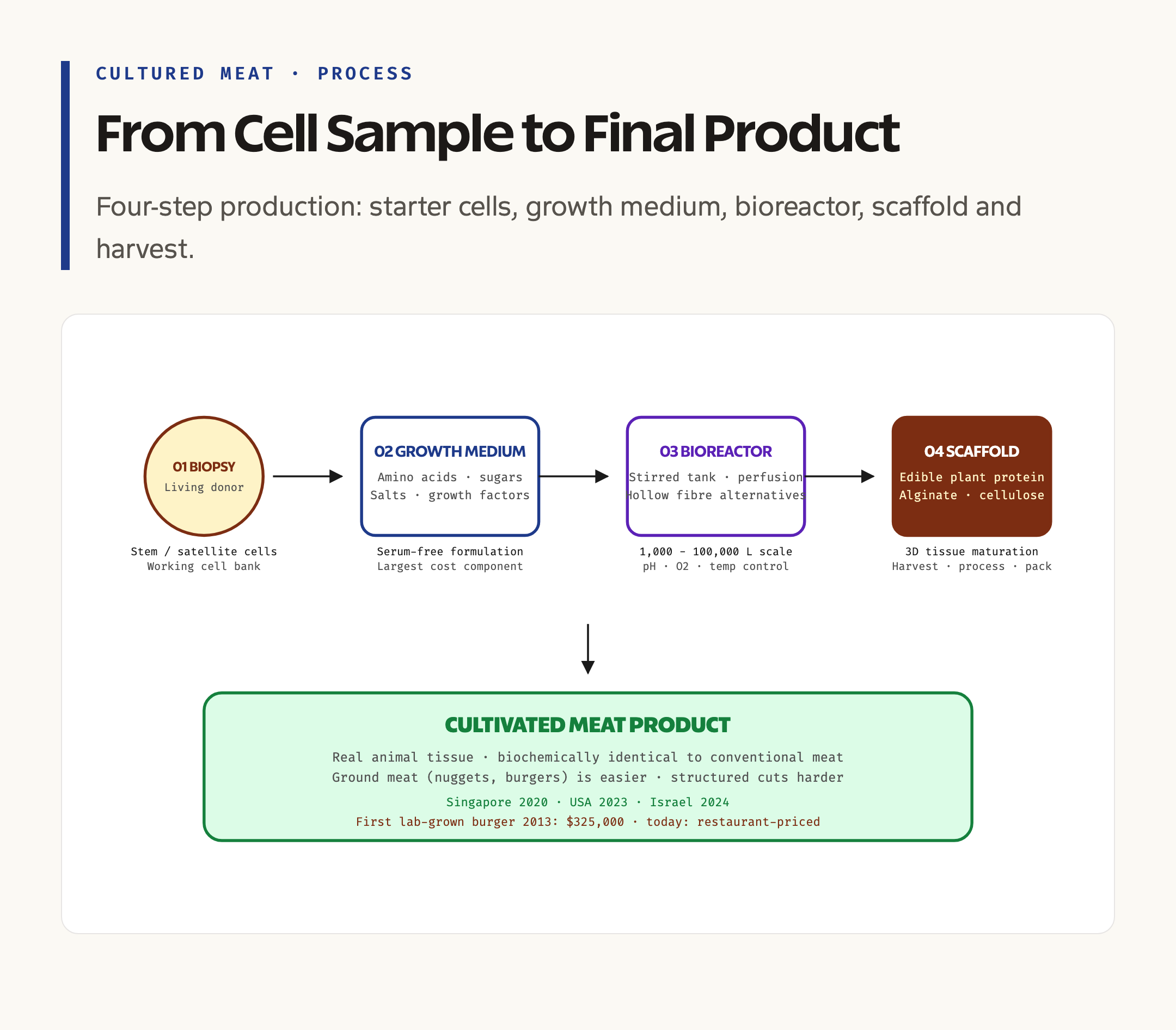
Cultivated meat production has four main steps, each of which has its own technical and economic challenges.
The starter cell sample is the first step. A small biopsy from a living donor animal yields stem cells or satellite cells, which are muscle precursor cells that can divide and differentiate into mature muscle tissue. Some companies use embryonic stem cells, induced pluripotent stem cells, or immortalised cell lines that have been engineered to divide indefinitely. The cells are characterised, screened for pathogens, and stored in a working cell bank that supplies all subsequent production runs.
The growth medium is the second step. Cells need a nutrient broth that contains amino acids, sugars, salts, vitamins, and growth factors that signal cell division and differentiation. Traditional cell culture used foetal bovine serum, which is a slaughterhouse byproduct that defeats the ethical purpose of cultivated meat and is also expensive. The shift to serum-free media is an active research area. Several companies have published serum-free formulations using recombinant growth factors produced by yeast or bacterial fermentation.
The bioreactor is the third step. Cells are seeded into a sterile vessel where temperature, pH, oxygen, and nutrient flow are tightly controlled. Stirred-tank bioreactors are the standard. Hollow-fibre bioreactors and packed-bed bioreactors are alternatives for higher cell density. Industrial-scale bioreactors of 10,000 to 100,000 litres are the operational target for cost-competitive cultivated meat. Singapore and the US production facilities currently operate at 1,000 to 5,000 litre scales.
The scaffold is the fourth step. Mature meat is not just cells; it is cells organised into three-dimensional muscle tissue with fibres, fat marbling, and connective tissue. The scaffold provides structural support during cell growth and differentiation. Edible scaffolds made from plant proteins, alginate, cellulose, or animal collagen are common. After the cells have grown on the scaffold and matured, the product is harvested, processed, and packaged.
The current production volumes are small. The largest cultivated meat facility globally produces a few tens of tonnes per year. Conventional meat production is in the hundreds of millions of tonnes per year. Bridging that gap is the central scaling challenge.
The Regulatory Landscape
The regulatory pathway for cultivated meat has emerged country by country through the past five years.
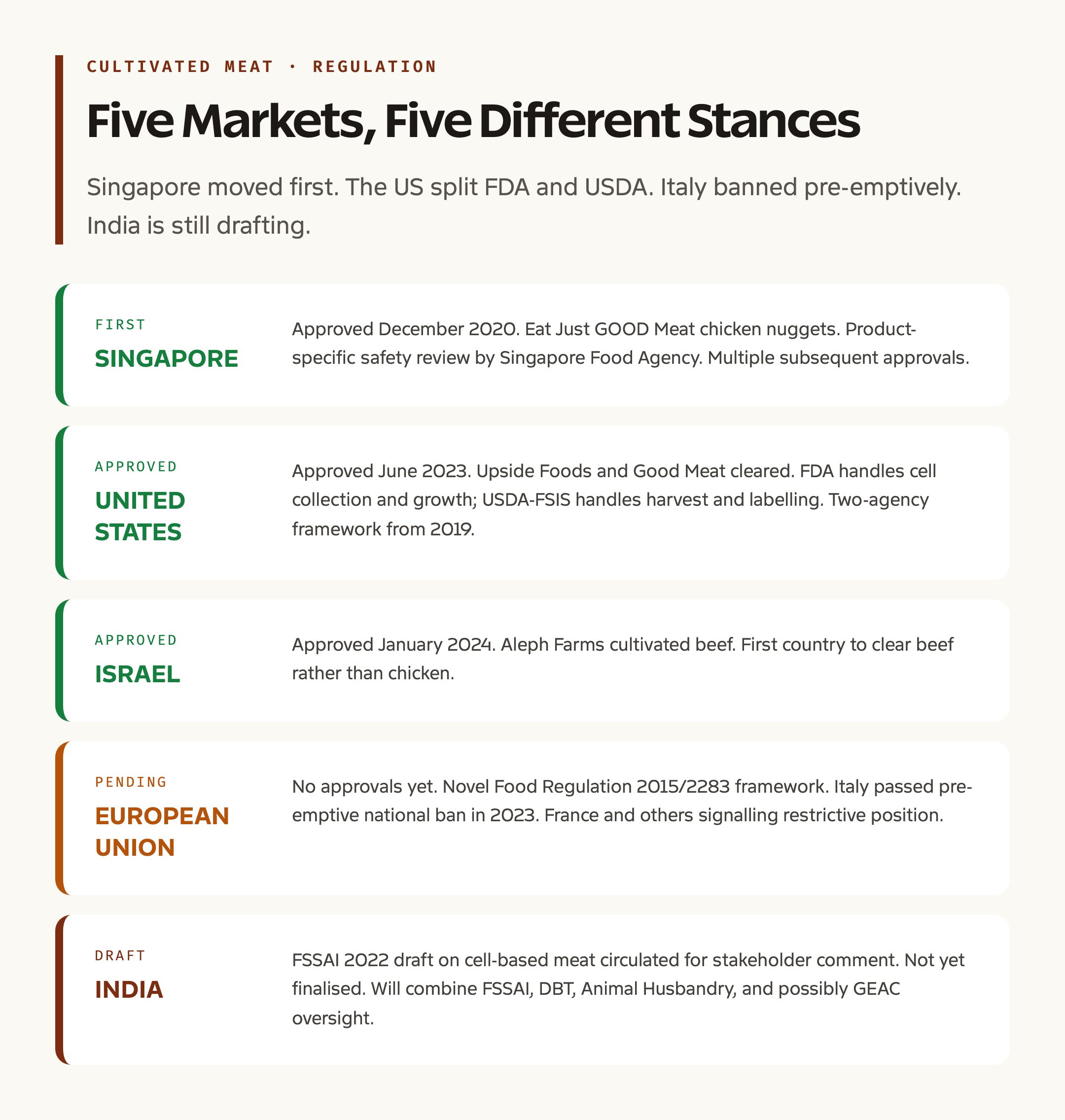
Singapore was first. In December 2020, the Singapore Food Agency approved the sale of Eat Just’s cultivated chicken nuggets, marketed under the GOOD Meat brand. The approval was a one-off, product-specific clearance after a detailed safety review covering the cell line, the growth medium, the bioreactor process, and the final product. Subsequent approvals have followed for additional companies and products, and Singapore has positioned itself as the global hub for early-stage commercialisation.
The United States followed in June 2023. The Food and Drug Administration cleared the cell lines of Upside Foods and Good Meat in late 2022 and 2023, and the United States Department of Agriculture’s Food Safety and Inspection Service approved the actual production processes in mid-2023. The two-agency framework reflects the FDA-USDA agreement of 2019 that splits oversight: FDA handles cell collection and growth, USDA handles harvest, processing, and labelling. Cultivated chicken from Upside Foods and Good Meat is now legally on sale in the US, though commercial volume remains limited.
Israel approved cultured beef in January 2024 from Aleph Farms, becoming the third country with a regulatory clearance and the first to clear beef rather than chicken. The approval used a similar product-specific safety review pathway.
The European Union has not yet cleared any cultivated meat product. The Novel Food Regulation 2015/2283 is the framework under which cultivated meat would be reviewed. Several companies have begun the EFSA pre-submission process. Italy passed a national law in 2023 that pre-emptively bans cultivated meat production and sale, even before EU rules are finalised. France and several other member states have signalled similar restrictive positions.
The United Kingdom’s Food Standards Agency cleared a cultivated pet-food ingredient in 2024 and is reviewing several human-food applications. Australia and New Zealand have a joint food regulator that has begun reviewing applications.
In India, the Food Safety and Standards Authority of India has not yet released a specific regulation for cultivated meat. FSSAI’s 2022 draft on cell-based meat circulated for stakeholder comment but has not been finalised. The Indian regulatory pathway will likely combine FSSAI for food safety, the Department of Biotechnology and the Department of Animal Husbandry for production, and the Genetic Engineering Appraisal Committee where genetic modification is involved.
The Climate and Ethical Case
The case for cultivated meat rests on three pillars. The relative weight of each varies by product, by company, and by methodological choice.
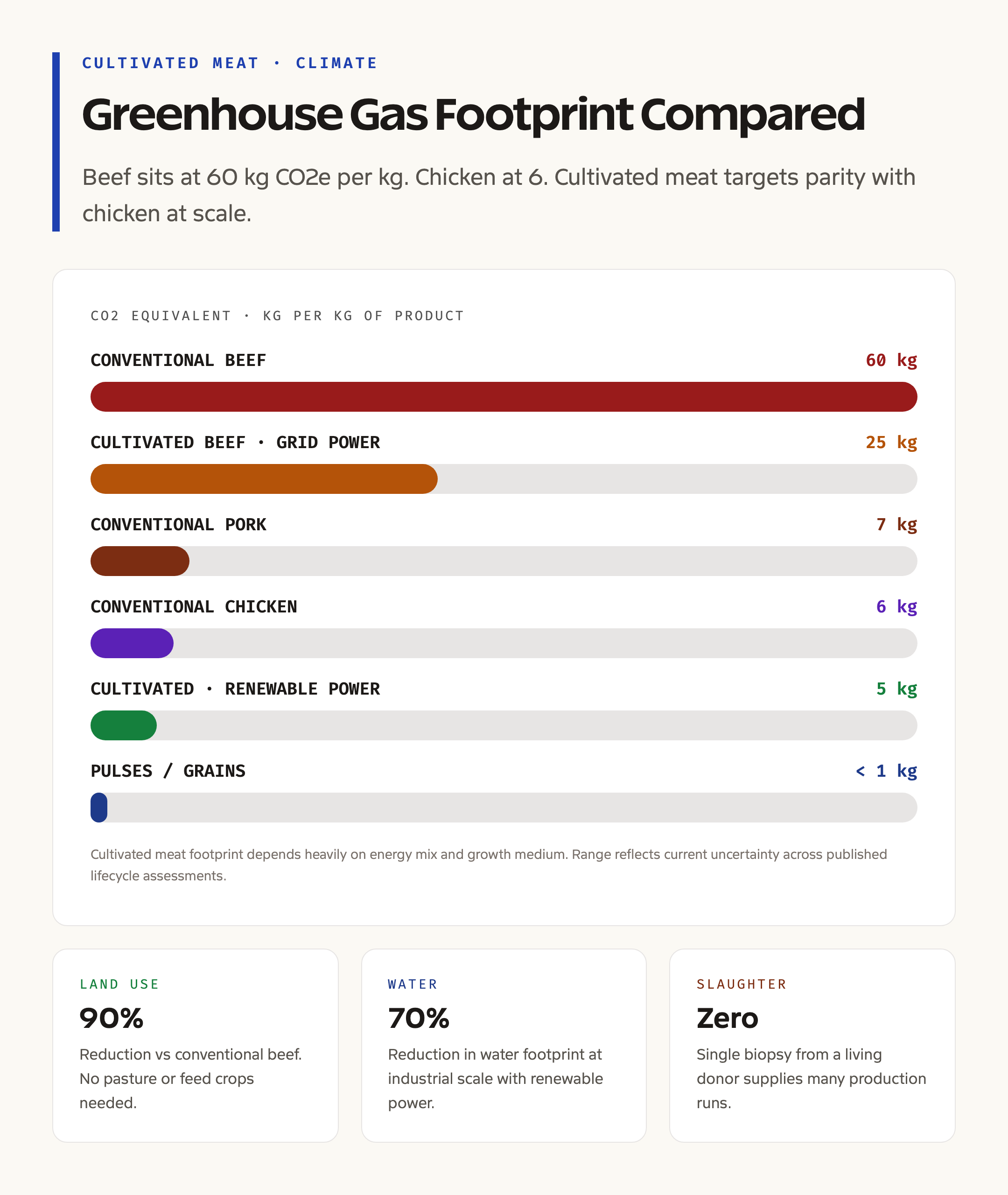
Greenhouse gas emissions is the first pillar. Conventional beef is the most carbon-intensive food product on the planet, with around 60 kg of CO2 equivalent per kilogram of meat. Pork is around 7 kg, chicken is around 6 kg, and pulses and grains are below 1 kg. Cultivated meat’s carbon footprint depends on the energy mix of the bioreactor and the growth medium production. Studies that assume current grid electricity have produced a wide range of estimates, from comparable to chicken at the low end to 25 times higher than beef at the high end. With renewable electricity and serum-free media at industrial scale, most estimates place cultivated meat below conventional beef and at parity with chicken.
Land use is the second pillar. Conventional meat production uses a large share of global agricultural land, both directly for grazing and indirectly for feed crops. Beef accounts for roughly 25 percent of global agricultural land use against under 5 percent of calorie supply. Cultivated meat does not require pasture or feed crops, only the inputs to the growth medium and energy. Land use savings of 90 percent or more are routinely cited.
Animal welfare is the third pillar. Cultivated meat does not require slaughter for the production process, only an initial biopsy from a living donor animal. The donor remains alive and a single biopsy can supply cells for production runs over many years. The welfare argument is the strongest for advocates and has driven most of the philanthropic capital behind the field.
The case is real but not absolute. The energy intensity of bioreactors is significant. The growth medium is the largest cost component and currently the largest environmental footprint. The land use case depends on what land would otherwise have been used for. The animal welfare case rests on the assumption that scaling cultivated meat displaces conventional meat rather than adding to total food supply.
Technical and Economic Challenges
Several challenges remain before cultivated meat can compete on price with conventional meat.
The growth medium cost is the largest. Foetal bovine serum was the original input and is the most expensive component by far. The shift to serum-free media has reduced cost per litre but the recombinant growth factors that replace serum components are themselves expensive. Companies including Mosa Meat, Believer Meats, and Aleph Farms have reported growth medium cost reductions of 99 percent over the past decade, but further reductions are needed for cost parity.
The bioreactor scaling challenge is the second. Cells grown at industrial scale need to maintain viability, growth rate, and nutrient flow at densities much higher than current pharmaceutical bioreactors achieve. Hollow-fibre bioreactors, perfusion systems, and proprietary suspension culture systems are all being explored. The capital cost of large bioreactor facilities is in the hundreds of millions of dollars per facility.
Product mimicry is the third. Cultivated chicken nuggets and burgers are easier to produce than steak or other structured cuts, because ground meat does not require precise tissue architecture. Producing a structured ribeye, a chicken breast with realistic muscle fibre orientation, or marbled wagyu beef is significantly harder. Several companies are working on bio-printing and structured-tissue approaches.
The regulatory uncertainty is the fourth. Markets like the EU and Italy are signalling restrictive positions for political and rural-economy reasons, even before scientific reviews complete. The risk of fragmented regulatory access is a constraint on investment.
Consumer acceptance is the fifth. Surveys consistently show that consumers in Asia and the US are more open to cultivated meat than European consumers. The framing matters. Calling the product cultivated meat scores higher in consumer surveys than calling it lab-grown meat or cell-based meat.
India’s Cellular Agriculture Position
India’s cellular agriculture sector is small but growing. The Centre for Cellular and Molecular Biology in Hyderabad has a cellular agriculture research programme funded by the Department of Biotechnology and the Bio-E3 framework. The Institute of Chemical Technology in Mumbai, the Indian Institute of Technology Madras, and a few other academic institutions have research groups working on growth media, bioreactor design, and scaffold materials.
The Indian startup ecosystem includes ClearMeat, a Delhi-based company working on cultivated chicken; Myoworks, a Hyderabad company working on scaffold technology; and a few others at early stages. The Good Food Institute India has provided ecosystem support and policy advocacy.
The Bio-E3 Policy approved by the Cabinet in 2024 includes precision biotherapeutics, sustainable bio-economy, and biomanufacturing as priority areas. Cultivated meat falls within the bio-manufacturing pillar, alongside biofortification and other applications of biotechnology for food and agriculture. The Bio-E3 framework signals public support for the sector but does not yet include specific funding for cultivated meat infrastructure.
The regulatory question is the most consequential near-term decision. FSSAI’s 2022 draft remains pending. A clear regulatory pathway, similar to Singapore’s product-specific approval framework, would allow Indian companies to commercialise. The absence of a pathway means Indian companies have begun targeting export markets first.
Religious and cultural considerations cut several ways. Cultivated meat is not vegetarian under most traditional Indian definitions, since it is animal tissue. It does not require slaughter, which removes one objection from some traditions. The interaction with Hindu, Jain, Muslim, and Sikh dietary frameworks is being worked out and will shape consumer acceptance once products reach the market.
What to Watch Through 2030
Three trends will shape the cultivated meat sector through 2030.
The first is the cost curve. Companies need to bring the production cost of cultivated chicken below conventional chicken at scale. The cost trajectory of the past decade points to parity in the late 2020s, but execution is not guaranteed.
The second is the regulatory expansion. EU clearance, Indian clearance, and clearance in other large markets including China and Japan will determine the global addressable market. Italy’s pre-emptive ban and the broader EU food-policy debate will shape the pace of expansion.
The third is the ingredient versus product split. Pure cultivated meat products may sit alongside hybrid products that combine cultivated cells with plant-based proteins, reducing cost and improving texture. Several companies are now positioning hybrid products as the near-term commercial offering.
For UPSC, the right way to remember cultivated meat is as a biotechnology that sits at the intersection of food security, climate policy, animal welfare, and rural livelihoods. The science is mature, the regulatory pathways are emerging, and India’s position is still being shaped by FSSAI’s pending framework and the Bio-E3 policy execution.
Frequently Asked Questions
What is lab-grown meat in simple terms?
Lab-grown meat is real animal meat produced by cultivating animal cells in a controlled bioreactor environment, instead of by raising and slaughtering animals. It starts with a small biopsy from a living donor animal, the cells are grown in a nutrient-rich medium inside a bioreactor, and the resulting muscle tissue is harvested as meat. The product is biochemically identical to conventional meat at the cellular level. It is also called cultured meat, cell-based meat, or cultivated meat.
Which countries have approved cultivated meat for sale?
Singapore was first in December 2020, approving Eat Just’s cultivated chicken under the GOOD Meat brand. The United States followed in June 2023, with the FDA and USDA approving cultivated chicken from Upside Foods and Good Meat. Israel approved cultivated beef from Aleph Farms in January 2024. The European Union has not yet cleared any product, and Italy passed a pre-emptive national ban in 2023. India has not yet finalised a specific regulatory framework, although FSSAI circulated a draft in 2022.
How does cultivated meat differ from plant-based meat?
Plant-based meat uses soy, pea, wheat, or other plant proteins to mimic the texture and flavour of meat. It contains no animal cells. Cultivated meat is real animal cells grown outside an animal. Plant-based meat is already widely sold globally including in India through brands like Imagine Meats and GoodDot. Cultivated meat is at an earlier commercialisation stage and is biologically identical to conventional meat at the cellular level.
What is the climate case for cultivated meat?
Conventional beef has a greenhouse gas footprint of around 60 kg CO2 equivalent per kilogram, by far the highest among major food products. Cultivated meat’s footprint depends on the bioreactor energy mix and the growth medium. With renewable electricity and serum-free media at industrial scale, most lifecycle estimates place cultivated meat below conventional beef and near parity with chicken. Land use savings are large; cultivated meat does not require pasture or feed crops, only the inputs to growth medium production.
Where does India stand on cultivated meat?
India has cellular agriculture research at CCMB Hyderabad and several academic institutions, supported by the Department of Biotechnology and the Bio-E3 Policy 2024. Indian startups including ClearMeat and Myoworks are at early development stages. FSSAI circulated a draft cell-based meat regulation in 2022 but has not finalised it. The absence of a clear regulatory pathway is the biggest near-term constraint on Indian commercialisation; many Indian companies are targeting export markets first.
Is lab-grown meat vegetarian?
Lab-grown meat is animal tissue and is therefore not vegetarian under most traditional definitions used in India, including the Hindu, Jain, and broader vegetarian frameworks. It does not require slaughter, which removes one ethical objection that some traditions have raised against conventional meat. The interaction with Hindu, Jain, Muslim, and Sikh dietary frameworks is being worked out by religious authorities and consumer-acceptance researchers, and will shape Indian market entry once products receive regulatory clearance.