A stem cell is a cell that has not yet decided what to become. Almost every other cell in the body has a fixed job. A red blood cell carries oxygen. A neuron sends electrical signals. A pancreatic beta cell makes insulin. A stem cell sits one or two steps before this commitment, and that property, the ability to become many things, is what makes it valuable to medicine. The promise is large. So is the hype.
For UPSC, stem cells matter for three reasons. They are foundational biology that connects to vaccines, gene therapy and personalised medicine. They sit inside an active ethical debate about embryos, consent and commercialisation. And India has a regulatory framework, the National Guidelines for Stem Cell Research, that students should be able to describe in two sentences. The trick is to separate what stem cells can already do from what is being marketed as therapy without good evidence.
This explainer walks through what stem cells are, how they are classified by potency, where they come from, what they actually treat, and how India regulates the field.
Quick Facts: Stem Cells at a Glance
- Definition: Undifferentiated cells with two defining properties, self-renewal and the ability to differentiate into specialised cell types
- Two functions: Self-renewal (make more stem cells) and differentiation (become specialised cells)
- Four potency classes: Totipotent, pluripotent, multipotent, unipotent
- Three main sources: Embryonic (ESC), adult or somatic, induced pluripotent (iPSC)
- Yamanaka discovery: Shinya Yamanaka, 2006 paper, 2012 Nobel Prize for iPSC reprogramming
- Indian regulator: Department of Biotechnology and ICMR, under National Guidelines for Stem Cell Research, 2017
- Approved standard therapy in India: Hematopoietic Stem Cell Transplantation (HSCT) for blood cancers and blood disorders
- Other applications: Most are experimental and require approval as clinical trials, not as routine treatments
What Are Stem Cells?
A stem cell is biologically defined by two properties. The first is self-renewal, which means the cell can divide and produce more copies of itself without losing its undifferentiated character. The second is differentiation, which means it can give rise to one or more specialised cell types under the right signals. Together, these properties allow stem cells to act as a reservoir for tissue maintenance and repair throughout life.
Differentiation is not random. Each stem cell sits inside a niche, a microenvironment that supplies signals determining whether the cell stays a stem cell, divides, or commits to a specific lineage. The signalling involves growth factors, cell-to-cell contact, and the physical stiffness of the surrounding tissue. Manipulating these signals is the core technical problem of regenerative medicine.
Stem cells are not a single thing. The cell that gives rise to all body tissues during early embryonic development is very different from the cell that maintains skin or blood in an adult. The classification by potency is what gives the field its grammar.
Background and Historical Context
The idea that some cells in the body can produce others is older than modern biology. Early hematologists in the late nineteenth century proposed that all blood cells originated from a common precursor. The first definitive proof came in 1961, when James Till and Ernest McCulloch in Toronto showed that a single bone marrow cell, transplanted into an irradiated mouse, could produce colonies of all blood cell types in the spleen. This was the first demonstration of an adult stem cell.
Embryonic stem cells were isolated next. In 1981, two groups working independently, in Cambridge and at the University of California, derived stem cells from mouse embryos. In 1998, James Thomson at Wisconsin derived the first human embryonic stem cell lines from leftover IVF embryos. This work created an immediate ethical controversy in many countries, because the derivation process destroys the embryo.
The next breakthrough sidestepped the ethics problem. In 2006, Shinya Yamanaka at Kyoto University showed that adult skin cells could be reprogrammed into a pluripotent state by introducing four transcription factors, now known as the Yamanaka factors. These reprogrammed cells, called induced pluripotent stem cells or iPSCs, behave like embryonic stem cells but require no embryo. Yamanaka shared the 2012 Nobel Prize in Physiology or Medicine with John Gurdon for this discovery. The iPSC technology opened the way to patient-specific stem cell models, in which a researcher can take a skin biopsy, reprogramme the cells, and study a patient’s specific disease in a dish. For broader context on cutting-edge biology, see our explainers on biotechnology, gene therapy versus gene editing and the Genome India Project.
The Four Potency Classes
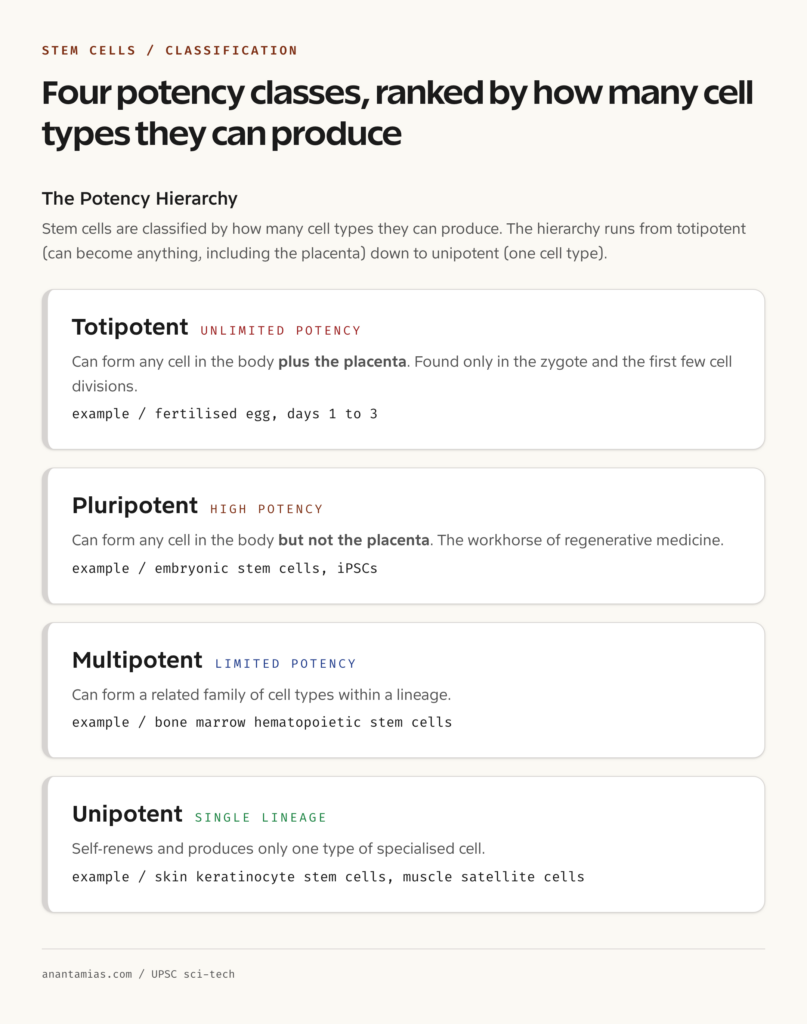
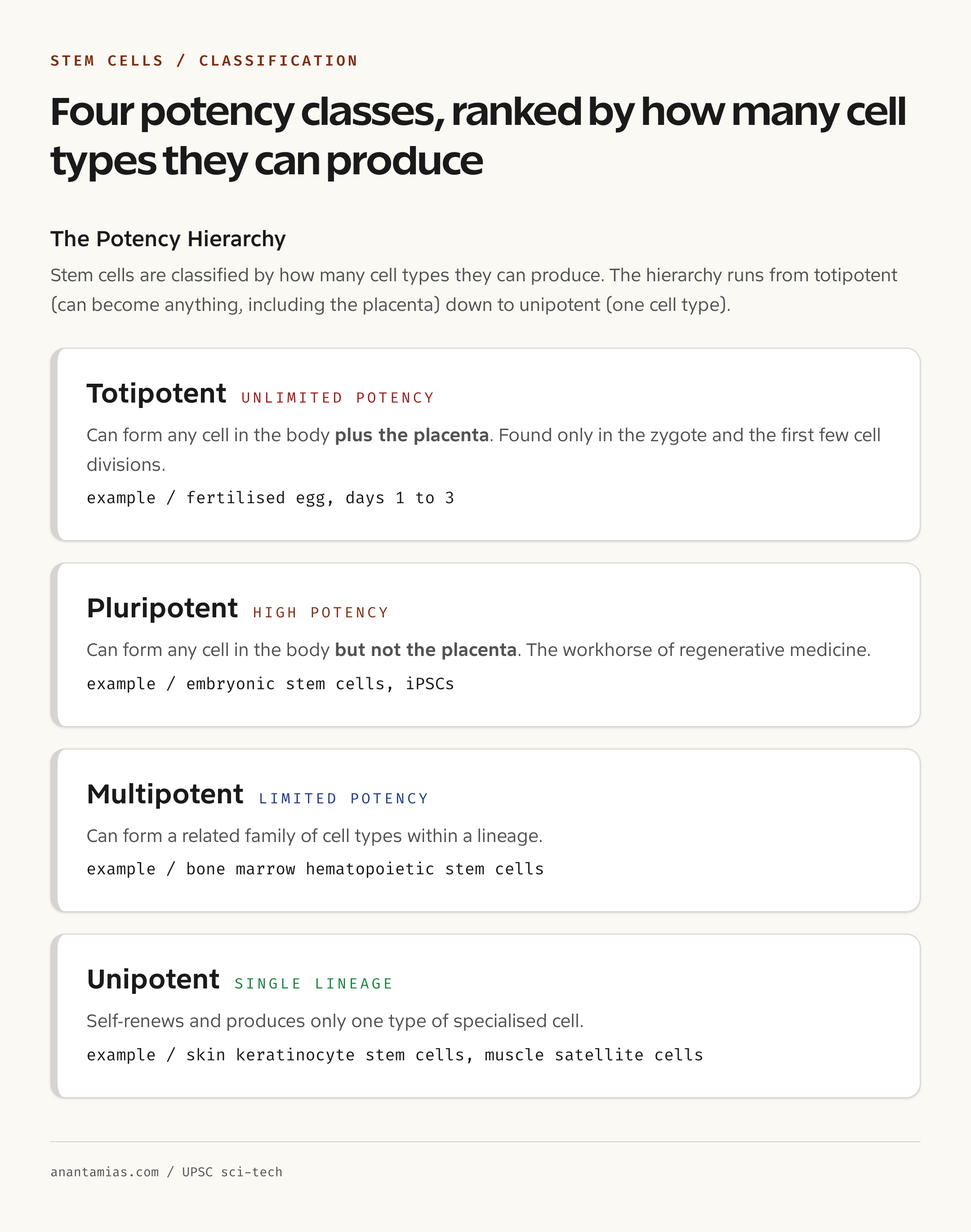
The classification of stem cells by potency describes how many different cell types a given stem cell can produce. The hierarchy runs from totipotent at the top to unipotent at the bottom, with each class more restricted than the one above.
A totipotent cell can produce every cell type in the body and also the extra-embryonic tissues such as the placenta. In humans, totipotency is limited to the zygote and the cells of the first few divisions, up to about the eight-cell stage. After that, the cells begin to specialise.
A pluripotent cell can produce any cell type in the body but cannot form the placenta. Embryonic stem cells, derived from the inner cell mass of the blastocyst, are pluripotent. So are induced pluripotent stem cells. Pluripotent cells are the workhorse of regenerative medicine research because they can in principle become any tissue.
A multipotent cell can produce a limited family of related cell types. The classic example is the hematopoietic stem cell in bone marrow, which can produce all blood cell types but not, say, neurons or muscle. Mesenchymal stem cells, which give rise to bone, cartilage and fat cells, are also multipotent.
A unipotent cell can produce only one cell type. Adult skin stem cells producing keratinocytes, or muscle satellite cells producing new muscle fibres, are unipotent. They self-renew and replace one specific cell type.
Sources of Stem Cells
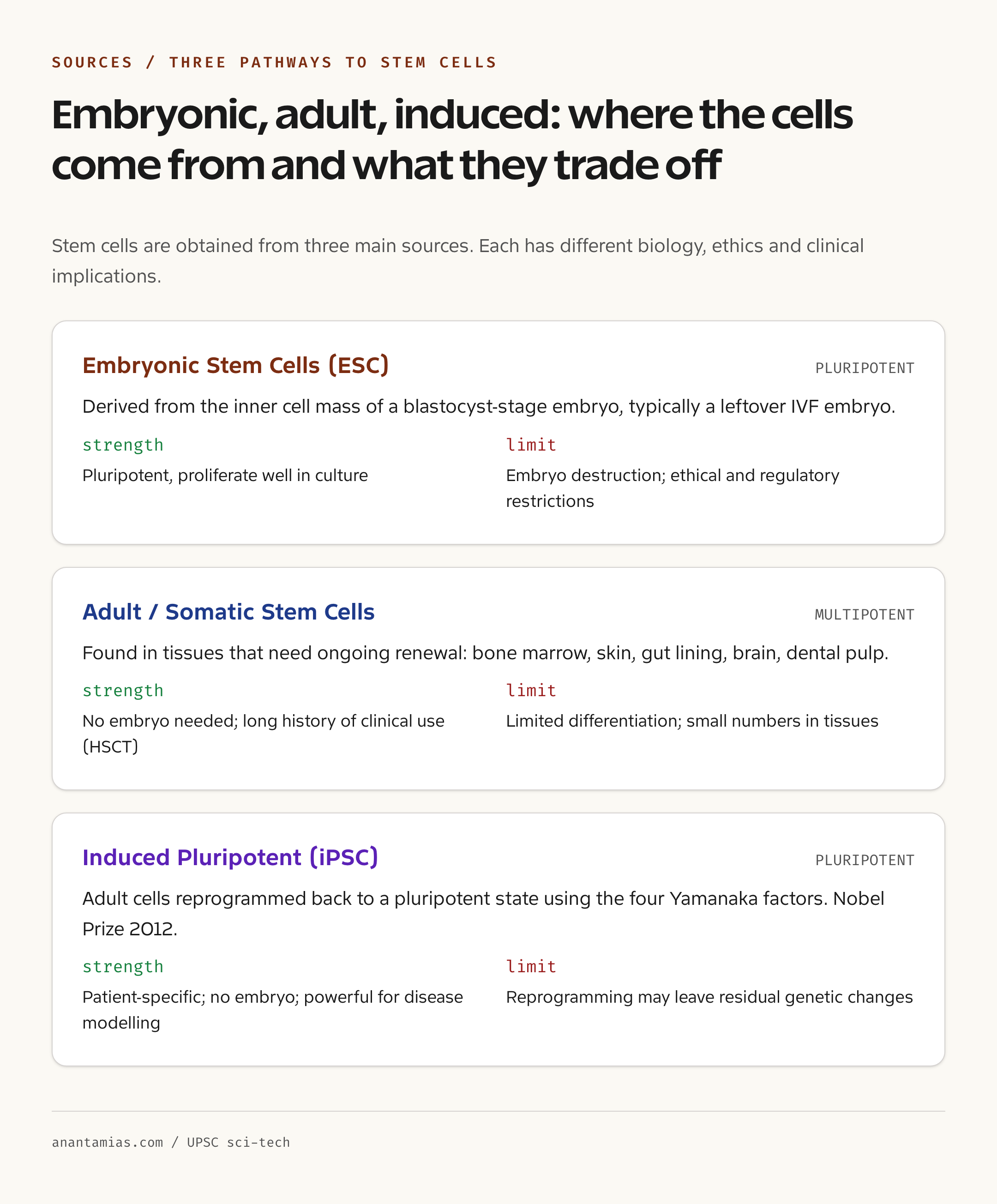
There are three main sources, each with distinct biology, ethics and clinical implications.
Embryonic Stem Cells (ESCs) are derived from the inner cell mass of a blastocyst-stage embryo, typically donated from IVF clinics where embryos were created but not implanted. ESCs are pluripotent and proliferate well in culture, which makes them scientifically valuable. The ethical objection is that derivation destroys the embryo, and many countries place tight restrictions on this work. India permits research on supernumerary IVF embryos under the NGSCR 2017 framework but prohibits the creation of embryos solely for research.
Adult or Somatic Stem Cells are found in specific tissues throughout the body. Bone marrow is the best-known reservoir, containing both hematopoietic stem cells (which produce blood) and mesenchymal stem cells (which produce connective tissues). Other adult stem cell pools include the gut lining, the basal layer of skin, the brain’s subventricular zone, and dental pulp. Adult stem cells are typically multipotent or unipotent, with more limited differentiation potential than embryonic cells, but they avoid the ethical issues and have been clinically used for decades.
Induced Pluripotent Stem Cells (iPSCs) are adult cells, typically skin or blood cells, that have been reprogrammed back to a pluripotent state by introducing the Yamanaka factors. The result behaves like an embryonic stem cell but without the embryo. iPSCs allow patient-specific cell lines, which is transformative for disease modelling and for autologous cell therapy where the patient’s own cells are used and immune rejection is minimised. The technology is still maturing, and concerns remain about residual genetic changes from the reprogramming process.
Stem Cell Therapies: What Actually Works
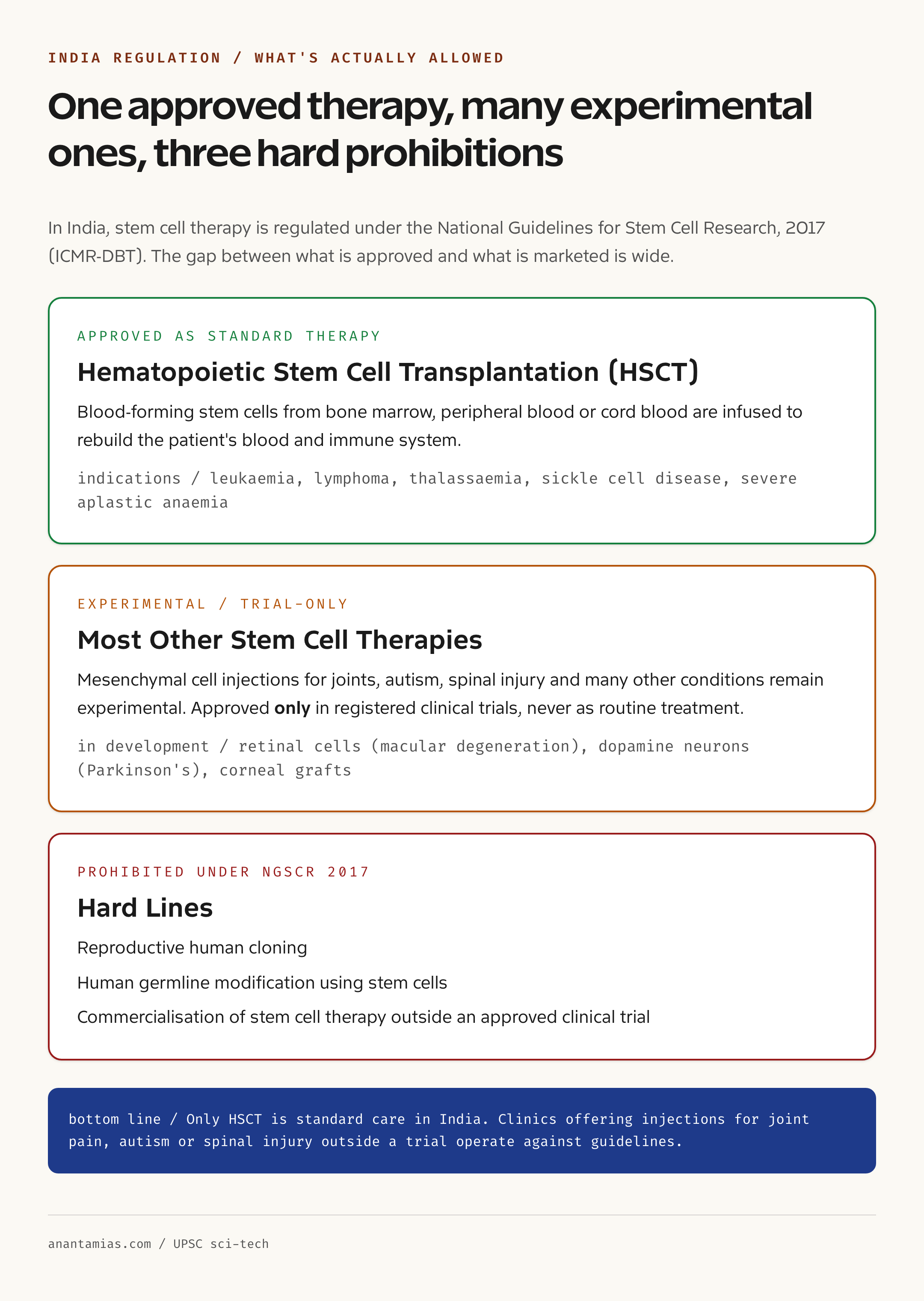
The single therapy that has reached the standard of care is hematopoietic stem cell transplantation, or HSCT. In this procedure, hematopoietic stem cells from bone marrow, peripheral blood after mobilisation, or umbilical cord blood are infused into a patient whose own bone marrow has been damaged or destroyed. The transplanted cells re-establish the patient’s blood and immune system. HSCT is approved in India and worldwide for blood cancers such as leukaemia and lymphoma, and for inherited blood disorders such as thalassaemia, sickle cell disease and severe aplastic anaemia.
Most other stem cell uses are experimental. Mesenchymal stem cell injections for joint pain, spinal cord injury, autism and a long list of other conditions are widely advertised but lack robust clinical evidence in most indications. The Indian Council of Medical Research and the Drugs Controller General of India have repeatedly warned against unapproved stem cell therapies, and clinics offering them outside an approved clinical trial are operating in violation of regulations.
A second area where evidence is accumulating is corneal regeneration using limbal stem cells, which has been used for chemical burns and corneal damage. Skin grafts grown from epidermal stem cells are used for severe burns. Several ongoing trials are testing iPSC-derived retinal cells for macular degeneration, and stem cell-derived dopamine neurons for Parkinson’s disease. None of these have yet become routine treatments.
Why Stem Cells Matter
Stem cells matter for medicine because they offer a path to repair what is currently irreparable. Most chronic diseases involve the loss of cells that the body cannot replace. Beta cells in type 1 diabetes, dopamine neurons in Parkinson’s, retinal pigment cells in macular degeneration, motor neurons in ALS. If specific cell types could be made from a patient’s own stem cells and transplanted to replace what has been lost, these conditions could be treated rather than merely managed.
They matter for research because they allow human disease to be modelled in a dish. Before iPSCs, the way to study a disease was either in animals (which often do not recapitulate human conditions well) or in human cells obtained from biopsies (which are rare for many tissues). With iPSCs, a researcher can take skin from a patient with, say, motor neuron disease, reprogramme the cells to pluripotency, and then differentiate them into motor neurons that carry the patient’s genetic mutation. This is now a standard part of biomedical research.
They matter for policy because the field is regulated unevenly across countries, and patients seeking unproven therapies travel between jurisdictions. India is part of this stem cell tourism map, both as a destination and as a place where domestic clinics offer unapproved treatments to local patients.
NGSCR 2017: India’s Regulatory Framework
The National Guidelines for Stem Cell Research, last revised in 2017, were jointly issued by the Indian Council of Medical Research and the Department of Biotechnology. They classify stem cell research and therapy into three categories.
Permissible activities include research on adult stem cells, on iPSCs, and on supernumerary IVF embryos with proper consent. Hematopoietic stem cell transplantation is permitted as standard therapy for the conditions listed earlier.
Restricted activities require prior approval from an Institutional Committee for Stem Cell Research and from the Indian Stem Cell Research Advisory Board. These include creation of new ESC lines, animal-human chimera research, and clinical trials of any unapproved stem cell therapy.
Prohibited activities include reproductive human cloning, human germline genetic modification using stem cells, and the commercialisation of stem cell therapies outside an approved clinical trial. The guidelines explicitly state that any stem cell therapy other than HSCT is to be treated as experimental and can be offered only in the context of an approved trial. Clinics operating outside this framework are not legal.
The framework has been criticised as guidelines rather than law, with limited enforcement teeth. A bill to give the framework statutory force has been discussed but not enacted.
Challenges and Ethical Concerns
The field faces challenges on multiple fronts. Scientifically, controlling differentiation reliably remains difficult. Cells delivered to a damaged tissue do not always engraft, do not always become the right cell type, and can occasionally form tumours, especially if pluripotent cells are not fully differentiated before transplantation. Manufacturing cell therapies at scale, with consistent quality, is far harder than manufacturing small-molecule drugs.
Ethically, embryonic stem cell research continues to generate controversy in religious and philosophical traditions that consider the early embryo a person. iPSCs sidestep this issue but raise their own concerns, including the possibility of creating gametes from skin cells in ways that could enable reproductive scenarios most societies have not yet thought through.
Commercially, the gap between what is approved and what is offered is wide. Hundreds of clinics worldwide market stem cell injections for conditions where evidence is weak or absent. Patients pay large sums and sometimes suffer harm. Regulators in the United States, Australia and India have taken enforcement actions, but the pace of clinic openings often exceeds the pace of enforcement.
UPSC Prelims Pointers
- Stem cells have two properties: self-renewal and differentiation
- Potency hierarchy: totipotent > pluripotent > multipotent > unipotent
- Totipotent cells can form the placenta; pluripotent cannot
- Embryonic stem cells (ESCs) are pluripotent, derived from the blastocyst inner cell mass
- Adult stem cells are typically multipotent (e.g., bone marrow hematopoietic stem cells)
- Induced Pluripotent Stem Cells (iPSCs) were created by Shinya Yamanaka in 2006
- Yamanaka shared the 2012 Nobel Prize with John Gurdon
- HSCT is the only stem cell therapy approved as a standard treatment in India
- HSCT is used for leukaemia, thalassaemia, sickle cell disease, aplastic anaemia
- India’s regulator is ICMR-DBT under NGSCR 2017
- Reproductive human cloning is prohibited under Indian guidelines
- Mesenchymal stem cell therapies for most conditions remain experimental in India
UPSC Mains Practice Questions
- Distinguish between totipotent, pluripotent and multipotent stem cells, with examples. Discuss why induced pluripotent stem cells were a major scientific advance.
- Critically evaluate the regulatory framework for stem cell research and therapy in India. What gaps exist between the NGSCR 2017 guidelines and on-ground practice?
- Examine the ethical and policy questions raised by stem cell research, particularly the use of embryonic stem cells. How does India’s framework navigate these concerns?
- “Stem cell therapy holds great promise but also great risks of unproven commercialisation.” Discuss with reference to current Indian and global trends.
Way Forward
India’s stem cell ecosystem needs three things to mature. First, the NGSCR framework should be given statutory force, with clear penalties for clinics offering unapproved therapies. Second, public funding for legitimate stem cell research, particularly iPSC-based disease modelling and approved clinical trials, should expand to keep pace with global activity. The Department of Biotechnology and ICMR can play this role. Third, public communication needs to improve so that patients understand the difference between the one approved therapy (HSCT) and the many marketed but unproven uses.
The field will continue to advance. Trials of iPSC-derived therapies for Parkinson’s, macular degeneration and heart failure are ongoing globally, and Indian institutions including AIIMS, NCBS, inStem and several IITs are active contributors. The next decade should see more therapies move from experimental to approved status. Until then, the gap between hope and evidence remains the central feature of the field, and a careful regulatory hand is what keeps patients safe.
Frequently Asked Questions
What is the difference between a stem cell and an ordinary cell?
An ordinary cell, like a red blood cell or a neuron, has a fixed identity and a specialised job. A stem cell has not yet committed to a specific identity. It can divide to make more stem cells (self-renewal) and can give rise to specialised cell types under the right signals (differentiation). These two properties together define what a stem cell is.
What does pluripotent mean?
Pluripotent means the cell can develop into any cell type in the body, but not into the extra-embryonic tissues like the placenta. Embryonic stem cells and induced pluripotent stem cells are both pluripotent. Totipotent cells, which include the zygote, can also form the placenta and are one step more powerful.
Are stem cell therapies legal in India?
Only one stem cell therapy is approved as a standard treatment in India: hematopoietic stem cell transplantation (HSCT) for blood cancers and blood disorders. All other stem cell uses are considered experimental and can be offered only in the context of an approved clinical trial under the NGSCR 2017 framework. Clinics offering injections of stem cells for joint pain, autism, spinal injury or other conditions outside a trial are operating in violation of the guidelines.
What did Shinya Yamanaka discover?
In 2006, Shinya Yamanaka and colleagues at Kyoto University showed that introducing four genes, now known as the Yamanaka factors, into ordinary adult cells like skin cells could reprogramme them into a pluripotent state. The reprogrammed cells, called induced pluripotent stem cells or iPSCs, behave like embryonic stem cells but require no embryo. He shared the 2012 Nobel Prize for this work.
What is HSCT?
HSCT stands for Hematopoietic Stem Cell Transplantation. It is the procedure in which blood-forming stem cells from bone marrow, peripheral blood after mobilisation with growth factors, or umbilical cord blood are infused into a patient. The transplanted cells re-establish the patient’s blood and immune system. It is the standard of care for several leukaemias, lymphomas, thalassaemia, sickle cell disease and severe aplastic anaemia.
What are induced pluripotent stem cells used for?
iPSCs have two main uses. The first is research, particularly disease modelling: cells from a patient with a specific genetic disease can be reprogrammed and differentiated into the affected cell type, allowing the disease to be studied in a dish. The second is the developing field of personalised cell therapy, where a patient’s own cells become the source of replacement tissue, reducing the risk of immune rejection. Most clinical applications remain in trials rather than approved use.
Where are adult stem cells found in the body?
Adult or somatic stem cells are found in specific tissues that need ongoing renewal. The best-known reservoir is bone marrow, which contains hematopoietic and mesenchymal stem cells. Other locations include the gut lining, the basal layer of skin, the dental pulp, the brain’s subventricular zone, and muscle satellite cells.
Who regulates stem cell research in India?
Stem cell research and therapy in India fall under the National Guidelines for Stem Cell Research, last revised in 2017, jointly issued by the Indian Council of Medical Research and the Department of Biotechnology. Institutional Committees for Stem Cell Research at each research site provide local oversight, and the Indian Stem Cell Research Advisory Board provides national oversight.
Why is there an ethical debate about embryonic stem cells?
Embryonic stem cells are derived from the inner cell mass of a blastocyst-stage embryo, typically donated from IVF clinics. The derivation process destroys the embryo. People who consider the early embryo a person on moral or religious grounds object to this destruction. iPSC technology was developed in part to provide a pluripotent cell source that does not require an embryo, and most advanced research today uses iPSCs rather than ESCs.
Tell Google you want more of this.
Add Anantam IAS as a preferred sourceOne tap, and this site shows up more often in your own Top Stories, AI Overviews and AI Mode. Remove it any time.