Last Governor General of India: C. Rajagopalachari Explained
Last Governor General of India was C. Rajagopalachari (1948–1950), the only Indian to hold the post. Full timeline, powers, and UPSC notes.
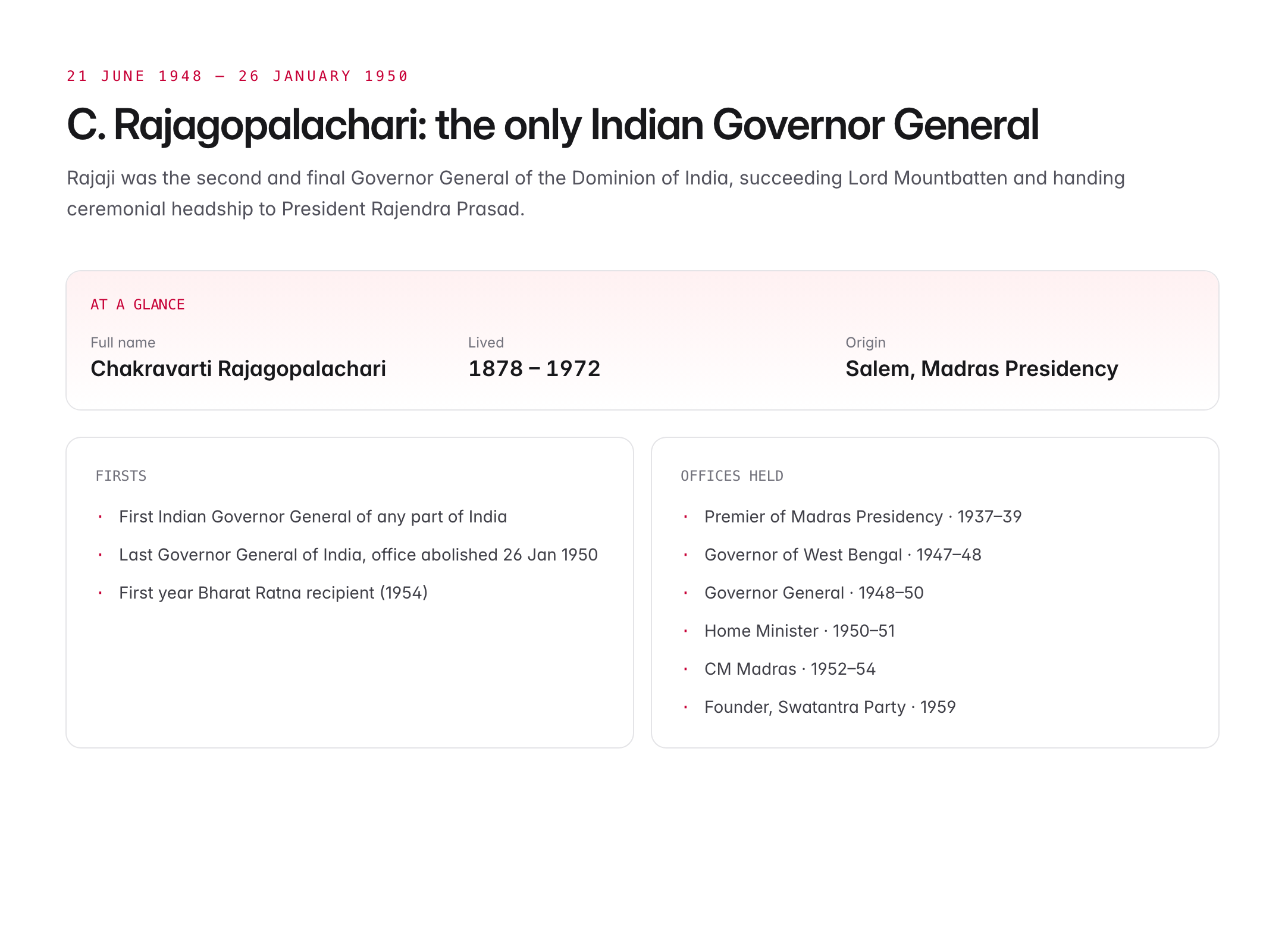
The last Governor General of India was Chakravarti Rajagopalachari (Rajaji), who held the office from 21 June 1948 to 26 January 1950. He was the only Indian and the only native-born holder of the post, which ceased to exist once India became a republic under the new Constitution. Rajaji succeeded Lord Louis Mountbatten, the first Governor General of independent India, and handed over ceremonial headship of state to Dr. Rajendra Prasad, India's first President. For UPSC aspirants, this transition captures the shift from Dominion to Republic, and the question is a recurring Prelims favourite along with the linked names of first Governor General of Bengal, first Governor General of India, and first Viceroy.
Who Was the Last Governor General of India
Chakravarti Rajagopalachari (1878–1972) was a lawyer, freedom fighter, politician, and Tamil scholar from Salem, Madras Presidency. Known affectionately as Rajaji or C.R., he was a close associate of Mahatma Gandhi and a key Congress leader. He was appointed the second and final Governor General of the Dominion of India on 21 June 1948 after Lord Mountbatten left. He held office until India adopted the Constitution on 26 January 1950, when the office itself was abolished.
Key facts about Rajaji:
- First Indian Governor General of any part of India.
- Former Premier of Madras Presidency (1937–39).
- Governor of West Bengal (1947–48) before becoming Governor General.
- First Home Minister of India after Sardar Patel's death (1950).
- Founder of the Swatantra Party (1959) — India's first major right-of-centre liberal party.
- Received the Bharat Ratna in 1954 (the first year it was awarded).
Timeline from Dominion to Republic
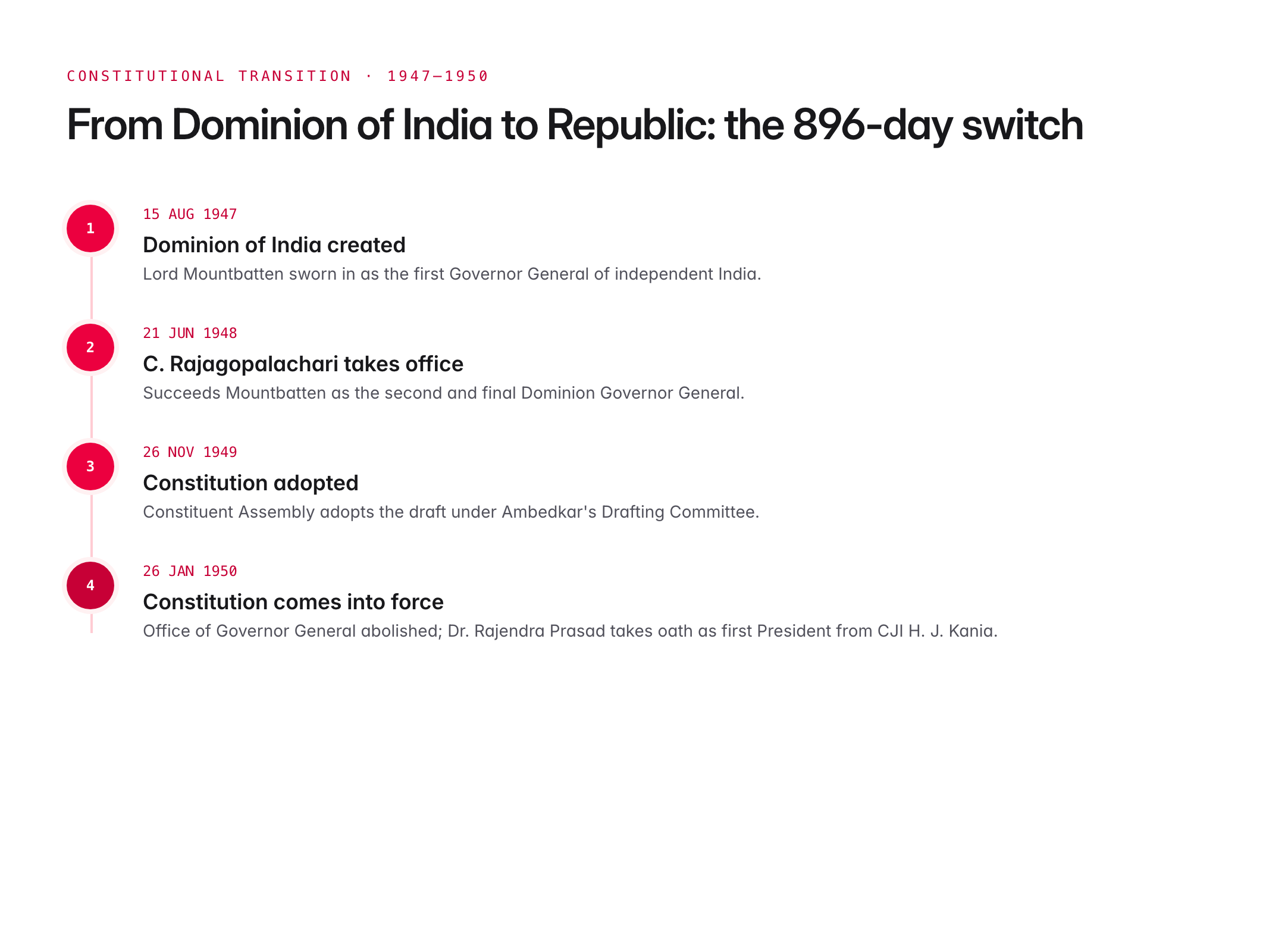
India's post-1947 constitutional journey is short but dense.
| Date | Event |
|---|---|
| 15 August 1947 | Dominion of India created; Lord Mountbatten becomes first Governor General of independent India |
| 21 June 1948 | C. Rajagopalachari sworn in as Governor General |
| 26 November 1949 | Constitution adopted by the Constituent Assembly |
| 26 January 1950 | Constitution comes into force; office of Governor General abolished |
| 26 January 1950 | Dr. Rajendra Prasad takes oath as the first President of India |
During Rajaji's tenure, India was still a Dominion within the British Commonwealth, with the British monarch as nominal sovereign and the Governor General as the head of state in India.
First Governor General of India — Context
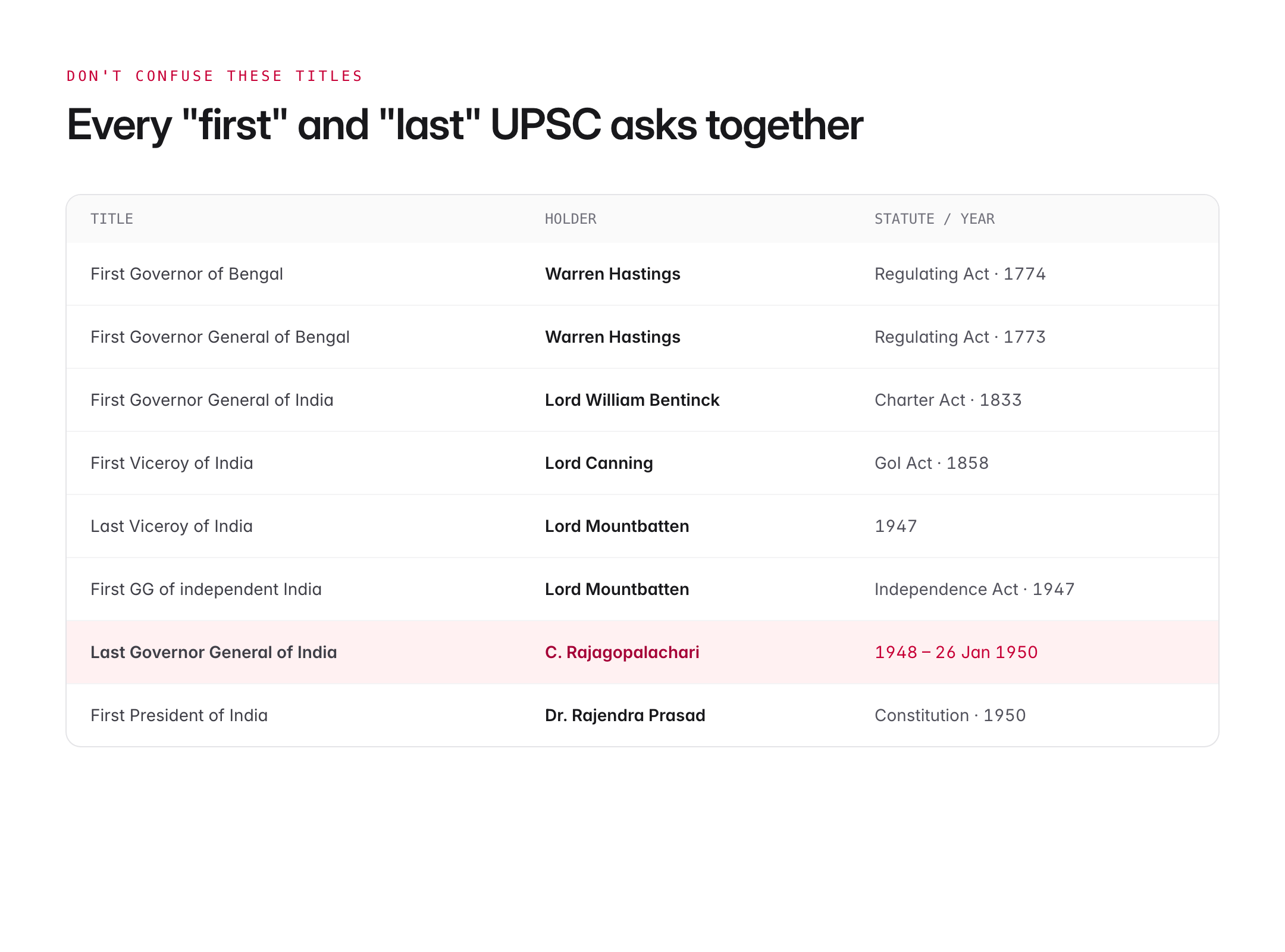
It helps to distinguish the three "first" answers UPSC asks together.
- First Governor of Bengal (under Regulating Act, 1773): Warren Hastings (1774–1785).
- First Governor General of Bengal: Warren Hastings (1773–1785) — title created by the Regulating Act.
- First Governor General of India (title created by Charter Act, 1833): Lord William Bentinck (1833–1835).
- First Viceroy of India (after 1858): Lord Canning (1858–1862) — title created by the Government of India Act, 1858.
- Last Viceroy of India: Lord Mountbatten (1947).
- First Governor General of independent India (Dominion): Lord Mountbatten (1947–1948).
- Last Governor General of India: C. Rajagopalachari (1948–1950).
Evolution of the Post
The role of Governor General changed dramatically across three centuries.
Regulating Act, 1773 created the Governor General of Bengal with supervisory powers over Bombay and Madras presidencies.
Charter Act, 1833 elevated the post to Governor General of India, giving him legislative authority over all British territories in India. Lord William Bentinck was the first to hold this title.
Government of India Act, 1858 — after the Revolt of 1857 — transferred power from the East India Company to the Crown. The same officer was now also called Viceroy when acting as the Crown's representative in political matters with Indian princely states. Administratively, he remained Governor General.
Indian Independence Act, 1947 — ended the office of Viceroy and made the Governor General a constitutional head of the Dominion, bound by the advice of Indian ministers.
Constitution of India, 1950 — abolished the post and replaced it with the President of India, an elected constitutional head.
Powers of the Governor General (1947–1950)
During the Dominion period, the Governor General had powers similar to those of the British monarch under a parliamentary democracy:
- Constitutional head of the Dominion.
- Acted on the advice of the Union Cabinet headed by Prime Minister Jawaharlal Nehru.
- Gave assent to bills passed by the Constituent Assembly (also functioning as Parliament).
- Appointed the Prime Minister, ministers, judges, and governors.
- Promulgated ordinances when the legislature was not in session.
- Represented India in ceremonial functions; commanded armed forces formally.
Rajaji's tenure was largely ceremonial; real authority lay with Nehru's Cabinet and the Constituent Assembly under B. R. Ambedkar's Drafting Committee.
Why the Post Was Abolished
The Constituent Assembly rejected retention of a monarchical link. Three reasons drove the shift:
- Republican ideal — a popularly derived head of state, not one linked to the British Crown.
- Parliamentary sovereignty — the President would be indirectly elected by an electoral college of MPs and MLAs, giving democratic legitimacy.
- Sovereign independence — becoming a republic completed the break from British paramountcy, even as India remained a Commonwealth member under the London Declaration of 1949.
On 26 January 1950, the office of Governor General was replaced by that of the President, and Dr. Rajendra Prasad took the oath from Chief Justice H. J. Kania.
Rajaji's Legacy
Beyond the title, Rajaji shaped independent India in lasting ways:
- Moved the Rajaji Formula (1944) — an early attempt to resolve the Hindu-Muslim deadlock with Jinnah.
- As Home Minister (1950–51) after Patel, he steered communal harmony efforts post-Partition.
- As Chief Minister of Madras (1952–54), he introduced the controversial Modified Scheme of Elementary Education.
- Founded the Swatantra Party to oppose the Nehruvian socialist consensus and push for free markets, property rights, and smaller government.
- Authored acclaimed retellings of the Ramayana and Mahabharata in English and Tamil.
UPSC Relevance
Prelims focus:
- C. Rajagopalachari — last Governor General of India and only Indian to hold the post (1948–1950).
- Lord Mountbatten — first Governor General of independent India; last Viceroy.
- Lord William Bentinck — first Governor General of India under the Charter Act, 1833.
- Warren Hastings — first Governor General of Bengal (1773 Regulating Act).
- Lord Canning — first Viceroy (Government of India Act, 1858).
- Rajaji — first recipient of the Bharat Ratna (1954), alongside Radhakrishnan and C. V. Raman.
Mains GS-I / GS-II angle:
- Evolution of executive headship in India from Regulating Act 1773 → 1833 → 1858 → 1947 → 1950.
- Significance of India becoming a republic while staying in the Commonwealth (London Declaration, 1949).
- Rajaji's political philosophy and Swatantra Party as an alternative to Nehruvian socialism.
Sample PYQ angle: "The Government of India Act of 1919 clearly defined … " or "Discuss the role of Dominion status and the transition to a Republic." — candidates should link the legal instruments (Independence Act 1947, Constitution of India 1950) with the symbolic shift from Governor General to President.