List of Chief Justices of India (1950 to 2026): Complete List and Tenure
A verified, chronological list of every Chief Justice of India from 1950 to 2026 with exact tenures, plus how the collegium appoints the CJI and the must-know records.
If you have ever tried to memorise the Chief Justices of India for an exam, you know the pain. The early names blur together, the recent ones change every few months, and half the “lists” online still stop at 2022. So here is the version you can actually trust: every Chief Justice of India in order, from H. J. Kania in 1950 to Surya Kant, the 53rd CJI sitting in 2026, with exact tenure dates.
The Chief Justice of India (CJI) is the head of the judiciary and the senior-most judge of the Supreme Court of India. For UPSC and state PCS, this list is high-yield. Prelims loves the records (first, longest, shortest) and the appointment process, while Mains rewards you for understanding the collegium system and the debate around it. This page gives you both: the full roster to bookmark, and the constitutional logic behind it so the names actually stick.
Who the Chief Justice of India Is and the Constitutional Basis
The Chief Justice of India is the highest judicial officer in the country, appointed by the President under Article 124(2) of the Constitution. Article 124 sets up the Supreme Court and says the President appoints every judge, including the CJI, after “consultation” with such judges as the President thinks necessary. That single word, consultation, is where the whole story lives.
The Constitution does not actually say the senior-most judge must become CJI. That is a convention, a settled practice, not a written rule. By long-standing convention the senior-most judge of the Supreme Court (counted by date of appointment to the apex court, not by age) becomes the next Chief Justice. The convention was broken only once, infamously, during the Emergency in 1977, when A. N. Ray and later M. H. Beg were elevated over senior colleagues, a move widely read as punishment for judges who had ruled against the government.
The word “consultation” was later reinterpreted to mean something much stronger. Through the Three Judges Cases (1981, 1993, and 1998), the Supreme Court held that “consultation” means “concurrence”, and built the collegium system: a body of the CJI plus the four senior-most Supreme Court judges that recommends appointments and transfers. The government can return a name once, but if the collegium repeats it, the appointment is binding. We will unpack that mechanism below, because it is the part aspirants most often get wrong.
A CJI holds office until the age of 65 (Article 124(2)). There is no fixed term, so tenure length depends entirely on how senior and how young a judge is when they reach the top. That is why some Chief Justices serve seven years and others seventeen days. If you want the deeper version of the role itself, see our explainer on the Chief Justice of India: role, appointment and powers.
Complete List of Chief Justices of India (1950 to 2026)
Here is the full chronological list of all 53 Chief Justices of India, from the inaugural CJI in 1950 to the incumbent in 2026. The “Notable for” column flags the one thing each is most remembered for, so the table doubles as a revision sheet. Tenure dates are taken from the Supreme Court of India’s own records.
| # | Chief Justice | Tenure (from – to) | Notable for |
|---|---|---|---|
| 1 | H. J. Kania | 26 Jan 1950 – 6 Nov 1951 | First CJI of independent India; died in office |
| 2 | M. Patanjali Sastri | 7 Nov 1951 – 3 Jan 1954 | Early Supreme Court foundations |
| 3 | Mehr Chand Mahajan | 4 Jan 1954 – 22 Dec 1954 | Former PM of Jammu & Kashmir before joining the bench |
| 4 | Bijan Kumar Mukherjea | 23 Dec 1954 – 31 Jan 1956 | Authority on Hindu law |
| 5 | Sudhi Ranjan Das | 1 Feb 1956 – 30 Sep 1959 | One of the longer early tenures |
| 6 | Bhuvaneshwar Prasad Sinha | 1 Oct 1959 – 31 Jan 1964 | Led the Court through the early 1960s |
| 7 | P. B. Gajendragadkar | 1 Feb 1964 – 15 Mar 1966 | Pioneer of Indian labour jurisprudence |
| 8 | Amal Kumar Sarkar | 16 Mar 1966 – 29 Jun 1966 | Very short tenure |
| 9 | Koka Subba Rao | 30 Jun 1966 – 11 Apr 1967 | Resigned to contest the presidential election |
| 10 | Kailas Nath Wanchoo | 12 Apr 1967 – 24 Feb 1968 | Headed a key direct-tax inquiry committee |
| 11 | Mohammad Hidayatullah | 25 Feb 1968 – 16 Dec 1970 | Later Vice-President; twice acting President |
| 12 | Jayantilal Chhotalal Shah | 17 Dec 1970 – 21 Jan 1971 | Headed the Shah Commission on the Emergency |
| 13 | Sarv Mittra Sikri | 22 Jan 1971 – 25 Apr 1973 | Led the bench in the Kesavananda Bharati case |
| 14 | Ajit Nath Ray | 26 Apr 1973 – 28 Jan 1977 | Controversially elevated over three senior judges |
| 15 | Mirza Hameedullah Beg | 29 Jan 1977 – 21 Feb 1978 | Also elevated superseding a senior colleague |
| 16 | Yeshwant Vishnu Chandrachud | 22 Feb 1978 – 11 Jul 1985 | Longest-serving CJI, over seven years |
| 17 | P. N. Bhagwati | 12 Jul 1985 – 20 Dec 1986 | Father of Public Interest Litigation (PIL) |
| 18 | Raghunandan Swarup Pathak | 21 Dec 1986 – 18 Jun 1989 | Resigned to join the International Court of Justice |
| 19 | E. S. Venkataramiah | 19 Jun 1989 – 17 Dec 1989 | Brief tenure |
| 20 | Sabyasachi Mukharji | 18 Dec 1989 – 25 Sep 1990 | Died in office |
| 21 | Ranganath Misra | 26 Sep 1990 – 24 Nov 1991 | Later first chairman of the NHRC |
| 22 | Kamal Narain Singh | 25 Nov 1991 – 12 Dec 1991 | Shortest-serving CJI, just 17 days |
| 23 | M. H. Kania | 13 Dec 1991 – 17 Nov 1992 | Nephew of the first CJI, H. J. Kania |
| 24 | Lalit Mohan Sharma | 18 Nov 1992 – 11 Feb 1993 | Short tenure |
| 25 | M. N. Venkatachaliah | 12 Feb 1993 – 24 Oct 1994 | Later chaired the Constitution Review Commission |
| 26 | Aziz Mushabber Ahmadi | 25 Oct 1994 – 24 Mar 1997 | Long tenure in the mid-1990s |
| 27 | Jagdish Sharan Verma | 25 Mar 1997 – 18 Jan 1998 | Authored the Vishaka guidelines judgment |
| 28 | Madan Mohan Punchhi | 18 Jan 1998 – 9 Oct 1998 | Brief tenure |
| 29 | Adarsh Sein Anand | 10 Oct 1998 – 31 Oct 2001 | Long tenure spanning the turn of the century |
| 30 | Sam Piroj Bharucha | 1 Nov 2001 – 5 May 2002 | Short tenure |
| 31 | Bhupinder Nath Kirpal | 6 May 2002 – 7 Nov 2002 | Delivered a landmark right-to-education ruling |
| 32 | Gopal Ballav Pattanaik | 8 Nov 2002 – 18 Dec 2002 | Very short tenure |
| 33 | Vishweshwar Nath Khare | 19 Dec 2002 – 1 May 2004 | Headed the Court in the early 2000s |
| 34 | S. Rajendra Babu | 2 May 2004 – 31 May 2004 | One-month tenure |
| 35 | Ramesh Chandra Lahoti | 1 Jun 2004 – 31 Oct 2005 | Mid-2000s reforms |
| 36 | Yogesh Kumar Sabharwal | 1 Nov 2005 – 13 Jan 2007 | Delhi sealing-drive orders |
| 37 | K. G. Balakrishnan | 14 Jan 2007 – 11 May 2010 | First Dalit CJI; later chaired the NHRC |
| 38 | Sarosh Homi Kapadia | 12 May 2010 – 28 Sep 2012 | Known for judicial restraint |
| 39 | Altamas Kabir | 29 Sep 2012 – 18 Jul 2013 | Oversaw the NEET case |
| 40 | Palanisamy Sathasivam | 19 Jul 2013 – 26 Apr 2014 | Later Governor of Kerala |
| 41 | Rajendra Mal Lodha | 27 Apr 2014 – 27 Sep 2014 | Cricket-administration reforms |
| 42 | H. L. Dattu | 28 Sep 2014 – 2 Dec 2015 | Later chaired the NHRC |
| 43 | Tirath Singh Thakur | 3 Dec 2015 – 3 Jan 2017 | Flagged judicial vacancies publicly |
| 44 | Jagdish Singh Khehar | 4 Jan 2017 – 27 Aug 2017 | First Sikh CJI; triple-talaq verdict |
| 45 | Dipak Misra | 28 Aug 2017 – 2 Oct 2018 | Section 377 and Aadhaar judgments |
| 46 | Ranjan Gogoi | 3 Oct 2018 – 17 Nov 2019 | Ayodhya verdict; later nominated to Rajya Sabha |
| 47 | Sharad Arvind Bobde | 18 Nov 2019 – 23 Apr 2021 | Led the Court through the pandemic |
| 48 | N. V. Ramana | 24 Apr 2021 – 26 Aug 2022 | Pushed for judicial infrastructure |
| 49 | Uday Umesh Lalit | 27 Aug 2022 – 8 Nov 2022 | Rose to CJI directly from the bar |
| 50 | D. Y. Chandrachud | 9 Nov 2022 – 10 Nov 2024 | 50th CJI; son of Y. V. Chandrachud |
| 51 | Sanjiv Khanna | 11 Nov 2024 – 13 May 2025 | Part of the bench on electoral bonds |
| 52 | Bhushan Ramkrishna Gavai | 14 May 2025 – 23 Nov 2025 | First Buddhist CJI |
| 53 | Surya Kant | 24 Nov 2025 – Incumbent (term to 9 Feb 2027) | First CJI from Haryana; current CJI in 2026 |
A quick verification note, because this is where most online lists go stale. D. Y. Chandrachud (the 50th CJI) demitted office on 10 November 2024. Sanjiv Khanna served as the 51st CJI until 13 May 2025, B. R. Gavai as the 52nd until 23 November 2025, and Surya Kant became the 53rd and current Chief Justice of India on 24 November 2025, with his tenure scheduled to run until 9 February 2027. If a list shows D. Y. Chandrachud as the sitting CJI, it is out of date.
Must-Know Records and Facts About the CJI
These are the facts examiners pull questions from, so commit them to memory. The single most-asked pair is the longest and shortest serving CJI.
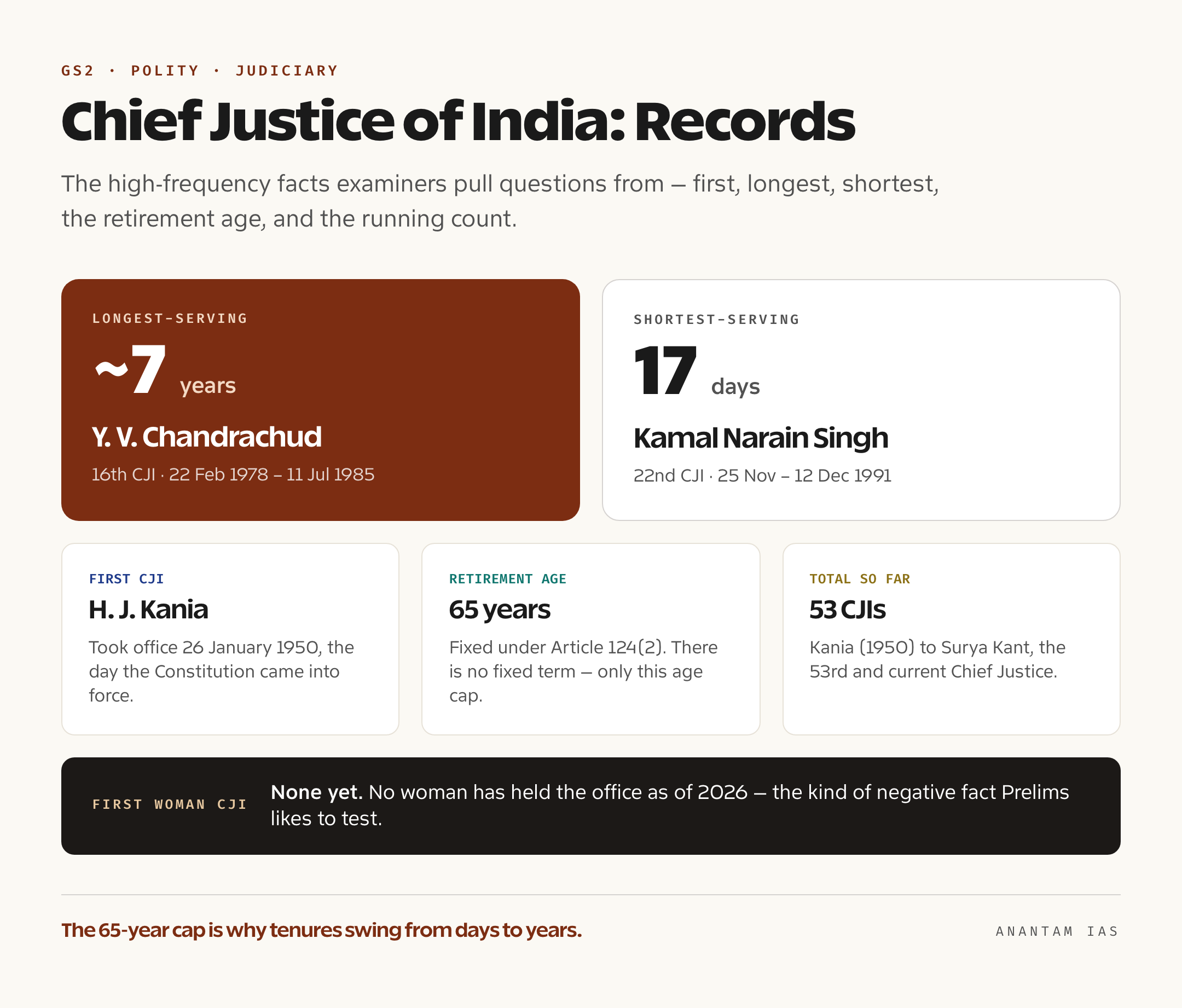
The longest-serving Chief Justice of India is Y. V. Chandrachud (the 16th CJI), who served for over seven years, from 22 February 1978 to 11 July 1985. No one has come close since, because the retirement age of 65 caps how long anyone can hold the post. By a neat coincidence his son, D. Y. Chandrachud, later became the 50th CJI, making them the only father-son pair to both hold the office.
The shortest-serving CJI is Kamal Narain Singh (the 22nd CJI), who held office for just 17 days in 1991, from 25 November to 12 December. He retired on reaching 65 almost immediately after taking charge, the textbook example of how the seniority convention can hand someone the top job for barely a fortnight.
A few more high-frequency facts, laid out so you can drill them:
| Record | Holder | Detail |
|---|---|---|
| First CJI | H. J. Kania | Took office 26 January 1950, the day the Constitution came into force |
| Longest-serving CJI | Y. V. Chandrachud | Over 7 years (1978 – 1985) |
| Shortest-serving CJI | Kamal Narain Singh | 17 days (1991) |
| First Dalit CJI | K. G. Balakrishnan | 37th CJI (2007 – 2010) |
| First Sikh CJI | Jagdish Singh Khehar | 44th CJI (2017) |
| First woman CJI | None yet | No woman has held the office as of 2026 |
| Retirement age | 65 years | Fixed under Article 124(2) |
| Total CJIs so far | 53 | Kania (1950) to Surya Kant (2026) |
On the woman-CJI question, be honest in your answer and do not guess: India has not yet had a woman Chief Justice of India. The first woman judge of the Supreme Court was Justice M. Fathima Beevi, appointed in 1989, and several women have served on the apex court since, but none has reached the top post. That is exactly the kind of negative fact a Prelims paper likes to test, so do not let a confident-sounding option trick you.
How the CJI Is Appointed: Collegium and Criticism
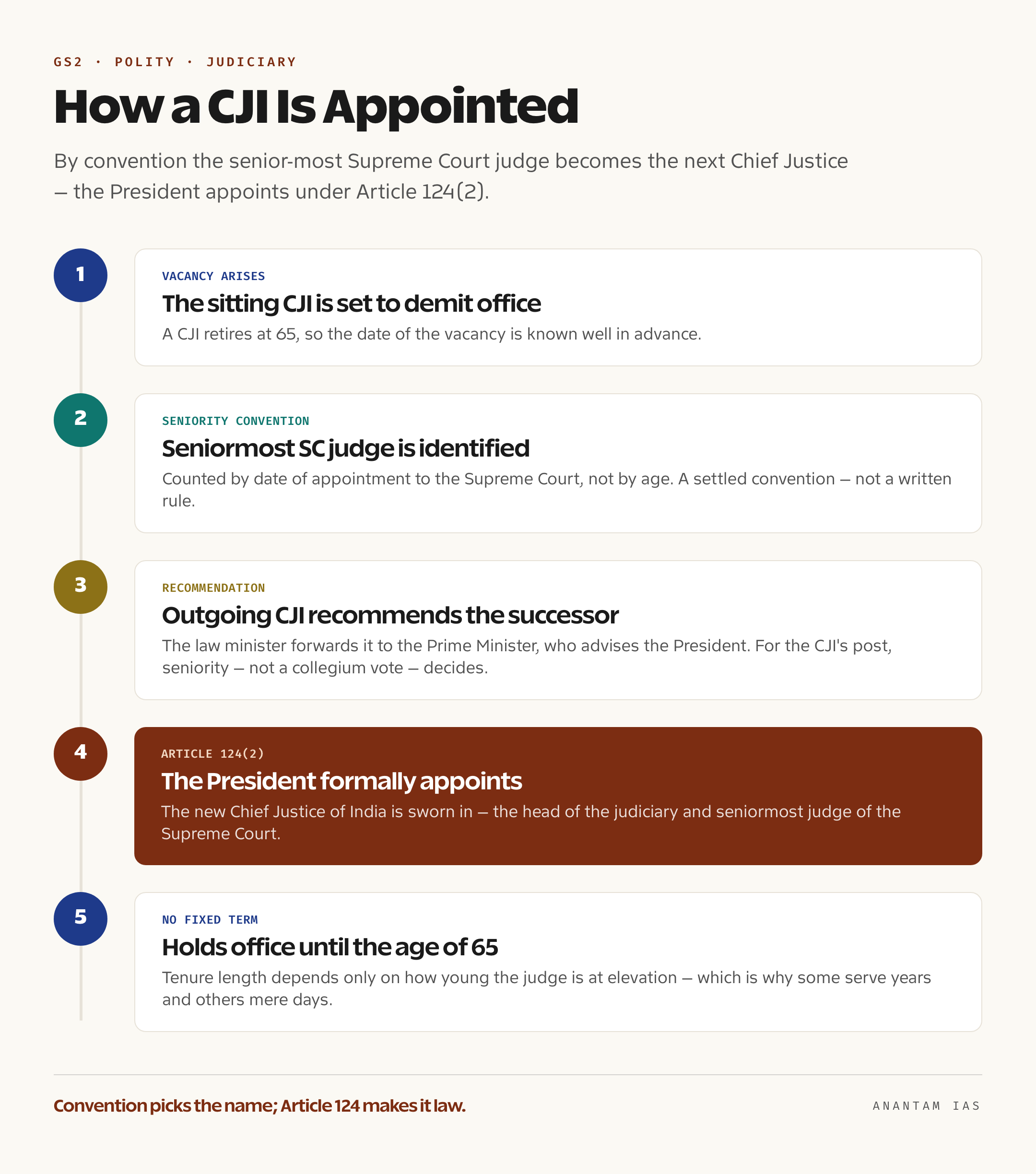
The appointment is short to describe and long to debate. When a vacancy is about to arise, the outgoing CJI recommends the senior-most judge of the Supreme Court as successor, the law minister forwards it to the Prime Minister, and the President formally appoints that judge under Article 124. For the CJI’s own post, the collegium does not “vote”, the seniority convention decides who is recommended. This is the appointment of the Chief Justice, and it runs almost on autopilot once seniority is settled.
For all other Supreme Court and High Court judges, the collegium system does the heavy lifting. The Supreme Court collegium is the CJI plus the four senior-most judges of the Court. It recommends names; the government can raise objections and send a name back once; if the collegium reiterates it, the government is bound to appoint. There is no role here for Parliament and no public interview, which is precisely the friction point. If you want the mechanism in full, read our deeper note on the collegium system and judicial appointments in India, and pair it with the broader Indian judiciary and Supreme Court overview.
The big criticism is transparency. Critics, including many within the legal fraternity, argue the collegium is opaque, has no published criteria, and amounts to “judges appointing judges” with no accountability to the elected branches. Parliament tried to change this with the 99th Constitutional Amendment and the National Judicial Appointments Commission (NJAC) Act, 2014, which would have given the executive and eminent persons a formal say. But in 2015, in the Fourth Judges Case (Supreme Court Advocates-on-Record Association v. Union of India), a five-judge bench struck down the NJAC as unconstitutional by a 4-1 majority, holding that it violated the basic structure by compromising judicial independence. So the collegium survived, and the transparency debate is still very much alive, which makes it a ready-made Mains question on judicial reform. For the foundational doctrine, see our explainer on the basic structure doctrine.
How to Study This for UPSC
Treat this topic as a Prelims-first, Mains-second target. Get the records cold, then build the conceptual layer on top.
For Prelims, memorise the high-frequency facts, not the full list of 53 names. Lock in the first CJI (Kania), the longest-serving (Y. V. Chandrachud, ~7 years), the shortest-serving (Kamal Narain Singh, 17 days), the retirement age (65), and the negative fact that there has been no woman CJI yet. Know that appointment is under Article 124 and that the CJI is appointed by the President. Do not waste hours rote-learning every name from the 1960s; that level of detail almost never appears.
For Mains, the value is in the collegium versus NJAC debate. Be able to explain the Three Judges Cases, how “consultation” became “concurrence”, why the NJAC was struck down in 2015, and what reforms (a Memorandum of Procedure, more transparency, fixed criteria) are on the table. This connects to broader themes of judicial independence, separation of powers, and accountability. Skip the trivia in Mains; the examiner wants your reasoning on the appointment system, not a recital of tenures.
The smartest move is to study this alongside the institution itself rather than in isolation. Read the appointment process, then immediately revise the basic structure doctrine and the powers of the Supreme Court, because GS Paper 2 questions usually braid them together. That linkage is the whole secret to scoring on the Polity judiciary section.
Frequently Asked Questions
Who is the current Chief Justice of India in 2026? Justice Surya Kant is the current and 53rd Chief Justice of India. He took office on 24 November 2025 and his tenure is scheduled to run until 9 February 2027. He is the first CJI from Haryana.
Who was the first Chief Justice of India? H. J. Kania was the first CJI, taking office on 26 January 1950, the day the Constitution came into force. He served until his death in office on 6 November 1951.
Who is the longest-serving Chief Justice of India? Y. V. Chandrachud, the 16th CJI, holds the record at over seven years (22 February 1978 to 11 July 1985). The shortest-serving was Kamal Narain Singh at just 17 days in 1991.
Has India ever had a woman Chief Justice of India? No. As of 2026, no woman has served as CJI. The first woman judge of the Supreme Court was Justice M. Fathima Beevi in 1989, but the top post has not yet gone to a woman.
Under which Article is the Chief Justice of India appointed? The CJI is appointed by the President under Article 124(2) of the Constitution. By convention the senior-most Supreme Court judge is elevated, and a CJI retires at the age of 65.
Practice Questions
Prelims MCQs
- Who among the following was the first Chief Justice of India? (a) M. Patanjali Sastri (b) H. J. Kania (c) B. K. Mukherjea (d) S. R. Das Answer: (b) H. J. Kania took office on 26 January 1950 as the first CJI.
- The Chief Justice of India is appointed by the President under which Article of the Constitution? (a) Article 76 (b) Article 124 (c) Article 148 (d) Article 217 Answer: (b) Article 124(2) governs the appointment of Supreme Court judges, including the CJI.
- Who is the longest-serving Chief Justice of India? (a) D. Y. Chandrachud (b) K. G. Balakrishnan (c) Y. V. Chandrachud (d) A. N. Ray Answer: (c) Y. V. Chandrachud served over seven years, from 1978 to 1985.
- Consider the following statements about the collegium system: 1. It was created by an Act of Parliament. 2. The NJAC, which sought to replace it, was struck down by the Supreme Court in 2015. Which is/are correct? (a) 1 only (b) 2 only (c) Both (d) Neither Answer: (b) The collegium evolved through judicial interpretation in the Three Judges Cases, not by statute; the NJAC was struck down in 2015.
- As of 2026, which of the following statements is correct? (a) India has had two women Chief Justices (b) The CJI retires at the age of 62 (c) No woman has yet served as CJI (d) The CJI is elected by Parliament Answer: (c) No woman has held the post; the CJI retires at 65 and is appointed by the President.
Mains Practice Questions
- Trace the evolution of the collegium system through the Three Judges Cases and assess whether it adequately balances judicial independence with accountability. (15 marks, 250 words)
- “The NJAC verdict of 2015 reaffirmed judicial independence but left the transparency problem unsolved.” Critically examine. (15 marks, 250 words)
- Discuss the constitutional provisions and conventions governing the appointment of the Chief Justice of India, and evaluate the consequences of the supersessions during the 1970s. (10 marks, 150 words)
- Examine the role of the Chief Justice of India as “master of the roster” and the concerns it has raised about concentration of administrative power within the judiciary. (15 marks, 250 words)
- What reforms could improve transparency in higher judicial appointments in India without compromising the independence of the judiciary? (10 marks, 150 words)
So here is what this list really gives you. The names are worth a few easy Prelims marks, but the durable value is the system behind them: a top job that runs on convention rather than statute, an appointment process the courts built for themselves, and a transparency debate Parliament could not legislate away. Memorise the records, yes, but spend most of your prep understanding why Surya Kant sits where Kania once did and why no one can change that route without touching the basic structure. Get that, and the judiciary section of Polity stops being a memory test and starts being a story you can argue.