Lithium-ion Batteries (UPSC Science & Tech)
UPSC guide to lithium-ion batteries: electrochemistry, cell architecture, India's battery push, PLI ACC, recycling, alternative chemistries, 2024-26 updates.
A lithium-ion (Li-ion) battery is a rechargeable electrochemical cell that stores energy by shuttling lithium ions between two electrodes. Light, power-dense and rechargeable thousands of times, the Li-ion battery has quietly become the operating system of the energy transition. It powers smartphones, laptops, electric vehicles, grid storage, satellites, drones and increasingly even airplanes. The 2019 Nobel Prize in Chemistry went to John Goodenough, Stanley Whittingham and Akira Yoshino for inventing it.
For an India that has committed to 500 GW of non-fossil power capacity by 2030, 30% EV penetration by 2030, net-zero by 2070, and a panchamrit climate framework, mastering lithium-ion batteries — and their successors — is the single most important industrial policy question of the decade. For UPSC, the topic spans GS III — Science & Technology, Economy, Environment and Internal Security.
What is a Li-ion battery — the underlying science
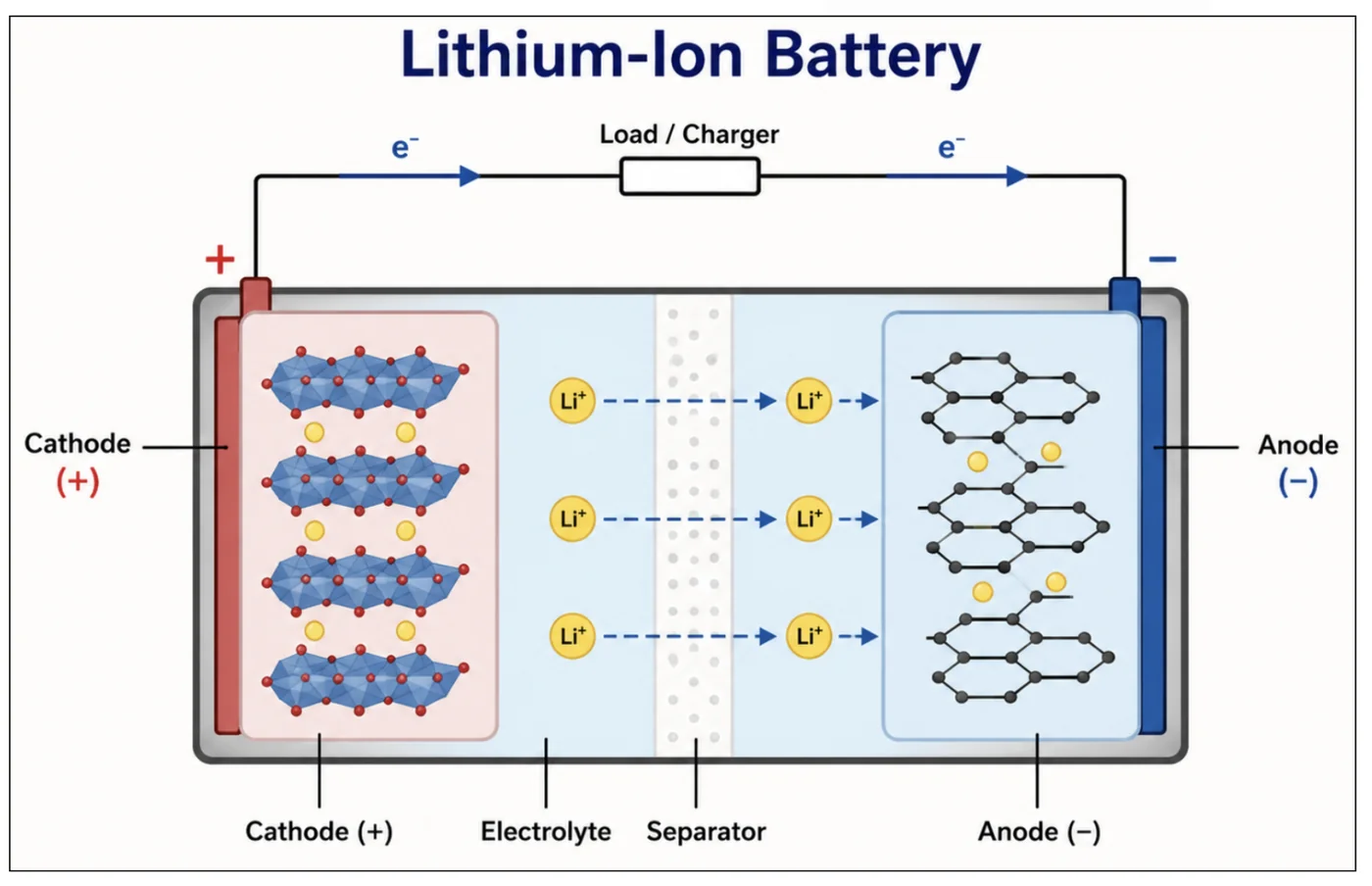
A Li-ion cell has four core components:
- Cathode (positive electrode) — typically a lithium metal oxide such as lithium iron phosphate (LFP), lithium nickel manganese cobalt oxide (NMC), or lithium nickel cobalt aluminium oxide (NCA).
- Anode (negative electrode) — usually graphite; emerging variants use silicon-graphite composites or lithium metal.
- Electrolyte — a lithium salt (typically LiPF₆) dissolved in an organic carbonate solvent. Solid electrolytes are emerging.
- Separator — a porous polymer membrane that prevents short circuits while letting lithium ions pass.
How it works
When the cell discharges, lithium ions move from the anode through the electrolyte to the cathode, while electrons flow through the external circuit, powering your phone or motor. Charging reverses the process — an external voltage drives lithium ions back to the anode.
This is intercalation chemistry: lithium ions slot into and out of layered electrode structures without destroying them, allowing 500-3,000 charge-discharge cycles depending on chemistry and use.
Cell formats
| Format | Use cases |
|---|---|
| Cylindrical (18650, 21700, 4680) | Laptops, EVs (Tesla, Ola), power tools |
| Prismatic | EV packs (BYD, CATL), stationary storage |
| Pouch | Smartphones, tablets, drones |
Why Li-ion batteries matter
| Property | Value | Significance |
|---|---|---|
| Energy density | 250-300 Wh/kg | 6× lead-acid; ideal for mobility |
| Round-trip efficiency | 90-95% | Far higher than thermal storage |
| Self-discharge | <5% per month | Stays charged for long periods |
| Cycle life | 500-3,000+ cycles | Multi-year service life |
| Voltage | 3.6-3.7 V (LFP 3.2 V) per cell | Fewer cells per pack |
These properties make Li-ion the only commercially viable chemistry for mass-market EVs today.
Cathode chemistries — which is winning?
| Chemistry | Energy density | Cost | Safety | Use |
|---|---|---|---|---|
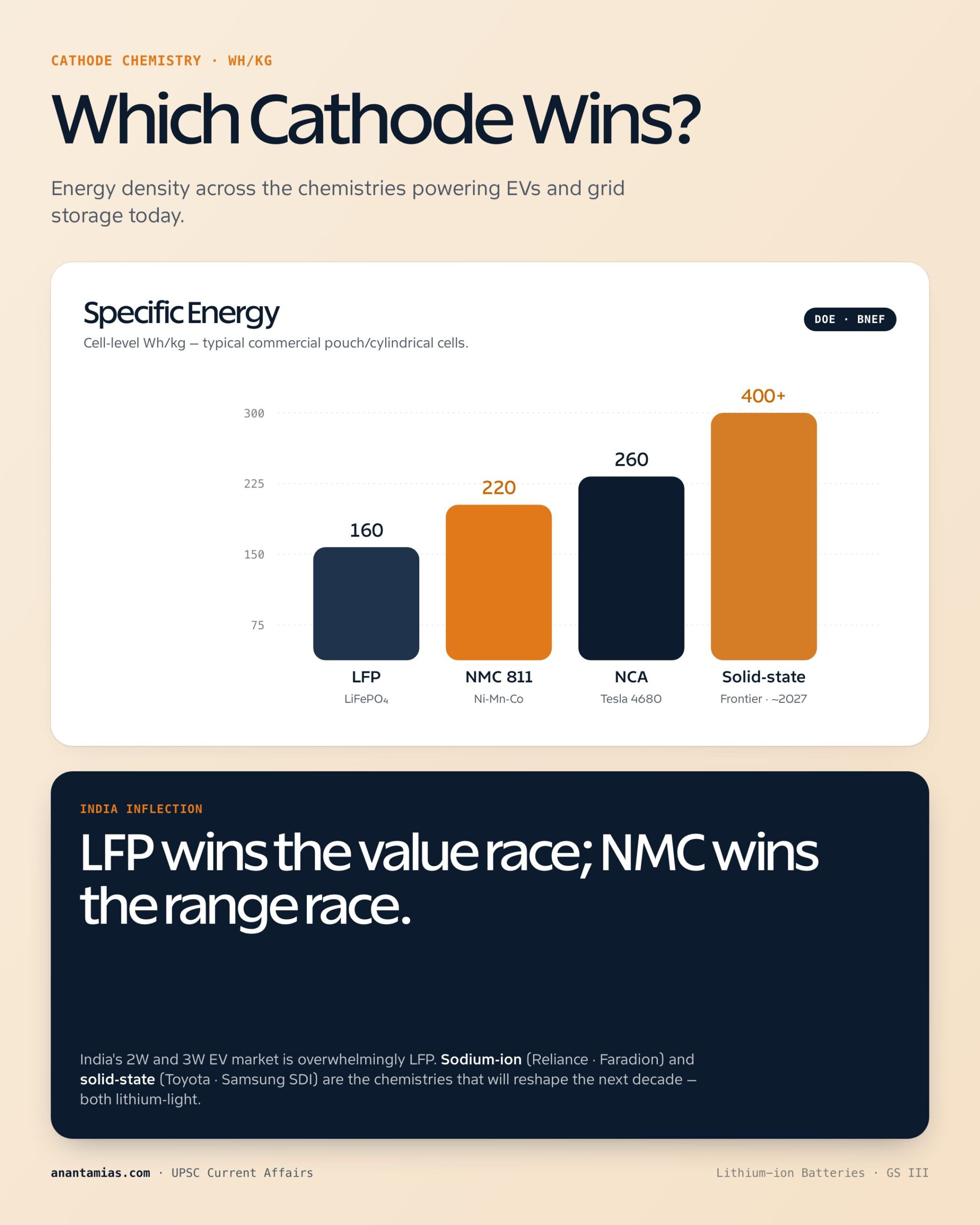
| LFP (LiFePO₄) | Lower (~160-180 Wh/kg) | Lowest | Best (no thermal runaway) | Mass-market EVs, grid storage |
| NMC | High (~200-260 Wh/kg) | Mid | Good | Premium EVs, consumer electronics |
| NCA | Highest (~250-280 Wh/kg) | High | Moderate | Tesla legacy packs |
| LMFP | ~200 Wh/kg | Low | Good | Emerging mid-range EVs |
| LCO (LiCoO₂) | High | High | Lower | Phones, laptops |
LFP has surged from ~10% of EV battery share in 2020 to over 50% globally in 2024, driven by cost and safety advantages — a major shift.
India's battery story
India sells over 20 lakh electric vehicles a year (2-wheelers, 3-wheelers, e-buses), runs the world's largest EV bus tender programme, and aims for 30% EV penetration by 2030. Yet most Li-ion cells are imported, mainly from China, South Korea, Taiwan and Japan. Plugging this gap is national-security-grade industrial policy.
Key initiatives
| Initiative | Detail |
|---|---|
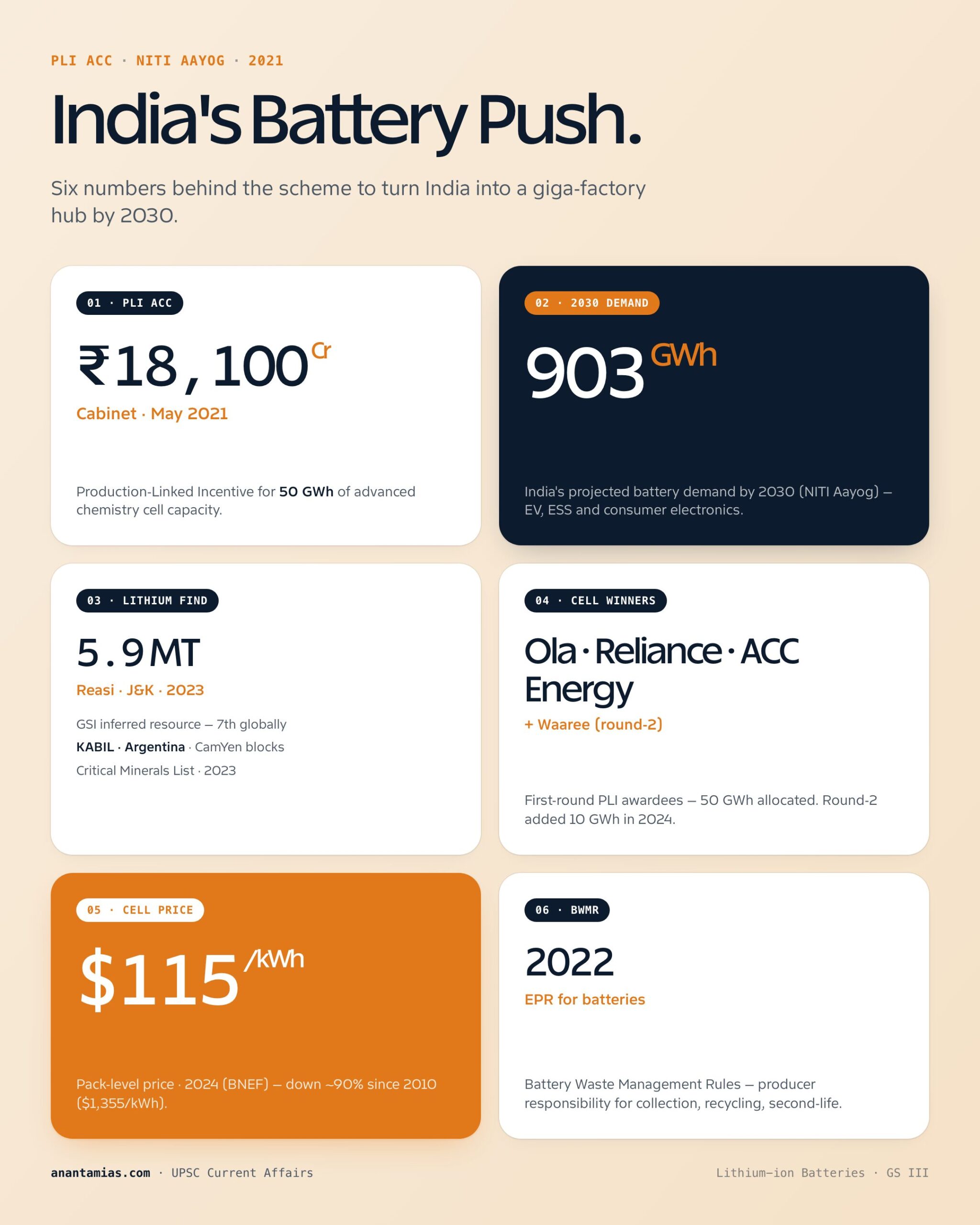
| PLI for Advanced Chemistry Cell (ACC) Battery Storage | Rs 18,100 crore outlay (2021); 30 GWh first round; 50 GWh capacity expected by 2027 |
| PLI for Auto and Auto Components | Rs 25,938 crore for EV-grade vehicles |
| FAME-II / PM E-DRIVE | Demand subsidies for EV adoption |
| National Mission on Transformative Mobility and Battery Storage (2019) | Niti Aayog blueprint |
| National Battery Energy Storage Systems Programme | Viability Gap Funding for grid-scale BESS |
| PM-KUSUM | Solar + battery for farm pumps |
| National Critical Minerals Mission (2024) | Secures lithium, cobalt, nickel, graphite supply |
| KABIL | Khanij Bidesh India — overseas critical minerals JV |
Domestic resources
- Lithium — major 5.9 million tonne inferred resource discovered in Reasi, Jammu & Kashmir (2023); blocks in Karnataka and Rajasthan also under exploration.
- Cobalt — minor reserves in Odisha, Jharkhand.
- Nickel — chromite-associated nickel in Odisha.
- Graphite — among the world's top reserves; Andhra Pradesh, Odisha, Jharkhand.
Companies setting up cell factories
- Reliance New Energy (Jamnagar) — gigafactory underway.
- Ola Electric (Krishnagiri) — first cells from 2024-25.
- Amara Raja (Telangana) — gigafactory.
- Exide Industries + SVOLT JV — Bengaluru gigafactory.
- Tata Cell — Sanand, Gujarat (under construction).
- Lucas TVS and others — smaller-scale.
ISRO technology transfer
ISRO has successfully run Li-ion batteries on Indian satellites for over a decade. It transferred its space-grade Li-ion battery technology to over a dozen Indian firms, helping kick-start the domestic ecosystem.
Challenges to Li-ion manufacturing in India
| Challenge | Detail |
|---|---|
| Critical mineral dependence | Lithium, cobalt, nickel mostly imported; China dominates 60-80% of refining |
| Capital intensity | Gigafactory: USD 1.5-3 billion; long payback |
| Cell technology IP | Held by China (CATL, BYD), Korea (LG, Samsung, SK), Japan (Panasonic) |
| Manufacturing cost | India 30-40% costlier than China at start of production |
| Energy and water | Cell plants need vast clean power and ultra-pure water |
| Skilled workforce | Cell engineering, electrochemistry talent in short supply |
| Charging infrastructure | Public charging network still maturing |
| MSME transition | 2,000+ ICE part suppliers need re-skilling for EV components |
| Recycling capacity | India yet to scale closed-loop battery recycling |
Battery recycling and second-life
A used EV battery still retains 70-80% of its capacity — enough for a decade more in stationary storage before recycling.
- Battery Waste Management Rules, 2022 — extended producer responsibility (EPR) for battery makers.
- Rules amended 2024-25 to clarify Li-ion handling.
- Second-life storage — paired with rooftop solar, telecom towers.
- Hydrometallurgical recycling — recovers lithium, cobalt, nickel; firms like Attero Recycling, Lohum, BatX Energies scaling up.
Alternative and next-generation chemistries
- Sodium-ion batteries — abundant raw materials; lower energy density; CATL's Naxtra and BYD's sodium products commercialised in 2024-25. India's CSIR-CECRI has indigenous sodium-ion cells.
- Solid-state batteries — replace liquid electrolyte with solid; higher density, safer; Toyota and QuantumScape racing to 2027 commercialisation.
- Lithium-sulfur — high theoretical density, lighter; cycle-life challenges.
- Lithium iron manganese phosphate (LMFP) — extends LFP energy density.
- Vanadium redox flow batteries — for grid-scale long-duration storage.
- Zinc-bromine and iron-air — emerging long-duration storage chemistries.
- Hydrogen fuel cells — complementary, not directly competitive; better for heavy mobility.
India's National Programme on Advanced Cell Manufacturing (PLI-ACC) explicitly covers all these chemistries, not only Li-ion.
Global landscape
| Country | Position |
|---|---|
| China | Dominates 70%+ of cell manufacturing and 60-80% of mineral refining |
| South Korea | LG Energy, Samsung SDI, SK On — premium NMC/NCA |
| Japan | Panasonic, Toyota — high-end cells; solid-state lead |
| United States | Inflation Reduction Act tax credits; Tesla, GM-LG, Ford-CATL |
| EU | EU Battery Regulation 2023; Northvolt and ACC gigafactories |
| Australia, Chile, Argentina | Lithium reserves and mining |
| DRC | World's largest cobalt producer |
The EU Battery Regulation (2023) mandates a digital battery passport by 2027 — every cell to carry traceable carbon-footprint and recycled-content data.
Recent developments (2024-26)
- Reasi lithium block (J&K) — first auction round in 2024 saw no qualifying bid; second round revised in 2025.
- Critical Minerals Mission approved in January 2025 for indigenous and overseas supply.
- PLI ACC second tranche — added 20-30 GWh capacity to base 30 GWh.
- PM E-DRIVE Scheme (2024) — Rs 10,900 crore for EV demand subsidy through 2026.
- Sodium-ion commercial launches by CATL, BYD, HiNa in 2024-25; CSIR-CECRI announced indigenous sodium-ion 2025.
- EU Battery Passport — phased rollout 2025-27 affecting Indian exporters.
- Battery Waste Management (Amendment) Rules 2024-25 — refined EPR thresholds.
- EV charging interoperability standard — Bharat AC-001 / DC-001 updated.
- National Hydrogen Mission continues to develop fuel cells for trucks, buses, trains as complement to Li-ion.
- Lithium recycling capacity crossed 100,000 tonnes/year in India by 2025 (Lohum, Attero, BatX, Tata Chemicals).
- Tesla India entry (announced 2025) — likely to source LFP cells locally over time.
Way forward
- Secure mineral supply — expedite Reasi auction, KABIL JVs in Argentina/Chile/Australia, recycle.
- Scale gigafactories — meet PLI ACC milestones; encourage cathode and electrolyte plants alongside cell plants.
- Move up the value chain — build cathode active material (CAM) and battery management systems domestically.
- Diversify chemistries — strong domestic LFP and sodium-ion bet; long-duration flow batteries for grid.
- Recycling infrastructure — incentivise hydrometallurgical recycling; standardise battery passports.
- Charging network — public-private rollout of fast chargers, battery swap standards (esp. for 2W/3W).
- Skill ecosystem — ITI and B.Tech specialisations in electrochemistry, battery engineering.
- Battery safety standards — codify AIS-156 phase 2; address fires in 2W EVs.
- Grid storage — viability-gap funding for BESS to absorb solar surplus.
- MSME transition — re-skilling auto-component makers for motors, BMS, electronics.
Mains hook
"In the 21st century, control of lithium will be what control of oil was in the 20th — except that lithium can be recycled almost indefinitely." In light of this, examine India's strategy for Li-ion battery security across mining, manufacturing and recycling. (GS III, 250 words, 15 marks)
Prelims pointers
- Li-ion battery components — cathode (LFP, NMC, NCA), anode (graphite/silicon), electrolyte (LiPF₆), separator.
- Nobel Prize in Chemistry 2019 — Goodenough, Whittingham, Yoshino for the lithium-ion battery.
- PLI ACC — Rs 18,100 crore for 50 GWh advanced chemistry cells.
- Reasi lithium discovery (J&K, 2023) — 5.9 MT inferred resource.
- KABIL — Khanij Bidesh India for overseas critical minerals.
- National Critical Minerals Mission — approved January 2025.
- Battery Waste Management Rules, 2022 — EPR for battery producers.
- AIS-156 — Indian standard for EV battery safety.
- EU Battery Regulation (2023) — mandates digital battery passport by 2027.
- LFP — lithium iron phosphate; NMC — nickel manganese cobalt; NCA — nickel cobalt aluminium.
- Sodium-ion — emerging chemistry, abundant inputs, lower energy density.
- PM E-DRIVE — Rs 10,900 crore EV scheme (2024-26).
- Top global cathode producers — China dominant; LFP overtook NMC globally in 2024.
For the UPSC aspirant, Li-ion batteries are the case study where electrochemistry, mineral geopolitics, climate policy, industrial policy and consumer technology collide. Treat them as the control point of the energy transition, and your answers will gain instant analytical depth.