Local Winds: Loo, Chinook and Foehn Compared
The Loo is hot because it comes from a hot place; the Chinook and Foehn are hot because they descend a mountain. Regions, mechanisms and impacts compared.
Local winds are small-scale winds produced by regional differences in heating, pressure or relief, and the Loo, Chinook and Foehn are the three most frequently compared examples. All three are hot and dry, which is why they are grouped together. The grouping hides a basic difference: the Loo is hot because it comes from a hot place, while the Chinook and Foehn become hot by descending a mountain.
The Two Mechanisms
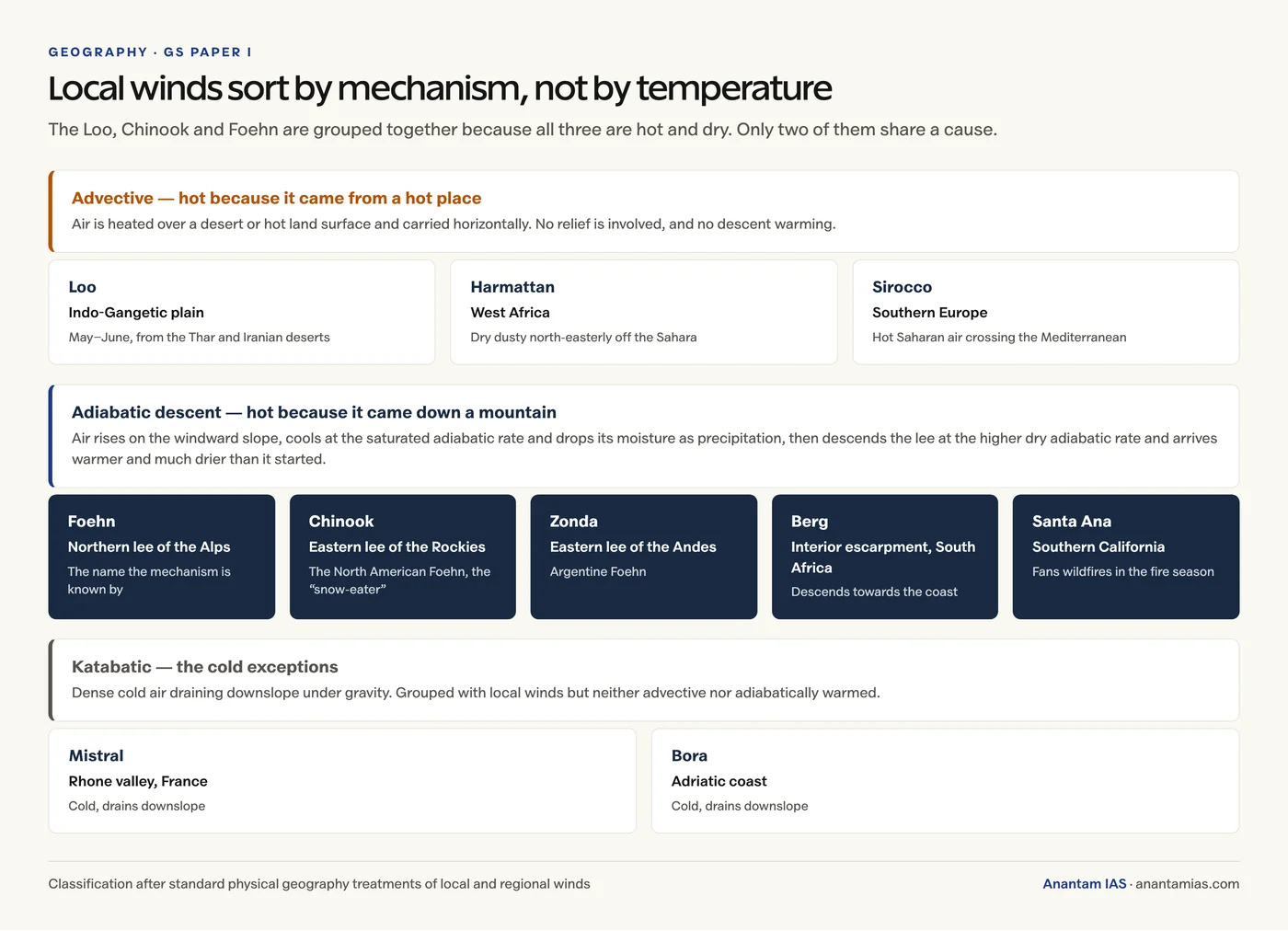
- Advective winds carry the temperature of their source region. The Loo, the Harmattan of West Africa and the Sirocco of the Mediterranean all belong here.
- Adiabatic descent winds are warmed by compression as they sink down the leeward side of a mountain range. Air rises on the windward slope, cools at the saturated adiabatic lapse rate while precipitating out its moisture, then descends at the higher dry adiabatic rate and arrives warmer and much drier than it started. The Chinook, Foehn, Zonda, Berg and Santa Ana are all of this type.
That single distinction is usually worth marks on its own. The general framework sits in our guide to pressure belts and wind systems.
The Loo
- Region: the Indo-Gangetic plain, from western Rajasthan and Punjab through Haryana, Delhi and Uttar Pradesh into Bihar; also parts of Pakistan.
- Season: May and June, strongest in the afternoon, dying down after sunset.
- Source: the Thar and the Iranian-Baluchi deserts, blowing from the west and north-west.
- Character: temperatures commonly 45 to 50 degrees Celsius with very low humidity.
- Mechanism: intense insolation over the north-western desert creates a thermal low, and air heated over that surface is advected eastwards. No descent warming is involved.
- Impacts: heat-stroke mortality, high evapotranspiration and soil-moisture loss, wilting of standing crops, forest-fire risk, dust storms and reduced visibility.
- The useful side: the deep thermal low the Loo signals is part of the pressure gradient that draws in the south-west monsoon.
The Chinook
- Region: the eastern slopes of the Rocky Mountains, in Alberta and British Columbia in Canada and Montana, Wyoming and Colorado in the United States.
- Season: chiefly winter and early spring.
- Character: a warm, dry, gusty westerly descending the lee slope. The name is often rendered as “snow-eater”.
- Mechanism: Pacific air rises over the Rockies, loses its moisture as precipitation on the windward side, then descends the lee at the dry adiabatic rate.
- Impacts: dramatic temperature jumps, historically over 20 degrees Celsius in an hour, which melt and sublimate snow cover. This exposes winter pasture for cattle on the prairies and clears roads, but also causes flash snowmelt flooding and raises wildfire risk.
The Foehn
- Region: the northern leeward valleys of the Alps in Switzerland, Austria, southern Germany and northern Italy.
- Season: any season, most notable in spring.
- Character: warm and very dry, often with an unmistakable “Foehn wall” of cloud on the windward crest and exceptional visibility on the lee side.
- Mechanism: identical adiabatic compression to the Chinook. The Chinook is, in effect, the North American Foehn.
- Impacts: early ripening of grapes and orchard fruit in Alpine valleys, an extended growing season, rapid snowmelt and avalanche triggering, increased fire risk, and the well-documented “Foehnkrankheit” reports of migraine and sleep disturbance.
Side-by-Side Comparison
| Basis | Loo | Chinook | Foehn |
|---|---|---|---|
| Region | Indo-Gangetic plain | Lee of the Rockies | Lee of the Alps |
| Season | May to June | Winter to spring | All year, mainly spring |
| Origin | Advection from a hot desert source | Adiabatic compression on descent | Adiabatic compression on descent |
| Moisture | Dry at source | Dried by windward precipitation | Dried by windward precipitation |
| Effect on snow | Not applicable | Melts and sublimates snow | Melts snow, triggers avalanches |
| Agricultural effect | Damages standing crops | Opens winter pasture for grazing | Ripens grapes and orchard fruit early |
| Net economic effect | Largely harmful | Mixed, often beneficial | Mixed, often beneficial |
Other Local Winds Worth Knowing
- Harmattan: dry dusty north-easterly over West Africa, advective like the Loo; locally called the “doctor” for its cooling relief on the humid coast.
- Sirocco: hot Saharan wind reaching southern Europe, often carrying dust and, after crossing the Mediterranean, moisture.
- Mistral and Bora: cold, not hot, descending winds in the Rhone valley and the Adriatic respectively.
- Santa Ana: Californian descent wind, the same mechanism as the Foehn, notorious for fanning wildfires.
- Zonda (Argentina) and Berg (South Africa): further Foehn-type winds.
Frequently Asked Questions
What is the difference between the Loo and the Chinook?
The Loo is an advective wind, hot because it blows out of the Thar and Iranian deserts across the Indo-Gangetic plain in May and June. The Chinook is an adiabatic descent wind, warmed by compression as it sinks down the eastern slopes of the Rockies in winter and spring. Different mechanisms, similar heat and dryness.
Why is the Chinook called the snow-eater?
Because it can raise temperatures by more than 20 degrees Celsius within an hour and is extremely dry, so it both melts and sublimates snow cover very quickly. This exposes winter pasture for cattle on the prairies, but can also cause flash snowmelt flooding.
Are the Chinook and Foehn the same wind?
They are the same phenomenon under different names. Both are warm, dry winds produced by adiabatic compression on the leeward side of a mountain range. Foehn is the Alpine name and Chinook the North American one; the Zonda, Berg and Santa Ana are further regional variants.
Is the Loo harmful or useful?
Mostly harmful. It causes heat-stroke deaths, wilts standing crops, raises evapotranspiration and drives dust storms. Its one useful role is indirect: the deep thermal low over north-west India that the Loo signals helps establish the pressure gradient that draws in the south-west monsoon.
What is the Foehn wall?
It is the bank of cloud that forms and remains over the windward crest of a mountain range while the Foehn descends on the leeward side. It marks where the rising air has dropped its moisture, and the lee side is left with exceptional clarity and visibility.
Which local winds are cold rather than hot?
The Mistral of the Rhone valley and the Bora of the Adriatic are both cold descending winds. They are katabatic, draining dense cold air downslope, rather than being warmed by adiabatic compression like the Foehn and Chinook.
Practice Questions
Prelims MCQs
1. The Loo is best described as a:
- (a) Katabatic wind
- (b) Advective hot wind from a desert source
- (c) Adiabatic descent wind
- (d) Cold local wind
Answer: (b) Advective hot wind from a desert source
2. The Chinook wind blows on the leeward side of which mountain range?
- (a) The Andes
- (b) The Alps
- (c) The Rocky Mountains
- (d) The Himalaya
Answer: (c) The Rocky Mountains
3. Which pair of winds shares the same physical mechanism?
- (a) Loo and Harmattan
- (b) Chinook and Foehn
- (c) Mistral and Sirocco
- (d) Bora and Loo
Answer: (b) Chinook and Foehn
4. A Foehn-type wind becomes warm and dry mainly because:
- (a) It passes over a hot desert
- (b) It absorbs heat from the sea
- (c) Descending air is warmed by adiabatic compression after losing moisture on the windward slope
- (d) It is heated by urban surfaces
Answer: (c) Descending air is warmed by adiabatic compression after losing moisture on the windward slope
5. Which of the following is a cold local wind?
- (a) Santa Ana
- (b) Zonda
- (c) Mistral
- (d) Berg
Answer: (c) Mistral
Mains Questions
- Compare the Loo, Chinook and Foehn winds with respect to their regions of prevalence, their nature and climatic impacts.
- Distinguish between advective and adiabatic descent winds with suitable examples.
- “Local winds are minor in scale but major in local economic consequence.” Discuss.
- Examine the role of the north-west Indian thermal low in the onset of the south-west monsoon.
- Discuss the impact of hot local winds on agriculture and public health in northern India.