16 Mahajanapadas: List, Capitals, Map and Significance in Ancient India
Complete guide to the 16 Mahajanapadas of ancient India with capitals, locations, map, rulers and UPSC significance for Prelims and Mains History preparation.
Introduction
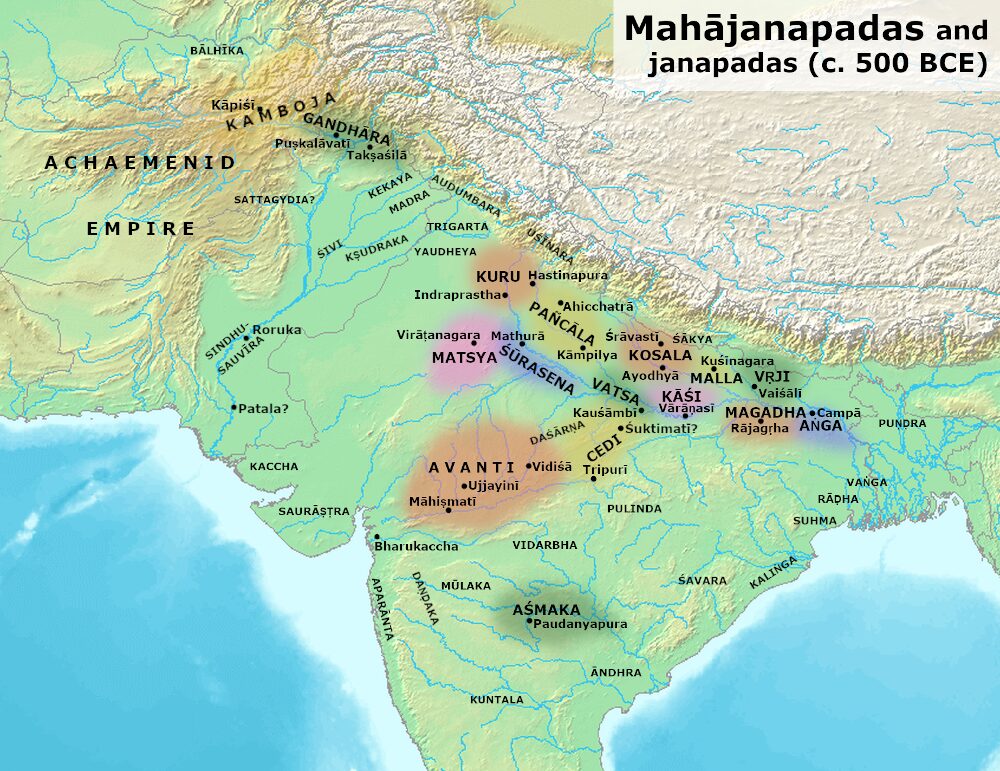
The 16 Mahajanapadas mark one of the most transformative phases in Indian history, the moment when the tribal republics and small chiefdoms of the later Vedic age coalesced into sixteen powerful territorial states spread across the northern half of the subcontinent. Emerging in the sixth century BCE, these kingdoms laid the political, economic and cultural foundations on which the Magadhan empire, the Mauryas and every subsequent imperial formation in India would eventually rest.
For the UPSC aspirant, the Mahajanapadas are non-negotiable. They appear in Prelims as direct factual questions on capitals and rulers, and in Mains as the context for the rise of heterodox faiths like Buddhism and Jainism, the shift from pastoral to agrarian economies, the birth of the second urbanisation, and the genesis of Indian statecraft. This guide consolidates every fact, map, and analytical angle you need.
Quick Facts at a Glance
| Parameter | Detail |
|---|---|
| Period | c. 600 BCE to c. 345 BCE |
| Primary sources | Anguttara Nikaya (Buddhist), Bhagavati Sutra (Jain), Mahabharata |
| Total number | 16 Mahajanapadas |
| Geographical spread | Kabul valley to Godavari basin |
| Political systems | Monarchies and Ganasanghas (republics) |
| Dominant polity | Magadha |
| Associated phase | Second urbanisation of India |
| Script in use | Brahmi and Kharoshthi |
Background and Historical Context
The term Mahajanapada literally means “great foothold of a tribe” (maha = great, jana = people, pada = foot or foothold). It evolved from the earlier concept of the Janapada of the later Vedic period (c. 1000 to 600 BCE), when Aryan-speaking clans settled along the Ganga-Yamuna doab and attached their tribal names to fixed territories. By the sixth century BCE, iron technology, surplus agriculture, the plough economy and the use of punch-marked silver coins (like the Karshapana) had converted these territorial pockets into full-blown states with standing armies, fortified capitals, salaried bureaucracies and codified taxation.
The Buddhist text Anguttara Nikaya, composed around the time of the Buddha, provides the canonical list of sixteen Mahajanapadas. The Jain Bhagavati Sutra offers a slightly different list, substituting names like Malaya and Vaccha for some of the Buddhist entries, which suggests regional variation in what constituted a “great” polity. The Mahabharata and Puranas also refer to these kingdoms, confirming that the sixteen-state framework was widely recognised by contemporaries.
Three forces accelerated the transition from janapada to mahajanapada. First, iron ploughshares cleared the dense forests of the middle Ganga basin, enabling large paddy surplus. Second, the emergence of towns like Rajagriha, Kaushambi, Varanasi and Ujjain created trade nodes that states wanted to tax and control. Third, constant warfare, documented vividly in the Buddhist Jatakas, forced smaller polities to either expand or be absorbed, and the four kingdoms of Magadha, Kosala, Vatsa and Avanti emerged as the ultimate survivors of this winnowing.
Key Features
The Canonical List of Sixteen
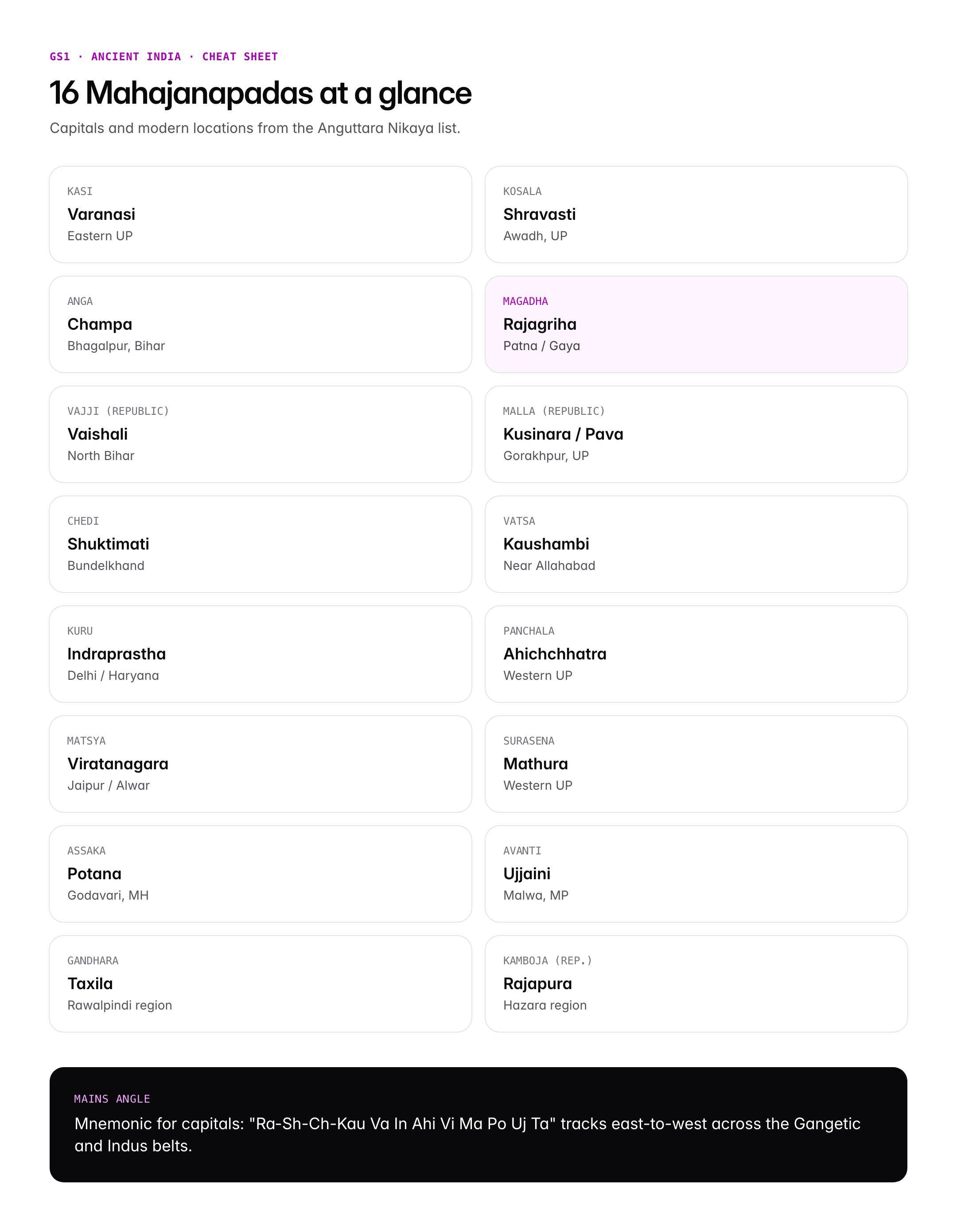
The following table integrates the Anguttara Nikaya list with modern geographical identifications.
| Mahajanapada | Capital | Modern Location | Type |
|---|---|---|---|
| Kasi | Varanasi | Eastern Uttar Pradesh | Monarchy |
| Kosala | Shravasti (north), Kushavati (south) | Awadh region, UP | Monarchy |
| Anga | Champa | Bhagalpur, Munger (Bihar) | Monarchy |
| Magadha | Rajagriha (later Pataliputra) | Patna, Gaya (Bihar) | Monarchy |
| Vajji | Vaishali | North Bihar | Republic (Ganasangha) |
| Malla | Kusinara and Pava | Gorakhpur region, UP | Republic |
| Chedi | Shuktimati | Bundelkhand, MP | Monarchy |
| Vatsa | Kaushambi | Near Allahabad, UP | Monarchy |
| Kuru | Indraprastha | Delhi, Meerut, Haryana | Monarchy |
| Panchala | Ahichchhatra (north), Kampilya (south) | Western UP | Monarchy |
| Matsya | Viratanagara | Jaipur, Alwar (Rajasthan) | Monarchy |
| Surasena | Mathura | Western UP | Monarchy |
| Assaka | Potana or Potali | Banks of Godavari, Maharashtra | Monarchy |
| Avanti | Ujjaini (north), Mahishmati (south) | Malwa, MP | Monarchy |
| Gandhara | Taxila | Rawalpindi region, Pakistan | Monarchy |
| Kamboja | Rajapura | Hazara region, Pakistan/Afghanistan | Republic |
Monarchies versus Republics
Twelve of the sixteen Mahajanapadas were monarchies (rajya), governed by hereditary kings advised by councils of ministers (parishad) and a commander-in-chief (senapati). The remaining four, most notably Vajji and Malla, were Ganasanghas or oligarchic republics where a ruling assembly of khattiya (kshatriya) clan heads governed through debate and majority vote. The Licchavi-led Vajji confederacy at Vaishali is often cited as the world’s first republic, predating the Greek city-states in some interpretations, and its constitutional traditions are preserved in the Buddha’s own praise of the seven conditions of welfare delivered to Vajji in the Mahaparinibbana Sutta.
Administrative Machinery
The typical Mahajanapada was divided into districts (ahara), villages (grama) headed by a gramani, and fortified towns (pura or durga). Taxation revolved around bhaga (a one-sixth share of produce), bali (tributes), and customs duties called shulka at river crossings and market gates. Standing armies consisted of the chaturanga bala (four limbs of infantry, cavalry, chariots and elephants). Currency was the silver punch-marked karshapana, minted by state authority and accepted across kingdom boundaries, signalling an integrated early-historic economy.

Significance for UPSC and General Knowledge
- The Mahajanapadas are the single most important template for understanding the birth of territorial statehood in India, which forms the backbone of the NCERT class 6 and class 12 History curricula.
- They constitute the political backdrop for the lives of Gautama Buddha and Mahavira, making them essential for questions on the origins of Buddhism and Jainism.
- The rivalry of the four leading Mahajanapadas, Magadha, Kosala, Vatsa and Avanti, directly anticipates the Magadhan supremacy under the Haryankas, Shishunagas and Nandas.
- They illustrate India’s indigenous experiments with republican governance centuries before democratic theory emerged elsewhere.
- The period marks the second urbanisation of India, with cities like Rajagriha, Shravasti and Ujjaini becoming planned political capitals.
- Coinage, iron metallurgy, Northern Black Polished Ware and the codification of Prakrit languages are all datable to this era, giving it immense archaeological value.
Detailed Analysis: Rise of Magadha and the Power Struggle
Among the sixteen Mahajanapadas, Magadha rose to eclipse all others and this story is a standard Mains favourite. Four factors explain its dominance. Geography was decisive: Magadha sat on the lower Ganga, with Rajagriha ringed by five hills and Pataliputra guarded by the confluence of the Ganga, Son, Gandak and Ghaghra, a riverine fortress almost impossible to besiege. Economically, the kingdom straddled the rich alluvial plains of south Bihar, the iron mines of modern Jharkhand (especially around Rajgir and Gaya) and elephant forests that fed a powerful war machine. Politically, a succession of ambitious rulers, Bimbisara and Ajatashatru of the Haryanka dynasty, pursued relentless expansion through matrimonial alliance and conquest. Culturally, Magadha remained relatively free from rigid Brahmanical orthodoxy, which allowed heterodox sects like Buddhism and Jainism to flourish and attract merchant patronage.
Bimbisara (c. 544 to 492 BCE) annexed Anga to its east, secured Kosala through marriage to Prasenajit’s sister, and forged a web of diplomatic ties with Vatsa and Avanti. His son Ajatashatru (c. 492 to 460 BCE) was more aggressive, defeating Kosala, dismembering the Vajji confederacy after a sixteen-year war, and introducing siege weapons like the rathamusala (chariot-scythe) and the mahashilakantaka (large stone-hurling catapult) recorded in Jain texts.
The Shishunagas absorbed Avanti, ending the last major rival in western India. The Nandas who followed (c. 345 to 321 BCE) finally consolidated Kalinga, Kosala and most of the Gangetic plain under a single administration, creating the political foundation Chandragupta Maurya would later inherit. The trajectory from sixteen Mahajanapadas to one Magadhan empire thus represents two centuries of centralisation, a process comparable in world history to the Warring States period of China or the unification of archaic Greece under Macedon.
Comparative Perspective
How do the Mahajanapadas compare with contemporary state formations elsewhere?
| Feature | Mahajanapadas (India, 6th c. BCE) | Greek City-States (Classical Greece) | Warring States (China, 475 to 221 BCE) |
|---|---|---|---|
| Typical polity size | Large territorial state | Small city-state (polis) | Large territorial state |
| Political variety | Monarchies and republics | Democracies, oligarchies, tyrannies | Centralising monarchies |
| End-point | Unification under Magadha/Maurya | Conquest by Macedon | Unification under Qin |
| Iron and coinage | Punch-marked silver karshapana | Drachma and obol | Spade and knife coins |
| Philosophical ferment | Buddha, Mahavira, Ajivikas | Socrates, Sophists | Confucius, Legalists, Mohists |
The parallel with the Warring States is especially striking: both began with a plurality of comparable polities and ended with a single autocratic victor who bequeathed administrative templates to all successors. The Indian path was less totalitarian than Qin China but more centralised than Greek poleis.
Challenges and Criticisms
Modern historiography flags three caveats. First, the list of sixteen is not absolute; the Jain Bhagavati Sutra preserves alternative names like Malaya, Vaccha and Lata, and some Puranas extend the count further. This suggests the “sixteen” is a stylised Buddhist convention rather than a geographer’s census. Second, the chronology is uncertain; absolute dates depend on the disputed “long” or “short” chronology of the Buddha’s life, which can shift the entire timeline by up to a century. Third, the survival of Ganasangha republics is sometimes romanticised as proto-democracy, but modern scholars like Romila Thapar caution that these were oligarchies restricted to kshatriya clans, excluding women, shudras and outsiders from the voting assembly.
There is also an ongoing debate about how much the second urbanisation owed to indigenous agrarian expansion versus stimulus from trans-regional trade with Persia and Central Asia, especially after Darius I’s Achaemenid conquest of Gandhara around 516 BCE. The current consensus leans heavily toward endogenous causes, but the question keeps surfacing in Mains answers.
Prelims Pointers
- The Anguttara Nikaya is the primary Buddhist source listing the 16 Mahajanapadas.
- Magadha’s first capital was Rajagriha (Girivraja), shifted to Pataliputra by Udayin.
- Vaishali was the capital of the Vajji confederacy, led by the Licchavi clan.
- Taxila (Gandhara) became a Persian satrapy after Darius I, circa 516 BCE.
- Ujjaini (Avanti) and Pataliputra were known as “nagaras” (planned cities) by the 4th century BCE.
- The Licchavis were the dominant clan in the Vajji Ganasangha.
- Pradyota was the famous king of Avanti contemporary to Bimbisara.
- Udayana was the legendary ruler of Vatsa at Kaushambi.
- Prasenajit ruled Kosala during the Buddha’s lifetime.
- Bimbisara founded the Haryanka dynasty of Magadha.
- Jainism’s Bhagavati Sutra offers an alternate list with some different names.
- Punch-marked karshapana was the standard silver coin of the period.
Mains Practice Questions
Q1. “The rise of Magadha among the 16 Mahajanapadas was as much a product of geography as of leadership.” Discuss. (15 marks, 250 words)
- Outline Magadha’s geographical advantages: fertile Gangetic plain, iron ore access, elephant forests, riverine defences at Rajagriha and Pataliputra.
- Analyse leadership factors: Bimbisara’s matrimonial diplomacy, Ajatashatru’s siege innovations, Mahapadma Nanda’s consolidation of Kalinga.
- Conclude that geography supplied the resource base while dynastic ambition converted it into hegemony, making the two forces complementary.
Q2. Examine the significance of the Ganasangha republics in the political history of ancient India. (10 marks, 150 words)
- Identify key republics: Vajji (Licchavis), Malla, Kamboja, Shakya of Kapilavastu.
- Describe institutional features: assembly (santhagara), voting, rotational leadership, codified procedure preserved in Buddhist texts.
- Evaluate their contribution as an indigenous tradition of collective governance and debate, while flagging limitations of clan-based exclusion.
Conclusion
The sixteen Mahajanapadas represent India’s first full-fledged experiment with territorial statehood, transforming a mosaic of tribal chiefdoms into centralised polities with standing armies, codified taxation and fortified capitals. Their rise coincided with the second urbanisation, the emergence of coinage, the flowering of Buddhism and Jainism, and the composition of the earliest Dharmasutras, making this period arguably the most intellectually creative phase of ancient Indian history.
For UPSC aspirants, mastery of the sixteen names, capitals, and locations is only the starting point. The deeper story lies in how four survivors, Magadha, Kosala, Vatsa and Avanti, whittled down the field until a single kingdom on the lower Ganga inherited the subcontinent’s imperial mantle. Understanding that trajectory prepares you for questions not just on the Mahajanapadas themselves but on every successor formation from the Mauryas to the Guptas.
Frequently Asked Questions
What are the 16 Mahajanapadas?
The 16 Mahajanapadas were large territorial states that flourished in northern India between the sixth and fourth centuries BCE. Listed in the Buddhist text Anguttara Nikaya, they include Kasi, Kosala, Anga, Magadha, Vajji, Malla, Chedi, Vatsa, Kuru, Panchala, Matsya, Surasena, Assaka, Avanti, Gandhara and Kamboja.
Why are the Mahajanapadas important for UPSC?
They form the backbone of Ancient Indian History in GS Paper 1. UPSC regularly asks about their capitals, rulers and political systems in Prelims, and about the rise of Magadha, the second urbanisation and the origins of Buddhism and Jainism in Mains. Understanding them unlocks every later empire from the Mauryas onwards.
How are the Mahajanapadas related to the rise of Magadha?
Magadha was one of the sixteen Mahajanapadas but used its geographic advantages, iron resources and ambitious rulers like Bimbisara and Ajatashatru to absorb rivals such as Anga, Kosala and Vajji. By the time of the Nandas, Magadha had effectively ended the Mahajanapada system and laid the foundation for the Mauryan Empire under Chandragupta.
Which Mahajanapadas were republics?
Four of the sixteen Mahajanapadas were Ganasanghas or oligarchic republics: Vajji (led by the Licchavi clan at Vaishali), Malla (with capitals at Kusinara and Pava), and Kamboja. The Shakya clan of Kapilavastu, the Buddha’s homeland, was another important republic though often counted within Kosala.
What is the capital of each Mahajanapada?
Major capitals include Rajagriha (Magadha), Shravasti (Kosala), Champa (Anga), Kaushambi (Vatsa), Vaishali (Vajji), Ujjaini (Avanti), Mathura (Surasena), Indraprastha (Kuru), Taxila (Gandhara) and Viratanagara (Matsya). Several Mahajanapadas had two capitals reflecting northern and southern halves.
What sources describe the Mahajanapadas?
The Buddhist Anguttara Nikaya is the primary source. The Jain Bhagavati Sutra offers an alternative list with some variant names like Malaya and Vaccha. The Mahabharata, Puranas and Panini’s Ashtadhyayi also reference many of these kingdoms, while archaeology confirms them through Northern Black Polished Ware and punch-marked coin hoards.
What was the political system of the Mahajanapadas?
Twelve Mahajanapadas were monarchies with hereditary kings, ministerial councils called parishad, and standing armies organised on the chaturanga pattern. Four were Ganasangha republics where assemblies of kshatriya clan heads deliberated in a santhagara and decided by vote. Both systems coexisted peacefully for nearly two centuries.
Why did the Mahajanapada system end?
Continuous warfare, economic integration and ambitious leadership led to consolidation. Magadha progressively annexed Anga, Kosala, Vajji and finally Avanti under the Shishunagas and Nandas. By around 345 BCE the sixteen-state framework was effectively absorbed into a single Magadhan empire, which Chandragupta Maurya inherited and expanded.