Major Missions to Jupiter and Its Moons: Galileo, Juno, JUICE, Europa Clipper
Jupiter missions for UPSC: Galileo, Juno, JUICE, and Europa Clipper compared. Covers the four Galilean moons (Io, Europa, Ganymede, Callisto), why each one matters, the science of subsurface oceans, and the missions targeting alien life and human bases.
Jupiter is the largest planet in the Solar System, more than twice the mass of all other planets combined. Around it orbits a system that resembles a miniature Solar System on its own. Four large moons, called the Galilean moons after their discoverer, dominate this system. One of them is volcanically the most active body in the Solar System. Another hides a salty ocean of liquid water beneath an icy crust, an ocean that contains more water than all of Earth’s oceans put together. A third is the largest moon in the Solar System, larger than the planet Mercury, and the only moon known to generate its own magnetic field. The fourth is so heavily cratered and so geologically dead that it has become the favoured candidate for a future human research base.
For these reasons, Jupiter and its moons have been the target of some of the most ambitious robotic missions in the history of space exploration. For UPSC aspirants, the missions matter because they represent the cutting edge of planetary science, the search for life beyond Earth, and the kind of long-duration deep-space engineering that India will eventually have to develop if it wants a presence beyond the Moon.
This explainer walks through the four major missions that define Jupiter exploration, the four Galilean moons that are their primary targets, and what each mission is trying to learn.
Quick Facts: Jupiter Missions at a Glance

- Active mission: Juno (NASA), studying Jupiter’s interior and magnetosphere; in extended mission
- En route to Jupiter: Europa Clipper (NASA), arriving 2030, focused on Europa
- En route to Jupiter: JUICE (ESA), arriving 2031, focused on Ganymede
- Past mission: Galileo (NASA), 1989 to 2003, first orbiter of Jupiter
- Past flybys: Voyager 1 and 2 (1979), Pioneer 10 and 11, New Horizons
- Galilean moons: Io, Europa, Ganymede, Callisto, all discovered by Galileo Galilei in 1610
- Largest moon: Ganymede, larger than Mercury and the only moon with its own magnetic field
- Best life candidate: Europa, with a global subsurface ocean beneath an icy crust
- Most volcanically active body: Io, with hundreds of active volcanoes powered by tidal heating
What Are the Jupiter Missions?
A Jupiter mission is a robotic spacecraft sent to study the planet, its moons, its rings, or its magnetosphere. Because Jupiter is roughly five times further from the Sun than Earth, it takes a spacecraft anywhere from five to nine years to reach Jupiter, depending on the trajectory and the gravity assists used along the way. Solar panels at Jupiter’s distance receive only about 4 per cent of the sunlight they receive at Earth, so missions either use vast arrays of solar panels (Juno, Europa Clipper, JUICE) or radioisotope thermoelectric generators powered by plutonium (Galileo, Voyager).
The missions divide into two broad categories. Jupiter-focused missions like Juno and Galileo concentrate on the planet itself, its atmosphere, its interior, and its powerful magnetosphere. Moon-focused missions like JUICE and Europa Clipper concentrate on the Galilean moons, with Jupiter primarily as the gravitational anchor that lets the spacecraft loop through repeated flybys of the moons.
The radiation environment at Jupiter is brutal. Jupiter’s magnetosphere accelerates charged particles to lethal energies, and the Galilean moons orbit deep inside this radiation field. Spacecraft must be heavily shielded, and even with shielding, electronics degrade quickly. This is why Europa Clipper does not orbit Europa but instead orbits Jupiter and makes around 50 close flybys, each lasting only a few hours, to limit the cumulative radiation dose.
Background and Historical Context
Jupiter has been observed by telescope since 1610, when Galileo Galilei first saw the four moons that now bear his collective name. The discovery was a turning point in astronomy because it showed that not everything in the universe orbits Earth. Three and a half centuries later, in 1973, NASA’s Pioneer 10 became the first spacecraft to fly past Jupiter, returning the first close-up images.
The Voyager missions in 1979 transformed our picture of Jupiter. Voyager 1 and Voyager 2, launched in 1977 on a grand tour of the outer planets, flew past Jupiter and revealed two extraordinary discoveries. Io’s surface was covered in active volcanoes, the first volcanic activity ever observed beyond Earth. Jupiter had a faint ring system, previously unknown. Voyager also confirmed the gross structure of the Galilean moons and the extent of Jupiter’s magnetosphere.
Galileo, launched in 1989 and arriving at Jupiter in 1995, was the first spacecraft to orbit the planet. It dropped an atmospheric probe that descended into Jupiter’s clouds and survived for about an hour before being crushed by pressure. Galileo’s most enduring discovery was magnetic and gravitational evidence for a subsurface ocean on Europa, which transformed astrobiology overnight. The mission ended in 2003, when controllers deliberately crashed Galileo into Jupiter to prevent any contamination of Europa’s potentially habitable environment.
Juno, launched in 2011 and entering Jupiter orbit in 2016, is the current resident mission. It flies a polar orbit that takes it close to Jupiter every 53 days while spending most of its time outside the worst of the radiation belts. Juno’s discoveries about Jupiter’s deep interior, including evidence that Jupiter’s core is “fuzzy” rather than a sharp boundary, have rewritten textbook accounts of giant planets.
The current era of Jupiter exploration features two simultaneous missions in cruise phase. Europa Clipper launched in October 2024 and is on its way to Jupiter, where it will arrive in 2030 to study Europa specifically. JUICE, launched by ESA in April 2023, is on a longer trajectory and will arrive in 2031 to study Ganymede, Callisto, and Europa, eventually entering orbit around Ganymede.
The Four Galilean Moons
| Moon | Distinguishing Feature | Why It Matters |
|---|---|---|
| Io | Most volcanically active body in the Solar System | Tidal heating; hundreds of active volcanoes |
| Europa | Global ocean of liquid water beneath ice | Best candidate for life beyond Earth |
| Ganymede | Largest moon in Solar System, has its own magnetic field | Internal dynamo; possible subsurface ocean |
| Callisto | Heavily cratered, geologically dead | Low radiation makes it a candidate for human bases |
Io orbits closest to Jupiter and is squeezed by Jupiter’s gravity and gravitational pulls from the other Galilean moons. The constant flexing generates internal heat, a process called tidal heating, that powers more than 400 active volcanoes across Io’s surface. The volcanoes spew sulfur and silicate rock so violently that material thrown into space ends up coating Jupiter’s inner moons. Io is observed by Juno from afar but is not the focus of any current mission.
Europa is the second of the Galilean moons and the most exciting from an astrobiology standpoint. Beneath its smooth icy crust, which is laced with cracks and ridges, lies a global ocean of liquid water estimated to contain 2 to 3 times as much water as all of Earth’s oceans combined. The ocean is kept liquid by tidal heating, similar to Io but milder. Where there is liquid water and energy, life is possible. Europa Clipper exists to assess whether Europa has the chemistry and stability to support life, even if it does not directly look for life itself.
Ganymede is the giant of the moon system. It is larger than Mercury and only slightly smaller than Mars. Uniquely among moons, Ganymede generates its own magnetic field through a metallic core dynamo. This is the central scientific puzzle JUICE will address. Ganymede also likely hosts a subsurface ocean, but it is sandwiched between layers of ice rather than being directly under the surface like Europa’s.
Callisto is the outermost Galilean moon and the most heavily cratered body in the Solar System. Its surface has been geologically inactive for nearly four billion years, which preserves a record of the early Solar System but means there is little active geology to study. Callisto’s value is its location outside Jupiter’s intense radiation belts, which makes it the most radiation-friendly site in the Jovian system. Long-term proposals for crewed exploration have identified Callisto as a possible base.
The Four Major Missions Compared
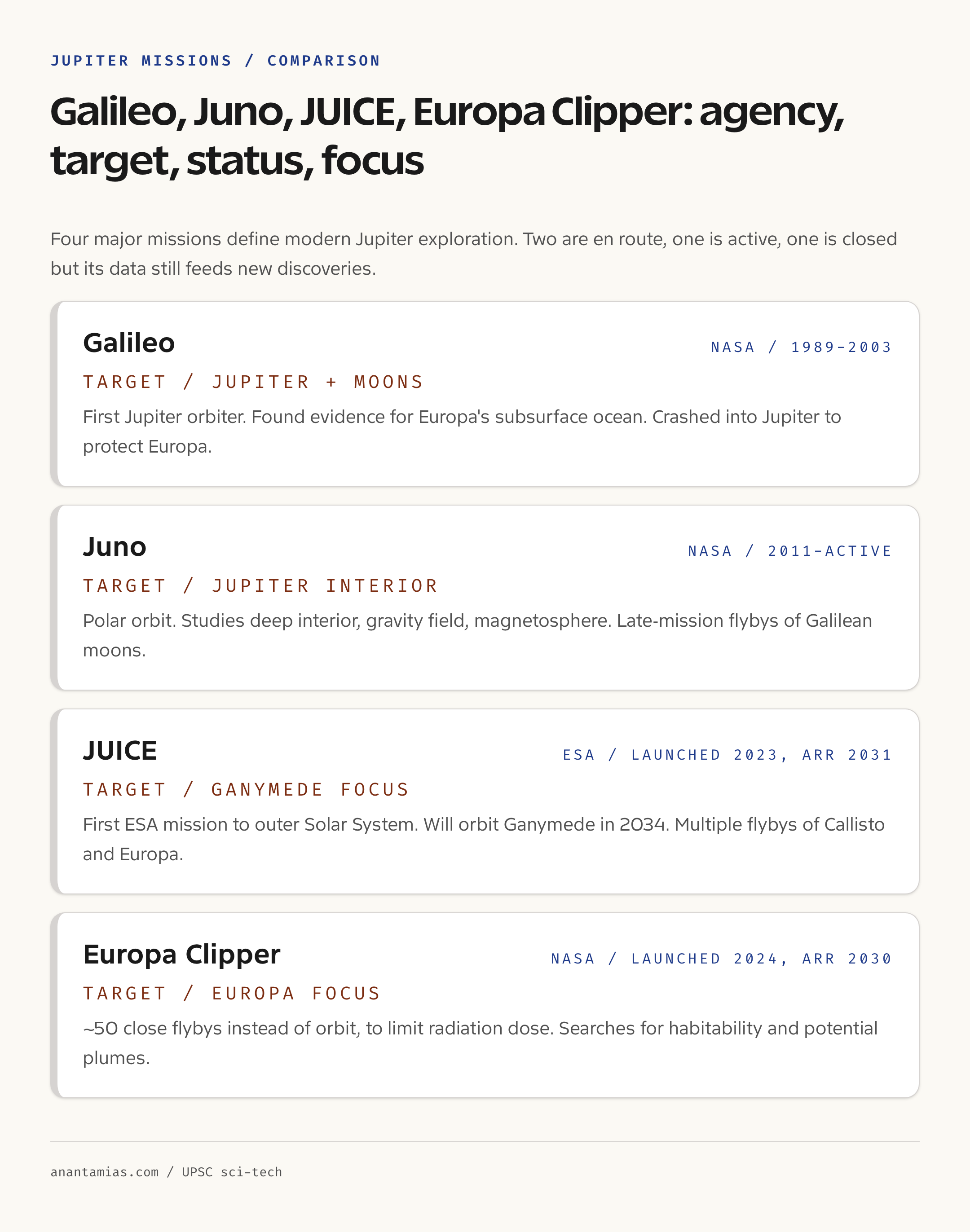
Galileo (NASA, 1989 to 2003) was the first dedicated Jupiter orbiter. Its main scientific achievements include the first close-up images of all four Galilean moons, the discovery of evidence for Europa’s subsurface ocean, and the only direct atmospheric sampling of Jupiter via the Galileo Probe. The mission is a closed chapter, but its data still feeds new analyses decades later.
Juno (NASA, 2011 to ongoing) is the active resident mission. Its instruments are tuned to study Jupiter’s deep interior, gravity field, magnetic field, and polar atmosphere. Juno’s polar orbit is unusual for a Jupiter mission because it gives the spacecraft views of Jupiter’s poles, which are scientifically important and were never well-imaged before. Juno has been extended through 2025 and may continue further. Late in its mission, Juno has been making flybys of Galilean moons including Europa and Io, providing close-up data that complements its primary Jupiter focus.
JUICE (ESA, launched 2023, arriving 2031) stands for Jupiter Icy Moons Explorer. The mission is unique because it is the first ESA-led mission to the outer Solar System, and the first mission ever to enter orbit around a moon other than Earth’s Moon. JUICE will fly past Callisto, Europa, and Ganymede multiple times before settling into orbit around Ganymede. The Ganymede orbit phase, scheduled for 2034, will allow JUICE to map the moon’s magnetic field, surface composition, and internal structure in unprecedented detail.
Europa Clipper (NASA, launched 2024, arriving 2030) is single-mindedly focused on Europa. It will not orbit Europa because the radiation would destroy its electronics within months. Instead, it orbits Jupiter and makes nearly 50 close flybys of Europa, each spaced weeks apart to give the spacecraft time to cool down and downlink data between flybys. Europa Clipper’s instruments include radar to map the ice shell, magnetometers to confirm the ocean, and a mass spectrometer to sample any plumes that may erupt from beneath the surface.
Why It Matters
The Jupiter missions matter because they probe questions that are central to modern science. Is Earth the only place in the Solar System where life exists? If subsurface oceans on Europa, Ganymede, or Callisto can support microbes, the answer is no, and the implications for the prevalence of life in the universe are profound. Where does Jupiter’s magnetic field come from, and what does it tell us about how giant planets form? How does the Jupiter system, which resembles a small Solar System, compare to the planet-around-star systems that astronomers are now finding around other stars?
The missions also matter for the development of deep-space engineering. Jupiter is the testing ground for solar panels at low light, for radiation-hardened electronics, for autonomous navigation in environments where commands take 35 to 50 minutes to reach the spacecraft, and for the long-duration cryogenic propulsion that future missions to Saturn, Uranus, and Neptune will require. Each Jupiter mission feeds the next generation of outer-Solar-System exploration.
For India, none of the current Jupiter missions involves direct ISRO participation, but the techniques they pioneer will eventually be relevant to Indian planetary missions if and when ISRO’s space technology programme moves beyond Mars and the Moon to the outer planets.
Detailed Analysis: The Search for Life on Europa
The case for Europa as a candidate for life rests on three pieces of evidence. First, the global ocean is real, confirmed by magnetic field measurements made by Galileo decades ago. Jupiter’s magnetic field induces a secondary magnetic field in Europa, and the strength and direction of that induced field can only be explained by a layer of conducting material, which is salty water, beneath the surface.
Second, the ocean is in contact with a rocky seafloor. Heat from tidal flexing keeps the ocean liquid, and the seafloor likely hosts hydrothermal vents similar to those on Earth, where chemosynthetic life thrives without sunlight. The combination of liquid water, energy, and a rocky chemistry supply is what astrobiologists call the trifecta of habitability.
Third, the ice shell is geologically active. The chaos terrain visible in Galileo images suggests that material moves between the ocean and the surface, which means surface samples could carry signatures of ocean chemistry. Europa Clipper will look for organic molecules, salts, and possibly biological signatures in any plume material it can sample during close flybys.
JUICE will perform similar analyses at Ganymede and Callisto, where the ocean evidence is weaker but where the sheer size of Ganymede makes it impossible to rule out without close investigation.
Comparative: Jupiter Versus Saturn Missions

Saturn has hosted only one orbiter mission, Cassini-Huygens, which operated from 2004 to 2017. Jupiter has had two orbiters (Galileo, Juno) plus two more arriving (JUICE, Europa Clipper). The asymmetry reflects priorities. Jupiter’s moons, especially Europa, have been considered higher-priority astrobiology targets than Saturn’s moons. That balance is shifting, with Saturn’s moon Enceladus emerging as a stronger candidate after Cassini’s confirmation of plume activity. Future Saturn missions, including the Dragonfly rotorcraft to Titan launching in 2028, will keep Saturn in the science conversation.
The Voyager spacecraft remain the only missions to have visited Uranus and Neptune. Both encounters were in the late 1980s, and no follow-up mission has been launched. NASA’s planetary science decadal survey has prioritised a Uranus orbiter and probe as the next flagship mission for the 2030s.
Challenges of Jupiter Exploration
Jupiter’s radiation belts are the single biggest obstacle. Cumulative radiation dose limits how long spacecraft can operate near the Galilean moons. Heavy shielding adds mass, which adds launch cost, which reduces the science instruments that can fly. Every Jupiter mission is a trade between shielding, science payload, and trajectory.
Distance compounds the problem. A round-trip light-time of over an hour means autonomous operations are essential. Solar power is marginal; for long-duration missions, plutonium RTGs are preferred but supply is limited. Communication bandwidth is low, so instrument data must be heavily compressed and prioritised onboard.
Cost is the final constraint. A Jupiter flagship mission today costs in the range of three to five billion dollars. The economics drive consolidation of objectives into single large missions, which then take a decade or more from concept to launch.
Prelims Pointers
- Galilean moons discovered in 1610 by Galileo: Io, Europa, Ganymede, Callisto
- Largest moon in Solar System: Ganymede (larger than Mercury)
- Only moon with its own magnetic field: Ganymede
- Most volcanically active body: Io
- Best candidate for extraterrestrial life: Europa
- First spacecraft to orbit Jupiter: Galileo (1995)
- Current resident mission: Juno (NASA)
- JUICE: ESA mission launched 2023, arriving 2031, primary target Ganymede
- Europa Clipper: NASA mission launched 2024, arriving 2030, will perform around 50 flybys
- First flyby of Jupiter: Pioneer 10 in 1973
Mains Practice Questions
- Compare and contrast the missions JUICE and Europa Clipper in terms of agency, scientific objectives, and engineering approach. (15 marks, 250 words)
- “The search for life beyond Earth is now centred on the moons of the outer planets, not on Mars.” Critically examine. (15 marks, 250 words)
- Discuss the engineering challenges of operating spacecraft in Jupiter’s radiation environment. How do JUICE and Europa Clipper address them differently? (10 marks, 150 words)
Way Forward
The 2030s will be the most productive decade in Jupiter science since Galileo. Juno will likely conclude its extended mission. Europa Clipper will arrive in 2030 and run its flyby campaign through the mid-2030s. JUICE will arrive in 2031 and begin its tour of Callisto, Europa, and Ganymede before settling into Ganymede orbit in 2034. The combined data from these missions will tell us whether the Galilean moons host habitable environments, and whether targeted life-detection missions should follow in the 2040s.
For India, the relevance is indirect. ISRO’s planetary programme has so far been Mars and the Moon, with a Venus mission (Shukrayaan) under development. A Jupiter mission would require capabilities that India does not yet have, including long-duration cryogenic propulsion and radiation-hardened electronics. But the broader trajectory of India’s ISRO missions suggests that participation in international missions, perhaps as an instrument provider or a ground-station partner, is likely before any independent Indian mission to Jupiter is approved.
Frequently Asked Questions
Why is Jupiter so important to study?
Jupiter is the largest and most influential planet in the Solar System. Its gravity shapes the orbits of comets and asteroids. Its system of moons is a miniature Solar System that lets us study planetary formation in compressed form. And its magnetic environment is a natural laboratory for plasma physics that cannot be replicated on Earth.
Why does Europa have a subsurface ocean?
Europa orbits Jupiter on a slightly elliptical path. Jupiter’s gravity squeezes Europa more strongly when it is close and less when it is far, flexing the moon’s interior. This flexing generates heat, which keeps the ocean liquid despite Europa’s distance from the Sun.
What is tidal heating?
Tidal heating is the conversion of orbital and gravitational energy into thermal energy through the flexing of a body’s interior. It is the same physics that produces ocean tides on Earth, but on the Galilean moons it is intense enough to power volcanoes (on Io) and keep oceans liquid (on Europa).
Why does Europa Clipper not orbit Europa?
Jupiter’s radiation belts are intense around Europa’s orbit. A spacecraft that stayed in Europa orbit would receive a lethal dose of radiation within months. Europa Clipper instead orbits Jupiter and makes around 50 brief flybys of Europa, ducking in and out of the radiation zone to limit cumulative dose.
What is the difference between JUICE and Europa Clipper?
JUICE (ESA) is broader in scope and will study Callisto, Europa, and Ganymede before settling into Ganymede orbit. Europa Clipper (NASA) is focused entirely on Europa and will make repeated flybys without orbiting any moon. The two missions complement each other and arrive in the same window.
What did Galileo discover about Europa?
Galileo’s magnetic field measurements provided the strongest evidence that Europa has a subsurface ocean. Galileo also imaged Europa’s surface in detail, revealing the chaos terrain and the network of cracks and ridges that suggest the icy crust is geologically active.
Why is Callisto considered for human bases?
Callisto orbits at the outer edge of Jupiter’s radiation belt, where the radiation environment is far less intense than at Io, Europa, or Ganymede. A human base on Callisto would face a manageable radiation challenge, unlike the inner Galilean moons.
Has India sent any mission to Jupiter?
No. India has sent missions to the Moon (Chandrayaan series), Mars (Mangalyaan), and the Sun (Aditya-L1), and is developing a Venus mission. A dedicated Jupiter mission has not been announced.
What about the Voyager spacecraft?
Voyager 1 and 2, launched in 1977, flew past Jupiter in 1979 and provided the first detailed observations of the planet and its moons. Both Voyagers have since left the Solar System and are now in interstellar space, no longer studying Jupiter but still returning data on the heliosphere boundary.
What is special about Ganymede’s magnetic field?
Ganymede is the only moon in the Solar System known to generate its own magnetic field, indicating an active dynamo in a metallic core. Other moons, including Earth’s Moon, have weak crustal fields but no internal dynamo. Understanding Ganymede’s dynamo is one of JUICE’s primary scientific goals.