Minimum Support Price (MSP) Regime: A2+FL, C2, Crops & UPSC Notes
MSP fixed by CCEA on CACP advice covers 22 crops. A2+FL vs C2 debate, Swaminathan formula, Shanta Kumar Committee, MSP legalisation, 2025-26 procurement update.
The Minimum Support Price (MSP) regime is the cornerstone of India's farm price-protection policy. The MSP is a government-announced floor price at which Central Nodal Agencies (FCI, NAFED, NCCF, CCI, JCI) are willing to procure specified crops, providing farmers a downside hedge against market price collapses. The Cabinet Committee on Economic Affairs (CCEA) notifies MSPs twice a year — for the kharif and rabi seasons — based on recommendations of the Commission for Agricultural Costs and Prices (CACP). As of the 2025-26 marketing seasons, MSP is announced for 22 mandated crops spanning cereals, pulses, oilseeds, copra and raw cotton.
For UPSC, the MSP regime is among the most-tested GS-III topics, intersecting with agricultural economics, doubling farmers' income, food security, PDS, edible-oil imports, MSP legalisation debate, and the 2020-21 Farm Laws. Prelims has tested CACP-CCEA roles, A2+FL vs C2 formulas, the 22 mandated crops, and the Swaminathan Commission. Mains has asked why MSP procurement is uneven and whether MSP should be legalised.
| A2+FL method | C2 method |
|---|---|
| ‘A2’ covers all paid-out costs directly incurred by the farmer — in cash and kind — on seeds, fertilisers, pesticides, hired labour, leased-in land, fuel, irrigation, etc ‘A2+FL’ includes A2 plus an imputed value of unpaid family labour | ‘C2’ is a more comprehensive cost that factors in rentals and interest forgone on owned land and fixed capital assets, on top of A2+FL. |
What is MSP?
MSP is a non-statutory price assurance announced by the Government of India before the sowing season for selected crops. Key features:
- Announced twice a year — kharif (June) and rabi (October).
- Recommended by CACP, an expert body under the Ministry of Agriculture.
- Approved by CCEA, the apex Cabinet body.
- Operationalised through procurement by FCI (rice, wheat, coarse cereals), NAFED (pulses, oilseeds), CCI (cotton), JCI (jute), and state agencies.
- Currently applies to 22 crops: 7 cereals, 5 pulses, 7 oilseeds, copra, raw cotton, and de-husked coconut.
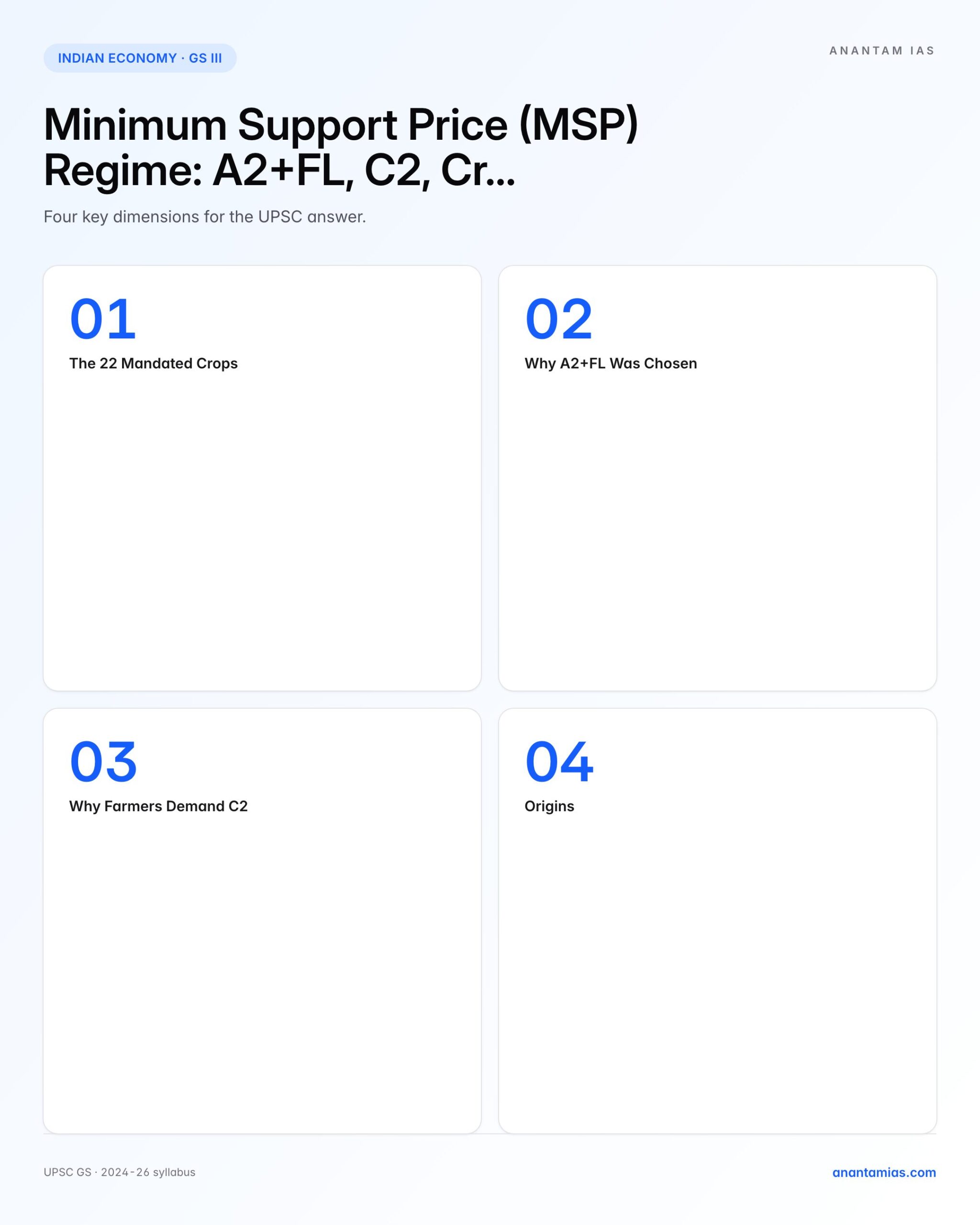
The 22 Mandated Crops
| Category | Crops |
|---|---|
| Cereals (7) | Paddy, wheat, jowar, bajra, maize, ragi, barley |
| Pulses (5) | Tur (arhar), moong, urad, gram (chana), masur (lentil) |
| Oilseeds (7) | Groundnut, soybean, sunflower seed, sesamum, niger seed, rapeseed-mustard, safflower |
| Other (3) | Copra (de-husked coconut), raw cotton, raw jute |
Note: Sugarcane has a separate Fair and Remunerative Price (FRP) notified by CCEA on advice of CACP under the Sugarcane (Control) Order, 1966 — distinct from MSP.
How MSP is Calculated: A2, A2+FL, C2
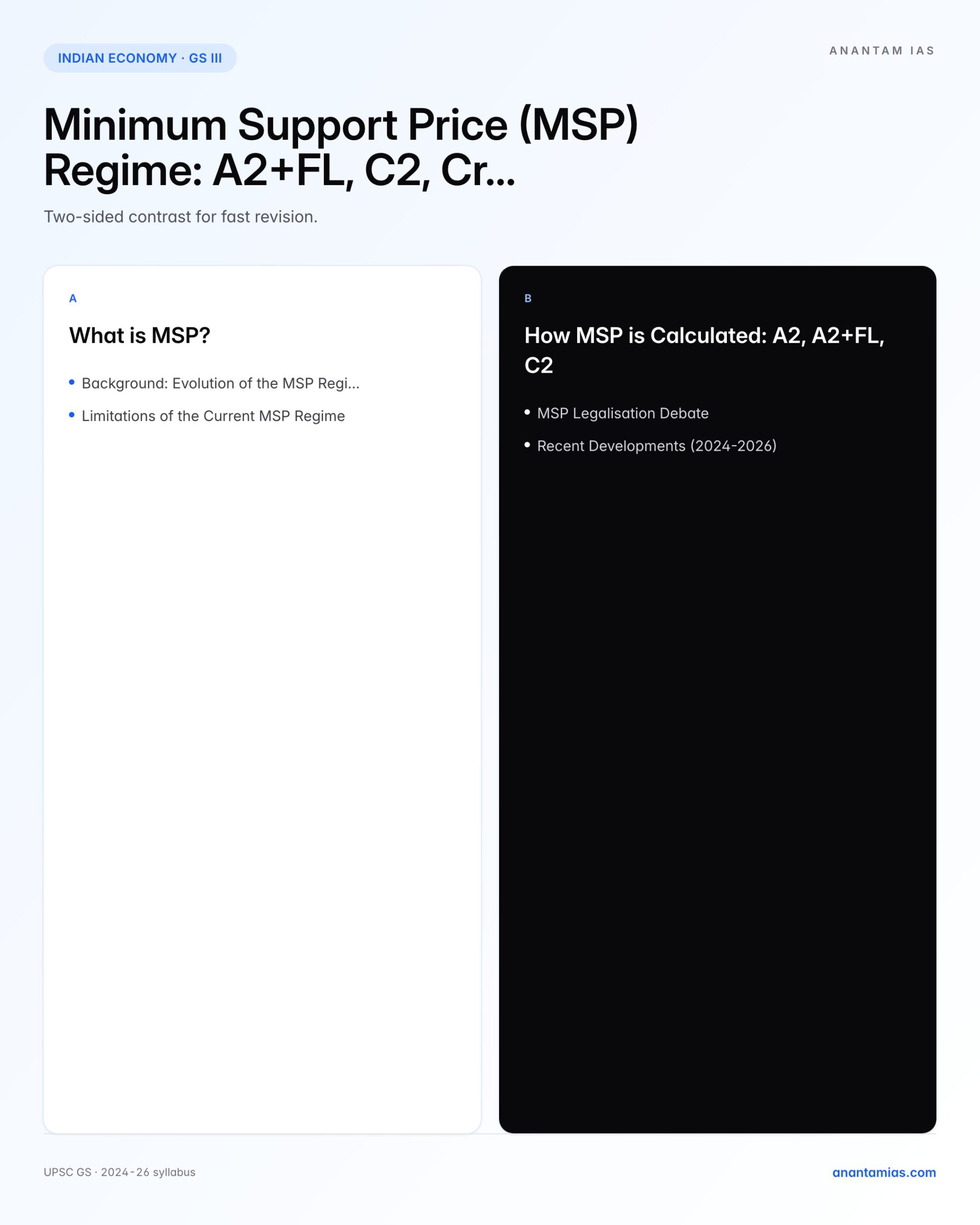
The CACP computes cost of production using three methodologies:
| Cost Concept | What It Includes |
|---|---|
| A2 | Out-of-pocket expenses — seeds, fertilisers, pesticides, labour, fuel, irrigation, machinery hire |
| A2+FL | A2 + imputed value of family labour |
| C2 | A2+FL + rental value of owned land + interest on owned capital + depreciation |
The National Commission on Farmers (M.S. Swaminathan, 2006) recommended MSP = C2 + 50% margin as a fair benchmark.
The Government's official position (since 2018-19): MSP is fixed at least 50% above A2+FL, not C2. This gap is the heart of the Swaminathan formula vs Government formula debate.
Why A2+FL Was Chosen
- Easier to compute and audit.
- Avoids inflating MSP to politically unsustainable levels.
- C2 includes notional land rent which varies wildly by region; standardisation is difficult.
Why Farmers Demand C2
- Tenant farmers pay actual land rent — not captured in A2+FL.
- Owned-capital depreciation erodes net returns.
- Economists (Ashok Gulati, Ramesh Chand, Ashok Dalwai) argue that C2-based MSP would make pulses and oilseeds genuinely competitive with paddy/wheat.
Background: Evolution of the MSP Regime
Origins
MSP traces back to 1965 when the Agricultural Prices Commission (later renamed CACP) was set up against the backdrop of food scarcity and PL-480 wheat dependence. The first MSP was announced for wheat in 1966-67 to incentivise the Green Revolution.
Expansion
Through the 1970s-80s, MSP expanded to cover paddy, coarse cereals, pulses, oilseeds, cotton, jute. By 2000, the list had stabilised at 22 crops.
Procurement Concentration
Despite 22 crops on paper, FCI procurement is concentrated in paddy and wheat — 80-90% of MSP procurement value. Punjab, Haryana, MP, UP, Telangana, Chhattisgarh, Odisha together capture ~75% of MSP procurement.
Limitations of the Current MSP Regime
1. Promoted Cultivation of Water-Intensive Crops
Effective procurement signals (paddy, wheat) push farmers in Punjab, Haryana, Western UP to grow these instead of less thirsty alternatives (millets, pulses, oilseeds). Result: groundwater depletion — Punjab water table fell from 5 m to 25-30 m in three decades.
2. Lack of Procurement Safeguards
For most crops outside paddy/wheat, the MSP exists on paper but procurement is patchy. Farmers in Bihar, Eastern UP, Odisha often sell below MSP because no agency procures.
3. Flawed Cost Approach
A2+FL underestimates true cost. Swaminathan recommended C2-based MSP. The gap between A2+FL+50% and C2+50% can be 15-30% of MSP value — enough to determine whether a farmer makes a real profit.
4. Benefits Only Large Farmers
Shanta Kumar Committee on FCI Reforms (2015) found: only 6% of farmers in India benefit from MSP procurement; the rest sell to private traders at market prices. Large landholders in Punjab, Haryana, MP capture the bulk of MSP gains.
5. Delayed Announcement
In some years, MSP for kharif crops is announced after sowing decisions are already made — undermining the price signal function.
6. Distorts Cropping Patterns
Strong MSP for paddy/wheat leads to:
- Mono-cropping — soil health deterioration.
- Over-fertilisation — soil acidification, nitrate pollution.
- Stubble burning in Punjab/Haryana.
- Water table depletion.
7. Fiscal Burden
FCI food subsidy bill exceeded Rs 2 lakh crore in FY24, with MSP procurement and PDS distribution as the main drivers. Buffer stocks frequently exceed norms — increasing storage and carrying costs.
8. Trade Distortion
WTO classifies MSP-procurement-based subsidies as Amber Box — trade-distorting. India already faces challenges defending its rice MSP under WTO rules.
MSP Legalisation Debate
The 2020-21 farmer protests centred on a demand for statutory legal guarantee of MSP — i.e., making it illegal to buy below MSP. Key arguments:
For Legalisation
- Provides enforceable price floor for all 22 crops.
- Reduces distress sales.
- Drives crop diversification by extending procurement guarantees.
Against Legalisation
- Fiscal cost: Legal MSP for all 22 crops at full procurement could cost Rs 10-12 lakh crore annually — multiple times current food subsidy.
- Market distortion: Above-equilibrium prices dump private buyers out; only government procurement remains.
- Storage burden: Where to store all that grain?
- Inflation effect: Pass-through to PDS and food prices.
- WTO compatibility: Already strained.
The Ramesh Chand Committee on MSP (2024) examined these questions and is expected to recommend a graduated approach — stronger market intervention without full legalisation.
Recent Developments (2024-2026)
| Year | Update |
|---|---|
| 2024 | Ramesh Chand Committee on MSP examines legalisation feasibility |
| 2024-25 | Paddy MSP raised to Rs 2,300/quintal (common); wheat Rs 2,425/quintal |
| 2024-25 | Tur MSP raised to Rs 7,550/quintal; mustard Rs 5,950/quintal |
| Budget 2024-25 | Food subsidy: Rs 2.05 lakh crore |
| 2025 | PM-AASHA continued with Rs 35,000 crore outlay through 2025-26 |
| 2025-26 | Paddy MSP Rs 2,369/quintal; wheat Rs 2,575/quintal |
| Budget 2025-26 | Food subsidy: Rs 2.03 lakh crore |
| 2025-26 | Millets push — MSP procurement of jowar, bajra, ragi expanded under International Year of Millets follow-through |
| 2026 | Final Ramesh Chand Committee report on MSP framework |
Reforms and Way Forward
- Move toward C2-based MSP in a phased manner — start with pulses and oilseeds where procurement is low.
- Decentralise procurement — strengthen state and FPO-led procurement to reach the 94% of farmers who don't currently benefit.
- Diversify procurement away from paddy/wheat — incentivise millets, pulses, oilseeds.
- Strengthen PM-AASHA — PSS, PDPS, PPPS as complementary tools.
- Time MSP announcement before sowing — restore the price-signal function.
- Link MSP procurement with FPOs and AgriStack for plot-level traceability.
- Use modal market price + DBT in deficit-payment mode where physical procurement is uneconomic.
- Cap procurement quantities to avoid open-ended fiscal exposure.
- Reform FCI — implement Shanta Kumar Committee recommendations on outsourcing storage and procurement.
- WTO strategy — defend MSP under public-stockholding "peace clause"; push for permanent solution at WTO ministerial.
- Climate-linked MSP bonuses for low-water-footprint crops.
Government Schemes and Budget Allocations (2025-26)
- MSP procurement through FCI, NAFED, NCCF, CCI, JCI.
- Food subsidy: Rs 2.03 lakh crore (Budget 2025-26).
- PM-AASHA: Rs 35,000 crore through 2025-26.
- NFSA (National Food Security Act): 81 crore beneficiaries via PDS.
- PMGKAY (PM Garib Kalyan Anna Yojana): free foodgrain extended through 2028.
- Operation Greens: perishable price stabilisation.
- NMEO-Oilseeds and NMEO-OP: oilseed self-reliance.
Mains Answer Hook
A balanced GS-III answer should: (a) explain the CACP-CCEA architecture and the A2+FL vs C2 debate; (b) cite the Shanta Kumar 6% finding and 22 crops on paper, paddy-wheat in reality; (c) examine the legalisation debate with fiscal, WTO, and market-distortion arguments; (d) link MSP failures to groundwater depletion, soil degradation, and stubble burning; (e) propose a phased reform — C2 for pulses/oilseeds first, FPO-led procurement, PM-AASHA strengthening, modal-price DBT.
Use: "MSP must evolve from a paddy-wheat procurement guarantee into a crop-neutral, C2-based, FPO-delivered floor for the 94% of farmers it currently misses."
Prelims Pointers
- MSP recommended by: CACP (Commission for Agricultural Costs and Prices).
- MSP notified by: CCEA (Cabinet Committee on Economic Affairs).
- MSP covers: 22 crops (7 cereals, 5 pulses, 7 oilseeds, copra, raw cotton, jute).
- Cost concepts: A2, A2+FL, C2.
- Swaminathan formula: MSP = C2 + 50%.
- Government formula: MSP at least 50% over A2+FL.
- Sugarcane: governed by FRP under Sugarcane (Control) Order, 1966 — not MSP.
- Shanta Kumar Committee (2015): 6% of farmers benefit from MSP.
- Ramesh Chand Committee: 2024-26 review of MSP framework.
- MSP-procurement agencies: FCI, NAFED, CCI, JCI, NCCF.
FAQ on Minimum Support Price
What is MSP?
Minimum Support Price — a non-statutory floor price at which government agencies procure crops to protect farmers from market price collapses.
Who recommends MSP?
Commission for Agricultural Costs and Prices (CACP); approved by Cabinet Committee on Economic Affairs (CCEA).
How many crops are covered under MSP?
22 crops — 7 cereals, 5 pulses, 7 oilseeds, copra, raw cotton, raw jute. Sugarcane has a separate FRP.
What is the difference between A2+FL and C2?
A2+FL = paid-out cost + imputed family labour. C2 = A2+FL + rental value of land + interest on capital. Government uses A2+FL+50%; Swaminathan recommended C2+50%.
What is the Shanta Kumar Committee finding?
That only ~6% of Indian farmers benefit from MSP procurement; the rest sell to private traders at market prices.
Should MSP be legalised?
Debated. Legalisation would guarantee a price floor but could cost Rs 10-12 lakh crore annually, distort markets, breach WTO commitments. Ramesh Chand Committee is reviewing.
The MSP regime is India's defining farm-price institution — both a lifeline for some and a distortion for others. For UPSC, anchor your answers in CACP-CCEA, A2+FL vs C2, the 22 crops, the Shanta Kumar 6% finding, the Swaminathan formula, and the legalisation debate. Layer in the procurement concentration in paddy-wheat and the climate consequences for a Mains-grade answer.