Nano-Fertilizers: How Nano Urea and Nano DAP Are Trying to Rewrite Indian Agriculture
A complete UPSC GS-III explainer on nano-fertilizers in India. Covers IFFCO Nano Urea and Nano DAP, the science of nanoscale nutrient delivery, foliar spray absorption through stomata, the efficiency contrast with conventional urea and DAP, the regulatory clearances, the subsidy and import substitution case, the field trial controversy, and the policy outlook for 2030.
Indian agriculture runs on three macronutrients applied to the soil at heroic scale every season. Nitrogen, phosphorus, and potassium together account for almost all the chemical fertiliser the country produces, imports, and subsidises. Urea alone is consumed at more than thirty-five million tonnes a year, the highest in the world, and the chemistry of urea has been essentially unchanged for decades. The efficiency of conventional urea is the hidden problem. Roughly thirty to forty percent of the nitrogen in a urea bag actually reaches the plant. The rest is lost to runoff, leaching into groundwater, and volatilisation into the atmosphere as ammonia and as nitrous oxide, which is itself a powerful greenhouse gas.
Nano-fertilizers are an attempt to rewrite that loss equation. The basic idea is to package the nutrient as nanoscale particles, between roughly twenty and a hundred nanometres in size, and deliver it as a foliar spray on the leaf rather than as a granular pour onto the soil. The leaf absorbs the nano-particles directly through its stomata, the gas-exchange pores on the underside, and the nutrient enters the plant’s vascular system without having to survive the chemistry of the soil. If the model works, a 500 millilitre bottle of nano urea can replace a 45 kilogram bag of conventional urea, with comparable yield, lower environmental load, and a fraction of the logistics burden.
The two flagship products in the Indian market are IFFCO Nano Urea and IFFCO Nano DAP, both developed by the Indian Farmers Fertiliser Cooperative. This article walks through what nano-fertilizers actually are, how they are absorbed, the contrast with conventional urea and DAP, the regulatory and subsidy framework, the production capacity now being built, the criticism from independent agronomists, and the policy outlook through to 2030.
What a Nano-Fertilizer Actually Is
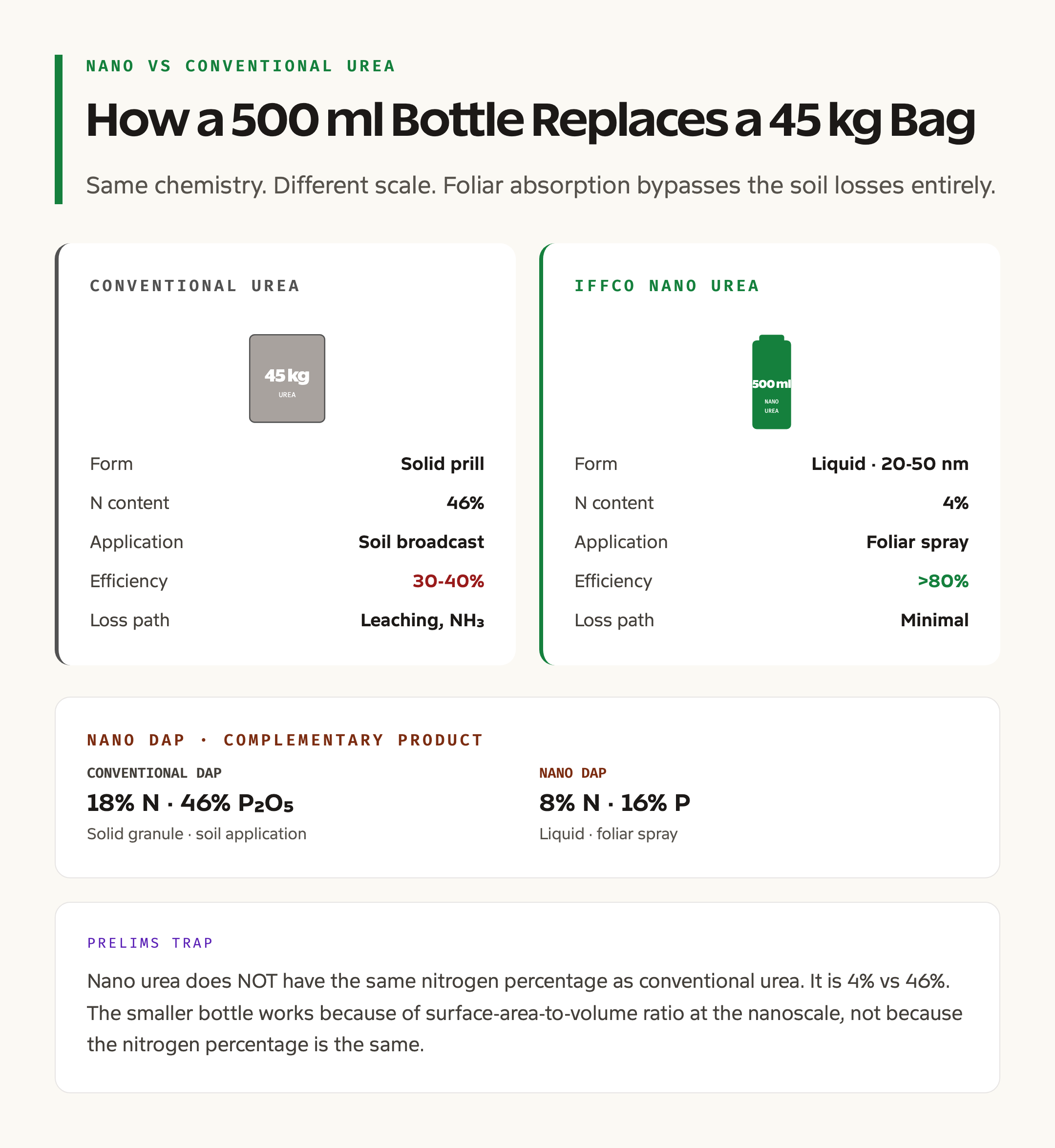
A nano-fertilizer is not a new chemical. It is a familiar nutrient, almost always urea or diammonium phosphate, formulated at the nanoscale. Conventional urea is sold as solid prills of about two to four millimetres diameter. Each prill contains forty-six percent nitrogen by mass. The prill is broadcast on the soil, dissolves in water, hydrolyses to ammonium and bicarbonate, and the ammonium is taken up by the plant root system or lost.
Nano urea takes the same chemistry but disperses it as particles of twenty to fifty nanometres suspended in a liquid carrier. A nanometre is one billionth of a metre. Particles at that size have an enormous surface-area-to-volume ratio, which dominates the chemistry. The total surface area of the nitrogen in a 500 millilitre bottle of nano urea is more than ten thousand times the surface area in a 45 kilogram bag of conventional urea. That difference is what allows the smaller package to deliver comparable nutrient effect to the plant.
Nano DAP follows the same logic for phosphorus and a smaller fraction of nitrogen. Conventional DAP, diammonium phosphate, contains eighteen percent nitrogen and forty-six percent phosphorus pentoxide by mass. Nano DAP contains eight percent nitrogen and sixteen percent phosphorus by mass in liquid form. The percentages are lower because the carrier dilutes the nutrient, but the absorption efficiency is much higher.
How a Foliar Spray Reaches the Plant
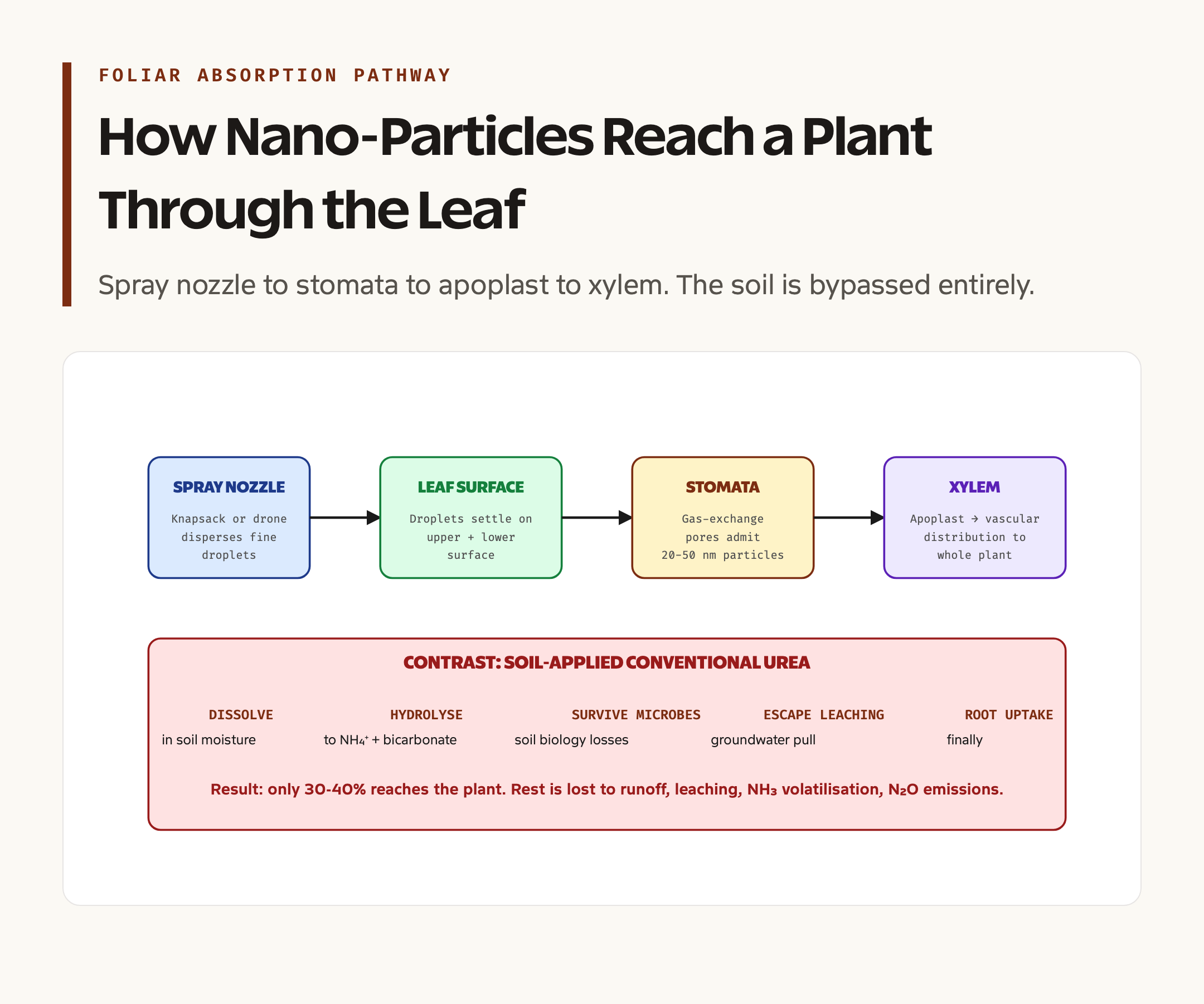
The application method is the most important piece of the system. Nano-fertilizers are sprayed on the leaves rather than poured on the soil. The spray nozzle on a knapsack or drone disperses the liquid as fine droplets that settle on both the upper and the lower surface of the leaf. The lower surface carries the stomata, the small mouth-like pores through which the plant exchanges gases with the atmosphere. Nano-particles in the size range of twenty to fifty nanometres are small enough to enter the stomatal apparatus and pass into the apoplast, which is the cellular network outside the plasma membrane. From the apoplast the nutrient reaches the xylem and is distributed throughout the plant.
The contrast with soil application is sharp. Soil-applied urea must dissolve, hydrolyse, survive the soil microbiome, escape the leaching pull of irrigation water, and finally be taken up by the root system. At each step a fraction of the nitrogen is lost. Soil-applied DAP fixes phosphorus into insoluble calcium and iron complexes, especially in alkaline or heavy-clay soils, which can lock up half the applied phosphorus before the plant can use it.
Foliar nano application bypasses the soil entirely. The published efficiency for nano urea in IFFCO’s trials is more than eighty percent compared to thirty to forty percent for conventional urea. The efficiency for nano DAP is similarly higher than soil-applied DAP, particularly in soils where phosphorus fixation is high.
IFFCO and the Indian Origin Story
The Indian Farmers Fertiliser Cooperative is one of the largest cooperative enterprises in India, owned by tens of thousands of farmer cooperatives across the country. IFFCO was set up in 1967 to manufacture and distribute fertiliser to its member cooperatives at fair prices. The cooperative has historically been a major producer of conventional urea, DAP, and complex fertilisers across multiple plants.
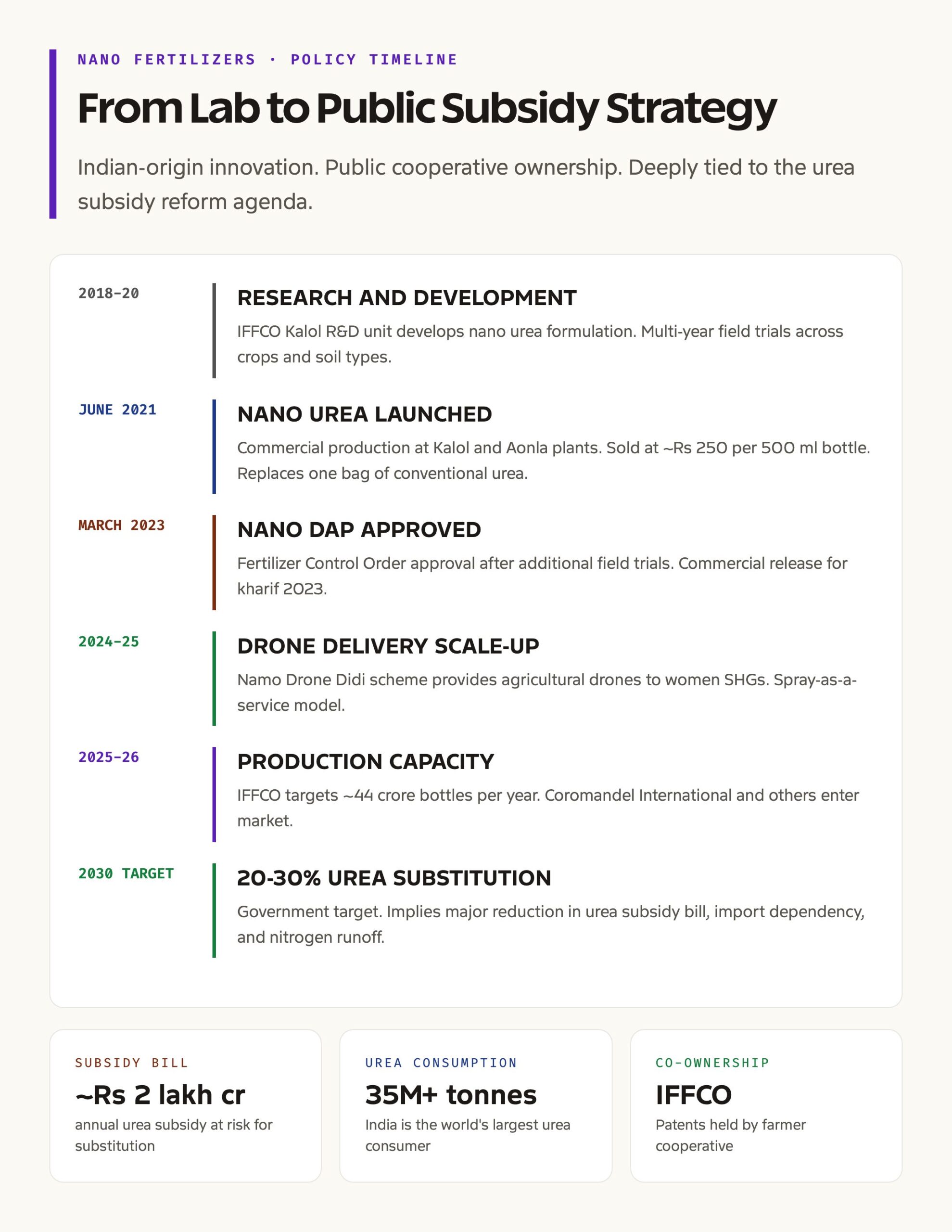
The nano programme started in IFFCO’s Kalol research and development unit in Gujarat. The product development took several years and concluded with the commercial launch of Nano Urea Liquid in June 2021 at the IFFCO plants in Kalol and Aonla. Nano DAP was approved by the Fertilizer Control Order in March 2023 after additional field trials. IFFCO has since expanded production to multiple plants and has begun licensing the technology to other cooperatives and to a few private partners.
The patents for the formulation, the spray nozzle calibration, and the manufacturing process are held by IFFCO, which makes the company the dominant Indian player in the segment. Coromandel International and a few other firms have entered the market with their own nano formulations, and several startups have begun research on nano-formulations of micronutrients including zinc, boron, and iron.
The Subsidy and Import Substitution Case
The economics around nano-fertilizers is shaped by the long-running fertiliser subsidy regime in India. Conventional urea is sold to farmers at a heavily subsidised statutory price, currently around two hundred and sixty rupees for a 45 kilogram bag. The difference between the production cost and the statutory price is paid to the manufacturer by the central government as the urea subsidy. The total annual urea subsidy bill is in the range of one and a half to two lakh crore rupees, depending on global gas prices, because most Indian urea is produced from imported natural gas.
Nano urea, in contrast, is sold at around two hundred and fifty rupees for a 500 millilitre bottle, which is the official price for one full conventional bag equivalent. Crucially, the nano product is not subsidised in the same way. The retail price covers the cost of production, distribution, and a small margin. The implication is direct. If a meaningful fraction of conventional urea consumption is replaced by nano urea, the urea subsidy bill drops sharply. The savings are real public money.
The import substitution dimension is also strategic. India imports a large fraction of its urea, its DAP, and the natural gas used to produce both. Liquid nano-fertilizer is much lighter to transport per unit of plant-effective nitrogen, which reduces the logistics cost and the import dependency. The full transition would also reduce the demand for soil-applied phosphorus, which India imports substantially as DAP or phosphate rock from Morocco, Russia, and Saudi Arabia.
Production Capacity and Rollout
IFFCO’s published roadmap targets nano urea production capacity of around forty-four crore bottles per year across multiple plants once the full network is operational. That capacity is sized to substitute roughly thirty percent of conventional urea consumption in India. The Department of Fertilizers has supported this rollout with the Production Linked Incentive scheme for nano-fertilizer manufacturing and with capital subsidies for plant construction.
Drone-based application is being actively promoted. The government’s Namo Drone Didi scheme provides agricultural drones to women self-help groups to spray nano-fertilizers across smallholder farms. The model assumes that the drone operators are paid by farmers per acre sprayed, which adds an income stream for rural women’s groups while reducing the labour cost of spraying for individual farmers. The scheme is in early stages, but the demonstration value is high.
The Field Trial Controversy
Independent agronomists have raised concerns about the published efficiency claims. A study published by researchers at Punjab Agricultural University in 2023 reported that nano urea applied as recommended did not match the yield from full-dose conventional urea in Punjab wheat trials, with yield gaps of around five to ten percent in some plots. Another study from ICAR institutes reported variable performance across crops and soil types.
IFFCO has responded that the trials cited used incorrect application rates, missed the recommended timing, or did not pair nano urea with a basal soil application of conventional fertiliser as the company’s protocol specifies. The company’s position is that nano urea is meant to substitute the second and third top-dressings of urea, not the basal application that establishes nutrient availability for the early growth stages of the crop.
The honest read of the literature as of 2026 is that nano urea works well as a partial substitute, especially for top dressing, but the claim that a 500 millilitre bottle fully replaces a 45 kilogram bag in all conditions is not yet supported by independent meta-analysis. The product is genuinely useful and the science is sound. The marketing claim has been ahead of the evidence in some segments.
Prelims Traps and Common Mistakes
Two specific factual traps come up repeatedly in test questions. The first is the claim that nano urea contains the same nitrogen percentage as conventional urea. That is false. Nano urea contains about four percent nitrogen by mass in the liquid carrier. Conventional urea contains forty-six percent nitrogen by mass in the solid prill. The reason a smaller bottle of nano works is the surface area effect and the foliar absorption pathway, not the nitrogen percentage.
The second is the claim that nano DAP contains the same nutrient percentage as conventional DAP. That is also false. Conventional DAP is eighteen percent nitrogen and forty-six percent phosphorus pentoxide. Nano DAP is eight percent nitrogen and sixteen percent phosphorus. The third is the claim that nano urea fully replaces conventional urea. As discussed, the product is positioned as a top-dressing substitute, with basal soil application of conventional fertiliser still required for most cropping systems.
How Nano Connects to Other Indian Agriculture Reforms
Nano-fertilizers sit alongside several other reforms aimed at improving fertiliser efficiency and crop nutrition. The push to expand biofortification of staple cereals, the soil health card scheme that diagnoses field-level nutrient deficiencies, the neem-coated urea mandate that slows release in the soil, and the integrated nutrient management programmes promoted by Krishi Vigyan Kendras all aim at the same broad goal of reducing wastage and tightening the link between nutrient input and crop output.
The drone delivery angle also connects nano to the wider biotechnology and precision agriculture story. Drones equipped with multispectral cameras can map nitrogen stress in real time and target spray application only to the deficient zones. That moves Indian agriculture from blanket application to variable-rate precision farming, which is the global frontier.
Policy Outlook to 2030
The medium-term policy direction is reasonably clear. The government wants to reduce the urea subsidy bill, reduce import dependency on natural gas and phosphate rock, and reduce the environmental load from fertiliser runoff and ammonia emissions. Nano-fertilizers are aligned with all three goals. The expected trajectory is gradual substitution. Nano urea may capture twenty to thirty percent of the conventional urea market by 2030 if the production rollout, the drone-based application infrastructure, and the field-level adoption all develop in parallel.
The frontier products to watch include nano potash, nano micronutrient formulations including zinc and boron, nano biostimulants, and slow-release nano formulations that combine the foliar absorption advantage with controlled release at the leaf surface. The Indian Council of Agricultural Research, the Department of Biotechnology, and several IITs are running parallel research programmes. The overall direction is to move agricultural inputs from a blunt, soil-mediated, low-efficiency model to a precise, plant-mediated, high-efficiency model. Nano-fertilizers are the first commercial product class to make that transition at population scale.