National Blockchain Framework (NBF): India’s Sovereign Blockchain-as-a-Service Stack Explained
A complete UPSC GS-III explainer on the National Blockchain Framework launched by MeitY. Covers the Blockchain-as-a-Service architecture, the Vishvasya core stack, NBFLite for startups and academia, the Praamaanik mobile app verification layer, the C-DAC and NIC implementation roles, the permissioned blockchain design, and the sector applications across governance, land records, supply chains, and digital identity.
The National Blockchain Framework, or NBF, is India’s attempt to do for blockchain what Aadhaar and UPI did for identity and payments: build a sovereign, government-grade infrastructure layer that anyone in the public sector can plug into without rebuilding the wheel. Launched by the Ministry of Electronics and Information Technology, with C-DAC as the technology developer and the National Informatics Centre as the infrastructure host, NBF offers a Blockchain-as-a-Service platform that government departments can use to issue tamper-evident records, run permissioned ledgers, and verify digital artefacts at scale. Three components anchor it: Vishvasya, the core BaaS stack; NBFLite, a sandbox for startups and academia; and Praamaanik, a mobile app verification layer. The framework is the latest layer in a digital trust stack that began with Aadhaar in 2009 and now extends across digital public infrastructure.
This guide unpacks the National Blockchain Framework for UPSC GS-III aspirants. It walks through what blockchain actually is, how a permissioned blockchain differs from a public cryptocurrency network, the architecture of the NBF, the three core components, the implementing agencies, the sector applications, and where the framework fits in India’s broader digital trust roadmap.
What Blockchain Is, Briefly
A blockchain is a distributed ledger that records transactions across many nodes such that no single node can alter past entries unilaterally. Each block contains a batch of transactions, a timestamp, and a cryptographic hash of the previous block. Once a block is added, changing any past entry requires recomputing the hashes of every subsequent block on a majority of the nodes, which is computationally infeasible at scale. The result is a record that is tamper-evident, auditable, and trusted without depending on a single central authority.
Blockchain came into public consciousness through Bitcoin and the broader cryptocurrency wave, where the network is permissionless, anyone can participate, and consensus is achieved through proof-of-work or proof-of-stake mining. But the underlying technology is much broader. Permissioned blockchains, where a defined set of authorised entities run the nodes and validate transactions, are now the dominant model for enterprise and government use. They keep the tamper-evident ledger property without the energy cost or open membership of public chains. For more on the technology layer, see the article on blockchain technology.
What the National Blockchain Framework Is
The National Blockchain Framework is a geographically distributed, shared blockchain infrastructure designed to support digital governance applications. It is built and operated as a platform that government departments and authorised entities can use without setting up their own physical servers, networks, or blockchain nodes. The Ministry of Electronics and Information Technology launched it as a flagship initiative under the National Strategy on Blockchain.
Three design principles define NBF. The first is shared infrastructure. Instead of every department running its own blockchain, NBF provides a single managed platform that any department can use, paying only for the capacity it consumes. The second is the BaaS model. Departments interact with NBF through standard application programming interfaces, not by managing the underlying nodes. The third is permissioned architecture. Only authorised government entities and approved partners can run nodes, validate transactions, and read sensitive ledger entries. The combination delivers tamper-evident record-keeping at government scale without the open-ended membership of public chains.
Implementing Agencies
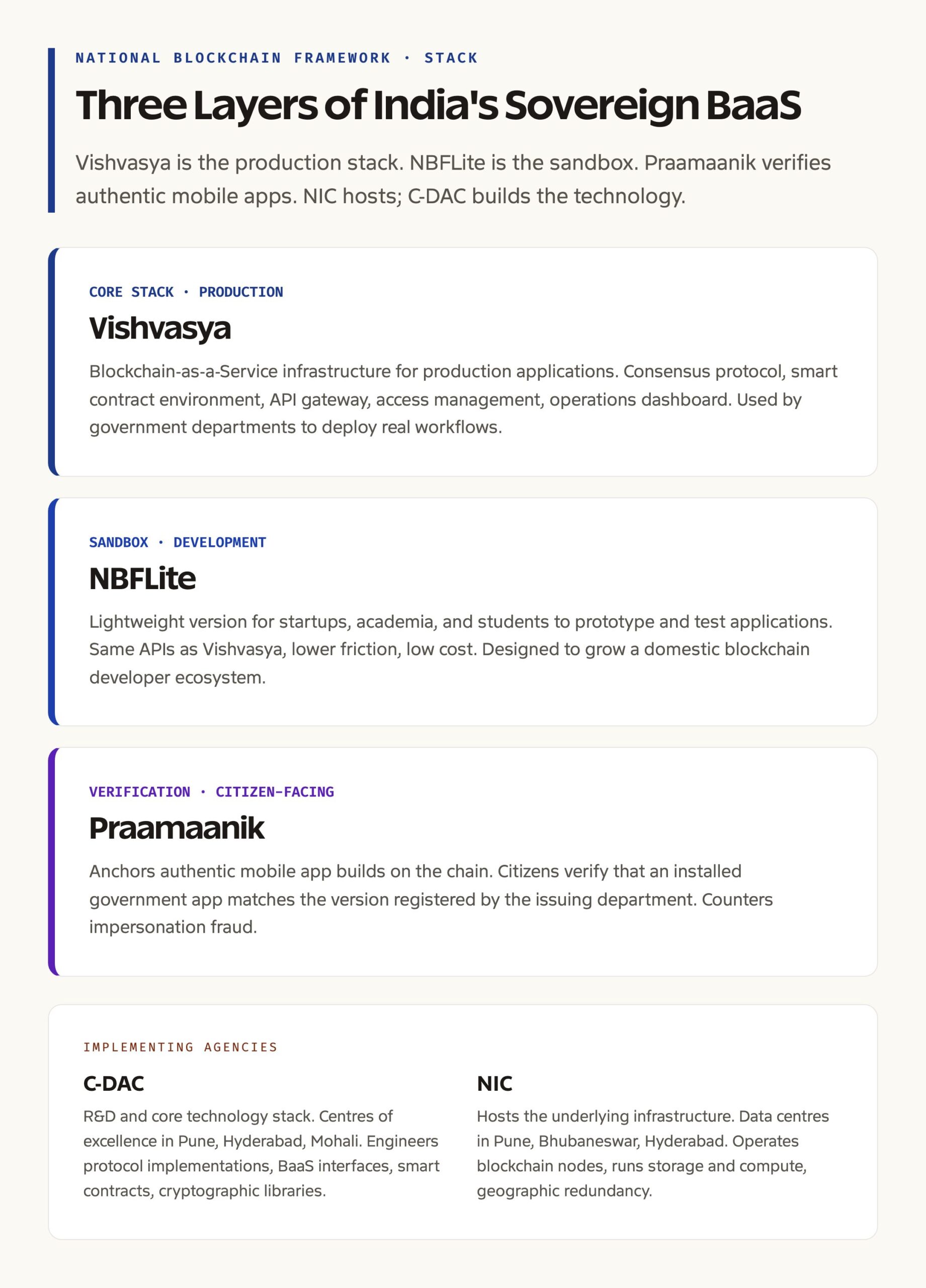
NBF is jointly executed by two technical agencies of the Government of India. The Centre for Development of Advanced Computing, C-DAC, is responsible for research and development and the core technology stack. C-DAC engineers the blockchain protocol implementations, the BaaS interfaces, the smart contract environment, the cryptographic libraries, and the developer tooling. The agency also runs the centres of excellence in blockchain at its Pune, Hyderabad, and Mohali locations.
The National Informatics Centre, NIC, hosts the underlying infrastructure at its data centres in Pune, Bhubaneswar, and Hyderabad. NIC operates the blockchain nodes, manages the network connectivity, runs the storage and compute layers, and provides the operations support that keeps the platform running. The geographic distribution across three data centres delivers the redundancy that a national infrastructure layer needs. If one data centre goes offline, the others continue to validate and write transactions.
The split between R&D at C-DAC and operations at NIC mirrors the model used for other national digital infrastructure, including the Aadhaar authentication backend and the major public-sector data exchange platforms.
The Three Core Components
NBF has three named components, each sized for a different user base.
Vishvasya is the core BaaS stack. It is the production infrastructure that government departments use to deploy real applications on the blockchain. It includes the consensus protocol, the smart contract execution environment, the API gateway, the access management layer, and the operations dashboard. A department that wants to issue verifiable certificates, maintain a tamper-evident asset register, or run a multi-party workflow on a shared ledger interacts with Vishvasya through standard APIs. The development team writes the application logic, Vishvasya handles the underlying chain.
NBFLite is the lightweight sandbox version. It is designed for startups, academia, and students to prototype and test blockchain applications without committing to the full Vishvasya production environment. NBFLite reduces the friction of getting started, exposes the same APIs as the production stack, and lets early-stage builders validate their use cases at low cost. The objective is to grow a domestic blockchain developer ecosystem rather than concentrate all the building inside government technical teams.
Praamaanik is the mobile app verification layer. It addresses a specific problem: how does a citizen know that a mobile app claiming to be from a government department is actually from that department, and not a fake or modified version uploaded to a third-party app store. Praamaanik issues blockchain-anchored attestations of authentic mobile app builds. A user can verify, through the Praamaanik service, that the app installed on the device matches the version registered by the issuing department. This addresses the fast-growing category of impersonation fraud where citizens download fake banking apps, fake KYC apps, or fake government service apps from untrusted sources.
Architectural Choices
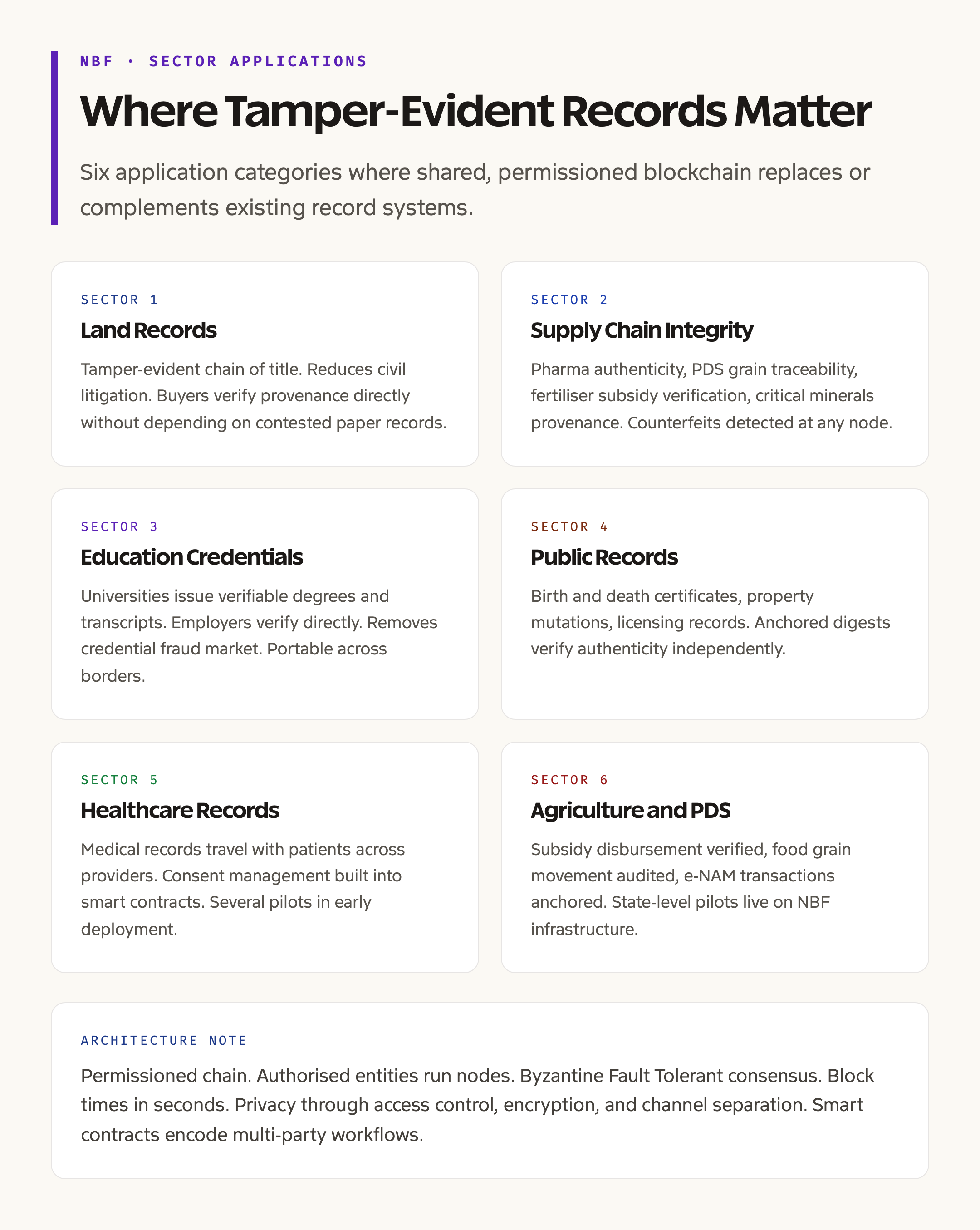
NBF is a permissioned blockchain. Authorised government entities and approved partners run the validating nodes. Citizens and other participants interact with the ledger through APIs, but they do not run nodes or participate in consensus. The consensus algorithm is a Byzantine Fault Tolerant variant suited to permissioned environments, with much lower latency and energy cost than public-chain proof-of-work. Block times are measured in seconds rather than minutes.
The smart contract environment supports execution of code that automates multi-party workflows. A typical use case is a multi-step approval process where a document moves between departments, each department adds its endorsement, and the final state is anchored on the chain. Smart contracts encode the workflow rules, ensure that only authorised parties can endorse each step, and produce a verifiable audit trail that any subsequent inspector can examine without reconstructing the history from paper records.
Privacy is handled through a combination of access control, encryption, and channel separation. Sensitive transactions can be confined to a subset of authorised nodes, with the broader network seeing only the cryptographic commitments rather than the underlying data. This is critical because much government information is confidential and cannot be visible to all node operators.
Sector Applications
NBF has potential applications across most sectors of governance. Land records is the most cited. Land titles in India are notoriously contested, with overlapping records, fraudulent registrations, and weak audit trails. A blockchain-anchored land record system makes every transfer tamper-evident, lets buyers verify the chain of title, and reduces the litigation that clogs civil courts.
Supply chain integrity is another flagship use case. Tracking pharmaceuticals, fertilisers, food grains, or critical minerals through a multi-party supply chain on a shared ledger lets buyers verify provenance and lets regulators detect counterfeits. Several state-level pilots have run on NBF infrastructure for traceability of public distribution system grain, fertiliser subsidies, and pharmaceutical authenticity.
Education credentials is a growing application. Universities issue degrees and transcripts as blockchain-anchored attestations that employers can verify directly without contacting the issuing institution. This removes the credential fraud market that affects Indian education and lets graduates carry portable digital credentials internationally.
Public records, including birth and death certificates, property mutations, and licensing records, are candidates for blockchain anchoring. The objective is not to replace the underlying record systems but to anchor digests of those records on the chain so that any subsequent claim about their authenticity can be verified independently.
Healthcare is a longer-term application. Medical records anchored on blockchain can travel with patients across providers, with consent management built into the smart contract layer. Several pilots in this area are at the design or early-deployment stage.
Position in the Digital Trust Roadmap
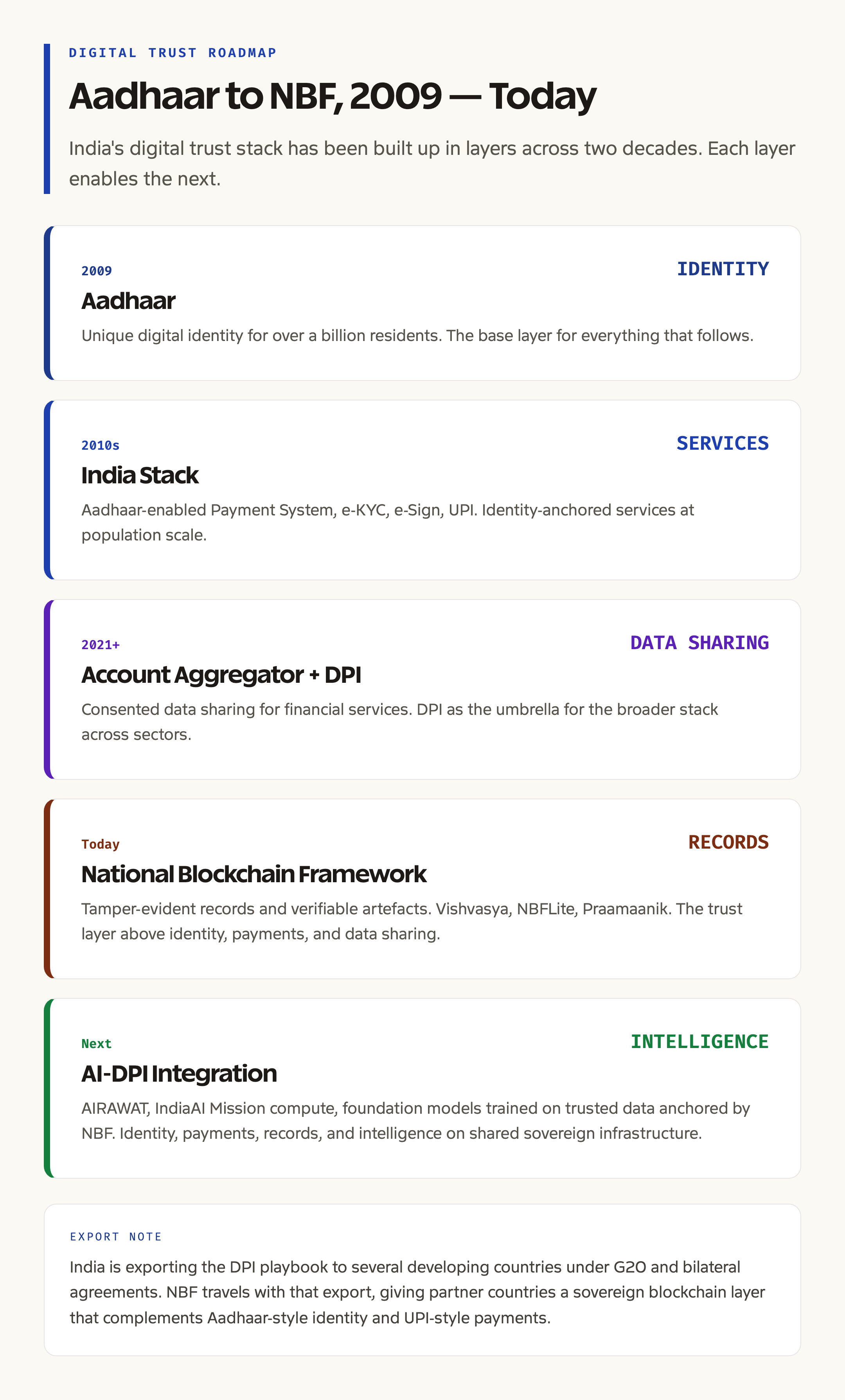
India’s digital trust stack has been built up in layers across two decades. Aadhaar in 2009 established a unique digital identity for over a billion residents. The India Stack added the Aadhaar-enabled Payment System, e-KYC, e-Sign, and the unified payments interface. The Account Aggregator framework added consented data sharing for financial services. Digital Public Infrastructure has been the umbrella term for this stack as it scales across sectors.
NBF is the next layer. Where Aadhaar provides identity and UPI provides payments, NBF provides tamper-evident records and verifiable artefacts. The three layers together let any government service or private application combine identity verification, payments, and trusted records on shared national infrastructure. For the broader frame on digital public infrastructure, see the article on the DPI India Stack and the NITI Aayog DPI 2047 roadmap.
The international dimension is also important. India is exporting the DPI playbook to several developing countries, with bilateral and multilateral agreements signed under the G20 presidency and follow-on engagements. NBF will travel with that export, giving partner countries a sovereign blockchain layer that complements Aadhaar-style identity and UPI-style payments.
Strategic and Open Questions
Three open questions define the NBF trajectory. The first is uptake. The platform is technically capable, but adoption depends on whether departments build applications on it rather than commission separate, single-purpose blockchain systems. The history of Indian e-governance has been full of stand-alone systems that never integrated. NBF avoids that fate only if MeitY and the implementing departments enforce a standards-based approach.
The second is governance. A permissioned blockchain is only as trustworthy as the governance over the validating nodes. Who decides which entities can run nodes, who can read which channels, and how disputes are resolved are policy questions, not technical ones. NBF needs a governance framework that survives changes of government and personnel.
The third is the relationship with public blockchains and crypto. NBF is firmly a permissioned, government-controlled platform. It is not a cryptocurrency platform, does not issue tokens, and does not connect to public chains. The Indian regulatory stance on private cryptocurrencies and on central bank digital currencies will shape the broader trust environment in which NBF operates, but NBF itself is a separate vertical. For the regulatory frame, see the article on crypto assets and virtual digital assets.
Frequently Asked Questions
What is the National Blockchain Framework?
The National Blockchain Framework is a geographically distributed, shared blockchain infrastructure for digital governance applications. It is launched by MeitY and built on a Blockchain-as-a-Service model, with C-DAC handling R&D and NIC hosting the infrastructure.
What are the three components of NBF?
The three components are Vishvasya, the core BaaS stack for production applications; NBFLite, a lightweight sandbox for startups, academia, and students; and Praamaanik, a mobile app verification layer that anchors authentic app builds on the chain.
Is NBF a public blockchain like Bitcoin or Ethereum?
No. NBF is a permissioned blockchain. Only authorised government entities and approved partners run the validating nodes. It does not issue cryptocurrency, does not connect to public chains, and uses a Byzantine Fault Tolerant consensus instead of proof-of-work mining.
Who builds and operates NBF?
C-DAC, the Centre for Development of Advanced Computing, develops the core technology stack. NIC, the National Informatics Centre, hosts the infrastructure at data centres in Pune, Bhubaneswar, and Hyderabad. MeitY is the nodal ministry.
What is Vishvasya in the framework?
Vishvasya is the core BaaS stack. It is the production infrastructure that government departments use to deploy real applications, including the consensus protocol, smart contract environment, API gateway, and access management.
What does Praamaanik do?
Praamaanik verifies the authenticity of mobile applications. It anchors a cryptographic attestation of authentic government app builds on the blockchain so that citizens can confirm the app on their device is the genuine version, not a fake or modified upload to a third-party store.
What sectors will use NBF first?
Land records, supply chain integrity for the public distribution system and pharmaceuticals, education credentials, public records, and healthcare are the leading application categories. Several state-level pilots are already running on NBF infrastructure.