National Manufacturing Mission: Objectives, Pillars and Significance (UPSC Economy)
Announced in Budget 2025-26, the National Manufacturing Mission is the government's fresh attempt to lift manufacturing's stuck share of GDP. Here are its five focus areas, the clean-tech push, and the honest gap between intent and delivery.
For more than a decade, India has chased one stubborn number. Manufacturing’s share of the economy has sat near 15 to 17% of GDP, and every flagship effort to push it higher — the National Manufacturing Policy of 2011, the Make in India launch of 2014, the Production Linked Incentive schemes after 2020 — has bent the curve a little without breaking through to the 25% target that policymakers keep restating. So when the Finance Minister stood up to read the Union Budget on 1 February 2025 and announced a National Manufacturing Mission to “further Make in India” across small, medium and large industries, the real headline wasn’t a new slogan. It was an admission that the existing toolkit, for all its incentives, still hadn’t moved the needle on factories and the jobs they create.
That’s exactly why this Mission matters for an economy exam. India’s growth story has a hole in the middle: it is a services-led economy that skipped much of the manufacturing-led job creation that lifted East Asia. The National Manufacturing Mission, or NMM, is the government’s attempt to plug that hole with coordination rather than just cash — to give central ministries and states a shared roadmap so that the dozens of scattered schemes finally pull in one direction. Whether it succeeds turns on the oldest problems in Indian industrial policy: land, labour, logistics, and follow-through. This is the kind of topic UPSC loves, because it sits right on the seam between ambition on paper and delivery on the ground.
What the Mission Is and Why It Was Launched
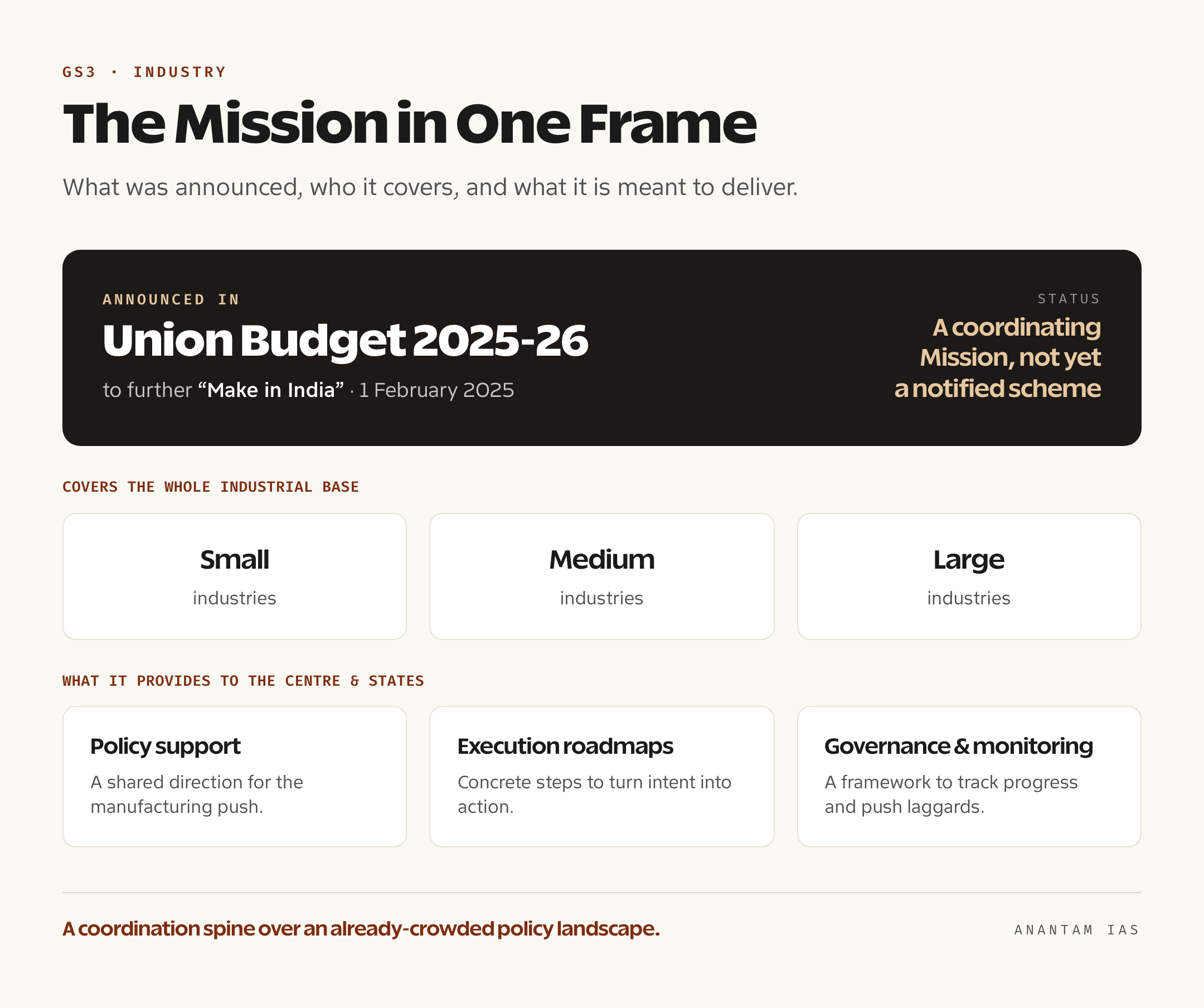
Let’s be precise about what was actually announced, because the NMM is easy to over-describe. It is not yet a scheme with a published outlay, eligibility list and sanctioned guidelines. It was announced as a Mission in the Budget speech of 2025-26, a framework meant to coordinate India’s manufacturing push, with the detailed contours to be worked out by the relevant ministries afterward. So at this stage the honest summary is this: the Budget set the direction and the deliverables, and the operational detail was left to follow. Anyone who quotes a precise rupee figure or a fixed institutional structure for the Mission is reading more into the announcement than the Budget actually said.
What the Budget did spell out is the Mission’s job. The Finance Minister framed the NMM as providing three things to central ministries and states: policy support, execution roadmaps, and a governance and monitoring framework. Read those three together and the design intent becomes clear. India doesn’t lack manufacturing schemes — it has the PLI schemes, the National Industrial Corridor programme, cluster development, scheme after scheme. What it has lacked is a single coordinating spine that aligns them, tracks them, and keeps central and state governments rowing the same way. The Mission is meant to be that spine. It is, in plain terms, a coordination-and-monitoring layer over an already crowded policy landscape, aimed at “Make in India” 2.0.
So the “why now” has two layers. The surface reason is the target everyone keeps missing. The National Manufacturing Policy of 2011 set out to raise manufacturing to 25% of GDP and create 100 million jobs within a decade; more than a decade on, the share is still stuck around 15 to 17%, and the jobs never arrived at that scale. Worse, by some measures manufacturing’s share has slipped rather than climbed since the mid-2010s, even as the wider economy grew quickly. That is the uncomfortable backdrop: a fast-growing economy whose factory base has not kept pace, leaving India unusually dependent on services and farm work for employment.
The deeper reason is the moment in global trade. As multinationals look to diversify supply chains away from a single dominant hub — the strategy popularly called “China plus one” — India has a once-in-a-generation chance to capture some of that relocating manufacturing. But that window doesn’t stay open forever, and Vietnam, Mexico, Indonesia and others are competing for the same factories with their own incentives and faster clearances. The Mission is the government’s signal that it intends to fight for that share with a more joined-up effort than before — and the choice of the word “Mission”, rather than “scheme”, is itself a tell. It frames manufacturing revival as a whole-of-government priority that cuts across ministries, not a single line department’s programme.
The Five Focus Areas and the Clean-Tech Push
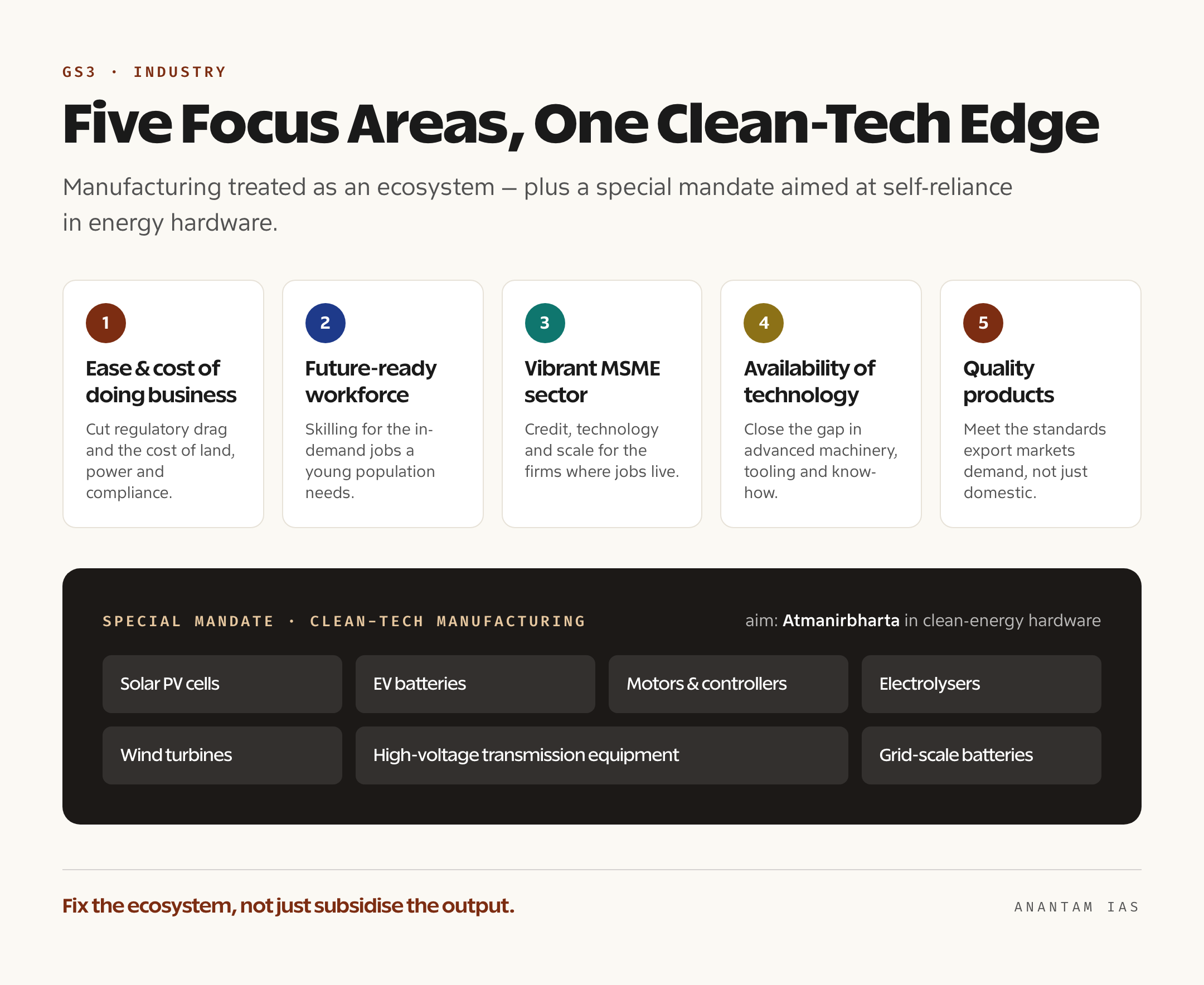
Here is the architecture in plain terms, because the details are exactly what gets tested. The Budget framed the National Manufacturing Mission around five focus areas, and you should be able to list all five cleanly. They are: ease and cost of doing business; a future-ready workforce for in-demand jobs; a vibrant and dynamic MSME sector; availability of technology; and quality products. Notice what that list is really saying. It treats manufacturing not as one lever but as an ecosystem — regulation, skills, the small-firm base, technology access, and quality standards all at once. The implicit diagnosis is that earlier efforts threw money at output through incentives while leaving the surrounding ecosystem under-fixed, so the same bottlenecks kept resurfacing.
Take the five in turn, because each maps to a real Indian weakness. Ease and cost of doing business targets the regulatory drag and the high cost of land, power and compliance that make Indian factories less competitive than rivals. A future-ready workforce for in-demand jobs admits that India’s skilling has lagged its ambition, and that a young population is a dividend only if it is employable. A vibrant and dynamic MSME sector recognises that micro, small and medium enterprises — the bulk of India’s manufacturing units and employment — are where the jobs actually live, yet they struggle for credit, technology and scale. Availability of technology points at the gap in advanced machinery, tooling and process know-how. And quality products is about competing globally, not just domestically, by meeting the standards that export markets demand.
The Mission also carries a sharper, more specific edge: clean-tech manufacturing. The Budget gave the NMM a special mandate to support domestic manufacturing and build the home-grown ecosystem for clean-energy hardware — solar PV cells, EV batteries, motors and controllers, electrolysers, wind turbines, very high-voltage transmission equipment, and grid-scale batteries. That list is worth memorising, because it tells you where the strategic anxiety sits. India imports a large share of this equipment, much of it from China, which dominates global clean-tech supply chains. The goal is “Atmanirbharta” — self-reliance — in clean energy, so that the energy transition doesn’t simply swap an oil-import dependence for a clean-tech-import dependence. The NMM’s clean-tech focus is meant to work alongside, not instead of, the PLI schemes for solar modules and advanced chemistry cell batteries, deepening domestic value addition rather than just final assembly.
How It Fits the Existing Manufacturing Push
To grade the Mission fairly, you have to place it inside the long line of efforts it is meant to coordinate, because the NMM is not starting from a blank page. Think of the manufacturing push as a stack built over fifteen years. At the bottom sits the National Manufacturing Policy of 2011, which first set the 25%-of-GDP target and the 100-million-jobs ambition, and introduced the idea of large National Investment and Manufacturing Zones. On top of that came Make in India in 2014, the branding-and-investment campaign that turned manufacturing into a headline priority and tried to pull in foreign direct investment. Then, from 2020, came the most concrete instrument of all: the Production Linked Incentive, or PLI, schemes.
The PLI schemes are the part you should know in detail, because they’re the benchmark against which the NMM will be judged. Announced for 14 key sectors with a combined outlay of about ₹1.97 lakh crore, the PLI model pays companies an incentive on incremental production and sales — reward output, not just intention. The covered sectors run from mobile phones and electronics to pharmaceuticals, automobiles and auto components, solar modules, advanced chemistry cell batteries, textiles, white goods and more. And the early scorecard is genuinely mixed-to-positive: by March 2024, official figures reported that schemes had attracted real investment of over ₹1.2 lakh crore, generated employment in the range of 8 lakh, and turned India into a major mobile-phone manufacturer and exporter almost from a standing start. Electronics is the PLI poster child. Several other sectors have lagged.
So where does the National Manufacturing Mission add value, if PLI already exists? The honest answer is coordination and the parts PLI doesn’t reach. PLI is an output subsidy for mostly larger firms in chosen sectors; it does little for the MSME base, for the ease-of-doing-business friction, or for skilling — three of the NMM’s five focus areas. The Mission is positioned as the wider ecosystem play that surrounds the incentives: fix the regulatory and skills environment, strengthen small firms, and give the whole effort a monitoring framework so progress can be tracked and laggards pushed. The risk, of course, is that a coordination layer adds another committee rather than another factory. That tension — orchestration versus on-the-ground delivery — is the heart of the debate, and it’s where your analysis should live.
Significance and Why It Matters for India
None of this is abstract, because the stakes for India are unusually high. The first reason the Mission matters is jobs. India adds roughly a crore young people to the working-age population every year, and services — even high-value IT — cannot absorb them all. Manufacturing is the classic escalator from farm to factory to formal employment, the route that pulled hundreds of millions out of poverty across East Asia. A manufacturing share stuck near 17% means that escalator is barely running. If the NMM can help lift the share toward 25%, the prize is measured in tens of millions of formal jobs, which is why the Mission is as much a social-policy story as an industrial one.
The second reason is strategic autonomy in the energy transition. India has committed to ambitious clean-energy and net-zero goals, and meeting them means installing vast quantities of solar panels, batteries, electrolysers and grid equipment. If all of that hardware is imported, India simply trades one external dependence for another, and exposes its energy security to a single supplier’s pricing and politics. The Mission’s clean-tech mandate is not just industrial policy, then; it’s energy-security and climate policy fused together. Building domestic capacity in solar cells, batteries and electrolysers is how India keeps the cost and control of its transition in its own hands.
The third reason is the China-plus-one moment in global value chains. As firms diversify manufacturing away from over-concentration in one country, a slice of global production is genuinely up for grabs, and it will land wherever the business case is strongest. India’s size, its domestic market and its young workforce are real advantages. But advantages don’t relocate factories on their own; predictable rules, fast clearances, reliable power and good logistics do. The NMM’s promise is to make India the easier choice. If it delivers, India captures investment and integrates deeper into global supply chains. If it doesn’t, the factories go to Vietnam or Mexico, and the window narrows. That high-stakes framing is what makes the Mission a serious GS3 topic rather than a passing budget line.
There’s a fourth, quieter significance worth naming: the MSME and quality dimension. Two of the Mission’s five focus areas — a vibrant MSME sector and quality products — point at the part of the economy that earlier, large-firm-centric incentives mostly bypassed. India’s small and medium manufacturers employ the bulk of the manufacturing workforce but struggle for credit, modern machinery and the certifications that export buyers demand. Lifting them is how manufacturing growth actually becomes broad-based employment rather than a handful of automated mega-plants. If the Mission can route technology, finance and quality support down to that long tail of small firms, its impact on jobs would dwarf anything a single subsidised sector can deliver. That, more than the headline GDP percentage, is the test that matters for the people the policy is meant to help.
Challenges, Criticisms and the Way Forward
A strong answer is only strengthened by stating the case against, so here it is without flinching. The first and most important criticism is that the NMM, so far, is a framework without detail. A Mission announced in a Budget speech, however well-intentioned, is not a sanctioned scheme with money, guidelines and accountable owners. Until the operational structure and outlay are notified and actually rolled out, much of the optimism rests on intent. Indian industrial policy has a long record of bold targets and quiet under-delivery — the 25% target itself has been restated for over a decade without being met — and a coordination Mission risks becoming one more layer of meetings rather than measurable output on the factory floor.
The second cluster of challenges is the structural one that earlier efforts also tripped over: land, labour and logistics. Acquiring industrial land remains slow and contested; labour reforms exist on paper as four consolidated codes but their implementation across states has been uneven; and logistics costs in India have historically run high as a share of GDP, eroding competitiveness even when factory-gate costs are low. These are largely state-subject or state-implemented issues, which is precisely why the Mission’s central-state coordination framework matters — and precisely why it is hard. A central Mission can publish a roadmap, but it cannot acquire land or amend a state’s labour rules by fiat.
There is also the harder economic puzzle of jobless growth and the global headwinds. Even where output has risen, India has worried that manufacturing has become more capital- and skill-intensive, so production grows faster than employment — the very “jobless growth” the Mission is meant to counter. Externally, rising tariffs and protectionism in major markets, including renewed trade frictions, make export-led manufacturing riskier than it was during East Asia’s rise. The way forward that experts point to is consistent: convert the Mission’s framework into time-bound, monitored action; deepen ease-of-doing-business reforms at the state level; target MSMEs with credit and technology rather than only subsidising large firms; double down on skilling tied to actual industry demand; and keep clean-tech localisation moving up the value chain from assembly to components and materials. Done that way, the NMM can be the spine that finally aligns India’s manufacturing effort. Left as a slogan, it joins a long list of targets quietly missed.
For Your Mains Answer
The National Manufacturing Mission is squarely a GS Paper 3 topic, sitting at the intersection of three of that paper’s themes: the Indian economy and mobilisation of resources, industrial policy and growth, and infrastructure. It also touches GS3 on the environment and energy through its clean-tech mandate, and it can supply a strong example in an Essay on jobs, self-reliance or India’s growth model. The smart move is to treat the Mission as a case study in why India’s manufacturing targets keep getting missed — examiners reward candidates who can explain a policy and critique it, not just describe it.
How to Build the Answer
Open with the stuck number, not the scheme. State that manufacturing has hovered near 15 to 17% of GDP against a 25% target, then introduce the NMM (Budget 2025-26) as the latest attempt to close that gap, framed as coordination over the existing toolkit. Lay out its design — five focus areas plus the clean-tech mandate, and the three deliverables of policy support, execution roadmaps and a governance framework. Then place it in the policy stack (National Manufacturing Policy 2011 → Make in India 2014 → PLI). Move to significance (jobs, energy self-reliance, China-plus-one), then to a clear-eyed critique (framework-without-detail, land-labour-logistics, jobless growth, global headwinds). Close with a balanced way forward. That arc — problem, policy, context, significance, critique, way forward — works for almost any scheme question.
Common Mistakes to Avoid
Don’t invent specifics. Quoting a precise outlay or a named institutional body for the Mission, when the Budget only announced a framework, will read as fabrication to an informed examiner. Don’t confuse the NMM with PLI — PLI is an output incentive, the NMM is a coordination-and-ecosystem Mission. Don’t list the five focus areas and stop; the analysis is in linking each to a real bottleneck. Don’t present the Mission as a guaranteed success or a certain failure — the honest position is conditional on delivery. And don’t forget the clean-tech angle, which is where the freshest marks are.
A Compact Answer Spine
Manufacturing stuck at ~15-17% of GDP vs the 25% target → NMM (Budget 2025-26) furthers Make in India across small, medium, large industry → five focus areas (ease/cost of doing business, future-ready workforce, vibrant MSME sector, availability of technology, quality products) → clean-tech mandate for self-reliance (solar cells, EV batteries, electrolysers, wind turbines, grid-scale batteries) → provides policy support, execution roadmaps, governance framework → sits atop NMP 2011, Make in India, PLI → significance: jobs, energy security, China-plus-one → challenges: framework-without-detail, land-labour-logistics, jobless growth, tariffs → way forward: time-bound monitored action, state reforms, MSME and skilling focus.
Diagram or Flowchart Idea
Draw a simple funnel or stacked pyramid: a base layer labelled “National Manufacturing Policy 2011 (25% target)”, a middle layer “Make in India 2014 + PLI (₹1.97 lakh cr, 14 sectors)”, and a top layer “National Manufacturing Mission 2025 — coordination + clean tech”. Beside it, list the five focus areas as a vertical chip-stack. A clean two-part visual like this shows the examiner you understand the Mission as the apex of an evolving stack, not an isolated announcement.
A Balanced-Conclusion Line
Something like: “The National Manufacturing Mission rightly diagnoses that India’s manufacturing problem is one of ecosystem and coordination, not ambition; its success will hinge on whether a Budget framework is converted into time-bound, monitored delivery, especially on the land, labour and logistics reforms that lie largely with the states.” That sentence credits the intent, names the real test, and points at the federal reality — a mature, non-partisan close.
How to Use Data Without Cramming
Carry a tight handful of anchors, not a spreadsheet. Four are enough: manufacturing’s share of GDP is around 15 to 17% against a 25% target; the National Manufacturing Policy dates to 2011 and Make in India to 2014; the PLI schemes cover 14 sectors with an outlay of about ₹1.97 lakh crore; and the Mission was announced in the Union Budget 2025-26. Drop these in as supporting evidence for an argument — never as a standalone list — and you’ll sound precise without padding the word count.
FAQ
What is the National Manufacturing Mission and when was it announced? The National Manufacturing Mission (NMM) is a framework announced by the Finance Minister in the Union Budget 2025-26, presented on 1 February 2025, to further the “Make in India” initiative across small, medium and large industries. Rather than a stand-alone scheme with a fixed outlay, it was announced as a coordinating Mission providing policy support, execution roadmaps, and a governance and monitoring framework for central ministries and states, with detailed guidelines to follow.
What are the five focus areas of the National Manufacturing Mission? The Budget set out five focus areas: ease and cost of doing business; a future-ready workforce for in-demand jobs; a vibrant and dynamic MSME sector; availability of technology; and quality products. Together they treat manufacturing as an ecosystem — regulation, skills, small firms, technology and standards — rather than as a single lever pulled by incentives alone.
How does the Mission support clean-tech manufacturing? The NMM was given a special mandate to build India’s domestic ecosystem for clean-energy hardware so the country isn’t dependent on imports. The Budget named solar PV cells, EV batteries, motors and controllers, electrolysers, wind turbines, very high-voltage transmission equipment, and grid-scale batteries. The aim is “Atmanirbharta”, or self-reliance, in clean energy, working alongside the PLI schemes for solar modules and advanced chemistry cell batteries.
How is the NMM different from Make in India and the PLI schemes? Make in India (2014) is the broad branding-and-investment campaign, and the PLI schemes (from 2020, ₹1.97 lakh crore across 14 sectors) are output-linked incentives mostly for larger firms in chosen sectors. The National Manufacturing Mission is positioned as the coordinating ecosystem layer over both — strengthening the MSME base, ease of doing business and skilling that incentives don’t reach, and giving the whole effort a monitoring framework to lift manufacturing toward the long-standing 25%-of-GDP target.
Practice Questions
Prelims MCQs
- With reference to the National Manufacturing Mission (NMM), consider the following statements. Which is/are correct?
(a) It was announced in the Union Budget 2025-26 to further “Make in India”
(b) It covers small, medium and large industries
(c) It provides policy support, execution roadmaps and a governance and monitoring framework for central ministries and states
(d) All of the above.
Answer: (d) The Mission was announced in Budget 2025-26 to further Make in India across small, medium and large industries, and was framed as providing exactly these three deliverables to the Centre and states. - Which of the following is NOT one of the five focus areas of the National Manufacturing Mission?
(a) Ease and cost of doing business
(b) A vibrant and dynamic MSME sector
(c) A guaranteed minimum income for industrial workers
(d) Availability of technology.
Answer: (c) The five focus areas are ease and cost of doing business, a future-ready workforce, a vibrant MSME sector, availability of technology, and quality products; a guaranteed minimum income is not among them. - The clean-tech manufacturing mandate of the NMM specifically targets the domestic ecosystem for which of the following? 1. Solar PV cells 2. EV batteries 3. Electrolysers 4. Wind turbines. Select the correct answer:
(a) 1 and 2 only
(b) 1, 2 and 4 only
(c) 2, 3 and 4 only
(d) 1, 2, 3 and 4.
Answer: (d) The Budget named solar PV cells, EV batteries, motors and controllers, electrolysers, wind turbines, high-voltage transmission equipment and grid-scale batteries. - Regarding India’s manufacturing targets, which statement is correct?
(a) The National Manufacturing Policy of 2011 set a target of raising manufacturing to 25% of GDP
(b) Manufacturing already contributes about 25% of India’s GDP
(c) The Make in India initiative was launched in 2011
(d) The PLI schemes replaced the National Manufacturing Policy in 2014.
Answer: (a) The 2011 policy set the 25%-of-GDP target; manufacturing’s actual share has stayed near 15 to 17%, Make in India launched in 2014, and PLI began around 2020 without formally replacing the 2011 policy. - Consider the following about the Production Linked Incentive (PLI) schemes:
1. They cover 14 key sectors.
2. They have a combined outlay of about ₹1.97 lakh crore.
3. They reward incremental production and sales rather than mere intention. Which are correct?
(a) 1 and 2 only
(b) 1 and 3 only
(c) 2 and 3 only
(d) 1, 2 and 3.
Answer: (d) The PLI schemes span 14 sectors with an outlay of roughly ₹1.97 lakh crore and pay incentives linked to incremental output, which the NMM is meant to complement with broader ecosystem support.
Mains Practice Questions
- “India’s manufacturing problem is one of ecosystem and coordination, not ambition.” In this light, critically examine the design of the National Manufacturing Mission and its prospects for lifting manufacturing’s share of GDP. (15 marks, 250 words)
- Discuss how the National Manufacturing Mission seeks to advance self-reliance in clean-energy hardware, and assess why domestic manufacturing of solar cells, batteries and electrolysers is strategically important for India. (15 marks, 250 words)
- Compare the National Manufacturing Mission with the Production Linked Incentive schemes, and explain the gaps the Mission is intended to fill. (10 marks, 150 words)
- “China plus one is an opportunity, but opportunities do not relocate factories on their own.” Examine the structural reforms India must pursue, alongside the National Manufacturing Mission, to capture relocating global manufacturing. (15 marks, 250 words)
- Explain the phenomenon of “jobless growth” in the context of Indian manufacturing, and evaluate whether coordination-led missions can convert output growth into mass formal employment. (15 marks, 250 words)