GST 2.0: The 2025 Rate Rationalisation and Two-Slab Reform (UPSC Economy)
From 22 September 2025, India's four GST slabs became two — a 5% merit rate and an 18% standard rate, plus a 40% rate for sin and luxury goods. Here is what GST 2.0 actually changed, and why it matters for fiscal federalism.
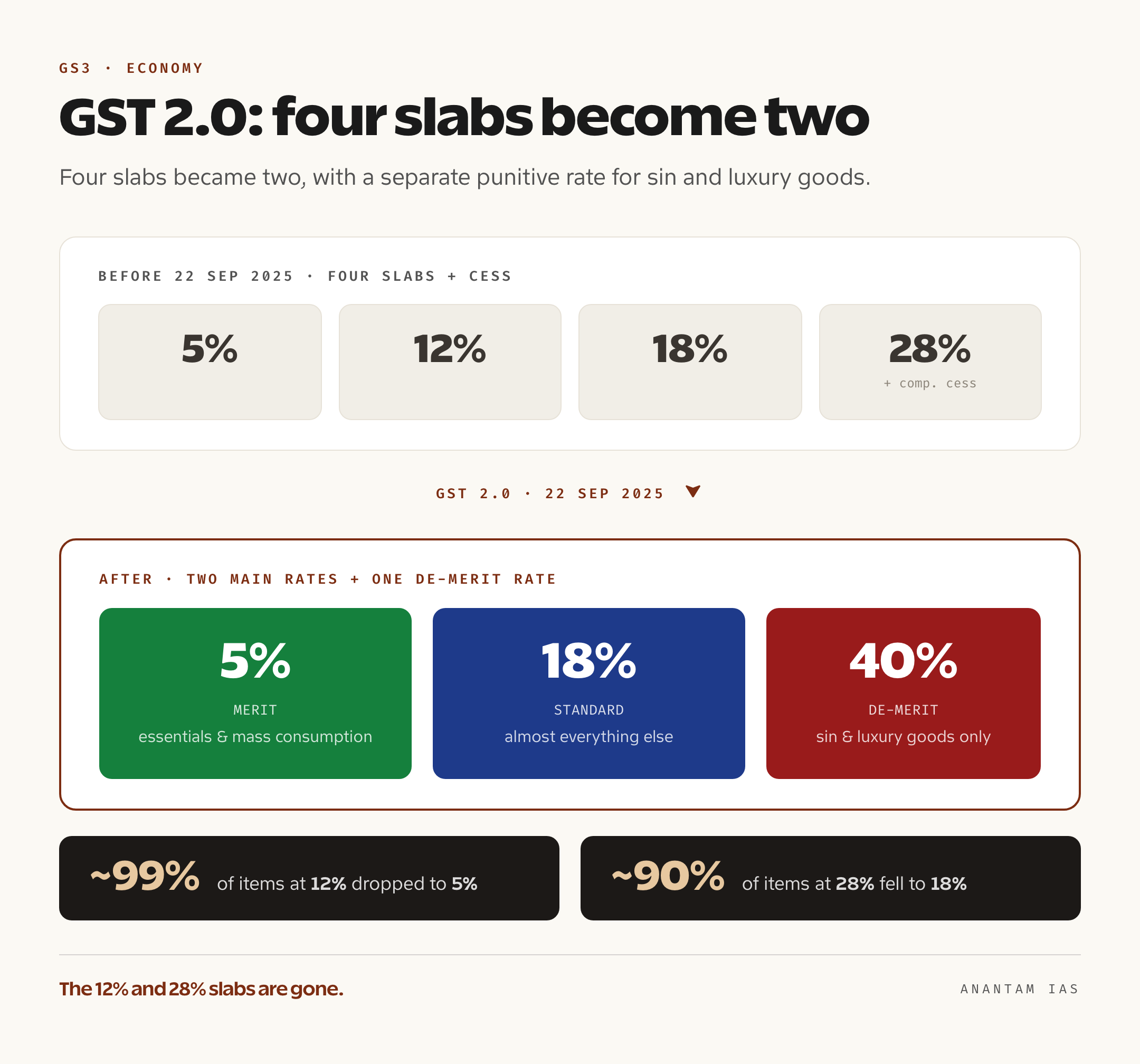
For eight years, the standard answer to “how many GST slabs does India have?” was four — 5%, 12%, 18% and 28% — plus a compensation cess sitting on top of the highest band. From 22 September 2025 that answer stopped being true. The GST Council, at its 56th meeting on 3 September 2025, signed off on the biggest overhaul of the tax since it launched in 2017, and the Centre branded it “next-generation GST reform,” or GST 2.0. The four-slab maze became a clean two-rate structure: a 5% “merit” rate for essentials and a mass-consumption tier, and an 18% “standard” rate for almost everything else. A third, deliberately punitive 40% rate was carved out for a short list of sin and luxury goods.
So why does a tax-slab reshuffle deserve a full explainer? Because GST is the single most important experiment in Indian fiscal federalism, and changing its rate architecture touches almost everything the exam cares about — Centre-state relations, the GST Council’s constitutional design under Article 279A, revenue buoyancy, inflation, consumption demand, and the long-running complaint that the old system was too complicated to comply with. The Finance Minister called it relief for the common man; states worried about the revenue they would forgo. Both are right, and that tension is exactly what makes GST 2.0 worth understanding properly rather than memorising as a list of new prices.
What GST 2.0 Actually Changed
Let’s get the structure exactly right, because the whole reform hangs on it. Before 22 September 2025, taxable goods and services fell into four rate slabs — 5%, 12%, 18% and 28% — with a separate compensation cess (anywhere from a few percent to over 200% on tobacco) layered above the 28% band for cars, aerated drinks, tobacco and a few other items. GST 2.0 deleted the two middle-and-top slabs. The 12% slab is gone; the 28% slab is gone. What remains is a 5% merit rate, an 18% standard rate, and a special 40% de-merit rate that applies only to a narrow list of sin and luxury products.
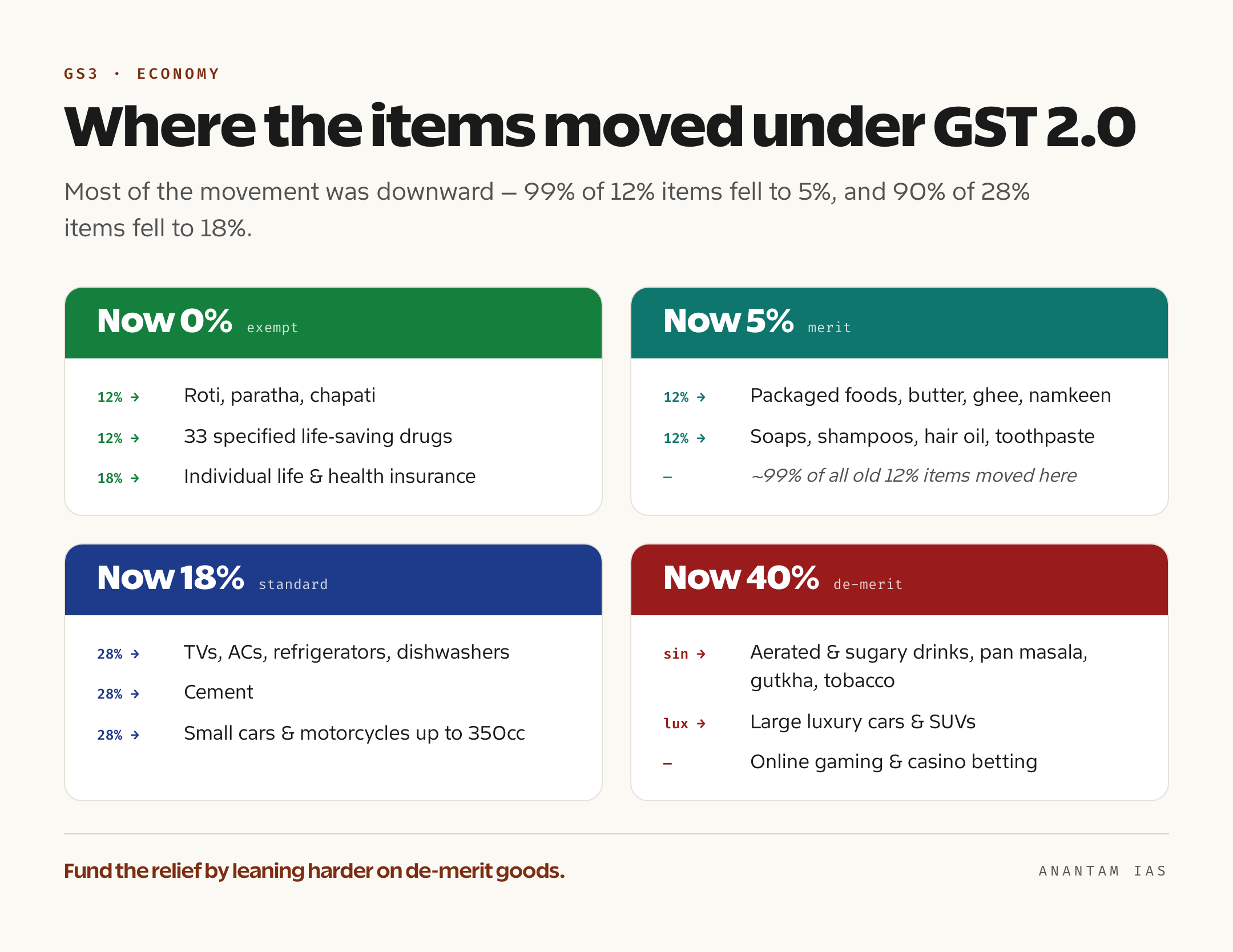
The migration was not random. By the Finance Ministry’s own account, about 99% of the items that used to sit at 12% have dropped to 5%, and roughly 90% of the items at 28% have fallen to 18%. So the typical effect for households was a tax cut. Packaged foods, butter, ghee, namkeen, and a long tail of FMCG goods such as soaps, shampoos, hair oil and toothpaste came down to 5% or lower. Roti, paratha and chapati went to nil. Thirty-three specified life-saving drugs moved from 12% to zero. Big-ticket consumer durables — televisions of every screen size, air-conditioners, refrigerators, dishwashers — slid from 28% to 18%, and cement, a critical input for housing and infrastructure, made the same 28%-to-18% jump.
Two changes stand out because they touch crores of people directly. Small cars (petrol engines below 1200cc, diesel below 1500cc, and under four metres long) and motorcycles up to 350cc dropped from 28% to 18%. And in a separate but parallel decision, GST on all individual life and health insurance policies — including family-floater health plans — was cut from 18% to zero, effective the same day. Group and employer-sponsored policies stay at 18%, but for an individual buying her own cover, the tax simply vanished. That single move was meant to nudge a chronically under-insured population toward protection.
The 40% rate is the mirror image of the merit cut: it exists to keep the burden high where the state wants consumption discouraged or where it can afford to tax indulgence. Aerated and sugar-sweetened drinks, energy and caffeinated beverages, pan masala, gutkha, tobacco products, large luxury cars and SUVs (above the small-car thresholds), and online gaming and casino betting all sit in the 40% band. The logic is straightforward — fund the giveaways to the common man by leaning harder on demerit goods and luxuries, while still simplifying the slab count.
The GST Basics You Still Need to Carry
Before the 2025 reform swallows your attention, anchor the fundamentals, because Prelims still tests them and the new slabs only make sense against them. GST is a destination-based, value-added tax on the supply of goods and services that replaced a tangle of central and state indirect taxes — excise duty, service tax, VAT, octroi and a dozen others — from 1 July 2017. Its central promise was a single national market: one tax, paid where goods are consumed rather than produced, with input tax credit flowing along the chain so that tax is levied only on the value each business adds, not piled tax-on-tax.
India runs a “dual GST,” and this is the part that makes it a federal instrument rather than a central one. On every intra-state sale, the levy splits into two halves collected simultaneously — Central GST (CGST), which goes to the Union, and State GST (SGST), which goes to the state where consumption happens. In a Union Territory without a legislature, SGST is replaced by UTGST. For an inter-state sale or an import, a single Integrated GST (IGST) is charged by the Centre and then apportioned to the destination state. So when a product is taxed at 18%, an intra-state buyer is really paying 9% CGST plus 9% SGST; the headline rate is what GST 2.0 changed, but this Centre-state plumbing underneath stayed exactly the same.
The constitutional scaffolding also survived untouched. The 101st Constitutional Amendment Act, 2016 created the legal basis for GST, inserting Article 246A (the concurrent power of Parliament and state legislatures to make laws on GST) and Article 279A (the GST Council). That dual taxing power is unusual in the Constitution and is the reason GST is genuinely a shared sovereignty arrangement rather than a tax handed down from Delhi. Keep these two articles ready — they are the most reliably examined facts in the whole topic.
How the Decision Was Made: The GST Council and Article 279A
GST 2.0 did not arrive by a Budget announcement or an ordinary law. It came through the GST Council, the body that the Constitution itself created to run GST cooperatively. So the process is as testable as the outcome. Article 279A required the President to constitute the Council within sixty days of the 101st Amendment coming into force. It is chaired by the Union Finance Minister, and its members are the Union Minister of State for Finance and the finance (or any nominated) minister of every state and Union Territory with a legislature. It is, in form, a permanent federal negotiating table for indirect tax.
The voting design is the bit examiners love. Every decision needs a majority of not less than three-fourths of the weighted votes of members present and voting. The Centre’s vote carries one-third of the total weight; all the states together carry the remaining two-thirds. Read that carefully: the Centre alone cannot pass anything, because it lacks three-fourths on its own, and the states cannot steamroll the Centre either, because a Union veto is built into the arithmetic. The framers wanted forced consensus, and in practice almost every Council decision — including the 2025 rationalisation — has been taken by broad agreement rather than a divided vote.
There’s one more constitutional nuance that turns this into a GS-II answer, not just a GS-III one. In Union of India v. Mohit Minerals (2022), the Supreme Court held that the GST Council’s recommendations are not binding on Parliament or the state legislatures; they have “persuasive value,” and both the Union and the states have simultaneous power to legislate on GST. The Court framed this as cooperative federalism, in which neither level of government is subordinate. So the correct way to describe GST 2.0 is process-precise: the GST Council recommended the new rate structure, and the Centre and states then gave it legal effect through their respective rate notifications under the CGST, SGST and IGST Acts. The Council recommends; the legislatures and governments enact.
Why the Reform Was Needed: Simplification and Consumption
The case for collapsing the slabs had been building for years, and it rested on three honest problems. The first was classification disputes. With four rates plus exemptions, the difference between 12% and 18% — or 5% and 12% — turned on hair-splitting product definitions, and the result was a steady stream of litigation and absurd-sounding rulings. The popcorn saga of late 2024, where ready-to-eat popcorn could attract 5%, 12% or 18% depending on whether it was loose, pre-packaged or caramelised, became the symbol of a system tying itself in knots. Fewer slabs mean fewer borders to argue over.
The second problem was compliance friction, especially for small businesses and MSMEs that had to track which of their inputs and outputs fell in which band. The third, and the one the government led with politically, was demand. Cutting the tax on mass-consumption goods, consumer durables and individual insurance was pitched as putting money back in household pockets ahead of the festive season, lifting disposable incomes and stimulating consumption — which, if it works, eventually widens the tax base and supports collections through volume. The Finance Ministry’s framing was explicitly pro-consumer: simpler slabs, lower everyday prices, and a tax that ordinary people could understand.
The deeper structural story is the compensation cess. When GST launched, states were promised compensation for any revenue shortfall against a guaranteed 14% annual growth, funded by a cess on luxury and sin goods for an initial five years to 2022. The pandemic blew a hole in collections, the Centre borrowed to keep paying the states, and the cess was extended to service those loans. GST 2.0 is timed around the unwinding of that legacy: the compensation cess is being phased out as the borrowings are cleared, which freed up fiscal room to rationalise rates. For most goods the cess simply ended; for tobacco, pan masala and similar products it was held in place until the loan account was discharged, after which those items moved fully into the 40% GST band — with a new Health and National Security Cess introduced so that the overall tax incidence on tobacco stays broadly unchanged rather than falling.
The Federal Fault Line: Revenue, Trust and What to Watch
No GST story is complete without the money, because rate cuts are also revenue forgone, and that revenue is shared with states. The government’s own short-term estimate put the net annual revenue impact of the rationalisation at roughly ₹48,000 crore. The official line is that this is modest against total GST collections that crossed ₹22 lakh crore for the year — and that lower rates on mass-consumption goods will spur demand, pull more activity into the formal net, and improve tax buoyancy over the medium term, partly clawing the loss back. Independent analysts broadly agreed the hit to the exchequer would be manageable rather than alarming.
But the states’ anxiety is real and structurally legitimate, and a good answer must hold it. States surrendered most of their independent indirect-taxing power when they joined GST, so their fiscal autonomy now depends heavily on the GST pool and on the Centre keeping faith. With the compensation guarantee already expired, several states had wanted a fresh assurance — or a revenue-protection mechanism — before agreeing to deep rate cuts, fearing they would absorb a permanent dent in their SGST receipts with no safety net if the promised consumption boom under-delivers. This is the heart of the fiscal-federalism debate: who bears the risk when the Council collectively cuts rates, and how is a state’s revenue protected once the original compensation deal is gone?
So the things to watch over the next two to three years are clear. Does consumption actually rise enough to offset the rate cuts, or do states see a sustained revenue gap? Do the simpler slabs really reduce litigation, or do new classification fights spring up at the 5%/18% and 18%/40% borders? Does the 40% band hold the line on sin goods, or does it invite the same disputes the old 28%-plus-cess structure created? And, longer term, will the Centre and states build a durable revenue-sharing understanding to replace the lapsed compensation regime? GST 2.0 simplified the rate card. Whether it strengthened or strained the federal compact underneath is the question the exam will keep returning to.
For Your Mains Answer
GST 2.0 is primarily a GS Paper III topic — it sits squarely in “mobilisation of resources,” “government Budgeting,” and indirect-tax reform. But its sharpest edge is the GS Paper II overlap on Indian federalism, Centre-state financial relations and constitutional bodies, because the GST Council under Article 279A and the Mohit Minerals ruling are pure GS-II material. A strong candidate writes the reform as an economic measure with a federal spine, not as a price list. It is also quotable in the Essay paper on themes of economic reform, simplification of the state, and cooperative federalism.
How to Build the Answer
Lead with the structural change in one crisp line — four slabs to two (5% and 18%) plus a 40% de-merit rate from 22 September 2025 — then explain the why in three moves: simplification (ending classification disputes), relief (lower rates on mass-consumption goods and zero GST on individual insurance), and demand (a consumption stimulus). Pivot to the federal dimension: the Council recommended it under Article 279A, the Centre and states notified it, and the revenue-sharing question lingers because the compensation cess has lapsed. Close on the watch-list — buoyancy versus revenue loss, and the durability of Centre-state trust.
Common Mistakes to Avoid
Don’t say the Council “imposed” or “passed” the new rates — it recommends; the legislatures and governments enact, and Mohit Minerals makes that distinction worth marks. Don’t claim GST became a single rate — it is now two main slabs plus a 40% special rate, not one. Don’t forget the compensation-cess backstory; an answer that ignores why states are nervous misses the federalism core. And don’t drown the page in item-by-item price changes — two or three examples (insurance to nil, cement 28%→18%, tobacco at 40%) are plenty.
A Compact Answer Spine
Four slabs (5/12/18/28) plus cess → collapsed into 5% merit and 18% standard, with a 40% de-merit rate, from 22 Sept 2025 (56th Council) → rationale: fewer classification disputes, lower everyday prices, consumption boost, individual insurance to nil → process: Council recommends under Article 279A (one-third Centre, two-thirds states, three-fourths majority); Centre and states notify; recommendations persuasive per Mohit Minerals (2022) → fiscal angle: ~₹48,000 crore revenue forgone, compensation cess phased out, states seek revenue protection → way forward: durable revenue-sharing settlement + watch buoyancy.
Diagram or Flowchart Idea
Draw a simple before/after funnel: on the left, four boxes (5%, 12%, 18%, 28% + cess); an arrow labelled “GST 2.0, 22 Sep 2025”; on the right, two boxes (5% merit, 18% standard) with a small separate box (40% sin/luxury). A clean structural diagram like this signals command of the reform in seconds and is fast to draw.
A Balanced-Conclusion Line
End by holding both truths at once: GST 2.0 makes the tax simpler for citizens and lighter on the common consumer, but its long-run success depends on whether the consumption gains materialise and whether the Centre and states rebuild a revenue-protection compact now that compensation has ended — simplification of the rate card must be matched by trust in the federal bargain beneath it.
How to Use Data Without Cramming
Pick a few load-bearing figures and deploy them with intent: the reform date (22 September 2025) and meeting (56th GST Council), the migration scale (about 99% of 12% items to 5%, around 90% of 28% items to 18%), the revenue estimate (~₹48,000 crore forgone), and the Council’s voting design (one-third Centre, two-thirds states, three-fourths majority). One precise figure beats five vague ones, and the voting weights are the single most exam-friendly number in the topic.
FAQ
What exactly did GST 2.0 change on 22 September 2025? It replaced India’s four GST slabs (5%, 12%, 18% and 28%) with a two-rate structure — a 5% merit rate and an 18% standard rate — plus a special 40% de-merit rate for sin and luxury goods such as tobacco, pan masala, aerated drinks, online gaming and large luxury vehicles. About 99% of 12% items moved to 5% and roughly 90% of 28% items moved to 18%.
Did insurance really become tax-free? Yes, for individuals. GST on all individual life and health insurance policies, including family-floater health plans, was cut from 18% to zero from 22 September 2025. Group and employer-sponsored policies, however, continue to attract 18% GST.
Who decides GST rates, and is the GST Council’s word final? The GST Council, a constitutional body under Article 279A chaired by the Union Finance Minister, recommends rate changes; the Centre and the states then give them legal effect through notifications under their respective GST Acts. The Supreme Court held in Union of India v. Mohit Minerals (2022) that the Council’s recommendations are persuasive, not binding, on the legislatures — a key cooperative-federalism point.
Why are states worried about GST 2.0? Because rate cuts mean revenue forgone, and states share that revenue through SGST. The government estimated a short-term hit of about ₹48,000 crore. With the original compensation guarantee already expired and the compensation cess being phased out, several states wanted assurance that their revenue would be protected if the expected consumption boost falls short.
Practice Questions
Prelims MCQs
- With reference to the GST rate structure effective 22 September 2025 (“GST 2.0”), consider the new slabs.
Which of the following best describes it?
(a) A single uniform rate of 12%
(b) Two main slabs of 5% and 18%, plus a 40% rate for sin and luxury goods
(c) Three slabs of 5%, 12% and 18%
(d) Four slabs of 5%, 12%, 18% and 28% retained with a cess.
Answer: (b) — GST 2.0 collapsed the four slabs into a 5% merit rate and an 18% standard rate, with a special 40% de-merit rate for sin and luxury items. - The Goods and Services Tax Council is established under which Article of the Constitution?
(a) Article 246A
(b) Article 269A
(c) Article 279A
(d) Article 280.
Answer: (c) — Article 279A, inserted by the 101st Constitutional Amendment Act, 2016, creates the GST Council. - Regarding voting in the GST Council, consider the following:
1. The Centre’s vote has a weightage of one-third of the total votes cast.
2. The states together have a weightage of two-thirds.
3. A decision needs a majority of not less than three-fourths of the weighted votes of members present and voting. Which are correct?
(a) 1 and 2 only
(b) 2 and 3 only
(c) 1 and 3 only
(d) 1, 2 and 3.
Answer: (d) — All three describe the Council’s constitutional voting design under Article 279A. - Under the dual GST model, an inter-state supply of goods or services is taxed through:
(a) CGST and SGST collected together
(b) SGST alone
(c) IGST collected by the Centre and apportioned to the destination state
(d) UTGST alone.
Answer: (c) — Inter-state supplies and imports attract IGST, which the Centre collects and apportions to the consuming state. - Which of the following correctly reflects a GST 2.0 change effective 22 September 2025?
(a) Individual life and health insurance premiums were exempted (zero GST)
(b) The 12% slab was retained for processed food
(c) Cement was raised from 18% to 28%
(d) All vehicles were taxed at a flat 5%.
Answer: (a) — Individual life and health insurance moved from 18% to nil; cement actually fell from 28% to 18%, and the 12% slab was abolished.
Mains Practice Questions
- “GST 2.0 simplified the rate card but tested the federal compact.” Examine the 2025 rate rationalisation in the light of Centre-state financial relations. (15 marks, 250 words)
- Discuss the constitutional design and decision-making process of the GST Council under Article 279A. How does its voting structure embody cooperative federalism? (10 marks, 150 words)
- Evaluate the rationale behind collapsing India’s four GST slabs into a two-rate structure with a separate de-merit rate. What are the likely effects on classification disputes, compliance and consumption? (15 marks, 250 words)
- The phasing out of the GST compensation cess has reopened the question of revenue protection for states. Critically analyse the fiscal-federalism implications. (15 marks, 250 words)
- “Rate rationalisation is as much a political-economy choice as an administrative one.” In the context of GST 2.0, discuss how the State balances revenue, equity and consumption while taxing merit, standard and demerit goods differently. (10 marks, 150 words)