OSIRIS-REx and OSIRIS-APEX: NASA’s Asteroid Sample Return and the Apophis Stalker Mission
A complete UPSC GS-III explainer on the OSIRIS-REx mission and its extension as OSIRIS-APEX. Covers the seven-year journey to asteroid Bennu, the touch-and-go sample collection, the September 2023 capsule return, the science motivation for studying carbon-rich and stony asteroids, the planned 2029 rendezvous with Apophis, and where the Indian asteroid programme fits into the global effort.
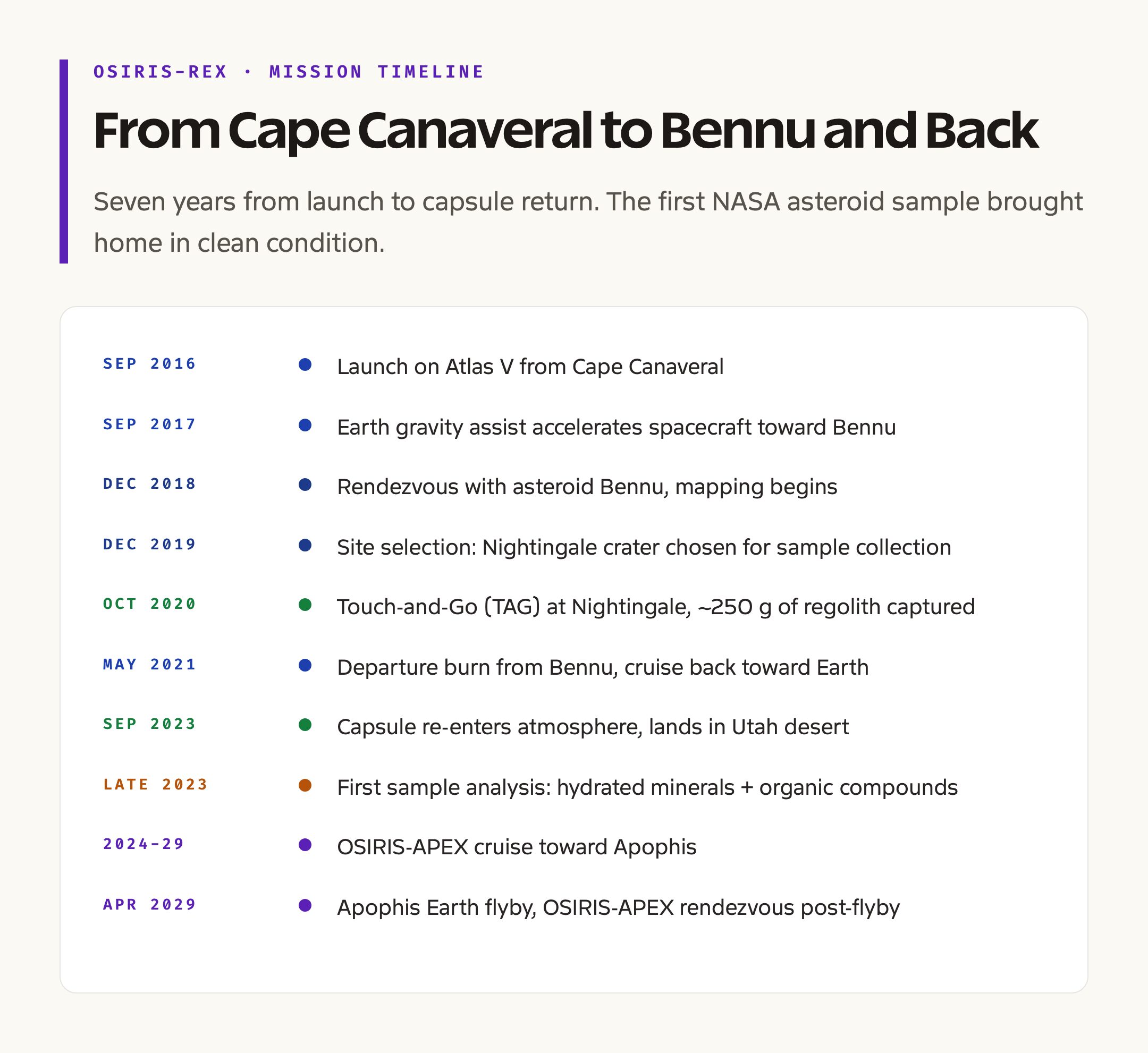
OSIRIS-REx is one of the most ambitious robotic missions NASA has ever flown. The spacecraft launched in September 2016, took two years to reach the asteroid Bennu, spent two more years mapping the surface in centimetric detail, descended to make a brief and improbable contact with the asteroid in October 2020, and delivered the resulting sample to a parachute-borne capsule that landed in the Utah desert in September 2023. The mission then turned around in flight and set off for a second asteroid called Apophis, which it will reach in 2029. The extended phase carries a new name, OSIRIS-APEX.
The name is an acronym that needs to be unpacked. OSIRIS stands for Origins, Spectral Interpretation, Resource Identification, and Security. REx is short for Regolith Explorer. APEX, the extended-mission identifier, stands for Apophis Explorer. The composite acronym tells you the mission’s three scientific arcs. Origins, because asteroids are time capsules from the solar system’s birth. Resource Identification, because they may one day be mined. Security, because some near-Earth asteroids could one day strike the planet, and understanding them is the first step to deflecting them.
For UPSC, the mission sits at the intersection of space technology, planetary defence, and the broader science of asteroids and comets. The Indian space programme has its own asteroid roadmap, and the ISRO missions page tracks the calendar. This article explains what OSIRIS-REx achieved at Bennu, what OSIRIS-APEX will attempt at Apophis, and how these missions connect to a global programme of small-body exploration that includes Hayabusa, DART, and the proposed asteroid missions tracked through current affairs.
Why Asteroids Matter
An asteroid is a rocky or metallic body in orbit around the Sun, smaller than a planet but larger than a meteoroid. The main belt, between Mars and Jupiter, contains millions of them, ranging from a few metres across to nearly a thousand kilometres for Ceres. Near-Earth asteroids are the subset whose orbits cross or come close to Earth’s orbit. They are the population that planetary defence cares about and the population that crewed and robotic missions can reach with the least propulsive cost.
Asteroids are scientifically valuable because they are remnants of the protoplanetary disk that formed the solar system about four and a half billion years ago. The terrestrial planets reprocessed their material through volcanism, plate tectonics, and water cycles. Asteroids did not. Carbon-rich asteroids in particular are believed to retain organic compounds and water-bearing minerals that may have seeded the early Earth. Studying them is a way to study the solar system’s chemistry before life began.
Asteroids are also strategically interesting. A body of even a few hundred metres across, if it struck a populated region, would do continental-scale damage. The Tunguska event of 1908 was caused by an object estimated at fifty to a hundred metres across. Knowing the orbit, composition, and structural properties of near-Earth asteroids is the first step to predicting which ones are dangerous and how to deflect them.
The Bennu Choice
Bennu was selected as the OSIRIS-REx target after a careful filtering process. The mission needed an asteroid that was reachable with reasonable propellant cost, that was small enough to map and orbit but not so small that the spacecraft would lose stable orbit, that was carbon-rich because the science case favoured that composition, and that had a non-trivial probability of an Earth-crossing future. Bennu fit all four criteria. It is a roughly five-hundred-metre carbonaceous asteroid in a near-Earth orbit, with a small but non-zero probability of impact in the late twenty-second century.
The spacecraft launched on an Atlas V rocket from Cape Canaveral in September 2016, used an Earth gravity assist in 2017, and rendezvoused with Bennu in December 2018. The first surprise was the surface. Pre-mission models had assumed Bennu would have a smooth, sandy regolith because that is what infrared remote sensing suggested. The first orbital photographs showed a surface covered in metre-scale boulders, with very few smooth patches large enough to land on. The landing site selection, originally a several-month exercise, became a much longer and more painstaking job.
After eighteen months of mapping and rehearsal, the team picked a site nicknamed Nightingale, a relatively boulder-free crater near Bennu’s north pole. The descent was scheduled for October 2020, four years after launch.
Touch-and-Go: TAGSAM in Action
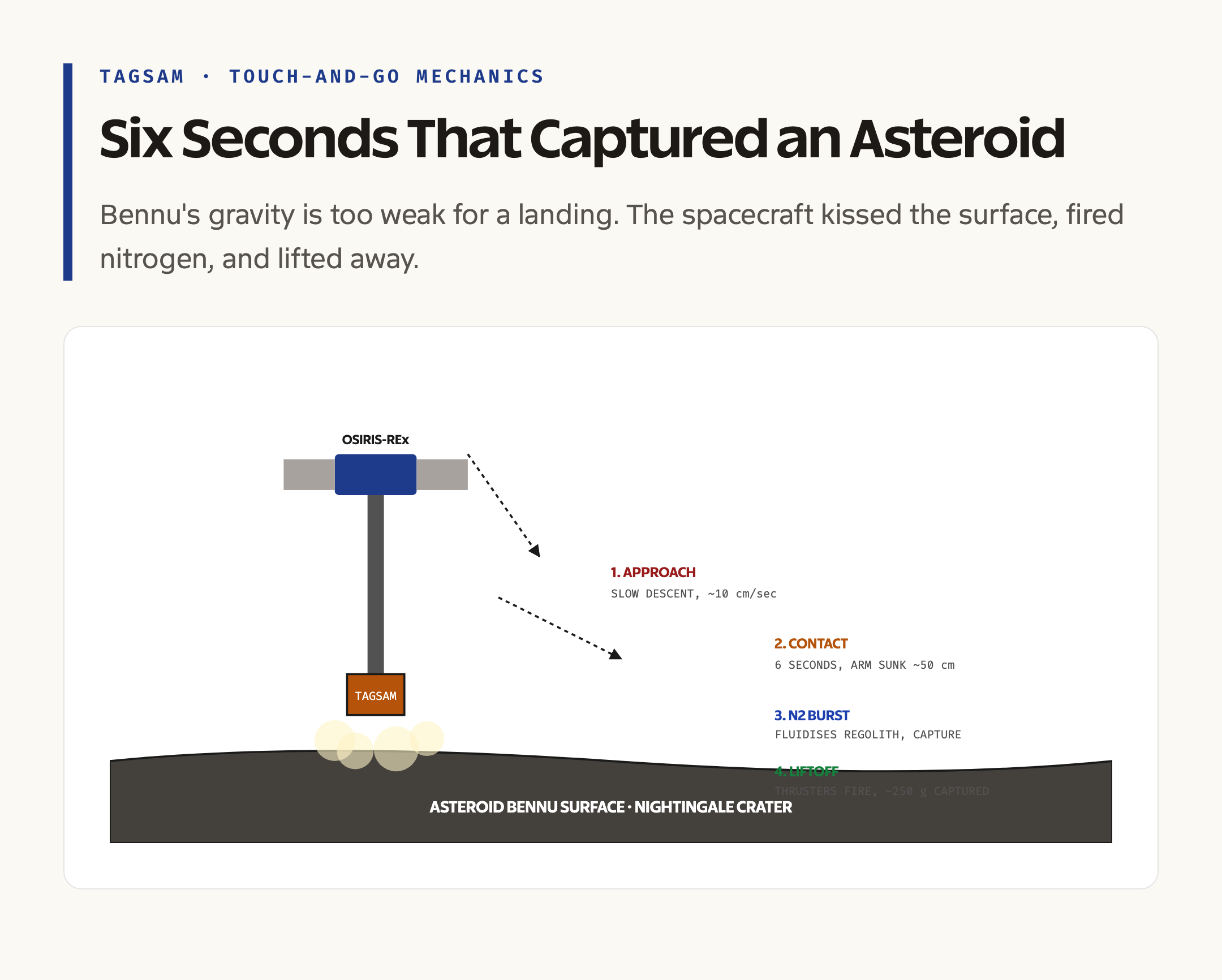
OSIRIS-REx did not land on Bennu. The asteroid’s gravity is far too weak to hold a lander reliably, and a propulsive landing would have stirred up regolith that contaminated the sampling arm. Instead, the spacecraft executed a touch-and-go manoeuvre, abbreviated TAG. The technique was elegant in concept. The spacecraft descended to the surface at a slow approach speed, extended a sampling arm called TAGSAM, made contact for a few seconds, fired a burst of nitrogen gas through the arm to fluidise the surface regolith, captured the rebounding particles in a collection head, and immediately fired thrusters to lift away.
The contact lasted six seconds. The arm penetrated nearly half a metre into the surface, far deeper than the team had planned for, because Bennu’s surface turned out to be much more loosely consolidated than the boulder-strewn appearance had suggested. The collection head closed over a quantity of material so large that some of it leaked back into space before the head could be stowed.
After stowage was complete, the team confirmed that the spacecraft had captured an estimated two hundred and fifty grams of regolith, far above the sixty-gram mission requirement. The actual recovered mass after Earth return was approximately one hundred and twenty-one grams. OSIRIS-REx then began its long cruise back home.
The Capsule Return
In September 2023, OSIRIS-REx flew past Earth and released its sample return capsule. The spacecraft itself, rather than re-entering, fired its engines to set up a different orbit. The capsule descended through the atmosphere, deployed parachutes, and landed at the Utah Test and Training Range. The sample was airlifted to NASA’s Johnson Space Centre in Houston.
The early scientific results were worth the seven-year wait. The Bennu sample contained organic compounds, including amino-acid precursors and nitrogenous bases related to those that form RNA. It also contained hydrated minerals, evidence that liquid water once interacted with the parent body. These are the same kinds of compounds that scientists believe were delivered to the early Earth by carbonaceous asteroids and comets, providing the chemical building blocks for life. A sample collected in deep space, brought home, and analysed in a clean laboratory is a far better dataset than any remote spectroscopy.
NASA distributed sub-samples to research institutions worldwide for analysis over the coming decades. A portion is curated for future generations of scientists with instruments that have not been invented yet, the same way Apollo lunar samples were preserved for analysis with techniques that emerged long after the Apollo missions ended.
Why the Spacecraft Did Not Retire
OSIRIS-REx still had functional instruments and remaining propellant after delivering the capsule. The mission planners had anticipated this. Instead of letting the spacecraft drift, they designated the extended phase as OSIRIS-APEX and pointed the bus at a second target. Apophis was the obvious choice.
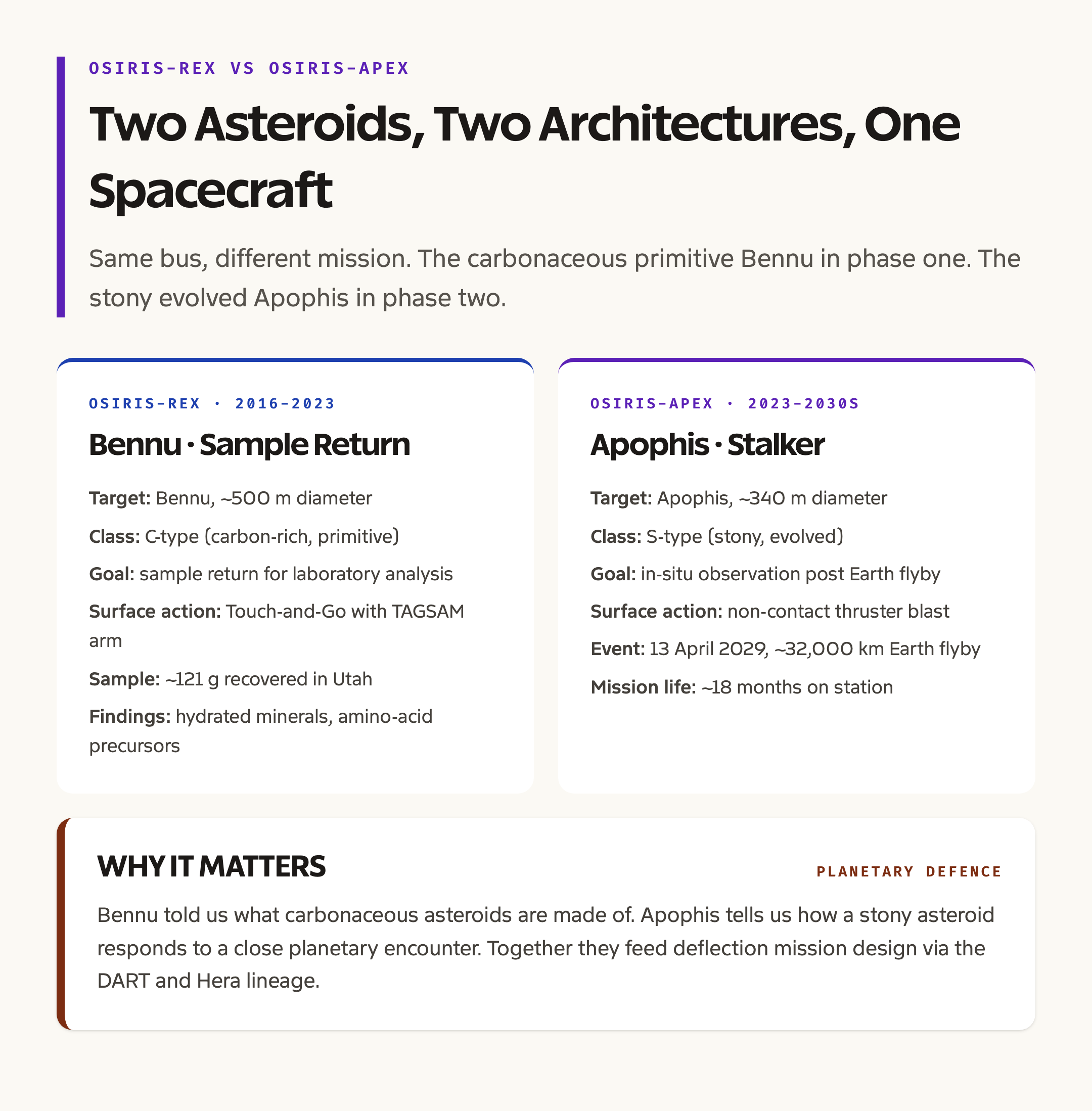
Apophis is a stony, S-type near-Earth asteroid about three hundred and forty metres across. It is named after the Egyptian god of chaos. Its scientific value comes from a rare orbital event. On 13 April 2029, Apophis will pass within thirty-two thousand kilometres of Earth, closer than the geostationary orbit. This is closer than many communication satellites. The flyby is so close that Earth’s gravity will measurably alter Apophis’s orbit, its rotation, and possibly its surface. No asteroid this large has ever been observed during such a close planetary encounter.
OSIRIS-APEX will arrive at Apophis shortly after the close approach, observe what the gravitational interaction has done to the surface, and use the spacecraft’s thrusters to blow regolith aside, exposing the subsurface. The mission is expected to operate for about eighteen months in the Apophis system.
OSIRIS-REx vs OSIRIS-APEX
The two phases of the mission contrast neatly. OSIRIS-REx visited a carbonaceous, primitive asteroid and returned a sample. OSIRIS-APEX is visiting a stony, evolved asteroid and conducting in-situ observation only. OSIRIS-REx descended to make physical contact with the surface using a robotic arm. OSIRIS-APEX will use a non-contact thruster blast to study the subsurface without landing. OSIRIS-REx focused on origins, and OSIRIS-APEX focuses on dynamics and tidal evolution.
The mission also contrasts with Japan’s Hayabusa programme. Hayabusa-1 visited the stony asteroid Itokawa and returned a small sample in 2010. Hayabusa-2 visited the carbonaceous Ryugu, fired a kinetic impactor to expose subsurface material, collected samples from the original surface and the impact crater, and returned them to Earth in December 2020. The two agencies’ programmes are complementary. Between them, scientists now have laboratory samples from at least four asteroids of different compositions.
Planetary Defence and the DART Connection
The third arc of the OSIRIS acronym, security, connects to the broader programme of planetary defence. NASA’s Double Asteroid Redirection Test, DART, struck the small moonlet Dimorphos of the asteroid Didymos in September 2022 and successfully altered its orbital period by a measurable amount. DART proved that a kinetic impactor can deflect a small asteroid. The European Space Agency’s Hera mission is en route to Dimorphos to study the aftermath and provide the engineering data needed to design future deflection missions.
OSIRIS-APEX is not a deflection mission. It is a characterisation mission. But the data on Apophis’s structure, composition, and response to gravitational stress will feed into the engineering of future deflection missions, because deflection efficiency depends on whether the target is a solid body or a rubble pile, on its rotation rate, and on its surface mechanical properties. The Bennu sample analysis is producing the first laboratory measurements of the strength and porosity of carbonaceous asteroid material, which is essential for predicting how a deflection impact would behave.
India’s Asteroid Programme
India has not yet flown an asteroid mission, but the roadmap is being prepared. ISRO has discussed an Apophis mission of its own, possibly using the Mars Orbiter Mission heritage hardware, to coincide with the 2029 close approach. A small interplanetary mission to a near-Earth asteroid is also under study at ISRO’s Space Science Programme. The Indian programme is more constrained than NASA’s by launcher capability and budget, but the small-body domain is well suited to small spacecraft and modest budgets.
Beyond direct missions, India contributes to the international planetary defence effort through the Space Situational Awareness centre at Bengaluru, which tracks near-Earth objects with help from the international Minor Planet Centre. The Multi-Object Tracking Radar at Sriharikota provides high-precision orbit determination for newly discovered objects.
Why the Mission Matters for UPSC
OSIRIS-REx and OSIRIS-APEX cover several recurring UPSC themes. The science of the early solar system, the origin of organic compounds, the engineering of robotic sample return, and the policy of planetary defence are all on the syllabus in different forms. The mission is the cleanest example of an end-to-end sample return campaign and is therefore a frequent comparison point in questions about Chandrayaan-4 and similar future Indian missions.
Prelims questions on the topic typically ask about the target asteroid, the launch vehicle, the year of return, and the meaning of TAGSAM. Mains questions are larger. Discuss the scientific case for asteroid sample return missions. Compare the OSIRIS-REx and Hayabusa-2 architectures. Examine the role of planetary defence in the global space programme. The set of facts is small enough to memorise and the policy hooks are strong.
Frequently Asked Questions
What does OSIRIS-REx stand for?
Origins, Spectral Interpretation, Resource Identification, and Security – Regolith Explorer.
Which asteroid did OSIRIS-REx visit and what did it bring back?
It visited Bennu, a carbonaceous near-Earth asteroid, and returned approximately 121 grams of regolith to Earth in September 2023.
What is OSIRIS-APEX?
OSIRIS-APEX is the extended mission of the same spacecraft. After delivering the Bennu sample capsule, the spacecraft set off for the asteroid Apophis, where it is expected to arrive after the April 2029 close approach.
Why did OSIRIS-REx not land on Bennu?
Bennu’s gravity is too weak for stable landing. The spacecraft executed a touch-and-go manoeuvre with a brief surface contact and used a nitrogen burst through the TAGSAM arm to collect material.
How is OSIRIS-APEX different from OSIRIS-REx scientifically?
OSIRIS-REx targeted a primitive carbon-rich asteroid for origins research. OSIRIS-APEX targets a stony asteroid to study tidal evolution from the close Earth flyby and uses a non-contact thruster blast rather than a sample arm.
Does India have its own asteroid mission planned?
Yes. ISRO has discussed a near-Earth asteroid mission and is studying an Apophis flyby using existing planetary mission heritage hardware.