Oxford Student Atlas: Which Edition to Buy and How to Use It for UPSC
The Oxford Student Atlas 7th edition is the atlas to buy for UPSC. Which sections carry the exam, a four-week map plan and what the atlas will not do.
The Oxford Student Atlas for India is the atlas nearly every UPSC booklist names, and the question you walked in with is narrower than whether it is good. It is: which edition do I buy, and what do I actually do with it once it’s on the desk? An atlas isn’t read like a textbook. It’s a reference you keep open beside every geography chapter, every current-affairs story with a place in it and every previous-year question that names a strait, a river or a national park. Bought and left on the shelf, it’s the cheapest book on your list and the one that does nothing.
Most aspirants handle it in one of two ways. The first group buys it in month one, flips through the world pages once and never opens it again. The second group decides maps are only a handful of questions, skips the atlas altogether and then drops exactly the location questions it would have settled in a minute.
The useful middle is a habit, not a purchase. Buy the current edition, keep it open while you read and give it twenty minutes a day of deliberate map work for a month. I want to settle the edition first, because older prints are still sold as new and the difference matters more for an atlas than for most books.
What the Oxford Student Atlas is, and which edition to buy
The Oxford Student Atlas for India is Oxford University Press’s atlas for competitive examinations. The current English print is the 7th edition, released on 10 December 2025, and the Hindi edition moved to its 5th edition in September 2026. It is a different book from the Oxford School Atlas, which is built for school syllabi and carries its own edition numbers.
The facts that matter when you order it:
- Title: Oxford Student Atlas for India, 7th edition (ISBN 978-9373745138)
- Publisher: Oxford University Press India
- Length: 160 pages, a 27.6 x 21.6 cm paperback
- Released: 10 December 2025
- Hindi edition: Oxford Student Atlas Hindi, 5th edition, 112 pages (ISBN 978-9373743561), published in September 2026
Edition matters here for three reasons:
- The 7th edition’s listing says it reflects recent administrative changes and the latest socio-economic data. State maps and data themes are the first parts of any atlas to go out of date.
- The new Hindi 5th edition bases its social, economic and demographic maps on 2024-25 and 2025-26 data, according to OUP.
- The 4th, 5th and 6th English editions are all still listed as new copies on Amazon.in. Check the edition number on the cover before you pay.
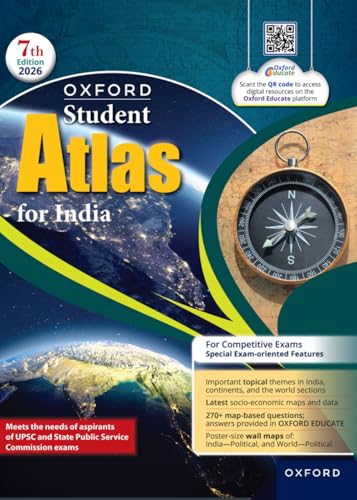
Oxford Student Atlas for India, 7th Edition (English)
- 160 pages, Oxford University Press, released December 2025
- Physical, political and thematic maps of India and the world, updated for recent administrative changes
- The current English edition; the 4th, 5th and 6th are still listed, so check the cover
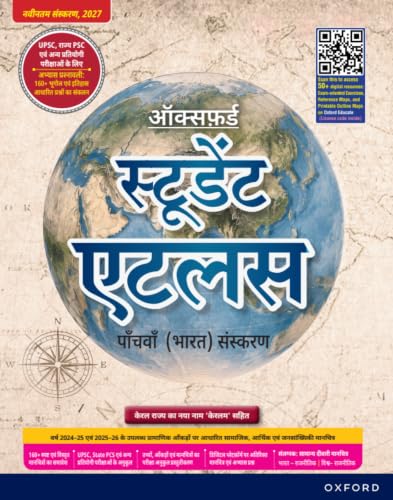
ऑक्सफोर्ड स्टूडेंट एटलस (हिंदी), 5वाँ संस्करण
- 112 पेज, Oxford University Press, सितंबर 2026
- सामाजिक, आर्थिक और जनसांख्यिकीय मानचित्र 2024-25 और 2025-26 के आँकड़ों पर आधारित
- भारत और सभी महाद्वीपों के अलग प्राकृतिक और राजनीतिक मानचित्र
If you write the exam in Hindi, buy the Hindi edition. Its labels and thematic titles are in Hindi, which is how you will have to write them. It is shorter than the English book, 112 pages against 160, so an English-medium reader gives up nothing by sticking to the English edition.
Who the Oxford Student Atlas is for, and who can skip it
Every UPSC aspirant needs an atlas, and for most of them the Oxford Student Atlas is the right one. Maps are not a side topic in this exam. They sit under most of the geography questions and a good share of the environment and current-affairs ones.
Our Prelims geography question bank counts 149 geography questions in GS Paper I from 2013 to 2026, an average of 10.6 a year. The average has risen too: 9.3 a year from 2013 to 2019, and 12.0 a year from 2020 to 2026. The three largest topics are all map topics:
- Continents: 18 questions
- Major physical divisions of India: 16 questions
- Drainage system: 14 questions
The Mains paper asks for the same skill in a different form. The GS1 syllabus lists geographical features and their location, and changes in critical geographical features including water bodies and ice caps, as a topic of its own. The Mains geography syllabus page breaks that clause down. For geography optional candidates, UPSC’s notification makes one map question compulsory in Paper II.
Treat the atlas as a core book if:
- UPSC Prelims or a state PSC prelims is in your plan this year or next.
- Geography is your optional, and Paper II’s compulsory map question is waiting for you.
- You read current affairs every day. Every place in the news should be found on the map the same day.
It is fine to skip it if:
- You already own a recent Oxford School Atlas or Orient BlackSwan School Atlas and actually use it. A second atlas adds nothing.
- You only need India’s states and union territories for revision. The free official map on our political map of India page does that job.
It is wise neither to treat the atlas as a book to finish nor to dismiss it as a school accessory. It’s a working tool, like a dictionary, and it only pays when it’s open.
The section map: what to use for UPSC, and what for state exams
OUP lists the atlas in seven blocks, followed by an index and a set of exercises for competitive exams. The page ranges below are from OUP’s contents for the sixth edition. The seventh keeps the same 160-page length. The blocks are not equal, and they sort out differently for the two kinds of reader.
| Section | What it holds | UPSC Prelims and GS1 | State PSC, SSC, CDS |
|---|---|---|---|
| Maps and Map Making; Introduction to Basic Geography | Map reading, projections, the Earth and its motions | Read once, carefully | Read once |
| Geographical Comparisons | Highest, longest and largest lists | Skim | Core |
| The Indian States (pages 14-33) | State-by-state maps | Use for places in the news | Core for your own state |
| India Thematic (pages 34-69) | Relief, drainage, climate, soils, vegetation, crops, minerals, demography; climographs of Indian cities; 121 topical themes | Core: this is the UPSC section | Core |
| Continents and Regions (pages 70-105) | Regional maps, SAARC nations, top-five crop and mineral producers, extra focus on Asia | Core for world geography and international relations | Read |
| World (pages 106-128) | Heat zones, forest cover, world climate, history; facts and figures on every country, time zones | Read with your climate chapters | Read once |
| Index and exercises | Place finder, practice questions | The index is a daily tool | Solve the exercises |
That leaves the India Thematic and Continents and Regions blocks, about 70 pages together, as the working core for a UPSC aspirant. Everything else is either a one-time read or a lookup.
The first block is worth one slow reading for a reason people miss. It explains why a flat map distorts area, which is why Greenland looks as big as Africa on a wall map. Our note on Mercator vs Equal Earth projection takes that further.
How to use the Oxford Student Atlas in four weeks
The method is locate, then recall. Twenty to thirty minutes a day for four weeks, one region at a time, and every session ends with a blank outline map instead of the atlas.
- Week 1, India physical. Relief, drainage and the major physical divisions from the India Thematic pages. Trace every major river from source to mouth and list the states it crosses. Our physical map of India guide follows the same order.
- Week 2, India’s resources and people. Soils, natural vegetation, crops, minerals and the protected-area maps. Mark ten protected areas a day on a blank map, then check.
- Week 3, the world by region. Asia first, since the atlas gives it extra space, then West Asia and Africa, then Europe and the Americas. Straits, gulfs and the countries around each sea.
- Week 4, places in the news. Every place from the month’s current affairs gets located and written into a register with one line on why it was in the news.
For the register, the UPSC mapping practice tracker keeps a daily log, and the 60-day mapping practice kit has printable blank maps for the recall step.
The test is simple. If you cannot place a feature on a blank map without the atlas, you don’t know it yet. Most people’s first blank-map attempt at the peninsular rivers is poor, and that is the whole point of doing it on paper.
What to skip, and what to cross-check
For UPSC, skim the geographical comparisons and the flags, and treat the Indian States block as a lookup rather than a chapter. The history maps are worth opening when you read ancient and medieval sites, not before.
Cross-check anything with a number or a year on it. An atlas prints data from a particular year and cannot move after the print date:
- Crop and mineral rankings, which shift every year. Never quote a rank from an atlas in a Mains answer without checking the ministry figure.
- Population, literacy and other demographic figures, which carry the year of the data they were drawn from.
- District names and counts, which change often enough that the state maps lag behind.
For India’s boundaries in any answer or diagram, use the official political map, not a map from a website or an old atlas.
What the Oxford Student Atlas will not do
It won’t explain anything. A map shows the Western Ghats and the rain shadow behind them. It doesn’t tell you why the rain falls on one side, and that belongs to NCERT and the physical geography books on our geography books for UPSC list.
It won’t update itself. A print from December 2025 cannot show what changed after it. It won’t make you remember, because recall comes only from the blank map. And it won’t teach you to draw quick maps and diagrams inside a Mains answer, which is a separate skill covered in how to make geography notes for UPSC.
The atlas is the cheapest book you’ll buy for this exam. It’s also the one people most often pay for and never use.
Oxford Student Atlas vs Orient BlackSwan vs Oxford School Atlas
Three atlases get bought for the same job, and all three are competent. The difference is what each was built for.
| Atlas | Pages and edition | Built for | Verdict |
|---|---|---|---|
| Oxford Student Atlas for India, 7th edition | 160 pages, December 2025 | Competitive exams, with exercises | The pick for UPSC and state PSC |
| The Orient BlackSwan School Atlas | About 124 pages | School syllabi, strong India thematic maps on disasters, protected areas and heritage sites | A good alternative, but its population maps use 2011 census data |
| Oxford School Atlas, 37th edition | 136 pages, more than 220 maps, 2022 print | School syllabi | More maps, older print; fine for the optional’s map practice |
For the physical geography text to read with the atlas open beside it, our GC Leong reading guide sets out the chapters that matter.
If you already own either school atlas in a recent print, keep it and spend the money on blank outline maps instead. If you are buying fresh, the Student Atlas is the one to buy, because it is the newest print and the only one of the three built around competitive exams.
Is there an Oxford Student Atlas PDF?
No official one. Oxford University Press sells the atlas as a printed book and does not give it away as a free PDF. The files that circulate as an Oxford Student Atlas PDF are scans of older editions, and a scanned atlas fails in ways a scanned textbook doesn’t. Relief shading turns muddy, small labels blur, and a phone screen shows a fraction of a page at a time, which is the opposite of what an atlas is for.
The free and legitimate map resources are elsewhere. NCERT’s geography textbooks, with their maps, are free on the NCERT textbook site at https://ncert.nic.in/textbook.php, and our India maps for geography page collects the maps worth printing.
The Oxford Student Atlas is a good book that only pays when it is open. Buy the 7th edition, or the Hindi 5th if you write in Hindi. Use the India Thematic and Continents blocks as your core, and give it twenty minutes a day with a blank outline map beside it. Start tonight with one river, source to mouth.
Frequently Asked Questions
Which edition of the Oxford Student Atlas should I buy?
The 7th edition in English, released in December 2025 at 160 pages, or the 5th edition in Hindi, published in September 2026 at 112 pages. Older English editions are still listed as new, so check the edition number on the cover before you pay.
Is the Oxford Student Atlas enough for UPSC map questions?
It is enough as an atlas, but not as preparation. The atlas holds the maps; recall comes from locating places on blank outline maps every day. Use it alongside NCERT, a physical geography book and the previous-year questions.
What is the difference between the Oxford Student Atlas and the Oxford School Atlas?
The Student Atlas is built for competitive exams and ends with exercises for them. The School Atlas is built for school syllabi. Both are sound, but for UPSC and state PSC preparation the Student Atlas is the better fit.
Should I buy the Oxford Student Atlas in Hindi or English?
In the language you will write the exam in. The Hindi edition uses Hindi labels and thematic titles, which is how you will have to write them. English-medium readers get a longer book, 160 pages against 112.
Which sections of the atlas matter most for UPSC?
The India Thematic block and the Continents and Regions block, about 70 pages together. They cover relief, drainage, climate, soils, crops, minerals and the regional maps of the world that Prelims questions keep returning to.
How much time should I give to map work?
Twenty to thirty minutes a day is enough if it is regular. Work one region at a time and end every session by marking places on a blank outline map without looking at the atlas.
Is there a free Oxford Student Atlas PDF?
There is no official free PDF. The scans that circulate are older editions, and a scanned atlas loses the relief shading and small labels that make it useful. NCERT textbooks with maps are free on the NCERT website.
Is the Oxford Student Atlas useful for the geography optional?
Yes. Paper II of the geography optional carries a compulsory map question, so regular map practice is not optional for these candidates. Any recent competitive-exam or school atlas works; the Student Atlas is the newest print.