Plastics Recycling in India: PWM Rules, EPR, Single-Use Plastic Ban, Bioplastics
UPSC guide to plastics recycling in India: types of polymers, mechanical and chemical recycling, EPR, single-use plastic ban, and biodegradable plastics.
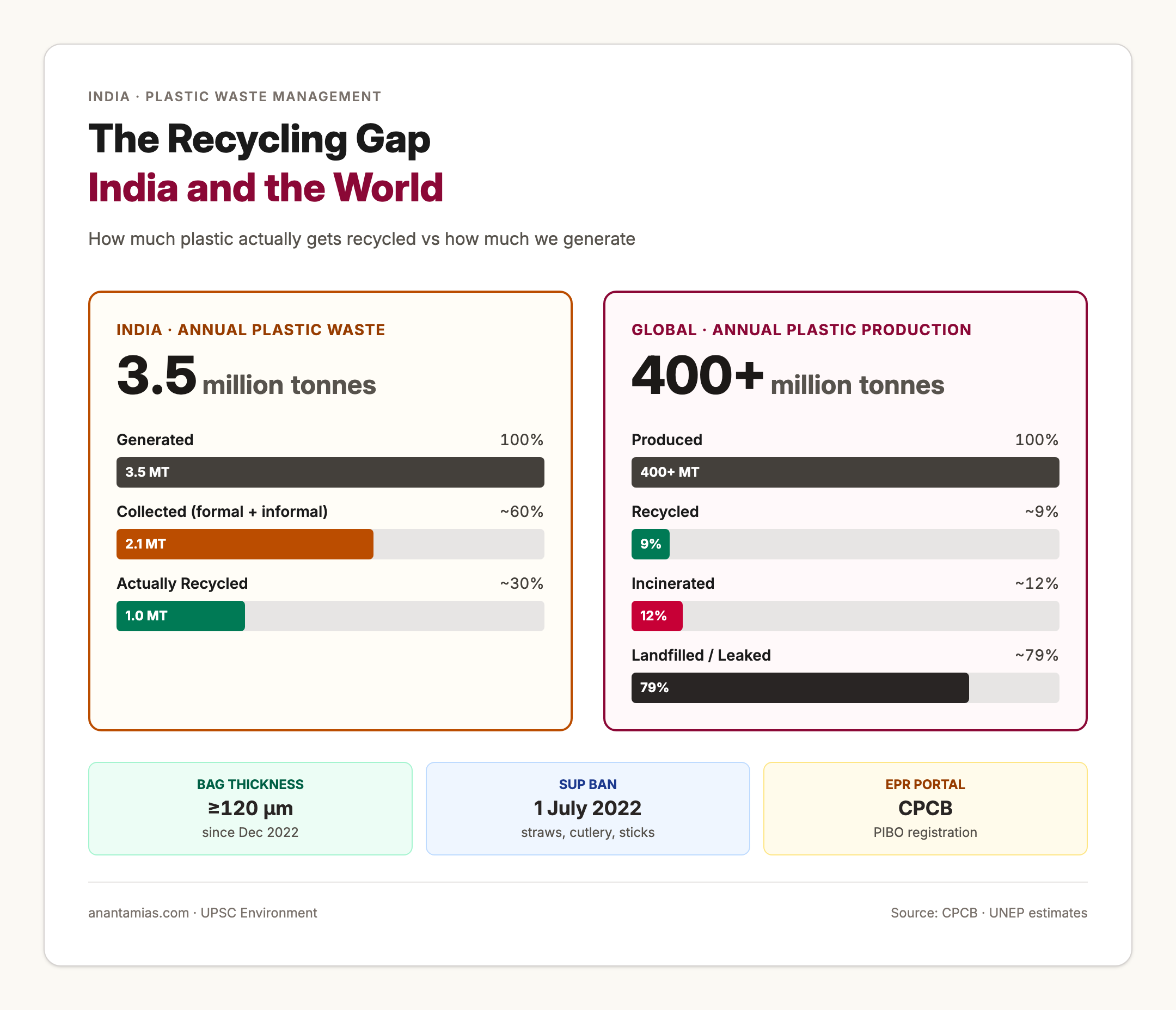
Plastics recycling sits at the heart of India’s circular economy debate. Every year India generates roughly 3.5 million tonnes of plastic waste, and the planet as a whole produces over 400 million tonnes annually. Globally, only about 9 percent of plastic ever produced has been recycled. The remainder has been landfilled, incinerated, or leaked into rivers and oceans, where it breaks into microplastics that have now been found in human blood, placentas, and the deepest ocean trenches. The plastic problem is structural: cheap, durable, and ubiquitous, plastic is engineered to outlast its use case by centuries, and the global system to recover it remains underdeveloped.
For UPSC aspirants, plastics recycling is a topic that braids together environment, science and technology, economy, and governance. It connects to GS-III themes around pollution, conservation, and sustainable development, and to GS-II questions around regulatory frameworks and Centre-State coordination. India’s policy response has evolved rapidly. The Plastic Waste Management Rules under the Environment Protection Act 1986 were notified in 2016 and have been amended several times to introduce mandatory Extended Producer Responsibility, ban single-use plastics, and tighten thickness standards. Understanding these instruments, their interplay with the Solid Waste Management Rules and Mission LiFE, and the science of biodegradable alternatives is essential for both prelims and mains.
This guide walks through what plastics recycling actually means in industrial practice, the chemistry of the seven major polymers, the difference between mechanical and chemical recycling, the structure of India’s regulatory architecture, and the environmental toxicology that makes plastic pollution more than just a litter problem.
Quick Facts at a Glance
India generates approximately 3.5 million tonnes of plastic waste per year, of which a fraction is formally collected and an even smaller fraction is recycled. Globally, only around 9 percent of plastic waste is recycled. Plastics take hundreds of years to decompose under most environmental conditions. The Plastic Waste Management Rules in India are notified under the Environment Protection Act 1986. The first national rules came in 2011 as the Plastic Waste Management and Handling Rules, replaced by the PWM Rules 2016. Successive amendments in 2018, 2021, and 2022 progressively introduced mandatory EPR, banned identified single-use plastics from 1 July 2022, and increased the minimum thickness of carry bags. The seven major plastic resin codes range from PET, the most recyclable, to PS and multilayer plastics, which are difficult to recycle. India is also a signatory to the ongoing UN Global Plastics Treaty negotiations under the UN Environment Programme.
What Plastics Recycling Is
Plastics recycling is the process of collecting, sorting, cleaning, and reprocessing plastic waste into new products to reduce reliance on virgin petroleum-based plastics. It is one pillar of a broader circular economy strategy that also includes redesign for recyclability, reduction in unnecessary plastic use, and reuse of plastic products. Recycling is not a complete solution: every cycle degrades polymer chains, contamination limits high-grade reuse, and many plastic products are inherently unrecyclable because they combine multiple polymers, additives, or layers that cannot be cleanly separated.
Two broad approaches dominate industrial recycling. Mechanical recycling processes plastic physically, through shredding, washing, melting, and remoulding, and is widely used for PET bottles, HDPE containers, and LDPE films. It is energy-efficient and economical but yields products of slightly lower quality than virgin plastic. Chemical recycling, sometimes called advanced recycling, breaks plastics down to their constituent monomers or fuels using techniques like pyrolysis and gasification. Chemical recycling can handle contaminated, mixed, or multilayer plastics that mechanical recycling cannot, but it is energy-intensive and economically marginal at current scale.
Background: How Plastic Got Here
Synthetic plastics emerged in the early 20th century with the development of bakelite and gathered industrial momentum after the Second World War with polyethylene, polystyrene, and polyvinyl chloride entering mass production. Plastics offered cheap, durable, lightweight alternatives to glass, metal, paper, and natural fibres. By the late 20th century, single-use packaging had become the dominant plastic application, and global production rose from around 2 million tonnes in 1950 to over 400 million tonnes in 2020.
India’s plastic story tracks this curve. Rapid urbanisation, rising consumption, and the growth of organised retail and food delivery have driven consumption upward. The recycling sector is dominated by the informal economy, with kabadiwallahs and ragpickers performing crucial collection and sorting roles, while formal recycling facilities have grown more slowly. The 2016 PWM Rules and subsequent amendments aim to formalise and scale this sector through producer responsibility and infrastructure investment.
Types of Plastics by Recyclability
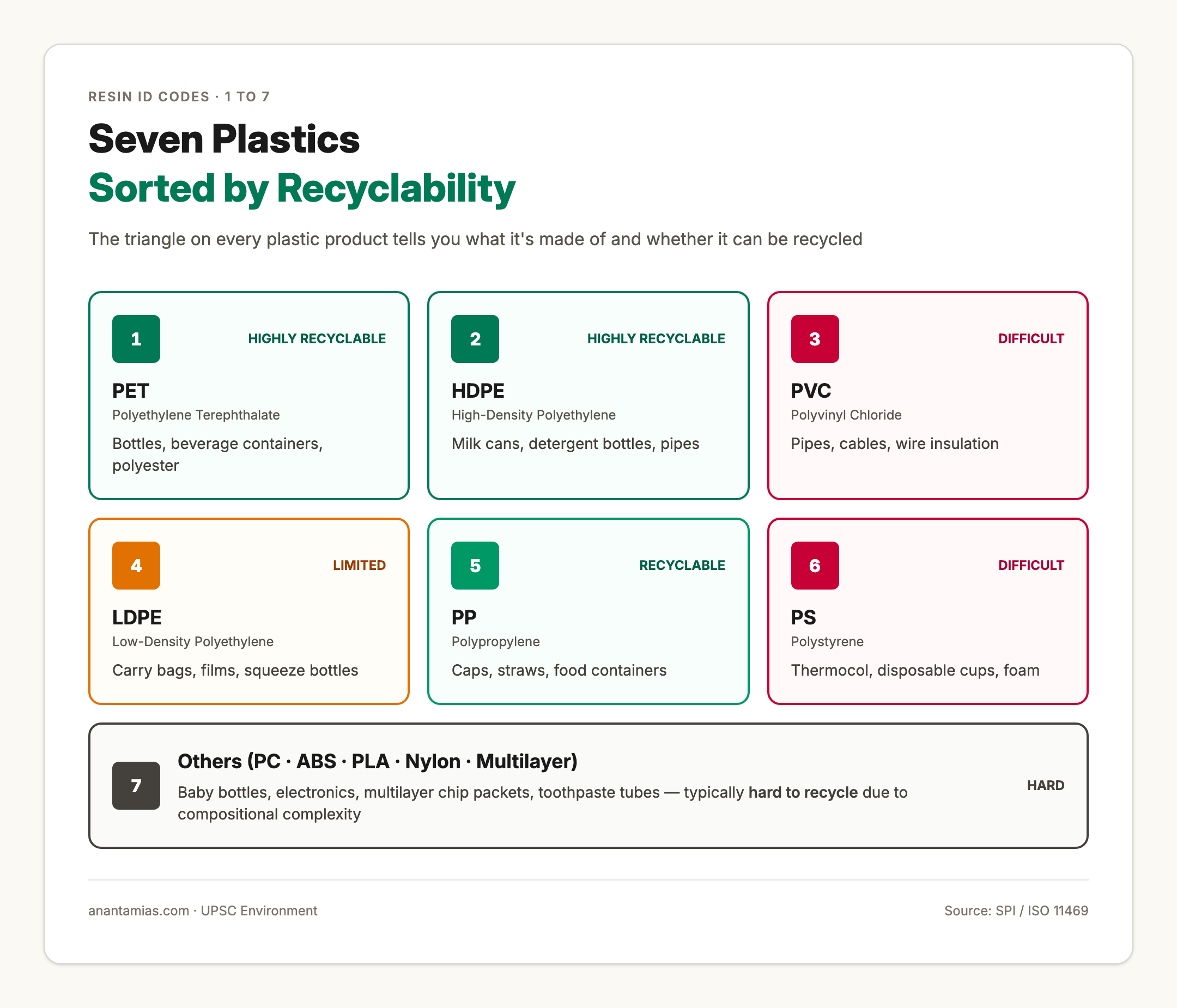
The seven plastic resin identification codes, marked with a triangular recycling arrow on packaging, indicate the polymer type and recyclability. PET, polyethylene terephthalate, is used in beverage bottles and food containers and is highly recyclable; it can be processed into recycled PET for new bottles or polyester fibre. HDPE, high-density polyethylene, is used in milk containers, detergent bottles, and pipes and is highly recyclable. PVC, polyvinyl chloride, is used in pipes, cables, and certain packaging; it is difficult to recycle because of chlorine content and additives that can release dioxins on incineration. LDPE, low-density polyethylene, is used in plastic carry bags, cling films, and squeeze bottles; it has limited recyclability due to its thinness and contamination. PP, polypropylene, is used in caps, straws, food containers, and automotive parts and is recyclable. PS, polystyrene, used in disposable cups, thermocol, and packaging foam, is difficult to recycle economically. The seventh category, called Others, includes polycarbonate, ABS, polylactic acid, nylon, and multilayer plastics; these are typically hard to recycle because of compositional complexity. Multilayer packaging, used for chips, chocolate wrappers, and toothpaste tubes, is one of the most challenging waste streams.
Mechanical and Chemical Recycling Compared
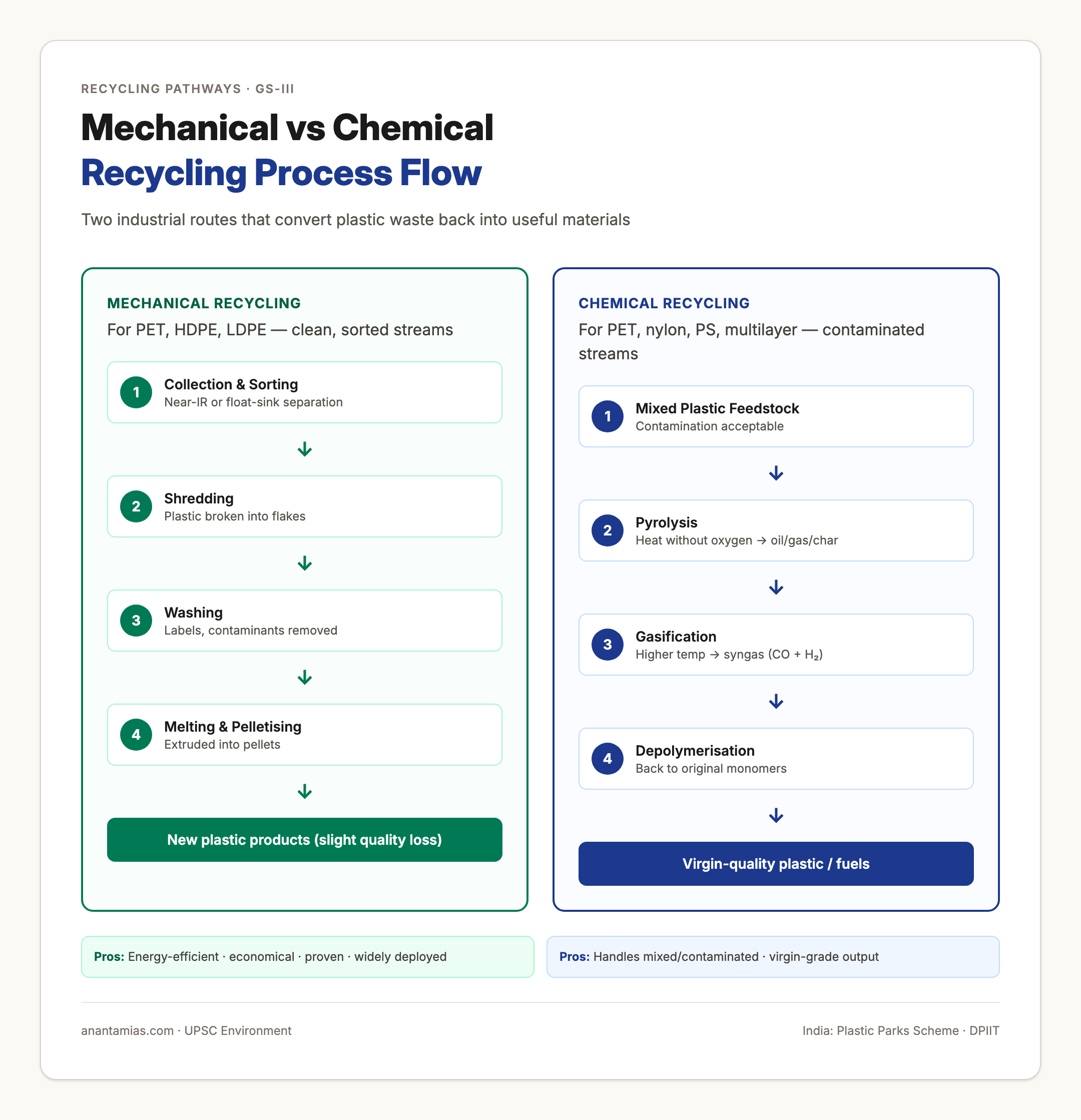
Mechanical recycling is the workhorse of the plastics industry. The process begins with collection and sorting, often using near-infrared spectroscopy or float-sink methods to separate polymers. The plastic is then shredded into flakes, washed to remove labels and contaminants, and melted in extruders to produce pellets that feed new product manufacturing. Quality declines slightly with each cycle because polymer chains shorten and pigments accumulate, which limits the number of times a given plastic can be mechanically recycled.
Chemical recycling encompasses several technologies. Pyrolysis heats plastic in the absence of oxygen to break it down into oils, gases, and char. Gasification converts plastic at higher temperatures into syngas, a mixture of carbon monoxide and hydrogen that can be reformed into chemicals or fuels. Solvolysis uses solvents to dissolve specific polymers. Depolymerisation breaks plastics back to their starting monomers, enabling theoretically infinite recycling without quality loss. Chemical recycling is suited to PET, nylon, polystyrene, and multilayer plastics where mechanical methods struggle. Critics note that yields, energy intensity, and economic viability remain challenges and that chemical recycling can blur into waste-to-fuel conversion, which does not close the material loop.
For broader context on plastic pollution, see our coverage of microplastics and pollution and pollution, smog, microplastics, and thermal.
Biodegradable Plastics: Promise and Limits
Biodegradable plastics are designed to break down under microbial action into water, carbon dioxide, and biomass under suitable conditions. Common types include polylactic acid, derived from corn starch or sugarcane and used in packaging and disposable cutlery; polyhydroxyalkanoates, produced by bacterial fermentation and used in medical implants and packaging; starch-based plastics from potato or maize, used for carry bags and food packaging; and cellulose-based plastics from wood pulp or cotton, used in films and coatings.
Two qualifications matter. First, not all biodegradable plastics are compostable. Compostability requires specific temperature, humidity, and microbial conditions usually found only in industrial composting facilities. PLA, for instance, persists in cool soils and oceans for decades. Second, not all plastics labelled biodegradable degrade in natural environments; some require industrial conditions and become litter when discarded outdoors. The Bureau of Indian Standards and the Central Pollution Control Board have moved towards stricter labelling requirements to prevent greenwashing.
India’s Regulatory Architecture
The Plastic Waste Management Rules, notified under the Environment Protection Act 1986, are the primary instrument. Key provisions include mandatory waste segregation at source, a ban on plastic carry bags below 50 microns since 2016, and a subsequent increase to a minimum thickness of 75 microns from 2021 and 120 microns from 31 December 2022, intended to make bags reusable rather than single-use. The rules introduced Extended Producer Responsibility, requiring producers, importers, and brand owners, collectively known as PIBOs, to register on a centralised EPR portal operated by the Central Pollution Control Board and to collect waste equivalent to their plastic packaging volumes. PIBOs must use prescribed minimum percentages of recycled plastic content in their packaging and ensure recycling or safe disposal of collected waste.
The Single-Use Plastic Ban came into effect on 1 July 2022, prohibiting the manufacture, import, stocking, distribution, sale, and use of identified single-use plastic items. Banned items include plastic plates, cups, glasses, forks, spoons, knives, straws, trays, stirrers, ear buds with plastic sticks, plastic sticks for balloons, candy sticks, ice-cream sticks, polystyrene for decoration, plastic wrapping or packaging films around sweet boxes, invitation cards, cigarette packets, plastic and PVC banners less than 100 microns, and stirrers. Compostable plastic carry bags are exempt subject to certification. See our deeper coverage of the single-use plastic ban.
The Plastic Parks Scheme, run by the Department for Promotion of Industry and Internal Trade under the Ministry of Commerce and Industry, develops state-of-the-art infrastructure for plastics reprocessing, recycling, and manufacturing as part of a circular economy push. The PRAKRITI mascot, launched by the Ministry of Environment, Forest and Climate Change, promotes lifestyle-level awareness about plastic pollution. Mission LiFE, the Lifestyle for Environment movement launched by Prime Minister Narendra Modi, places individual behaviour change at the centre of the response to plastic and broader environmental challenges. See our analysis of Mission LiFE.
Why It Matters and Environmental Toxicology
Environmental toxicology is the scientific study of how chemical, physical, and biological agents harm living organisms and ecosystems, including their pathways of exposure, mechanisms of toxicity, and environmental fate. Plastic pollution is a textbook case. Macroplastics entangle marine animals and clog drainage systems, exacerbating urban flooding. Microplastics, defined as plastic particles smaller than 5 millimetres, are now ubiquitous in soil, water, air, and human tissue. Nanoplastics, even smaller, can cross biological membranes. Additives like phthalates, bisphenol A, and brominated flame retardants leach from plastic into food and water, with documented endocrine-disrupting effects. The microbeads once used in cosmetics and personal care products were banned in many jurisdictions because they passed through wastewater treatment and entered marine food chains.
Plastic also has a climate footprint. Producing plastic from fossil feedstocks accounts for an estimated 3 to 4 percent of global greenhouse gas emissions, and incineration of plastic waste releases CO2 directly. A circular plastics economy is therefore both a pollution and a climate intervention.
Comparative Perspective: India versus the World
The European Union has tightened its packaging waste regulations and introduced ambitious recycled content targets. The EU Single-Use Plastics Directive bans many disposable items and obligates manufacturers to fund clean-up. China’s National Sword policy in 2018 banned imports of most foreign plastic waste, redirecting global recycling flows and exposing the limits of an export-dependent recycling model in developed countries. The United States lacks a federal recycling mandate and depends on a patchwork of state and city programmes. India’s EPR framework is among the more ambitious in the developing world, but enforcement, the integration of the informal sector, and the scaling of chemical recycling remain challenges.
The UN Environment Programme has been negotiating a Global Plastics Treaty since 2022, with the goal of a legally binding instrument covering the full lifecycle of plastic. Negotiations have been contentious, with major fossil fuel and petrochemical producers resisting strict production caps. India’s stance emphasises CBDR, equity, and the need for finance and technology transfer to support transitions in developing countries.
Challenges and Critiques
Several structural challenges persist. Collection coverage remains uneven, with rural and small-town areas underserved. The informal sector, which performs much of the actual recycling, lacks formal recognition, social security, and access to safer working conditions. Multilayer packaging continues to defy economical recycling. Greenwashing of biodegradable claims confuses consumers. EPR fees and obligations are still being contested by some PIBOs, and traceability of recycled content can be weak. The Single-Use Plastic Ban has faced enforcement gaps, with banned items still circulating in many markets. Building capacity in plastic credit verification and audit is an ongoing task.
UPSC Prelims Pointers
- India generates around 3.5 million tonnes of plastic waste annually; only about 9 percent of global plastic is recycled.
- PWM Rules are notified under the Environment Protection Act 1986.
- PWM Rules: 2016 base, amended in 2018, 2021, 2022.
- Carry bag thickness: minimum 75 microns from 2021, 120 microns from 31 December 2022.
- SUP ban effective from 1 July 2022.
- Banned items include plastic straws, ear buds, cutlery, balloon sticks, polystyrene decoration, thin banners.
- EPR: PIBOs must register on the CPCB EPR portal and collect waste equivalent to sales.
- Plastic resin codes: PET (1), HDPE (2), PVC (3), LDPE (4), PP (5), PS (6), Others (7).
- Mechanical recycling: shredding, washing, melting, remoulding.
- Chemical recycling: pyrolysis, gasification, solvolysis, depolymerisation.
- Biodegradable plastics include PLA (corn starch), PHA (bacterial fermentation), starch-based, cellulose-based.
- Plastic Parks Scheme is administered by DPIIT, Ministry of Commerce and Industry.
- PRAKRITI mascot launched by MoEFCC.
- EPR was first introduced in India in the e-Waste Management and Handling Rules 2011.
- Microbeads concern is primarily about marine ecosystem harm.
Mains Practice Questions
- Examine the structure of Extended Producer Responsibility under India’s Plastic Waste Management Rules. To what extent has it succeeded in shifting the burden of plastic management to producers? (GS-III, 250 words)
- Single-use plastics are an environmental hazard, but their ban has met implementation challenges. Discuss the design choices in India’s SUP ban and suggest measures for stronger compliance. (GS-III, 250 words)
- Biodegradable plastics are often presented as a substitute for conventional plastics. Critically evaluate their environmental credentials and the regulatory safeguards needed. (GS-III, 200 words)
- The informal sector is the backbone of India’s plastic recycling economy. Discuss the steps needed to formalise and protect it within the framework of the PWM Rules. (GS-II/III, 250 words)
Way Forward
A circular plastics economy in India needs four parallel moves. First, design out problem plastics through standards that mandate recyclability and recycled content, restrict multilayer packaging, and enforce strict labelling for biodegradable claims. Second, scale collection and sorting infrastructure, integrating the informal sector with social protection and dignified working conditions. Third, accelerate investment in chemical recycling for difficult waste streams, while ensuring it complements rather than replaces mechanical recycling. Fourth, push for an ambitious Global Plastics Treaty that addresses production volumes, not just waste management, and supports developing countries with finance and technology. Mission LiFE provides the cultural anchor by making plastic reduction a daily personal practice rather than a peripheral concern.
Frequently Asked Questions
What law governs plastic waste in India?
The Plastic Waste Management Rules, first notified in 2016 and amended several times, are the primary instrument. They derive their authority from the Environment Protection Act 1986. Related rules include the Solid Waste Management Rules 2016, which deal with general municipal solid waste, and the e-Waste Management Rules for electronic waste.
What is Extended Producer Responsibility?
EPR is a policy approach that makes producers, importers, and brand owners responsible for the post-consumer stage of their products. Under India’s PWM framework, PIBOs must register on the centralised EPR portal, fulfil targets for collection and recycling of plastic packaging waste equivalent to their sales, and use prescribed minimum percentages of recycled plastic content in their packaging.
Which single-use plastic items are banned in India?
Banned items include plastic cutlery (forks, spoons, knives), plates, cups, glasses, straws, stirrers, trays, ear buds with plastic sticks, sticks for balloons, candy sticks, ice-cream sticks, plastic flags, polystyrene used for decoration, wrapping films around sweet boxes and invitation cards, cigarette packet wrapping, and PVC banners under 100 microns. The ban took effect on 1 July 2022.
Which plastics are most recyclable?
PET (resin code 1) and HDPE (resin code 2) are the most widely and economically recyclable. PP (resin code 5) is also recyclable. PVC (3), LDPE (4), PS (6), and the Others category (7) are difficult or uneconomical to recycle and often end up in landfills, in waste-to-energy plants, or in the environment.
What is the difference between biodegradable and compostable plastic?
Biodegradable plastics break down through microbial action into water, CO2, and biomass under suitable conditions, but the time and conditions vary widely. Compostable plastics meet stricter standards, breaking down within a defined period in industrial composting facilities. All compostable plastics are biodegradable, but not all biodegradable plastics are compostable in home or natural environments.
What is the Plastic Parks Scheme?
The Plastic Parks Scheme is administered by the Department for Promotion of Industry and Internal Trade under the Ministry of Commerce and Industry. It develops dedicated industrial parks for plastics processing, recycling, and manufacturing with shared infrastructure and effluent treatment, supporting the circular economy and downstream value addition.
What is mechanical recycling?
Mechanical recycling involves physical processing of plastic waste through shredding, washing, melting, and remoulding into new products without changing the chemical structure of the polymer. It is the most widely used recycling method, suited to relatively clean and sorted PET, HDPE, and LDPE streams, but it is limited by polymer degradation over successive cycles.
What is chemical recycling?
Chemical recycling, also called advanced recycling, breaks plastics down to monomers or fuels through processes like pyrolysis, gasification, solvolysis, and depolymerisation. It can handle contaminated, mixed, or multilayer plastics that mechanical recycling cannot, but it is energy-intensive and economically challenging at current scale.
Why are microplastics a concern?
Microplastics are plastic particles smaller than 5 millimetres. They are now ubiquitous in soil, water, air, and human tissues. They are harmful to marine ecosystems, can be ingested by organisms across the food chain, and may carry toxic additives and adsorbed pollutants. Concerns include endocrine disruption, inflammation, and unknown long-term health effects.
What is Mission LiFE?
Mission LiFE, the Lifestyle for Environment movement, was launched by the Prime Minister to make sustainable lifestyle choices a mass movement. It promotes individual actions like carrying cloth bags, using non-plastic cutlery, conserving water and electricity, and adopting circular consumption patterns. It frames climate and environment action as a daily personal responsibility, not just a policy issue.