Bio-plastics are a family of materials that look and behave like conventional plastics but are made from biological feedstocks, biodegrade in defined environmental conditions, or both. The simplest one, polylactic acid, is fermented from corn or sugarcane and is the polymer behind most compostable cups and cutlery on the market. The most studied biological one, polyhydroxyalkanoates, is brewed inside microbial cells and disappears in soil and seawater. Starch blends, cellulose composites, and a small set of fossil-based but biodegradable polymers like PBAT round out the family.
The case for bio-plastics is straightforward. Conventional plastics are made from petroleum, last for centuries in the environment, and are now found in oceans, soils, drinking water, and the human bloodstream. Bio-plastics offer a way to keep the convenience of plastic without locking in the long-tail pollution. The case against is that bio-plastics are not a magic fix. They cost more, they need specific waste-management infrastructure to perform as advertised, and many of them quietly behave just like petroleum plastics if dumped in the wrong place.
For UPSC GS-III, bio-plastics sit at the intersection of environmental policy, materials science, agriculture, and the circular economy. India’s Plastic Waste Management Rules and the 2022 single-use plastic ban have explicit provisions for compostable plastic, and a domestic bio-plastics industry is starting to scale. This guide unpacks what bio-plastics are, what they are not, and where India is headed.
Quick Facts on Bio-Plastics
Bio-plastics are plastics that are bio-based, biodegradable, or both. They are derived partly or wholly from renewable biological sources such as corn, sugarcane, potato, cassava, algae, or microorganisms. The most important point to internalise is that not all bio-plastics are biodegradable, and not all biodegradable plastics are bio-based.
Bio-based but non-biodegradable plastics are made from biomass but do not break down easily. Bio-PET and Bio-polyethylene are the major examples. They reduce fossil-fuel use upstream but persist in the environment downstream just like their petroleum twins. Coca-Cola’s PlantBottle and Lego’s bio-PE bricks fall in this category.
Bio-based and biodegradable plastics are the family most people picture when they hear the word. Polylactic acid, PLA, polyhydroxyalkanoates, PHA, and starch-based plastics are the major examples. They are made from biomass and biodegrade naturally under the right conditions.
Fossil-based but biodegradable plastics are the third category. They are derived from fossil fuels but break down naturally. Polybutylene adipate terephthalate, PBAT, and polycaprolactone, PCL, are the major examples. PBAT is most commonly found blended with PLA in compostable shopping bags.
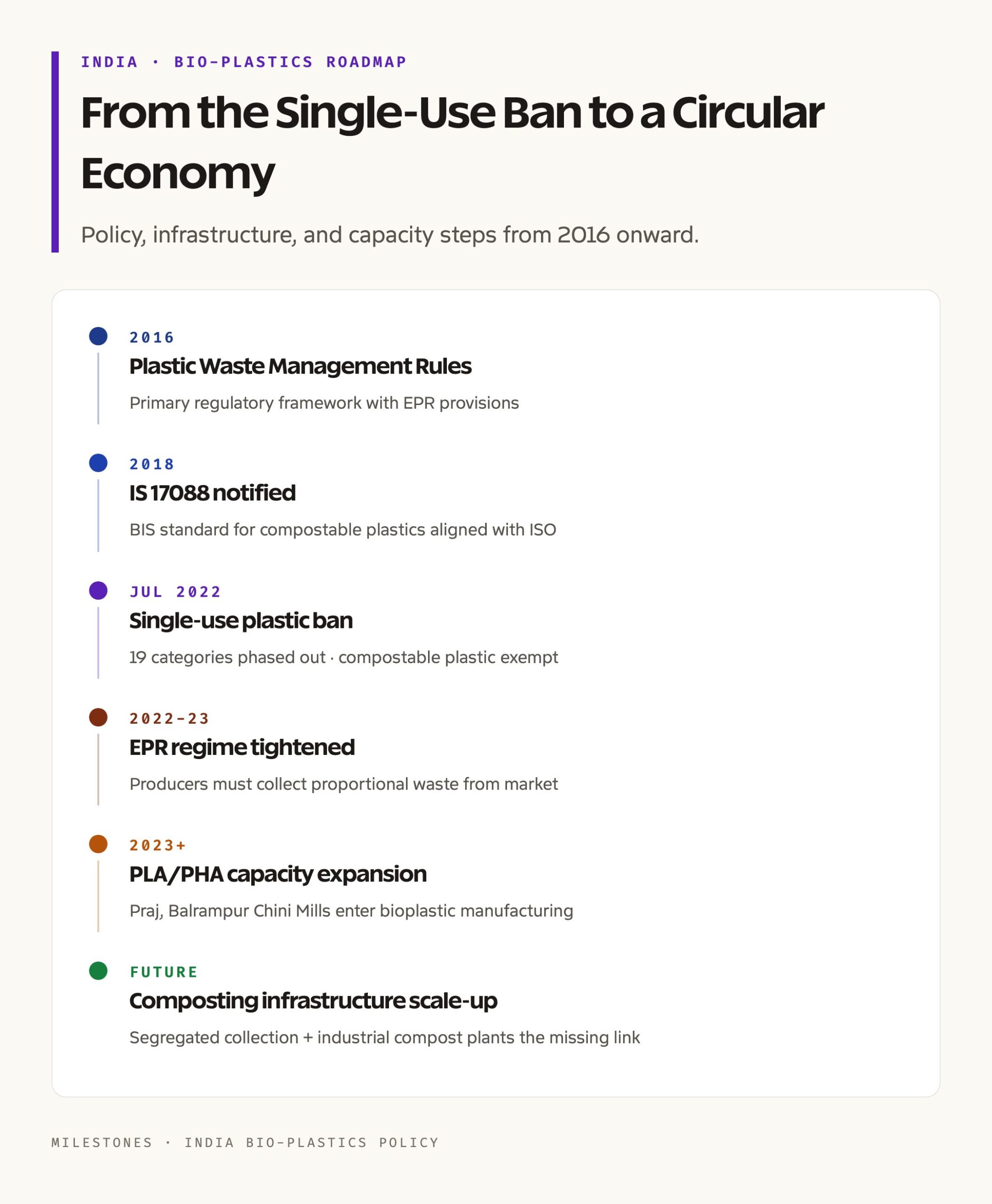
The Bureau of Indian Standards has notified IS 17088 for compostable plastics, aligned with the international ISO 17088 and ASTM D6400 standards. The Central Pollution Control Board, CPCB, runs the certification programme.
The Major Bio-Plastics Compared
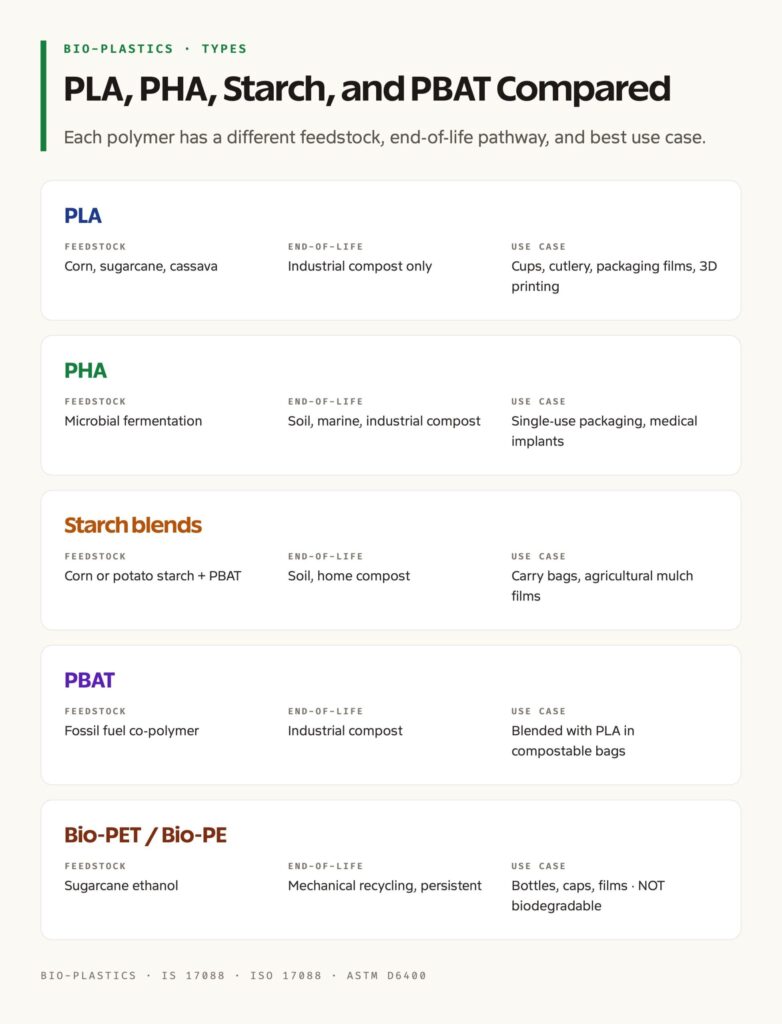
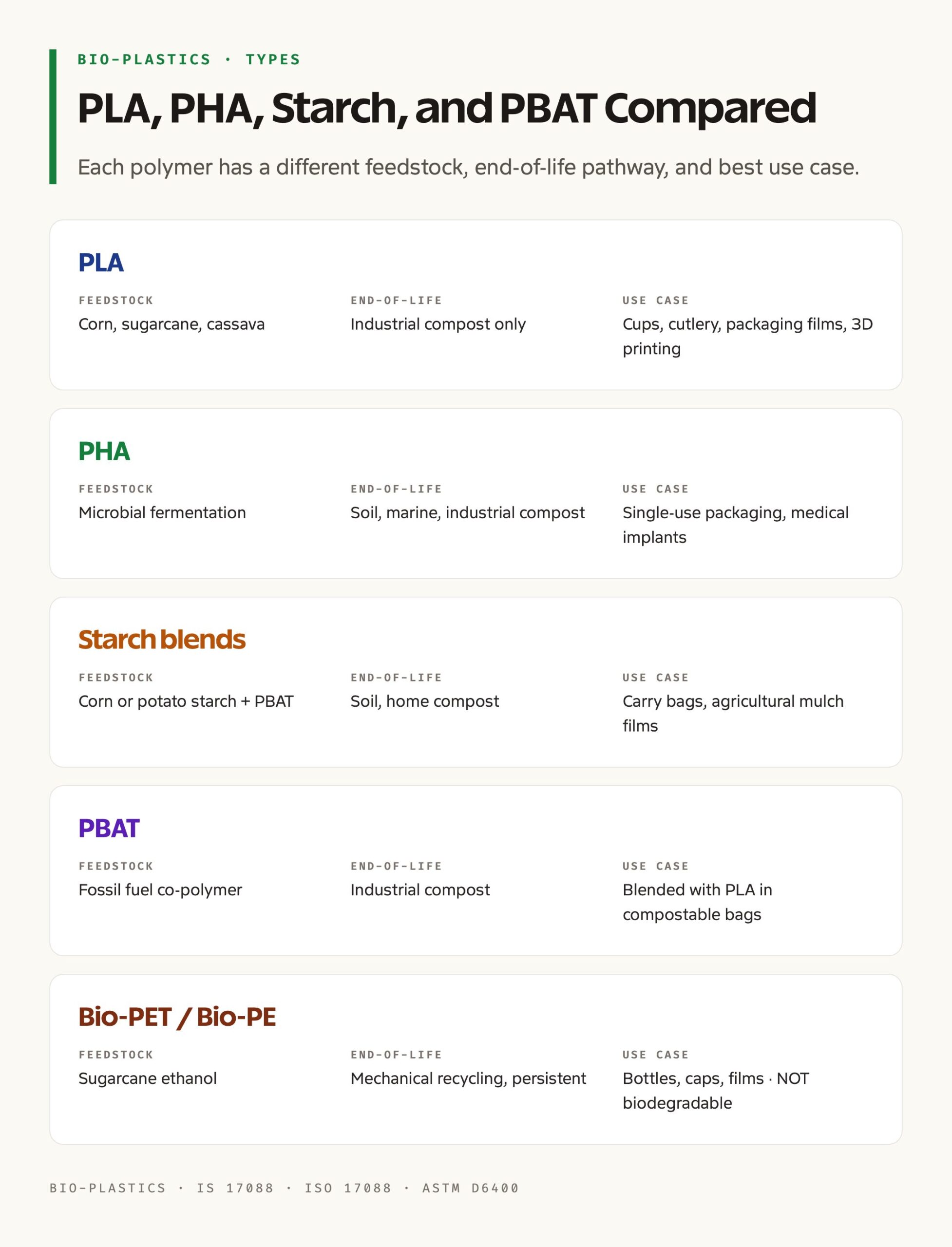
The simplest way to understand the family is to look at each major polymer side by side. Each has a different feedstock, a different production route, and a different end-of-life behaviour.
| Polymer | Feedstock | Production | End-of-life | Common use |
|---|---|---|---|---|
| PLA | Corn, sugarcane, cassava | Fermentation to lactic acid, then polymerisation | Industrial compost only | Cups, cutlery, packaging films, 3D printing filament |
| PHA | Plant sugars or vegetable oils | Microbial fermentation, polymer accumulates inside cells | Soil, marine, industrial compost | Single-use packaging, medical implants |
| Starch blends | Corn, potato, cassava starch | Plasticised starch with polymer additives | Soil, home compost | Carry bags, agricultural mulch films |
| Cellulose | Wood pulp, cotton | Regenerated cellulose, cellulose acetate | Soil, industrial compost | Films, sponges, eyewear frames |
| PBAT | Fossil fuel | Co-polymerisation with PLA in blends | Industrial compost | Compostable shopping bags blended with PLA |
| Bio-PET | Sugarcane and fossil fuel mix | Bio-monoethylene glycol with terephthalic acid | Mechanical recycling, persistent | PET bottles, carbonated drink packaging |
| Bio-PE | Sugarcane | Bio-ethylene polymerisation | Mechanical recycling, persistent | Caps, films, toys |
PLA is the largest by volume. NatureWorks in the United States and Total Energies Corbion in Thailand together produce most of the global supply. Indian PLA capacity is small but growing, with Balrampur Chini Mills and Praj Industries among the announced entrants.
PHA is the most exciting from an environmental angle. It is the only bio-plastic that biodegrades in soil and seawater on a useful timescale, and it is the closest match for the persistence problem of conventional plastics. The catch is cost. PHA today costs three to five times what PLA costs, and ten times what conventional polyethylene costs.
Starch blends are the workhorse of compostable shopping bags in much of Europe and a growing share of the Indian market. Their performance is adequate, the cost is manageable, and they decompose well in home compost. The downside is that starch blends absorb moisture and have weaker mechanical properties than PLA or PHA.
How Bio-Plastics Are Made
PLA production starts with corn or sugarcane. The starches are fermented to lactic acid by lactobacilli, the same family of microbes that turn milk into curd. Lactic acid is then dehydrated to lactide, a cyclic dimer, and ring-opened by polymerisation into long chains of poly-lactide. The result is a thermoplastic that can be moulded, extruded, or 3D-printed.
PHA production starts with sugar or vegetable oil and a bacterium that has been engineered or selected to overproduce the polymer. The bacterium accumulates PHA inside its cells as an energy reserve, sometimes up to 80 percent of cell dry weight. The cells are harvested, broken open, and the polymer is extracted with solvents. PHA is the only bio-plastic that grows inside a living cell rather than being chemically synthesised.
Starch blends combine native starch with a small fraction of biodegradable polymer, typically PBAT or PLA, plus glycerol or sorbitol as plasticisers. The mixture is processed through a twin-screw extruder. The result is a flexible film that can be blown into bags or cast into sheets.
Cellulose-based plastics start from wood pulp or cotton. The cellulose is dissolved in a solvent system, regenerated as a film or fibre, and sometimes acetylated to make cellulose acetate. Cellophane and the rayon family fall in this category, along with the eyewear frames made from bio-acetate.
How Bio-Plastics Break Down
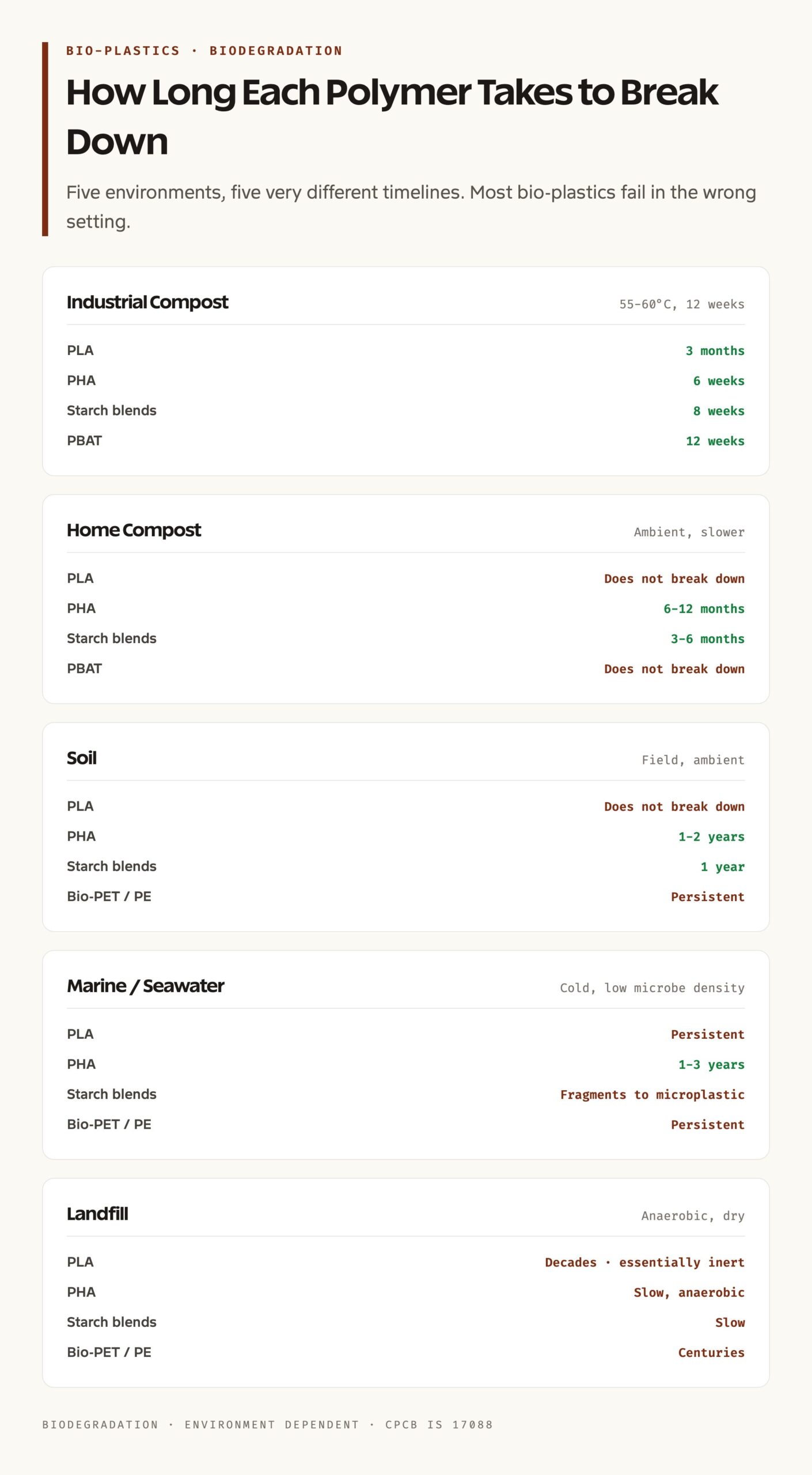
Biodegradation is not a single thing. The conditions under which a plastic breaks down matter as much as the chemistry of the polymer. Five environments are usually distinguished.
Industrial composting facilities run at 55 to 60 degrees Celsius for 12 weeks, with controlled moisture and oxygen. PLA, PBAT blends, and starch blends meet the ISO 17088 standard for industrial compostability. They will not break down in any other environment.
Home composting runs at ambient temperature and is much slower. Only some starch blends, some PHA grades, and a handful of cellulose products are home-compostable. PLA is not.
Soil biodegradation depends on temperature, moisture, and the local microbial community. PHA and some starch blends biodegrade in soil over months to a year. PLA does not.
Marine biodegradation is the strictest test. Only PHA reliably biodegrades in seawater. PLA, PBAT, and most starch blends do not break down in the ocean and contribute to marine plastic pollution just like conventional plastics.
Landfill conditions are anaerobic. Most bio-plastics do not biodegrade meaningfully in a landfill. PLA, in particular, is essentially inert in a landfill and can persist for decades.
The lesson for policy is that compostable plastics need composting infrastructure to deliver their environmental benefit. Without segregated waste collection and industrial composting plants, a PLA cup ends up in the same landfill or drain as a polystyrene cup, with similar long-term consequences.
Bio-Plastics in India
India consumes about 21 million tonnes of plastic a year, of which a small fraction, under 1 percent, is bio-plastic. Domestic production is concentrated in starch blends and small-volume PLA. The major Indian players include Earthsoul, Truegreen, Ecolife, Praj Industries, and Balrampur Chini Mills.
The Plastic Waste Management Rules, 2016, as amended, are the primary regulatory framework. The 2021 amendment phased out 19 categories of single-use plastic from July 1, 2022, including straws, plates, cups, cutlery, ear-buds with plastic sticks, and balloon sticks. Compostable plastics are exempt from the ban, provided they are certified by the CPCB and labelled as such.
The Extended Producer Responsibility, EPR, regime requires plastic producers, importers, and brand owners to collect and process plastic waste in proportion to what they put into the market. Compostable plastic generates EPR credits as well, but only if it is composted and not landfilled.
The Plastics Park scheme of the Department of Chemicals and Petrochemicals supports bio-plastic manufacturing capacity. Tamil Nadu, Madhya Pradesh, Odisha, and Assam have notified plastics parks, some of which are reserved or weighted for bio-based polymers.
The challenge is composting infrastructure. Most Indian cities lack segregated waste collection at the household level and industrial composting plants at the city scale. Without both, certified compostable plastics behave like conventional plastics in practice. The Swachh Bharat Mission and the Solid Waste Management Rules, 2016 are the policy hooks for fixing this gap.
Where Bio-Plastics Help and Where They Do Not
Bio-plastics are useful where the application has a clear waste pathway. Compostable plates and cutlery at events with on-site composting work well. Compostable agricultural mulch films, which break down in the soil after the harvest, save the labour of removing them and reduce micro-plastic loading in farmland. PHA-based medical implants dissolve harmlessly inside the body.
Bio-plastics are not useful where the waste pathway is undefined. A PLA bottle thrown in a roadside bin will go to a landfill or a drain. A PHA carry bag littered on a beach will biodegrade slowly, but a starch-based bag in the same place will fragment into micro-particles before fully decomposing. Bio-plastic is not a substitute for waste-management discipline.
Bio-plastics are also not a substitute for plastic-reduction strategies. Reusable cloth bags, refillable containers, and stainless-steel cutlery beat any single-use bio-plastic on environmental impact. The hierarchy in the Plastic Waste Management Rules is clear, reduce first, reuse second, recycle third, and only then dispose, whether by composting or otherwise.
The food versus fuel debate also applies. PLA and PHA need agricultural feedstocks, and large-scale displacement of food crops to bio-plastic feedstocks would raise food prices. The next generation of bio-plastics is therefore being developed from agricultural residues, lignin, and seaweed, which do not compete with food crops.
The Indian Bio-Plastics Roadmap
The trajectory in India looks like a slow scale-up of starch blends and PLA, building compost infrastructure city by city, and waiting for PHA prices to drop enough for mainstream use. The Department of Chemicals and Petrochemicals has set indicative targets for bio-plastic capacity in the new plastics parks. The CPCB certification regime is now functional.
The 2025 single-use plastic ban review, expected to widen the list of banned items, is the next inflection point. If the review extends the ban to additional categories without parallel investment in composting, the volume of certified compostable plastic will grow but its environmental impact will be muted by the same waste-management gap that limits today’s policy.
The longer-term opportunity is integration with India’s bioeconomy strategy. The BIRAC-led initiatives on industrial biotechnology, the BIO-RIDE programme, and the National Bioeconomy Mission all envisage bio-plastic manufacturing as a core component. The convergence of bio-feedstock, microbial fermentation, and enzymatic recycling is where India’s bio-plastics industry is likely to find its competitive niche.
Why Bio-Plastics Matter for UPSC GS-III
GS-III asks candidates to engage with environmental policy, science and technology, and the circular economy. Bio-plastics are a near-perfect case study because they touch every theme. The materials science is testable in prelims. The waste-management policy is testable in mains. The agricultural-feedstock and bioeconomy angle is the kind of cross-cutting argument the examiners reward.
The cleanest UPSC framing is to layer the topic. The science layer, what each polymer is and how it breaks down. The infrastructure layer, why bio-plastics need composting plants to deliver their benefit. The policy layer, how the Plastic Waste Management Rules and the single-use ban treat bio-plastics. The economic layer, what the food versus fuel and feedstock-cost questions imply for scale. Linking bio-plastics to plastics recycling and the wider e-waste management story rounds out the argument.
Frequently Asked Questions
What are bio-plastics?
Bio-plastics are plastics that are bio-based, biodegradable, or both. They are derived partly or wholly from renewable biological sources such as corn, sugarcane, cassava, or microbial fermentation. Not all bio-plastics are biodegradable. Bio-PET, for example, is bio-based but persists in the environment like conventional plastic.
Are all bio-plastics biodegradable?
No. Bio-PET and Bio-polyethylene are made from biomass but are chemically identical to fossil-based PET and PE and do not biodegrade. PLA, PHA, and starch blends are biodegradable but only under specific conditions. PLA, in particular, needs an industrial composting facility and does not break down meaningfully in a landfill or in the ocean.
What is the difference between PLA and PHA?
PLA, polylactic acid, is fermented from corn or sugarcane and chemically polymerised. It is industrially compostable but does not biodegrade in soil or seawater. PHA, polyhydroxyalkanoates, is produced inside microbial cells and biodegrades in soil, freshwater, and marine environments. PHA is currently three to five times more expensive than PLA.
Are compostable plastics included in India’s single-use plastic ban?
No. The 19 categories of single-use plastic banned from July 1, 2022 do not apply to compostable plastics provided they are certified by the Central Pollution Control Board and labelled as compostable. Certification is based on IS 17088 and aligns with international ISO and ASTM standards.
Do bio-plastics solve the marine plastic problem?
Only PHA reliably biodegrades in seawater. PLA, PBAT, and starch blends do not break down meaningfully in the ocean. A PLA cup tossed into the sea will persist for decades, just like a conventional plastic cup. Bio-plastics are not a substitute for waste-management discipline.
What is India’s bio-plastics production capacity?
India’s bio-plastics capacity is small relative to its 21-million-tonne plastics market. Domestic production is concentrated in starch blends and small-volume PLA. Capacity is being expanded through plastics parks in Tamil Nadu, Madhya Pradesh, Odisha, and Assam, and through new PLA and PHA facilities announced by Praj Industries and Balrampur Chini Mills.
Tell Google you want more of this.
Add Anantam IAS as a preferred sourceOne tap, and this site shows up more often in your own Top Stories, AI Overviews and AI Mode. Remove it any time.