PM Internship Scheme: Features, Eligibility and Significance (UPSC Governance)
The PM Internship Scheme wants to put 1 crore young Indians inside the country's top 500 companies over five years. Here is what it actually offers, who qualifies, and why its first two pilots have struggled to fill seats.
Every year, roughly 12 million young Indians walk up to the edge of the job market and find that a degree alone doesn’t get them in. They have the certificate but not the experience, and employers won’t give them the experience without the certificate-plus. The PM Internship Scheme is the government’s attempt to break that loop at scale: pay a young person a small monthly sum to spend a year inside one of India’s biggest companies, learning the unwritten rules of real work, so that the next interview goes differently. Announced in the Union Budget of 2024-25 and run, unusually, by the Ministry of Corporate Affairs rather than a skills or labour ministry, it carries one of the boldest numbers in Indian public policy: internships for one crore youth in the country’s top 500 companies, inside five years.
That number is why this scheme matters far beyond a single budget line. India’s biggest economic question for the next two decades is whether its young population becomes a dividend or a burden, and the honest answer turns on employability, not headcount. So the PM Internship Scheme sits right on the fault line of jobless growth, skilling, and the public-private bargain. But the early evidence is sobering. After two pilot rounds, only a few thousand interns have actually joined and finished, and most of the money set aside for the scheme has gone unspent. This is exactly the kind of policy UPSC loves: ambitious on paper, instructive in its gap between intent and outcome.
What the Scheme Is and Why It Was Launched
Let’s be precise about what the PM Internship Scheme, or PMIS, actually is, because the name invites a common mistake. It is not a job-guarantee programme and it is not an apprenticeship in the legal sense. It’s a structured, paid, twelve-month internship inside a large private company, funded mostly by the government, designed to give a young person their first real exposure to a workplace. The internship is the product. A job at the end is a hope, not a promise, and that distinction explains a lot of what has gone right and wrong.
It was announced by the Finance Minister in the July 2024 budget as the fifth scheme in the government’s wider “Prime Minister’s Package” for employment and skilling, and the pilot went live through an online portal and mobile app on 3 October 2024. The choice of the Ministry of Corporate Affairs as the nodal ministry is the clever, slightly counter-intuitive design decision at the heart of the scheme. Skilling normally lives with the Ministry of Skill Development. But PMIS leans on something only the corporate affairs ministry can easily reach: the Corporate Social Responsibility, or CSR, spending of India’s largest firms, and the data on who those firms are. Under the Companies Act, big companies must spend 2% of their average net profit on CSR. The scheme borrows that obligation and points it at youth employability.
So the “why now” has two layers. The surface reason is the unemployment headline: India grows fast, but not enough of that growth turns into formal jobs for the young, the phenomenon commentators call jobless growth. The deeper reason is structural. Surveys repeatedly find that a large share of Indian graduates are considered not readily employable, because what they learned and what a modern workplace needs have drifted apart. The government’s bet is that a year inside a Tata, a Reliance, an L&T or an HDFC Bank closes that gap faster and cheaper than another classroom course ever could.
Features, Eligibility and How It Works
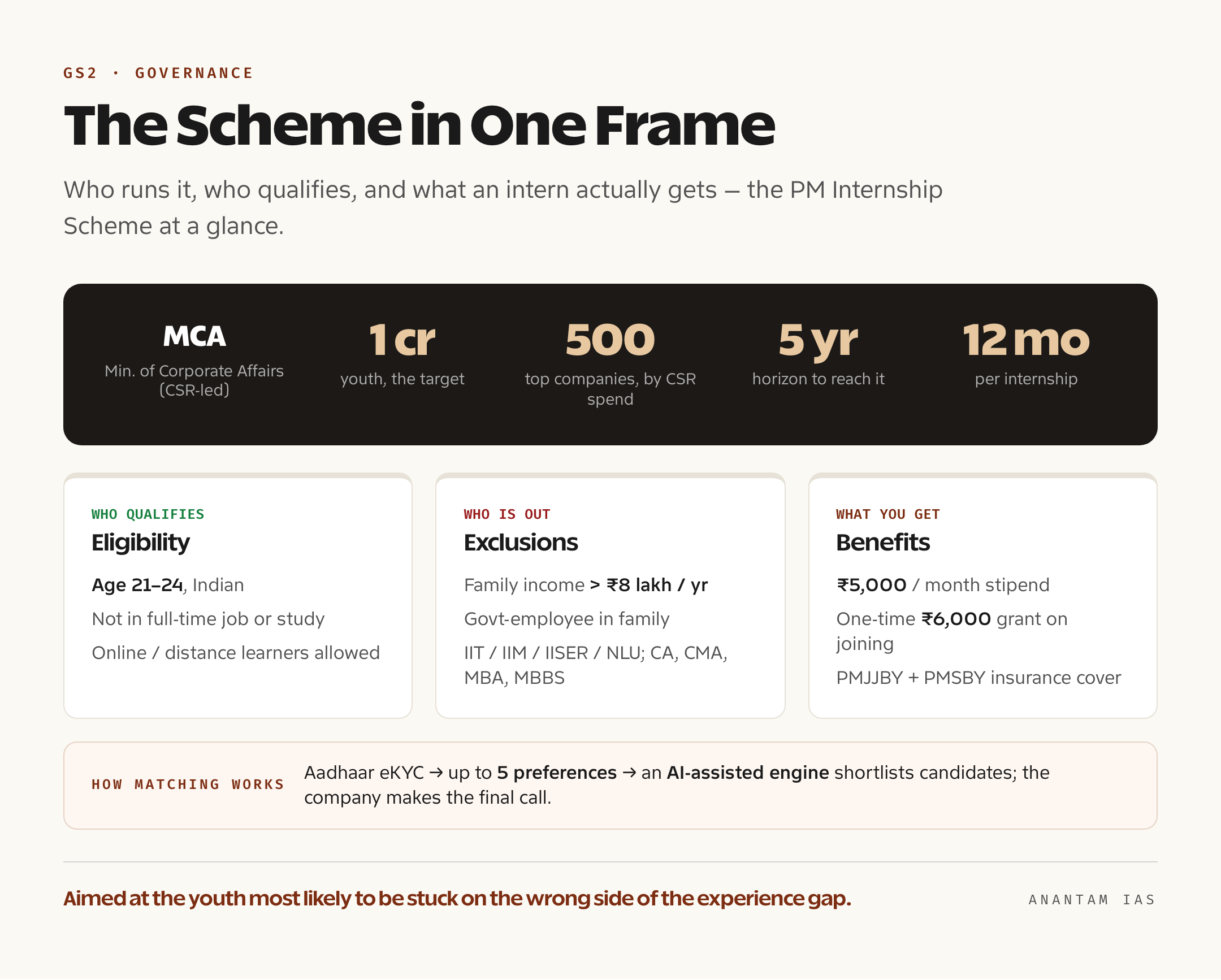
Here is the architecture in plain terms, because the details are exactly what gets tested. The headline target is one crore internships over five years, drawn from a list of the top 500 companies. Those 500 are not picked by size of revenue or fame; the ministry identifies them by their average CSR expenditure over the previous three years. The bigger your CSR footprint, the more likely you’re on the list and expected to offer slots. Companies post internships on the portal, and the number a firm offers is meant to track its CSR scale. Beyond the top 500, other companies, banks and even some financial institutions can join voluntarily.
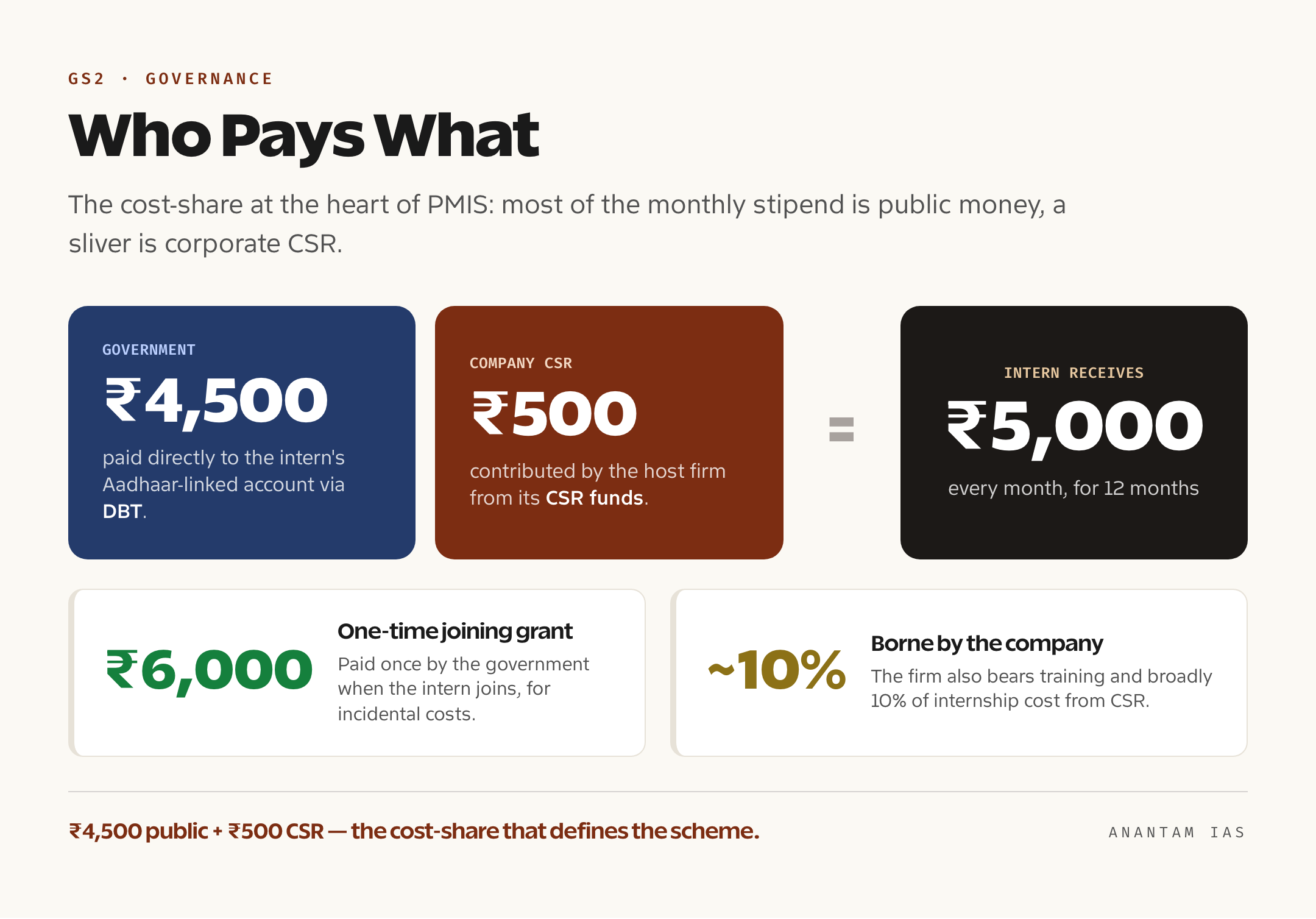
On money, the design is a deliberate cost-share. An intern receives ₹5,000 a month, but that figure is split: ₹4,500 comes from the government, paid directly into the intern’s Aadhaar-linked bank account through Direct Benefit Transfer, and ₹500 comes from the company out of its CSR funds. On top of that, the government pays a one-time grant of ₹6,000 when the intern joins, to cover incidental joining costs. The company is also expected to bear the training cost and broadly 10% of the internship cost from its CSR kitty. Interns are additionally covered by two flagship insurance schemes, the Pradhan Mantri Jeevan Jyoti Bima Yojana and the Pradhan Mantri Suraksha Bima Yojana, with premiums met by the government.
The eligibility rules are narrow by design, because the scheme is aimed at the young person who most needs the leg-up. You must be an Indian aged between 21 and 24, and you must not be in full-time employment or full-time education, though online and distance learners are allowed, since the whole point is to reach people who aren’t already on a settled track. Then come the exclusions, which are the part students forget in the exam hall. You’re out if anyone in your family earns more than ₹8 lakh a year, or if a family member holds a regular government job. You’re also out if you already hold a qualification from an IIT, IIM, IISER, an NLU, or hold a CA, CMA, MBA or MBBS, or are already enrolled in another government skilling, apprenticeship or internship programme. The logic is consistent throughout: target the moderately-educated youth from a modest household who is most likely to be stuck on the wrong side of the experience gap.
How does a candidate actually get matched? They register on the portal using Aadhaar-based eKYC, build a profile, and pick up to five internship preferences across sectors and locations. The portal then uses an AI-assisted matching engine to line up candidate profiles against company requirements and locations, and shortlists are sent to companies, who make the final call. So it’s a phygital, AI-mediated marketplace rather than a first-come queue, and that matching layer is where a lot of the scheme’s friction shows up, as we’ll see.
Benefits and Significance for India
Strip away the launch fanfare and the scheme’s real promise is modest but genuine: it tries to manufacture the one thing a first-time job-seeker can’t buy, which is a year of credible experience at a brand-name employer. For a graduate from a tier-three town whose family earns under ₹8 lakh, that line on a résumé can be worth more than the stipend. It signals to the next employer that someone serious already trusted you with real work, and it gives the intern a network, a reference, and a sense of how a large organisation actually runs.
The significance for India runs deeper than individual CVs. First, demographic dividend. India’s median age is around 28, and that youthful population only pays off economically if those young people are productive; an idle youth bulge becomes a liability, not an asset. PMIS is one lever to convert raw headcount into workforce-ready people. Second, it’s a public-private model worth studying on its own. Instead of building government training centres, the state rents the training capacity that already exists inside the best firms and subsidises access to it. That is a lighter, potentially more scalable design than running everything in-house. Third, it routes private CSR money toward a national skilling goal, nudging corporate philanthropy from scattered charity toward systemic employability.
And there’s a quieter equity angle that examiners reward you for spotting. By capping family income at ₹8 lakh, excluding government-job families, and keeping out elite-institution graduates, the scheme is consciously redistributive: it tries to hand the experience advantage to those least likely to inherit it. The early data even shows internships posted across hundreds of districts, not just metros, which matters in a country where opportunity is hoarded by a few cities. If it works at scale, PMIS could spread the on-ramp to the formal economy far wider than the market does on its own.
It also helps to place PMIS next to the older route it resembles, the apprenticeship system, because UPSC questions often ask you to distinguish the two. India already runs the National Apprenticeship Promotion Scheme, under the skills ministry and grounded in the Apprentices Act of 1961, which reimburses employers a part of the stipend they pay apprentices across a wide age band and a long list of trades. An apprenticeship is a legally structured training contract; the PM internship is a lighter, CSR-funded exposure year aimed at a narrow 21-24 cohort in the country’s biggest firms. So the two aren’t rivals so much as different rungs on the same ladder, one anchored in industrial training and law, the other in corporate exposure and a digital marketplace. Read together, they show the state trying several routes at once to the same destination: a young Indian who has actually done real work before their first salaried job.
Challenges, Criticisms and the Way Forward
Now the honest part, because UPSC answers live or die on balance. The PM Internship Scheme has struggled badly to convert its ambition into bodies on the floor. In the first pilot round from October 2024, companies made roughly 60,000 offers, only about 28,000 were accepted, around 8,700 interns actually joined, and only a few thousand completed, with reported dropout rates above 50%. The second round in April 2025 was no better: of about 71,000 offers, roughly 24,600 were accepted but only around 7,300 joined, and again a third dropped out before finishing. Against a five-year target of one crore, these are rounding errors.
The money tells the same story. The scheme was given a large ₹10,831 crore allocation for 2025-26, but the revised estimate was slashed by around 95% to a few hundred crore, and only a tiny fraction was actually spent through the year. A scheme that can’t spend its own budget is, by definition, not reaching people. The Ministry of Corporate Affairs has itself acknowledged the reasons in roughly these terms: low awareness of internships among the target youth, location constraints because the offered roles sit far from where candidates live, the ₹5,000 stipend being widely seen as too small to cover living costs in a big city, and the ministry’s thin on-ground presence to push the scheme into smaller towns.
Underneath those are three structural critiques worth holding in your answer. One is the internship-versus-job problem: candidates repeatedly say the scheme offers no placement guarantee, so a year on ₹5,000 with no promise of a role afterwards feels like a poor bet against simply finding paid work. Two is the matching mismatch: the AI engine pairs candidates and companies, but if a Bengaluru firm’s slot lands with a candidate in rural Bihar who can’t relocate on ₹5,000, the offer dies on the vine, which is why acceptance and joining rates collapse at each stage. Three is the CSR-funding tension: companies are being asked to host and partly fund interns out of CSR, but many firms are wary of treating an untrained 21-year-old as CSR rather than as recruitment, and that ambivalence dampens the supply of quality slots.
So what’s the way forward, the part you must offer rather than just diagnose? The sensible fixes follow directly from the diagnosis. Raise and regionalise the stipend so it actually covers living costs where the internship sits, an idea the government itself has reportedly weighed. Build a clearer post-internship pathway, even a soft preference in hiring, so the year reads as an on-ramp and not a detour. Strengthen awareness and hand-holding through colleges, ITIs and district administrations rather than relying on a portal to find people. And keep the scheme honestly in pilot mode, learning from each round, before scaling, because a half-built bridge to one crore youth is worse than a small, sturdy one that grows. The instinct to subsidise experience at scale is sound; the execution still has to earn the headline number.
For Your Mains Answer
This topic maps cleanly to GS Paper 2 (welfare schemes, government policies and interventions for vulnerable sections, and issues of implementation) and to GS Paper 3 (growth, employment, skill development, and inclusive growth). It’s also prime essay and interview material on the demographic dividend and jobless growth.
How to Build the Answer
Lead with the experience-gap logic, not the launch date. Frame the scheme as a response to a specific failure, that growth isn’t generating enough employable, formal-sector entrants, then lay out its design (what, who, how it’s funded), its significance (dividend, public-private model, equity), and its implementation gap (low joining, unspent funds). Close with calibrated reform, not blanket praise or dismissal.
Common Mistakes to Avoid
Don’t call it an apprenticeship or a job-guarantee scheme; it is a paid internship with no placement promise, and getting that wrong signals shallow reading. Don’t confuse the ministry; it’s the Ministry of Corporate Affairs, deliberately, because of CSR. Don’t quote the one-crore target as an achievement; quote it as an ambition and contrast it with the few thousand who’ve actually completed.
A Compact Answer Spine
Problem (employability gap, jobless growth) → Design (MCA-run, top 500 firms via CSR, age 21-24, ₹5,000 split plus ₹6,000 grant, 12 months, AI matching) → Significance (demographic dividend, public-private skilling, redistributive eligibility) → Gaps (low joining and high dropout, unspent budget, internship-not-job, location mismatch) → Way forward (regionalised stipend, post-internship pathway, ground-level outreach, learn-then-scale).
Diagram or Flowchart Idea
Draw a simple funnel: Applications → KYC-verified candidates → Offers made → Offers accepted → Actually joined → Completed. The dramatic narrowing at each stage visually makes the conversion-failure argument in one glance, far better than a paragraph.
A Balanced-Conclusion Line
“The PM Internship Scheme is the right instinct met with hard execution: subsidising real-world experience is exactly how a young nation should spend, but until the stipend, the matching and the post-internship pathway are fixed, the one-crore promise will keep outrunning the few thousand who finish.”
How to Use Data Without Cramming
Memorise one anchor set of numbers and deploy them surgically: 1 crore youth / top 500 companies / 5 years for the ambition; ₹5,000 (₹4,500 government + ₹500 CSR) plus a ₹6,000 grant for the design; and “only a few thousand of the first round completed, with dropout above 50%” for the reality check. Three numbers, three points. Don’t list budget figures unless the question is about fiscal management.
FAQ
Which ministry runs the PM Internship Scheme, and why that one? The Ministry of Corporate Affairs runs it. The choice is deliberate: the scheme is built on the CSR spending and data of India’s largest companies, and the corporate affairs ministry is the natural home for both. It identifies the top 500 firms by their average CSR expenditure over the previous three years.
Is the PM Internship Scheme a job? Will interns get hired afterwards? No. It is a twelve-month paid internship, not employment, and it carries no guarantee of a job at the end. That lack of a placement pathway is one of the most common criticisms candidates raise, and a key reason acceptance and joining rates have been low.
How much does an intern actually get, and who pays? ₹5,000 a month, split between ₹4,500 from the government via Direct Benefit Transfer and ₹500 from the company’s CSR funds, plus a one-time ₹6,000 government grant on joining and free insurance under PM Jeevan Jyoti and PM Suraksha Bima.
Who is excluded from applying? Anyone outside 21-24, anyone in full-time work or full-time education, anyone whose family earns over ₹8 lakh a year or has a regular government employee, and graduates of elite institutions like the IITs, IIMs, IISERs and NLUs or holders of CA, MBA or MBBS qualifications.
Practice Questions
Prelims MCQs
- With reference to the PM Internship Scheme (PMIS), consider the following statements. Which is/are correct?
(a) It is administered by the Ministry of Skill Development and Entrepreneurship
(b) It targets internships for one crore youth in the top 500 companies over five years
(c) The top 500 companies are identified on the basis of their average CSR expenditure over the previous three years
(d) Both
(b) and (c).
Answer: (d) PMIS is run by the Ministry of Corporate Affairs, not Skill Development, so statement
(a) is wrong; the target and the CSR-based selection of firms are both correct. - Regarding the monthly assistance under PMIS, which statement is correct?
(a) The entire ₹5,000 is paid by the government
(b) ₹4,500 is paid by the government via DBT and ₹500 by the company from CSR
(c) ₹4,500 is paid by the company and ₹500 by the government
(d) The stipend is fully funded by company CSR.
Answer: (b) The ₹5,000 monthly assistance is split ₹4,500 (government, via Direct Benefit Transfer) and ₹500 (company CSR), with an additional one-time grant of ₹6,000. - Who is eligible to apply under the PM Internship Scheme?
(a) A 23-year-old graduate from a family earning ₹6 lakh a year, not in full-time work or study
(b) A 22-year-old IIT graduate
(c) A 24-year-old whose parent is a regular central government employee
(d) A 26-year-old MBBS holder.
Answer: (a) Eligibility requires age 21-24, no full-time job or education, family income under ₹8 lakh, no government-employee family member, and exclusion of IIT/IIM/IISER/CA/MBBS-type qualifications. - The PM Internship Scheme was announced in which document?
(a) Economic Survey 2023-24
(b) Union Budget 2024-25
(c) National Education Policy 2020
(d) Pre-Budget consultations 2025.
Answer: (b) It was announced in the Union Budget 2024-25 as the fifth scheme under the Prime Minister’s Package, with the pilot launched in October 2024. - Consider the following features of PMIS:
1. A twelve-month internship duration.
2. Insurance under PMJJBY and PMSBY.
3. A guaranteed job on completion. Which are correct?
(a) 1 and 2 only
(b) 1 and 3 only
(c) 2 and 3 only
(d) 1, 2 and 3.
Answer: (a) The internship runs twelve months and interns are covered under PM Jeevan Jyoti and PM Suraksha Bima insurance; there is no guaranteed job, which is a noted criticism.
Mains Practice Questions
- “The PM Internship Scheme is the right instinct met with weak execution.” Critically examine the scheme’s design and its first-round outcomes, and suggest reforms. (15 marks, 250 words)
- Discuss how the PM Internship Scheme attempts to convert India’s demographic dividend into a workforce advantage, and the risks if it fails to scale. (15 marks, 250 words)
- Examine the rationale for routing a skilling intervention through the Ministry of Corporate Affairs and corporate CSR, rather than a dedicated skills or labour ministry. (10 marks, 150 words)
- Compare the PM Internship Scheme with the apprenticeship route under the National Apprenticeship Promotion Scheme, and assess which model better addresses youth employability in India. (15 marks, 250 words)
- “Jobless growth, not job scarcity, is the deeper challenge facing young India.” In this light, evaluate the place of internship and skilling schemes in India’s employment strategy. (15 marks, 250 words)