India’s demographic dividend is not a permanent national gift. It is a time-bound opportunity, and SRS 2024 makes that uncomfortable point clearer than the usual celebratory language. Some states still need child health, schooling and fertility-transition support. Others already need ageing policy, care systems and labour-force repair. A single national average now hides more than it reveals.
The Issue, Framed
The issue is how India reads its population. If we keep saying that India is young, we will miss the fact that many Indian states are already moving into low-fertility ageing. If we keep saying fertility has fallen, we will miss the fact that some states still need reproductive health, child survival and education support. Both statements are true. That is the policy challenge.
For UPSC, this is a classic GS1 and GS2 bridge. It begins with population and society, but quickly moves into health, education, employment, migration, urbanisation, social security and federalism. Demography is slow, but its consequences arrive fast once the age structure turns.
My stance is simple: India should stop treating demographic policy as a national slogan. The next phase has to be state-specific. Bihar, Uttar Pradesh, Kerala, Tamil Nadu, Delhi and Maharashtra are not at the same point in the transition, so they should not receive the same policy prescription.
What the Data Says
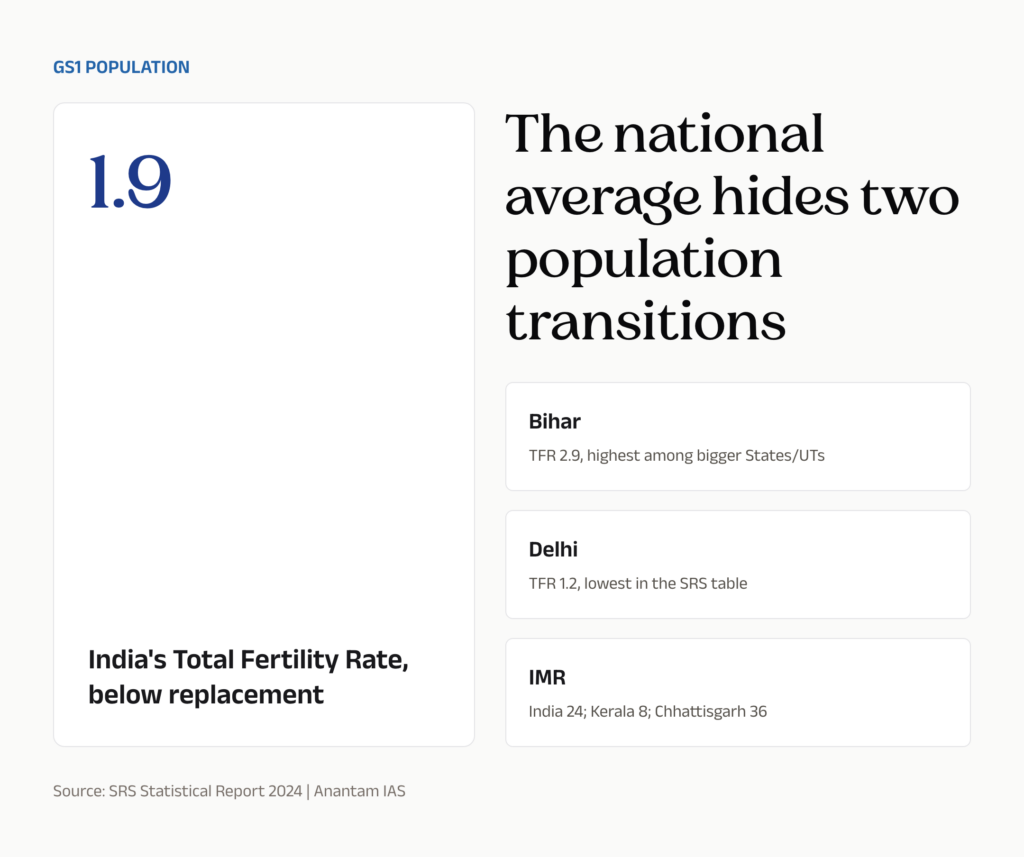
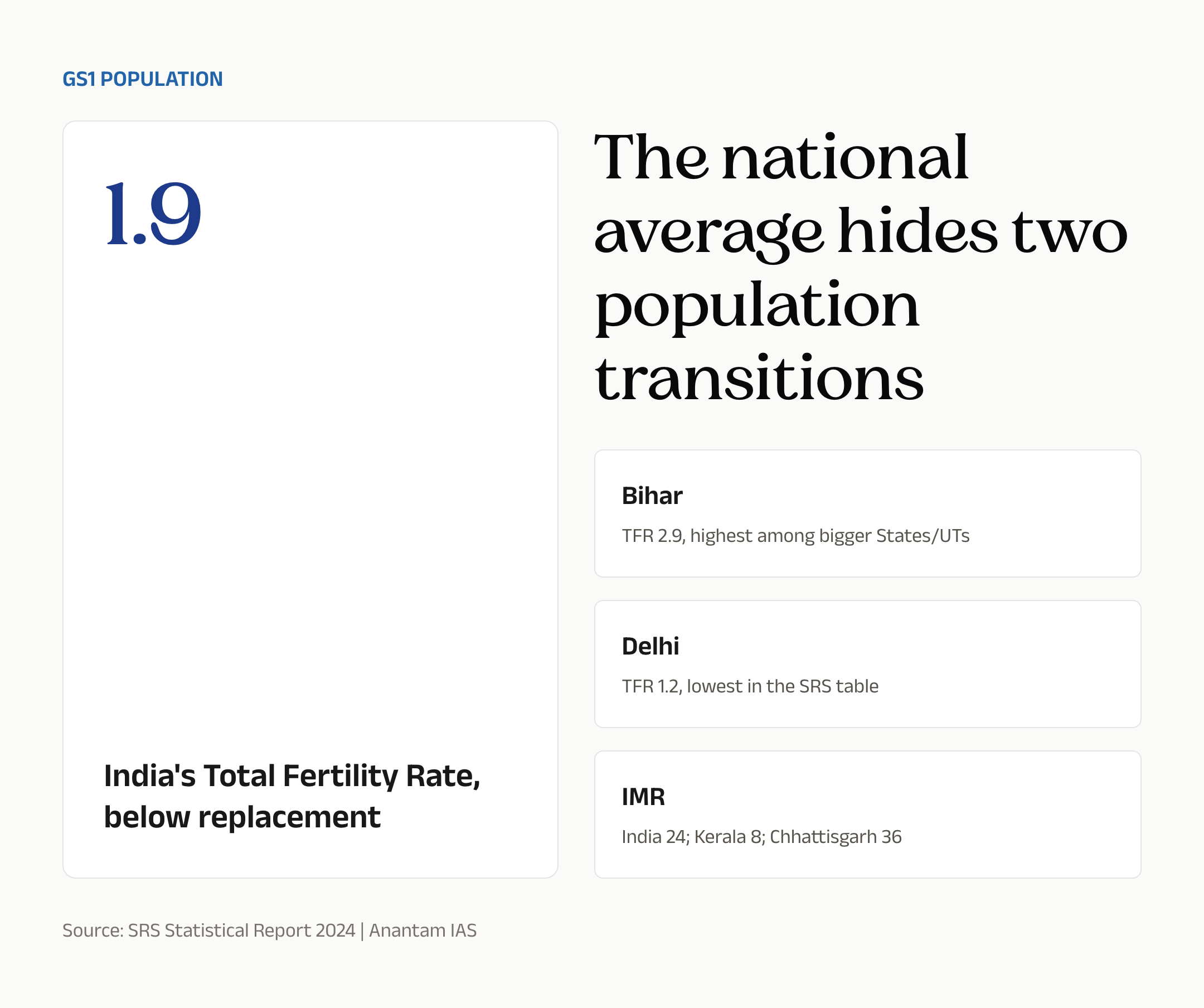
The SRS Statistical Report 2024 estimates India’s Total Fertility Rate at 1.9, below the replacement level of 2.1. Rural India is at 2.1 while urban India is at 1.5. That rural-urban gap alone tells you why a national headline cannot become a national policy.
The state spread is sharper. Bihar records a TFR of 2.9, Uttar Pradesh 2.6, Kerala 1.3, Tamil Nadu 1.3 and Delhi 1.2. In plain words, one part of India is still managing the late stages of fertility decline while another part has already entered the low-fertility zone that eventually brings ageing, shrinking school cohorts and pressure on care systems.
Health outcomes show the same unevenness. India’s Infant Mortality Rate declined to 24 in 2024 from 30 in 2019. That is real progress. But SRS still records Chhattisgarh at 36 and Kerala at 8 among bigger States/UTs. A baby born in one state is still living inside a very different risk environment from a baby born in another.
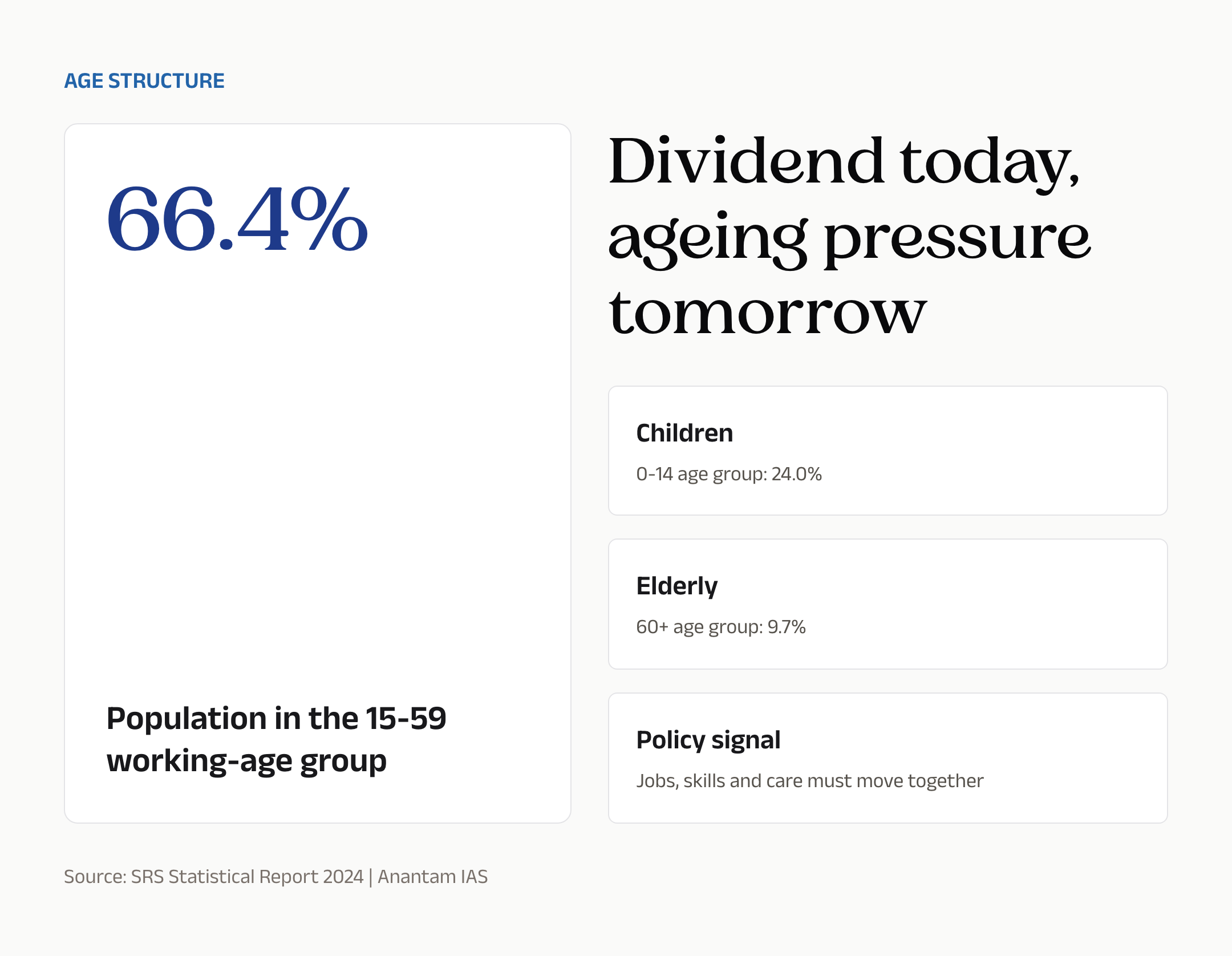
The age structure is the big policy clock. SRS 2024 puts 24.0% of the population in the 0-14 age group, 66.4% in 15-59, and 9.7% at 60 and above. That working-age share is the dividend. But it becomes a dividend only when people are healthy, educated, skilled and employed. Without that, it is only a demographic fact.
The Case For
The optimistic case is still valid. India has a large working-age population, a growing services base, expanding digital infrastructure, and rising educational aspiration. If jobs, skilling and female workforce participation improve, the working-age share can support growth, savings and domestic demand for many years.
Fertility decline also gives families more room to invest in each child. Fewer births can mean better nutrition, schooling and health, provided public systems work. This is where demographic transition becomes social policy. It is not anti-family. It is pro-capability.
There is also a federal advantage. States are at different stages of transition, so India can, in theory, use internal migration to balance labour demand and supply. Younger states can supply workers to ageing states. But that requires dignity, portability of welfare and urban planning, not the old suspicion of migrants.
The Case Against
The pessimistic case is that India is wasting the window. A demographic dividend is not automatic. It requires productive jobs, not just population. If the economy creates too few stable opportunities, a large working-age population can become frustration rather than growth.
Female labour-force participation is the quiet hinge. Fertility can fall and education can rise, yet women’s work may remain constrained by safety, unpaid care, social norms and weak urban transport. A low-fertility society without women’s economic participation loses one of the strongest gains of demographic transition.
Ageing will also arrive unevenly. Kerala and Tamil Nadu will face a care, pension and chronic-disease agenda earlier than Bihar or Uttar Pradesh. If national welfare design keeps focusing only on children and youth, older citizens will become the next invisible category.
The Deeper Structural Read
The deeper structural read is that India is moving from population control to population management. The old debate asked how to reduce fertility. The new debate asks how to support families, workers, migrants, elderly citizens and children at the same time. That is a more mature debate, and honestly, a harder one.
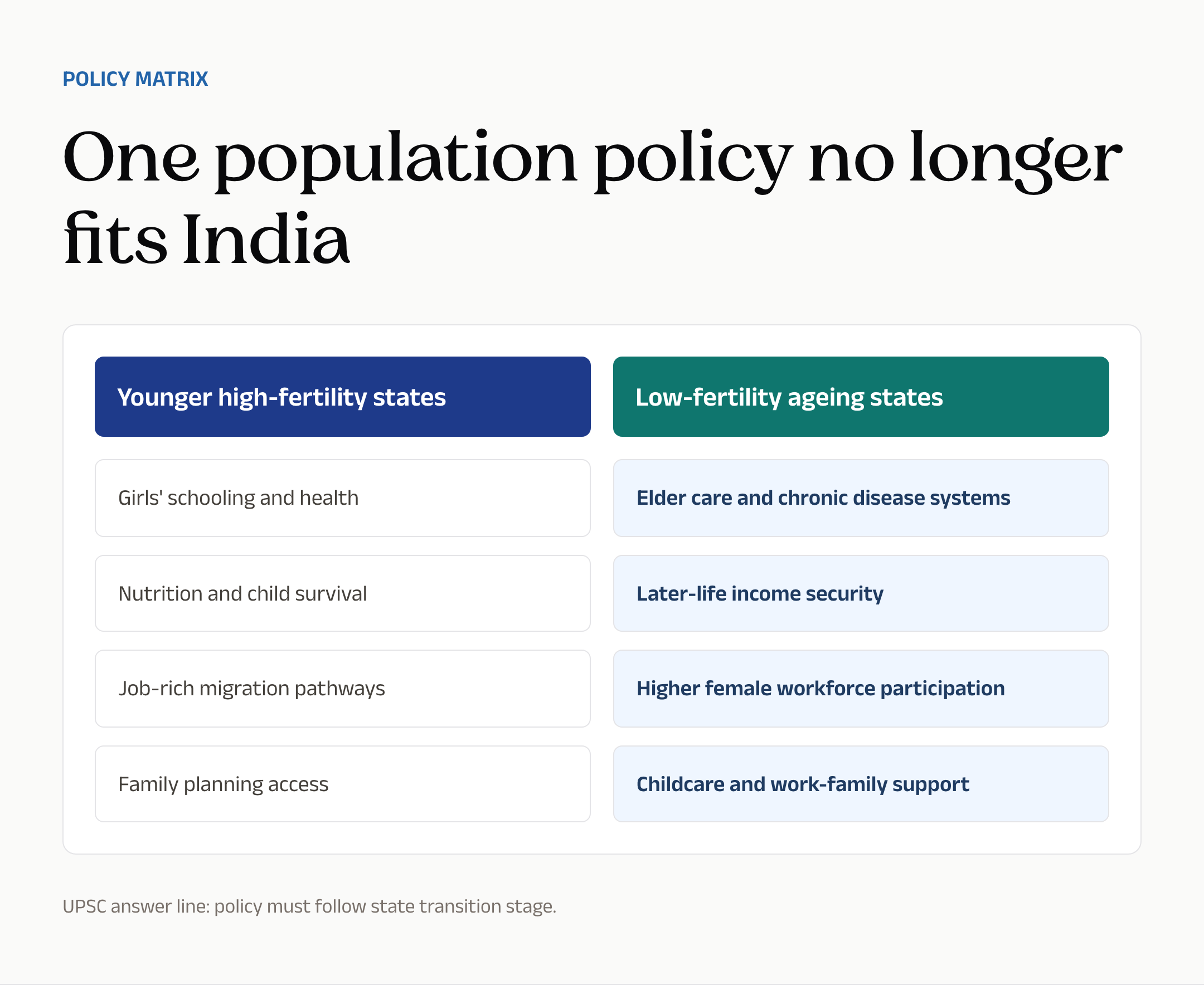
High-fertility states still need investments that look familiar: girls’ education, reproductive health, nutrition, child survival, and social norms that delay early marriage. But the purpose should not be coercive fertility reduction. The purpose should be capability. Fertility falls most durably when families trust health systems, girls stay in school, and women have agency.
Low-fertility states need a different package: childcare, elder care, geriatric health, chronic disease management, assisted living, age-friendly cities and labour-force participation. The senior citizens agenda is no longer a welfare footnote. They should not panic about low fertility with symbolic appeals for more children while ignoring the costs families face.
The missing connector is migration. India’s labour market is already national, but welfare and urban governance often remain local. If a young worker from a high-fertility state moves to a low-fertility state, the receiving city must provide housing, transport, health access and dignity. Otherwise the demographic adjustment happens in the most unjust way possible.
What Should Be Done
First, classify states by demographic stage. High-fertility, transition, low-fertility and ageing states need different policy dashboards. A national ministry can set principles, but the real action should be state-specific and district-specific.
Second, treat child survival and fertility as connected, not separate. When infant mortality remains high, families have stronger reasons to insure against loss through more births. Better public health is also better demographic policy.
Third, build the care economy. Anganwadis, creches, home-based elder support, community health workers and primary health centres are not soft welfare. They are labour-market infrastructure, especially for women.
Fourth, make migration portable. Food rations, health records, social security, rental housing and skilling benefits should follow the worker. The Periodic Labour Force Survey matters here because employment quality determines whether the demographic dividend turns into income, while the older demographic transition frame needs a state-specific update.
Finally, retire coercive population politics. Two-child penalties, moral scolding and panic about numbers are blunt tools. India now needs precision: support the young where fertility is still high, support workers everywhere, and build care systems where ageing is already visible.
For Your Mains Answer
GS paper mapping: GS1: population and society; GS2: health, education, welfare; GS3: employment and human capital.
Likely question frames: – India’s demographic dividend is becoming state-specific rather than national. Discuss with reference to SRS 2024. – Fertility decline is not the end of population policy. Examine the emerging challenges of ageing, migration and women’s work. – How should Indian states at different stages of demographic transition design different policy packages?
Quotable data points: – India’s TFR is 1.9 in 2024, below replacement level. – Rural TFR is 2.1; urban TFR is 1.5. – Bihar TFR is 2.9; Delhi TFR is 1.2. – India’s IMR is 24 in 2024, down from 30 in 2019. – India’s 15-59 working-age share is 66.4%. – The 60+ population share is 9.7%. – Sex ratio at birth is 918 for 2022-24.
Keywords to use: demographic transition, replacement fertility, human capital, care economy, internal migration, female workforce participation.
Syllabus linkages: Population and associated issues, Human resources, Welfare schemes, Health and education.
Balanced conclusion line: India’s demographic dividend will be won state by state, through jobs, health, education, migration dignity and care.
How to Build the Answer
Start with the central tension, not a textbook definition. For this topic, the tension is: India’s demographic dividend is becoming state-specific rather than national. Discuss with reference to SRS 2024. That opening immediately tells the examiner that you understand both the policy problem and the value conflict. A definition can come in the second or third sentence. The first sentence should frame the debate.
Use data early, but do not dump data. A good first body paragraph can carry three numbers: India’s TFR is 1.9 in 2024, below replacement level. Rural TFR is 2.1; urban TFR is 1.5. Bihar TFR is 2.9; Delhi TFR is 1.2. Then explain what those numbers prove. UPSC rewards the move from fact to inference. The number is the anchor; the inference is the mark-scoring part.
The second body paragraph should handle the other side fairly. If your stance supports reform, first admit why the existing approach has a rationale. If your stance criticises a policy, first say what problem the policy was trying to solve. This is how an answer becomes balanced without becoming vague.
The way forward should be grouped, not scattered. Use headings such as institutional reform, fiscal design, citizen impact, federal coordination and technology. Use the topic’s own vocabulary: demographic transition, replacement fertility, human capital, care economy, internal migration. These words help the answer sound like governance analysis rather than a newspaper summary.
Close by returning to the syllabus link: Population and associated issues, Human resources, Welfare schemes. The last line should not repeat the introduction. It should show judgment. One useful pattern is: ‘The goal is not X alone, but X with Y.’ That pattern lets you balance reform with rights, growth with equity, and security with liberty.
Common Mistakes to Avoid
- Do not write only the newspaper argument. Editorials are starting points. Mains answers need constitutional, economic, administrative or ethical structure.
- Do not overuse adjectives. Words like serious, grave, historic and transformative do not earn marks unless tied to evidence.
- Do not make the answer one-sided. Every topic in this batch has a real counter-argument. Steelman it in two or three lines before giving your final view.
- Do not end with a slogan. End with an implementable principle, a measurable reform, or a constitutional value.
- Do not forget the citizen. UPSC likes policy, but it rewards policy that names who gains, who loses and who needs protection.
A Compact Answer Spine
- Introduction: Open with the conflict in one sentence and define the key term in the next sentence.
- Evidence: Use two or three data points from the dossier and connect each to a policy implication.
- Arguments: Present the case for the current policy or trend, then the case against it. Keep both fair.
- Structural diagnosis: Explain the deeper administrative, economic, social or constitutional reason the issue persists.
- Way forward: Give four to five grouped reforms with clear actors: Union government, state government, regulator, court, market, municipality or citizen.
- Conclusion: Use the balanced conclusion line from this section and adapt it to the question wording.
Diagram or Flowchart Idea
Use one small diagram if the question is a 15-marker. Do not draw a decorative mind map. Draw a causal chain. The cleanest format is: problem trigger -> institutional gap -> citizen impact -> reform response. This works because the examiner can read the logic in five seconds.
For a 10-marker, skip the diagram unless it is genuinely simple. A table with two columns, ‘case for’ and ‘case against’, usually works better. The aim is not to show artistic effort. The aim is to make the answer easy to evaluate under time pressure.
Ethics and Governance Angle
Add one ethical line even in a GS2 or GS3 answer. Most current-affairs editorials are not only about efficiency. They also ask who bears the cost of policy failure. A migrant voter, an undertrial, an outdoor worker, a small exporter, a low-income commuter or an elderly citizen is often sitting silently inside the issue. Naming that citizen makes the answer sharper.
The governance angle should then convert empathy into design. Do not merely say ‘protect vulnerable groups’. Say how: targeted transfers, legal aid, local health surveillance, simplified compliance, public transport, transparent dashboards, or periodic judicial review. This is where many answers move from moral language to administrative maturity.
A useful sentence pattern is: ‘The policy is legitimate in aim, but its legitimacy depends on procedure, proportionality and capacity.’ This line works across many topics because it accepts the state’s objective without giving the state a blank cheque. It is especially useful for questions where the examiner expects balance.
How to Use Data Without Sounding Mechanical
Use fewer numbers than you know. Three well-explained data points beat ten scattered facts. Put the most important number near the beginning, use the second number to show contrast, and use the third number to justify the way forward. For example, one national number, one state or sector contrast, and one implementation gap is usually enough.
Never leave a statistic alone. Follow it with a sentence beginning with ‘This means…’ or ‘The policy implication is…’ That tiny move turns data into analysis. It also keeps the answer from reading like a fact sheet. In Mains, facts are raw material. Judgment is the finished answer.
End revision by asking one question: can this answer be understood by a tired examiner in one pass? If the answer needs rereading, simplify the structure. Keep the introduction short, give the data early, mark the two sides cleanly, and place the way forward in grouped points. Clarity is not a lower standard than depth. For UPSC writing, clarity is how depth becomes visible.
One final check: remove any line that sounds impressive but does no work. Replace it with a fact, a cause, a consequence or a reform. That habit is small, but it is the difference between an answer that feels informed and an answer that feels memorised.
Write for marks, not for noise. Every sentence should earn its place. Always be specific.
FAQ
What is India’s TFR in SRS 2024?
India’s Total Fertility Rate is estimated at 1.9 in SRS 2024, below the replacement level of 2.1.
Which state has the highest TFR?
Among bigger States/UTs in SRS 2024, Bihar records the highest TFR at 2.9.
Why is ageing now a policy issue?
Because low-fertility states will see faster growth in elderly shares, requiring pensions, geriatric health care, chronic disease systems and age-friendly cities.
What should aspirants remember?
Do not write one national demographic answer. Write a state-specific answer that links fertility, health, jobs, migration and care.
Tell Google you want more of this.
Add Anantam IAS as a preferred sourceOne tap, and this site shows up more often in your own Top Stories, AI Overviews and AI Mode. Remove it any time.