PM SHRI Yojana: Objectives, Features, Budget, and Significance
PM SHRI Yojana explained: aim to upgrade 14,500 schools, NEP 2020 alignment, funding, selection, challenges, and UPSC-ready analysis of education reform.
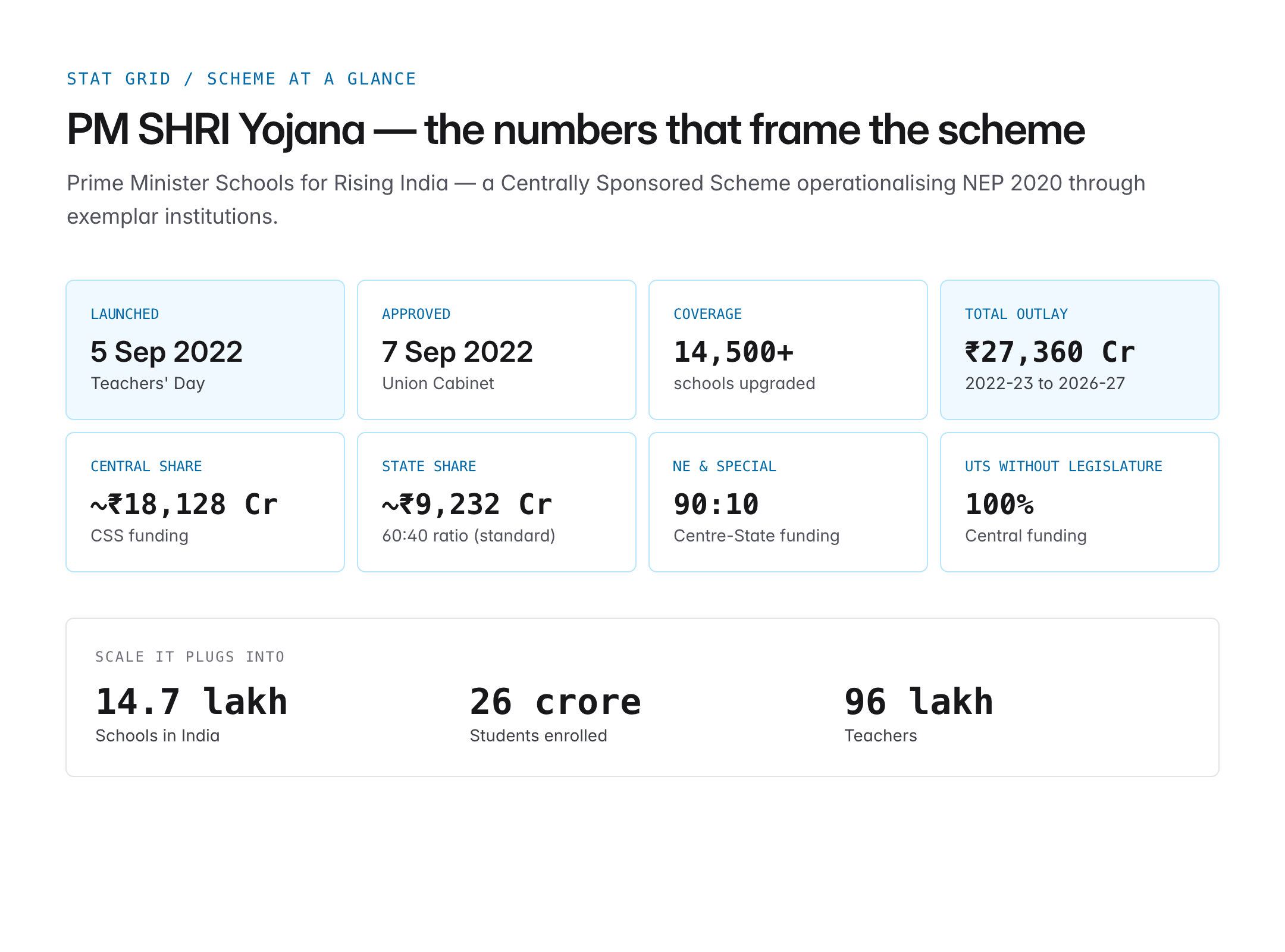
The PM SHRI Yojana, short for Prime Minister Schools for Rising India, is a centrally sponsored scheme launched in September 2022 to develop more than 14,500 existing schools across India into model schools that fully embody the spirit of the National Education Policy (NEP) 2020. Announced by Prime Minister Narendra Modi on Teachers' Day, 5 September 2022, and approved by the Union Cabinet on 7 September 2022, the scheme seeks to create exemplar institutions that combine modern pedagogy, holistic learning, and equitable access. For UPSC, PM SHRI is a prime example of NEP-era reforms.
Background: Why PM SHRI?
India's schooling system is defined by sheer scale – over 14.7 lakh schools, 26 crore students, and 96 lakh teachers – but is uneven in quality. Multiple reports have flagged learning gaps:
- ASER reports show a large share of students below grade-level in basic reading and arithmetic.
- NAS (National Achievement Survey) findings indicate variation across states and socio-economic groups.
- NEP 2020 highlighted the need for Foundational Literacy and Numeracy (FLN), 21st-century skills, and equity.
PM SHRI is designed to create a nationwide network of model schools that can showcase and propagate best practices, much like the earlier Kendriya Vidyalayas and Navodaya Vidyalayas set benchmarks in specific niches.
Objectives of PM SHRI Yojana
As per the Ministry of Education guidelines, PM SHRI aims to:
- Develop more than 14,500 schools as PM SHRI schools across India.
- Implement the NEP 2020 in full in these schools.
- Offer high-quality, equitable, joyful schooling to children in a well-designed, inclusive, safe environment.
- Provide leadership in quality to other schools in their neighbourhood through mentoring and benchmarking.
- Promote 21st-century skills – critical thinking, creativity, digital literacy, life skills.
- Foster Green Schools with water conservation, solar panels, waste management, and organic lifestyle.
The broader vision is that each PM SHRI school becomes a "living laboratory" of NEP 2020, blending technology, innovation, and rootedness in Indian languages, knowledge, and culture.
Scheme Architecture
Scheme type and tenure
- Centrally Sponsored Scheme (CSS).
- Total project period: initially 2022-23 to 2026-27 (5 years).
- Total outlay: approximately ₹27,360 crore, of which the Central share is around ₹18,128 crore and State share approximately ₹9,232 crore, in the ratio applicable to CSS (typically 60:40, with 90:10 for NE and special category states and 100% central for UTs without legislature).
Coverage
- Up to 14,500+ schools selected in a phased manner, drawn from the pool of existing schools managed by:
- Centre (Kendriya Vidyalayas, Navodaya Vidyalayas).
- States and Union Territories (government schools).
- Local bodies.
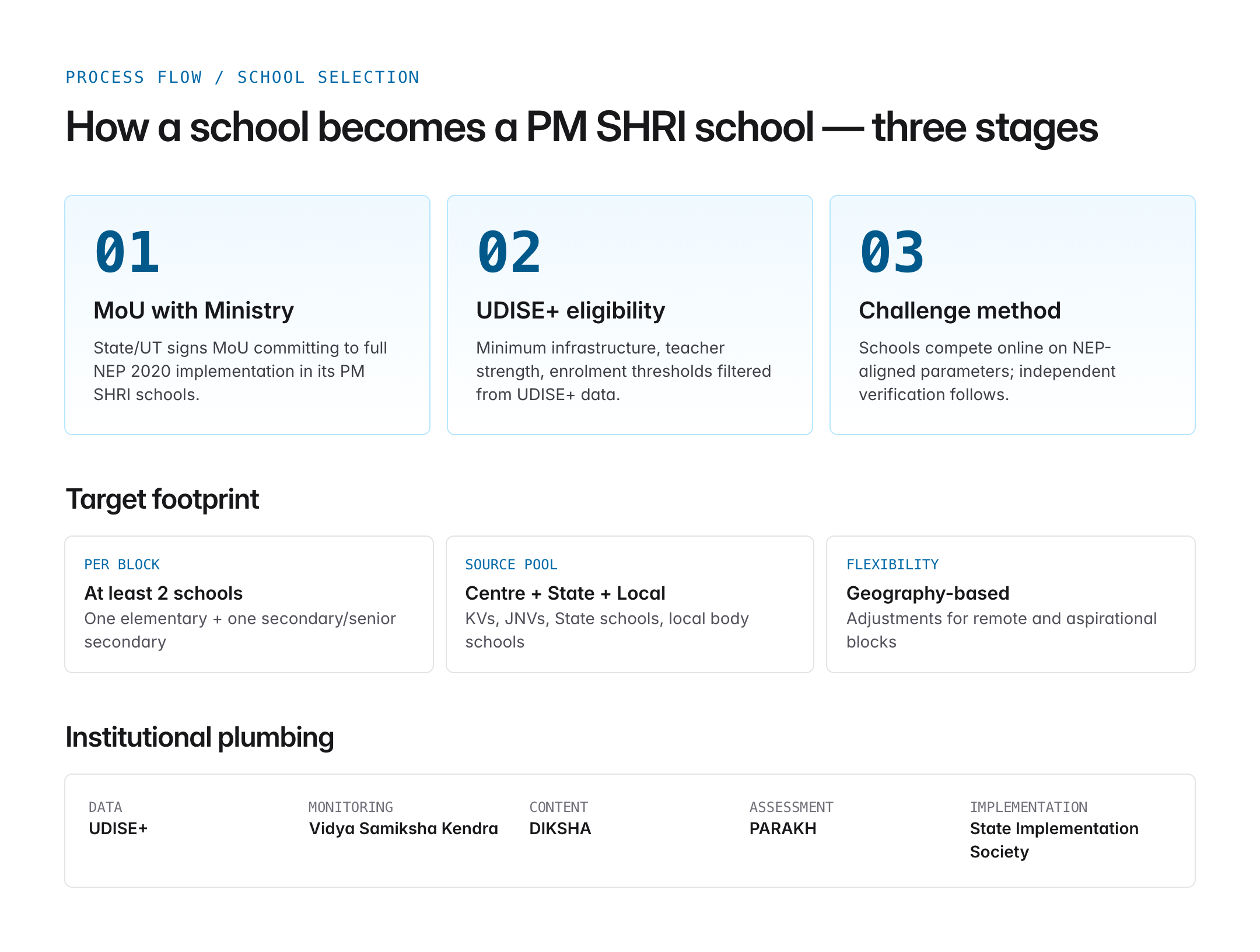
- Target: at least two schools per block (one elementary, one secondary/senior secondary), with flexibility based on geography.
Selection process
- Based on a three-stage selection:
- Signing of an MoU with the Ministry of Education by the State/UT committing to NEP 2020 implementation in PM SHRI schools.
- Eligibility criteria based on UDISE+ data, including minimum infrastructure, teachers, and enrolment thresholds.
- Challenge method: Schools compete online on NEP-aligned parameters; independent verification follows.
Key Features
A PM SHRI school is expected to differ from an average school in several ways.
Curriculum and pedagogy
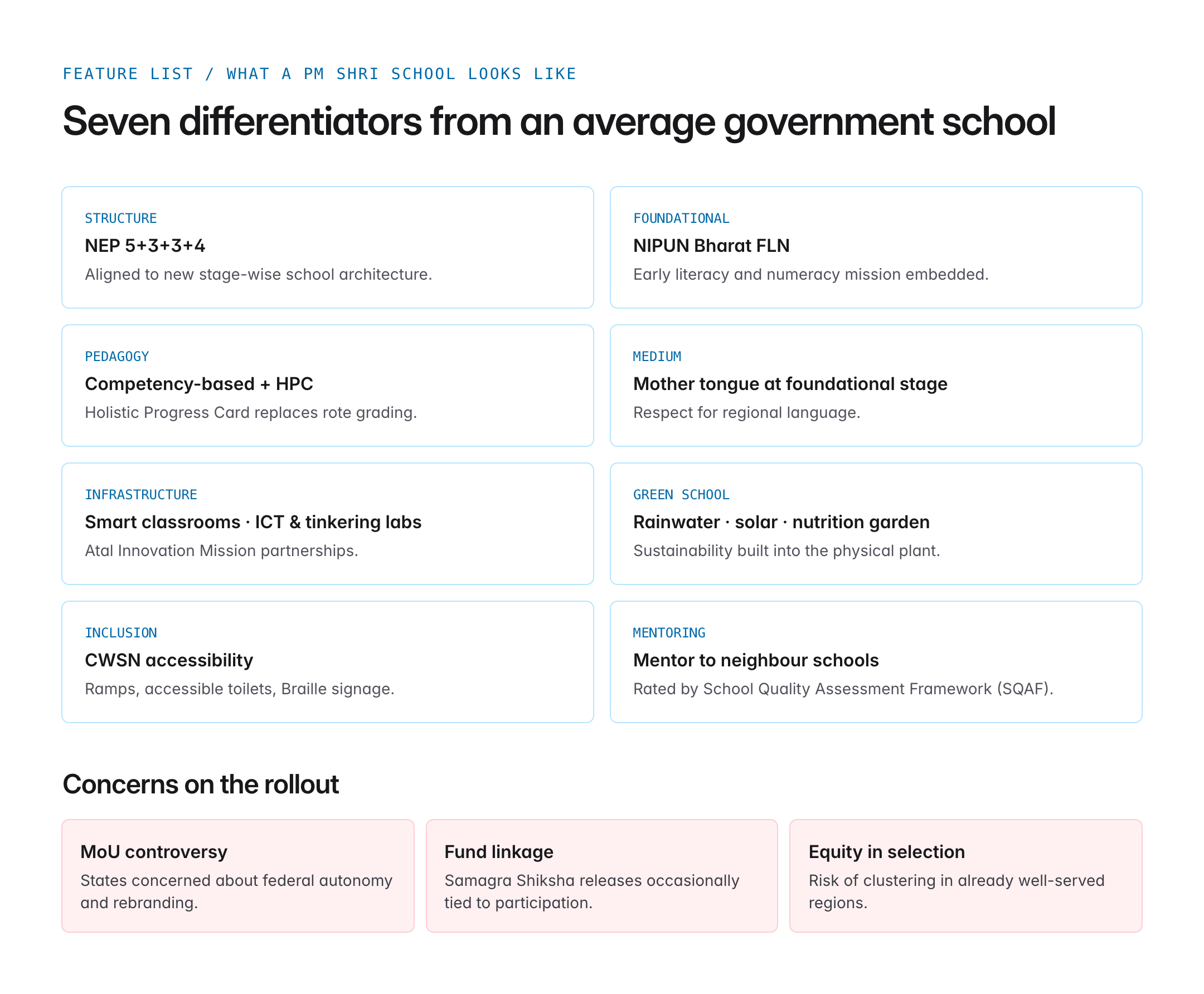
- Complete alignment with NEP 2020, including the 5+3+3+4 structure.
- Foundational Literacy and Numeracy (FLN) through NIPUN Bharat.
- Competency-based learning and Holistic Progress Card (HPC).
- Mother tongue/regional language instruction at foundational stages.
- Reduced bag-weight, no-bag days, and bag-less 10 days of internship exposure.
- Art-integrated, sports-integrated, and story-telling pedagogy.
Infrastructure and amenities
- Smart classrooms, ICT labs, science labs, tinkering labs (in partnership with Atal Innovation Mission).
- Libraries with age-appropriate books.
- Inclusive infrastructure for CWSN (children with special needs) – ramps, accessible toilets, Braille signage.
- Green school elements: rainwater harvesting, solar rooftops, waste segregation, nutrition gardens.
- Safety features: CCTV, secure boundary walls, vehicle checks.
Assessment
- Move from rote testing to 360-degree assessment, including self-assessment, peer assessment, and teacher assessment.
- Use of AI-based learning analytics and the PARAKH national assessment centre.
Mentoring and network
- PM SHRI schools serve as mentor schools for other schools in their block/district.
- Clustering with Samagra Shiksha, STARS project, and PM POSHAN.
- Each school to be rated and monitored through a dedicated School Quality Assessment Framework (SQAF).
Funding and Institutional Framework
- Central share largely routed through the Ministry of Education, Department of School Education and Literacy.
- Implementation through State Implementation Societies (as under Samagra Shiksha).
- Dedicated PM SHRI Programme Management Unit oversees rollout, monitoring, and knowledge management.
- Integration with UDISE+, Vidya Samiksha Kendra (VSK), and DIKSHA platform for real-time data.
Expected Outcomes
- Measurable improvements in learning outcomes, particularly FLN.
- Higher transition rates between stages and reduced dropouts.
- Enhanced gender parity and inclusion of marginalised groups.
- Establishment of a replicable model of NEP 2020 in diverse geographies.
- Stronger teacher professional development and leadership pipelines.
Challenges and Concerns
PM SHRI has drawn attention and critique on several counts.
- MoU controversy: A few states initially resisted signing the MoU, concerned about federal autonomy and rebranding of state schools.
- Funding asymmetries: Release of Samagra Shiksha funds has, at times, been linked to PM SHRI participation, raising fiscal concerns.
- Selection equity: Ensuring PM SHRI coverage reaches remote and aspirational blocks rather than clustering in already better-served regions.
- Teacher shortages and pupil-teacher ratio issues persist, especially in secondary schools.
- Outcome measurement: Moving beyond infrastructure to demonstrable improvements in learning outcomes requires robust evaluation.
- Linguistic and cultural diversity: Respect for medium of instruction and local context is critical under NEP 2020.
How PM SHRI Fits the Wider Education Ecosystem
| Scheme / Initiative | Focus |
|---|---|
| Samagra Shiksha | Overall school education CSS |
| PM POSHAN (Mid-day Meal) | Nutrition in schools |
| NIPUN Bharat | FLN mission |
| PARAKH | National assessment centre |
| STARS (with World Bank) | Select states' learning outcomes |
| ULLAS | Adult literacy |
| NEP 2020 | Overarching policy |
PM SHRI acts as a flagship demonstration layer riding on these initiatives, concentrating reforms in selected schools.
UPSC Relevance
Prelims focus:
- PM SHRI launched on 5 September 2022; approved by Cabinet on 7 September 2022.
- Centrally Sponsored Scheme with approximate total outlay of ₹27,360 crore over 2022-23 to 2026-27.
- Coverage: over 14,500 schools; selection via challenge method and MoU.
- Aligned to NEP 2020, 5+3+3+4 structure, and NIPUN Bharat.
- Institutional linkages: Samagra Shiksha, PM POSHAN, PARAKH, DIKSHA, UDISE+.
Mains GS-II angle:
- Evaluate PM SHRI in the context of NEP 2020's ambitions.
- Federalism concerns over MoUs and fund-linked conditionalities.
- Role of flagship schemes in raising overall system quality.
- Equity, access, and outcome-based monitoring in Indian education.
Sample PYQ angle: "Public expenditure on education and health in India has been much lower than in other developing countries. Discuss." PM SHRI offers a concrete illustration of how targeted, NEP-aligned expenditure attempts to bridge quality gaps, allowing students to blend data, design, and critique in answers.