PM Vidyalaxmi: The Education-Loan Guarantee Scheme Explained (UPSC Governance)
PM Vidyalaxmi is a Central Sector scheme that gives meritorious students collateral-free, guarantor-free education loans, backed by a government credit guarantee and an interest subvention. Here is what it actually offers, who qualifies, and how it differs from the older Vidya Lakshmi portal.
Every year, a quietly brutal sorting happens in Indian homes. A student clears a tough entrance exam, gets a seat at a genuinely good college, and then the family sits down with a calculator. The fees are real, the bank wants collateral the family doesn’t have, and a relative is asked to stand guarantor and politely declines. PM Vidyalaxmi is the government’s attempt to take that conversation off the table. Approved by the Union Cabinet on 6 November 2024, it’s a Central Sector scheme that promises any meritorious student admitted to one of India’s top institutions a collateral-free, guarantor-free education loan from a bank, backed by a government guarantee and, for the less well-off, a slice of the interest paid for them.
That promise matters far beyond a single budget line. India has staked its growth story on its young people, and the National Education Policy of 2020 set a target of pushing the share of young Indians in higher education up to 50% by 2035. You don’t get there if a bright student from a modest home has to turn down a seat for want of cash. So PM Vidyalaxmi sits right on the fault line of access, equity and the demographic dividend, run by the Department of Higher Education under the Ministry of Education. It also carries a common confusion built into its name, because there’s an older “Vidya Lakshmi” portal that does something related but different. Getting that distinction right is half the battle for UPSC, and we’ll untangle it carefully.
What the Scheme Is and Why It Was Launched
Let’s be precise about what PM Vidyalaxmi actually is, because the name invites a mistake. It is not a scholarship and it is not free money. It’s a loan scheme with two government supports bolted on. The core promise is that a student admitted to a recognised top institution can walk into a bank and get an education loan covering the full tuition and course-related costs without putting up collateral and without finding a guarantor. The bank still lends its own money and the student still repays it. What changes is that the government removes the two things that most often block such a loan for an ordinary family: the demand for security and the demand for someone to co-sign.
It was approved as a Central Sector scheme, which is the technical term that matters here. A Central Sector scheme is funded entirely by the Union government, unlike a Centrally Sponsored scheme where states chip in a share. So the money, the design and the accountability all sit with the Centre, specifically with the Department of Higher Education. That’s worth remembering, because education is on the Concurrent List of the Constitution, and the choice to run this fully from the Centre is itself a small statement about who is driving higher-education financing.
So why now, and why this shape? The surface reason is plain. Education costs have climbed faster than family incomes, and the bank loan that was meant to bridge the gap often doesn’t reach the students who need it most, precisely because banks ask for security a first-generation learner’s family can’t offer. The deeper reason is policy lineage. PM Vidyalaxmi flows directly out of NEP 2020, which explicitly recommended that financial help reach every meritorious student in both public and private institutions. The government’s bet is that by absorbing the bank’s risk and softening the interest burden, it can convert a bright admission letter into an actual enrolment far more reliably than another scholarship corpus could.
How PM Vidyalaxmi Works: Coverage, Guarantee and Subvention
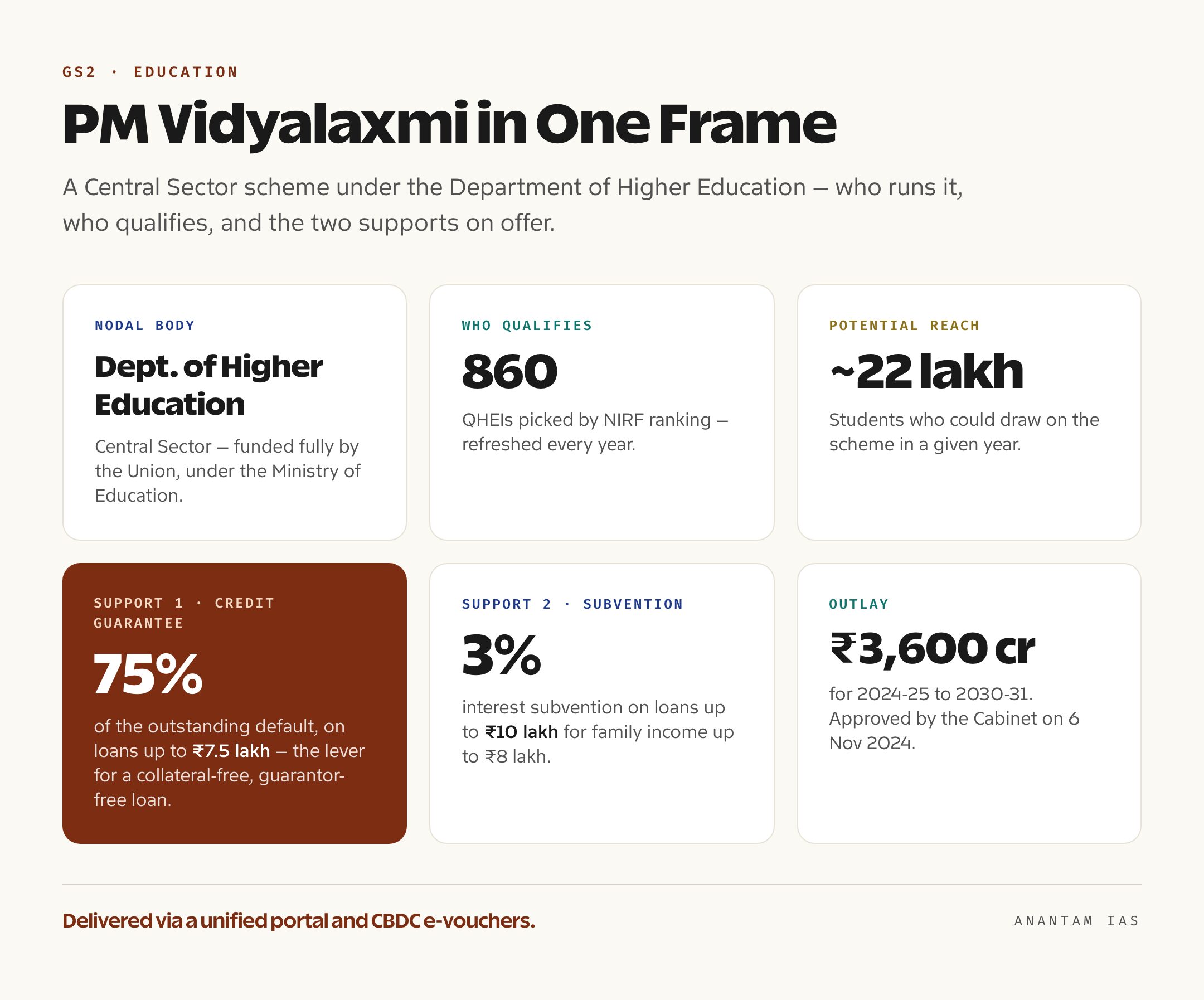
Here is the architecture in plain terms, because the details are exactly what gets tested. PM Vidyalaxmi doesn’t cover every college in India. It is aimed at what the scheme calls Quality Higher Education Institutions, or QHEIs, and the gatekeeper is the National Institutional Ranking Framework, the NIRF, which the Education Ministry uses to rank institutions every year. An institution qualifies if it sits in the top 100 of NIRF in the overall, category-specific or domain-specific lists; or if it’s a state government institution ranked between 101 and 200; or if it’s a central government-governed institution. Crucially, this catches both government and private institutions inside the top 100. The list is refreshed every year using the latest NIRF ranking, so it isn’t frozen. To begin with, it covers 860 qualifying institutions, and within them roughly 22 lakh students could potentially draw on the scheme in a given year.
Inside that universe, two distinct supports do the work, and the cleanest way to understand the scheme is to keep them separate. The first is a credit guarantee. For loans up to ₹7.5 lakh, the government offers banks a guarantee of 75% of the outstanding default. In plain language, if a borrower stops repaying, the government promises to make good three-quarters of what’s still owed. That guarantee is the lever that lets a bank drop its demand for collateral and a guarantor, because most of its downside risk is now covered by the State rather than by the student’s family. It’s deliberately aimed at the smaller loans, where first-generation and lower-income borrowers cluster.
The second support is an interest subvention, and it carries tighter conditions because it costs the exchequer directly. A student whose annual family income is up to ₹8 lakh, and who isn’t already covered by any other government scholarship or interest-subvention scheme, gets a 3% interest subvention on a loan up to ₹10 lakh during the moratorium period, the grace window while the student is still studying and not yet repaying. This subvention isn’t open-ended. It’s capped at about one lakh fresh students every year, with priority given to those in government institutions and those pursuing technical and professional courses, the streams where fees bite hardest and employability is clearest. Over the scheme’s life, roughly 7 lakh fresh students are expected to benefit from the subvention. To keep the leakage low and the trail digital, the government plans to pay the subvention through e-vouchers and Central Bank Digital Currency wallets rather than as a vague reimbursement. The whole package carries an outlay of ₹3,600 crore for the period 2024-25 to 2030-31.
PM Vidyalaxmi vs the Vidya Lakshmi Portal and CSIS
This is the part that trips up most candidates, so let’s slow down. There are three names in play that sound almost identical, and they are not the same thing. The oldest is the Vidya Lakshmi portal, launched back in 2015. That portal is not a scheme at all. It’s a single-window website, built and maintained by Protean eGov Technologies, the firm formerly known as NSDL e-Governance, under the joint guidance of the Department of Financial Services, the Department of Higher Education and the Indian Banks’ Association. Its whole job is to let a student fill one common application form, compare education-loan products across many banks, apply to several of them at once, and track the application. Think of it as the plumbing, the common pipe through which loan applications flow.
PM Vidyalaxmi, the 2024 scheme, is the new flow of benefits running through an upgraded version of that pipe. The Department of Higher Education is fielding a unified “PM-Vidyalaxmi” portal on which a student can apply for both the education loan and the interest subvention through a single, simplified process that every bank uses. So the relationship is clean once you see it: Vidya Lakshmi is the platform; PM Vidyalaxmi is the scheme and the credit guarantee and the subvention that the platform now delivers. When a news report says applications have “opened on the portal,” it’s the same lineage of platform; when it says the “scheme was approved,” it’s the 2024 Cabinet decision.
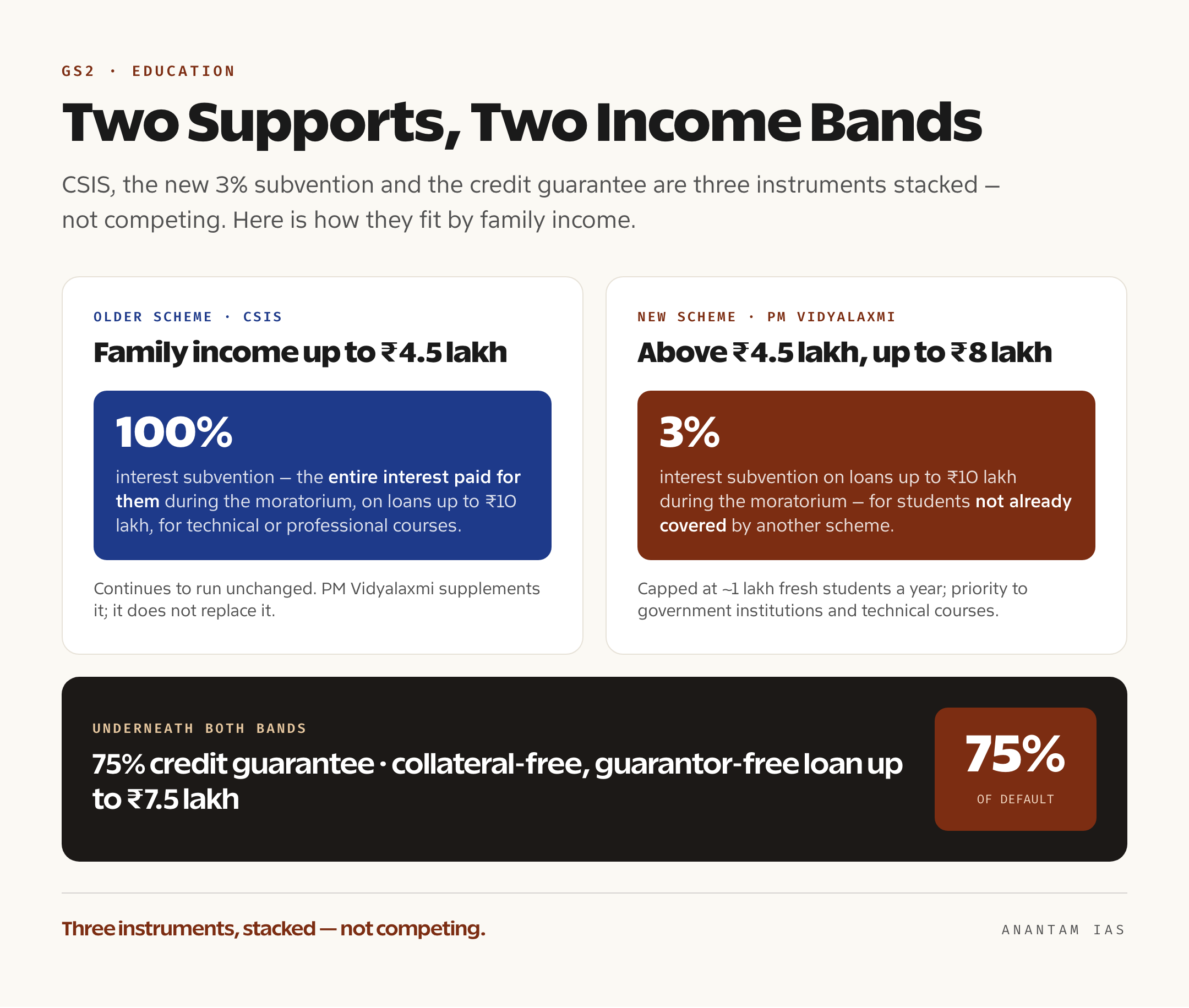
The third name is CSIS, the Central Sector Interest Subsidy scheme, and this is where you must avoid a double-count. PM Vidyalaxmi does not replace the existing supports. It supplements two older components of the PM Vidyalaxmi-USP umbrella, the Credit Guarantee Fund Scheme for Education Loans and CSIS. CSIS continues to run for a different, lower income band. Under CSIS, a student from a family earning up to ₹4.5 lakh a year, pursuing a technical or professional course at an approved institution, gets full interest subvention, the entire interest paid for them, on a loan up to ₹10 lakh during the moratorium. PM Vidyalaxmi’s new 3% subvention is designed to sit just above that, catching the band from above ₹4.5 lakh up to ₹8 lakh that CSIS leaves out, and only for students not already covered elsewhere. So the honest one-line summary is this: CSIS gives 100% interest subvention to families up to ₹4.5 lakh; PM Vidyalaxmi adds a 3% subvention for families up to ₹8 lakh; and the new credit guarantee on top makes the underlying collateral-free loan possible for both groups. Three instruments, stacked, not competing.
Significance: Access, Equity and the Demographic Dividend
Now the bigger picture, because this is where a Mains answer earns its marks. The strongest case for PM Vidyalaxmi is about access and equity. India’s Gross Enrolment Ratio in higher education, the share of the college-age population actually enrolled, has been climbing slowly, sitting around 28% in recent official surveys against the NEP 2020 ambition of 50% by 2035. You cannot close a gap that large by building seats alone; you have to make sure students can afford to occupy them. By removing the collateral and guarantor demands that disproportionately block first-generation learners, lower-income families and students from regions without family wealth, the scheme attacks one of the quieter forms of exclusion in Indian education, the kind that never shows up as a rejection letter because the student simply never applies.
There’s a financing-the-future argument layered on top. India’s much-discussed demographic dividend, its large working-age population, only pays off if that population is skilled and employable. Higher education is the engine of that conversion, and the targeting of PM Vidyalaxmi’s subvention towards technical and professional courses, the engineering, medicine and management streams, points the support at exactly where high fees and high earning potential meet. The design choices are also institutionally smart. Anchoring eligibility to NIRF ranking gives the scheme an objective, annually refreshed list rather than a discretionary one, which limits political pet-picking. Routing the subvention through CBDC wallets and e-vouchers, and the loans through a single digital portal, builds in a transparent, traceable trail that’s harder to leak than a cash reimbursement. And by guaranteeing the bank rather than handing students a grant, the government uses a relatively small outlay to unlock a much larger pool of private bank credit, the classic logic of a credit-guarantee instrument.
So in governance terms, PM Vidyalaxmi is a tidy illustration of a State that lends its balance sheet rather than its cash, nudging private banks to do social lending they’d otherwise avoid. That makes it a useful case study not just in education policy, but in how modern welfare is increasingly delivered through guarantees, subventions and digital rails rather than through cheques.
Challenges, Criticisms and the Way Forward
A strong case is only strengthened by stating its limits, so here they are without flinching. The loudest criticism is about coverage. PM Vidyalaxmi reaches the top 860 institutions, the cream identified by NIRF, while the overwhelming majority of Indian students study somewhere else entirely, in the thousands of ordinary state colleges and private institutions that will never crack the top 100 or the 101 to 200 state band. So a scheme pitched in the language of universal access in fact covers a narrow, already-advantaged slice, the students who got into good colleges. The very brightest from poor families are helped; the average student from a poor family, arguably the larger equity problem, is left to the older, thinner supports. There’s a real tension between rewarding merit and widening access, and this scheme leans hard towards merit.
Then there are the caps. The 75% credit guarantee applies only up to a loan of ₹7.5 lakh, which is modest against the real cost of a multi-year professional degree at a top private institution, where fees alone can run far higher. Above that ceiling, the old collateral conversation can creep back in. The interest subvention is similarly bounded, restricted to about one lakh students a year and to the ₹4.5-to-₹8 lakh income band, so a great many borrowers will get the collateral-free loan but no help at all with the interest. And as with every Indian scheme that lives or dies on a portal, the gap between approval and delivery is where the trouble usually shows up: banks have to actually relax their lending behaviour, students and parents have to know the scheme exists, and the unified portal has to work smoothly across dozens of banks. Awareness, especially in the smaller towns and the very families the scheme is meant to reach, is the quiet make-or-break variable.
The way forward writes itself from those gaps. The institution list could widen over time, perhaps reaching deeper into the NIRF ranks or adding accredited institutions beyond the top tiers, so the scheme grows from a merit reward into a genuine access tool. The ₹7.5 lakh guarantee ceiling and the ₹8 lakh income line will need periodic revision as fees and incomes rise, or they’ll quietly shrink in real terms. Sustained awareness campaigns, simple bank-level grievance redress, and tight monitoring of how many sanctioned loans actually disburse would tell us whether the promise is reaching homes or stalling on a server. The scheme is well-designed for what it sets out to do. The honest question, and the one UPSC will reward you for raising, is whether what it sets out to do is ambitious enough.
For Your Mains Answer
PM Vidyalaxmi is a clean fit for GS Paper 2, which covers “welfare schemes for vulnerable sections,” “issues relating to development and management of the social sector relating to education,” and “government policies and interventions for development in various sectors.” It also lends a ready example to GS Paper 3 when a question turns to inclusive growth, human capital or the demographic dividend, and to the Essay paper on education, equity or opportunity. Treat the scheme as a case study in how the State now delivers welfare through guarantees and subventions rather than direct grants, rather than just reciting its features.
How to Build the Answer
Open with the problem, not the scheme. One line on how collateral and guarantor demands keep able students out of good colleges sets up everything that follows. Then state what PM Vidyalaxmi is in a single clean sentence, naming the Department of Higher Education and the Central Sector tag. Next, lay out the two supports cleanly, the 75% credit guarantee and the 3% subvention, with their respective ceilings. Then pivot to significance, anchoring it to NEP 2020’s GER target and the demographic dividend. Close with a balanced critique of coverage and caps, and a forward-looking line. That arc, problem, design, significance, critique, way forward, works for almost any “evaluate this scheme” question.
Common Mistakes to Avoid
Don’t confuse PM Vidyalaxmi the scheme with the Vidya Lakshmi portal; one line distinguishing platform from scheme signals you’ve read carefully. Don’t merge the two supports, the credit guarantee and the interest subvention have different ceilings and different logic, so keep them apart. Don’t claim the scheme covers all students; its reach is the top 860 NIRF institutions, and saying so is what makes your critique credible. And don’t drown the answer in figures, two or three anchors are enough.
A Compact Answer Spine
Collateral and guarantor barriers keep meritorious students out → PM Vidyalaxmi, a Central Sector scheme under the Department of Higher Education (approved November 2024) → eligibility via NIRF, 860 QHEIs, ~22 lakh students → support one, 75% credit guarantee on loans up to ₹7.5 lakh → support two, 3% interest subvention on loans up to ₹10 lakh for family income up to ₹8 lakh, one lakh students a year → delivered via the unified Vidya Lakshmi portal and CBDC e-vouchers → significance, NEP 2020 GER target, equity, demographic dividend → critique, narrow coverage, modest caps, awareness → way forward, widen the list, revise the ceilings, track disbursal.
Diagram or Flowchart Idea
Draw a simple two-column ladder of income bands. On the left, “up to ₹4.5 lakh” linked to CSIS with “100% interest subvention.” On the right, “above ₹4.5 lakh to ₹8 lakh” linked to PM Vidyalaxmi with “3% subvention.” Run a single bar across the bottom labelled “75% credit guarantee, collateral-free loan” under both. That one figure shows the examiner you understand how the instruments stack, and it draws in under a minute.
A Balanced-Conclusion Line
Something like: “PM Vidyalaxmi rightly converts the State’s balance sheet into access for India’s brightest, but until its reach extends below the top institutions and its modest caps keep pace with real fees, it will widen opportunity at the top of the pyramid more than at its base.” That concedes the strength and names the limit in one breath, which is what a strong conclusion does.
How to Use Data Without Cramming
Pick a small, memorable set and use it deliberately: 860 QHEIs and ~22 lakh students for scale; ₹7.5 lakh and ₹10 lakh for the two ceilings; 3% subvention and the ₹8 lakh income line; ₹3,600 crore outlay over 2024-25 to 2030-31; and NEP 2020’s GER target of 50% by 2035 against the current ~28%. Drop each figure where it does argumentative work, not in a heap. Numbers earn marks when they prove a point, not when they prove you memorised.
FAQ
What is the PM Vidyalaxmi scheme in simple terms? It’s a Central Sector scheme approved by the Union Cabinet on 6 November 2024 and run by the Department of Higher Education. It lets a meritorious student admitted to a top-ranked institution take a collateral-free, guarantor-free education loan, backed by a government credit guarantee, and for lower-income students it pays part of the interest too. The aim is to stop money from blocking a good admission.
How is PM Vidyalaxmi different from the older Vidya Lakshmi portal? The Vidya Lakshmi portal, launched in 2015, is a single-window website where students can apply to multiple banks for education loans and track them; it’s the platform, not a benefit. PM Vidyalaxmi is the 2024 scheme, the credit guarantee and interest subvention, that is now delivered through an upgraded unified portal. One is the pipe; the other is what flows through it.
Who is eligible, and what exactly does the scheme offer? Students admitted to one of the 860 Quality Higher Education Institutions identified by NIRF ranking, that is, the top 100 institutions overall, by category or by domain, state institutions ranked 101 to 200, and central government-governed institutions. They get a collateral-free loan with a 75% government credit guarantee on amounts up to ₹7.5 lakh. Students from families earning up to ₹8 lakh a year also get a 3% interest subvention on loans up to ₹10 lakh during the study period, for about one lakh students a year.
How does PM Vidyalaxmi relate to the CSIS scheme? It supplements CSIS rather than replacing it. CSIS continues to give full interest subvention to students from families earning up to ₹4.5 lakh a year for technical or professional courses, on loans up to ₹10 lakh. PM Vidyalaxmi’s new 3% subvention covers the income band just above that, from ₹4.5 lakh up to ₹8 lakh, for students not already supported by another scheme.
Practice Questions
Prelims MCQs
- With reference to the PM Vidyalaxmi scheme, consider the following statements about its administration. Which is correct?
(a) It is a Centrally Sponsored scheme implemented mainly by states
(b) It is a Central Sector scheme run by the Department of Higher Education under the Ministry of Education
(c) It is administered by the Ministry of Finance through the RBI
(d) It is run by the Ministry of Skill Development and Entrepreneurship.
Answer: (b) PM Vidyalaxmi is a Central Sector scheme, fully Union-funded, under the Department of Higher Education, Ministry of Education. - Under PM Vidyalaxmi, the government provides a credit guarantee to banks. Which statement is correct?
(a) A 100% guarantee on loans up to ₹10 lakh
(b) A 75% guarantee on outstanding default for loans up to ₹7.5 lakh
(c) A 75% guarantee on loans up to ₹10 lakh
(d) A 50% guarantee with no ceiling.
Answer: (b) The credit guarantee covers 75% of the outstanding default on loans up to ₹7.5 lakh, which lets banks lend without collateral or a guarantor. - Consider the interest subvention under PM Vidyalaxmi. Which condition is correct?
(a) 3% subvention on loans up to ₹10 lakh for families earning up to ₹8 lakh a year
(b) 5% subvention for all borrowers regardless of income
(c) Full subvention for families earning up to ₹8 lakh a year
(d) 3% subvention only for families earning above ₹8 lakh.
Answer: (a) The 3% interest subvention applies to loans up to ₹10 lakh during the moratorium for students whose family income is up to ₹8 lakh and who are not covered by another scheme. - The institutions eligible under PM Vidyalaxmi (QHEIs) are identified using which framework?
(a) NAAC accreditation grade alone
(b) The National Institutional Ranking Framework (NIRF)
(c) UGC autonomous-college list
(d) The QS World University Rankings.
Answer: (b) QHEIs are drawn from NIRF, covering institutions in the top 100 overall, by category or domain, state institutions ranked 101 to 200, and central government institutions, about 860 to begin with. - How do PM Vidyalaxmi and the existing CSIS scheme relate to each other?
(a) PM Vidyalaxmi replaces CSIS entirely
(b) Both cover the same income band of up to ₹8 lakh
(c) CSIS gives full interest subvention up to a ₹4.5 lakh income band, while PM Vidyalaxmi adds a 3% subvention up to ₹8 lakh
(d) CSIS applies only to loans above ₹10 lakh.
Answer: (c) CSIS continues for families up to ₹4.5 lakh with full subvention, while PM Vidyalaxmi supplements it with a 3% subvention for the ₹4.5-to-₹8 lakh band.
Mains Practice Questions
- “PM Vidyalaxmi tries to remove financial barriers to higher education without replacing earlier schemes.” Examine the design of the scheme and explain how its credit guarantee and interest subvention complement the existing CSIS framework. (15 marks, 250 words)
- Access and merit are not always the same goal in education policy. Critically evaluate PM Vidyalaxmi against the National Education Policy 2020’s objective of raising the Gross Enrolment Ratio in higher education. (15 marks, 250 words)
- Discuss how credit-guarantee and interest-subvention instruments allow the State to deliver welfare while spending relatively little of its own money. Use PM Vidyalaxmi as your central example. (10 marks, 150 words)
- The eligibility of PM Vidyalaxmi is anchored to NIRF ranking. Analyse the merits and limitations of using institutional rankings as the gateway to a student-welfare scheme. (10 marks, 150 words)
- “A scheme is only as good as its delivery.” In the light of PM Vidyalaxmi, discuss the implementation challenges, including awareness, bank behaviour and coverage, that will determine whether the scheme meets its goals, and suggest a way forward. (15 marks, 250 words)