PMF IAS Environment Book: How to Read and Revise It for UPSC
Use PMF IAS as one core environment source. Check print and PDF access, explain ecological processes and connect concepts with verified current developments.
The PMF IAS Environment book can give your ecology preparation a structure, but it won’t help much if every page becomes another list to memorize. Start with how an ecosystem works, then connect the process with a law, convention or current development. That order makes the facts easier to use.
I’d choose PMF IAS as a core source if its sample suits your reading level and you don’t already have another environment book working well for you. If you’ve built usable notes from Shankar IAS, finish a concept-and-question cycle before switching. A change of book should solve a clear gap.
Identify The Book And Format
The official book page labels the printed product the 2026-27 edition. The official digital product page calls the PDF the Fourth Edition, released in March 2026, and names Manjunath Thamminidi as author. Those are different labels used on the publisher’s own pages.
The formats need separate attention:
- Printed book: sold as PMF IAS Environment for UPSC and State Civil Services Exams 2026-27. The matching retail record credits PMF IAS and Manjunath Thamminidi.
- Authorized PDF: offered through the official PMF IAS digital product page.
- Access terms: the digital page states 1-year download access and describes related current-affairs resources during the subscription period.
- Print-purchase benefit: that page says book purchasers can obtain the PDF product using instructions in the inner cover.
The official PMF IAS book page provides format links and a free sample. Check the official PDF product and access conditions before paying separately for digital access. If you’re buying a used copy, don’t assume its book-linked benefit is still redeemable.
The matching printed edition on Amazon is an affiliate link; a purchase may earn us a commission. Compare the full title rather than treating a third-edition listing as the same product.
PMF IAS says book and PDF content are the same, while layout and page totals can differ. Plan by topics rather than transferring printed page numbers into the PDF. An authorized PDF exists, so there’s no need to use an unidentified shared scan.
Choose One Core Source
The sensible choice is the source you can understand, revise and apply. I wouldn’t recommend buying PMF IAS and Shankar IAS together for parallel cover-to-cover reading.
| Your Position | Decision | What Still Needs Work |
|---|---|---|
| Starting environment preparation | Preview one ecology explanation and choose a core book | Concepts need recall and question practice |
| Comfortable with an existing environment book | Keep it unless a specific gap remains | Current developments need a separate update habit |
| Struggling with terms and causal processes | Read one process slowly and draw it | More highlights won’t fix a missing causal link |
| Comfortable with concepts but weak in Mains | Convert mechanisms into problem-response answers | A textbook paragraph isn’t automatically an answer |
The environment books for UPSC guide covers selection across titles. The Shankar IAS Environment guide explains that alternative. This page focuses on using PMF IAS once you’ve chosen it.
Map Topics To Outputs
Read concepts before memorizing conventions. A convention becomes meaningful when you know the ecological or policy problem it addresses. A current example then has a place to go in your notes.
This is a topic workflow based on the officially described coverage, not a claim about uninspected chapter numbers.
| Topic Group | Study Task | Finished Output | Boundary |
|---|---|---|---|
| Ecosystems and ecological processes | Explain a process with arrows and one exception | A concept card | An arrow chain simplifies a system with several influences |
| Biodiversity and conservation | Separate species, habitat, threat and conservation response | A four-field sheet | Species status and designations can change |
| Pollution | Trace source, pathway, exposure and effect | A mechanism diagram | A visible symptom doesn’t prove its cause |
| Climate change and energy | Separate cause, impact, mitigation and adaptation | A comparison card | A new target needs its own date and source |
| Conventions and environmental governance | Identify purpose, responsible bodies and obligations | A convention card | Membership and legal provisions need official checks |
| Current developments | Attach the news to a stable concept | A dated update line | An announcement may differ from an implemented measure |
Work Through Eutrophication
This original practice example uses a hypothetical lake. It is not a UPSC question and it doesn’t describe an actual lake incident.
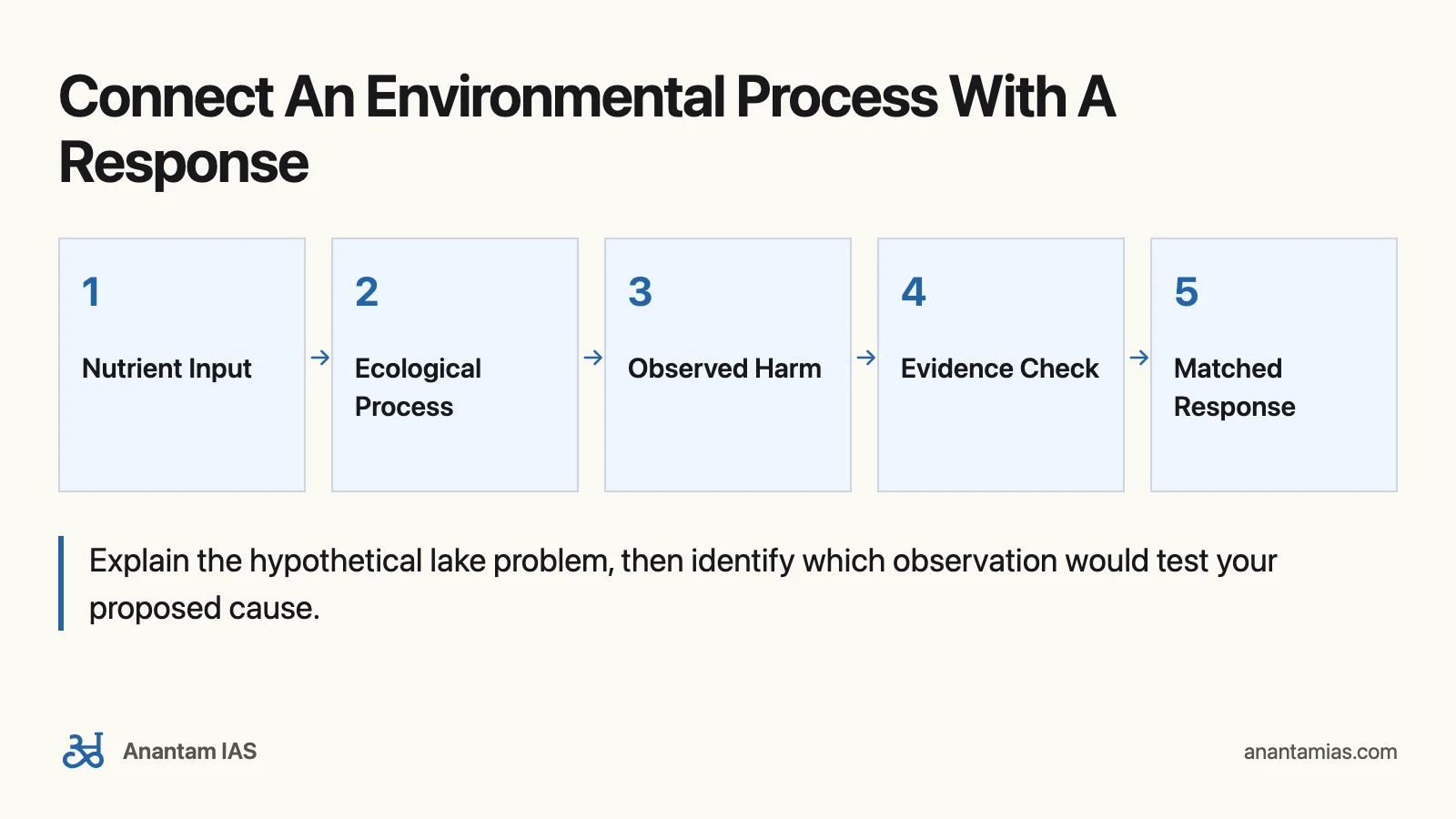
Suppose the lake receives fertilizer runoff and untreated sewage. Later, an algal bloom appears and fish deaths are reported. The first weak answer is “algae poisoned the fish.” That’s a possible claim needing evidence, not a complete explanation.
Build the reasoning step by step:
- Input: runoff and sewage can add nutrients, especially nitrogen and phosphorus.
- Growth: excessive nutrient availability can promote algal growth.
- Breakdown: when organic material dies, decomposition can increase oxygen consumption.
- Effect: low dissolved oxygen can harm aquatic life. Some blooms also produce toxins, but toxicity should not be assumed for every bloom.
- Evidence boundary: fish deaths alone don’t establish nutrient pollution as the cause. Dissolved oxygen, nutrient levels and other possible contaminants need checking.
The US EPA explanation of nutrient pollution and low-oxygen waters supports the mechanism. We use it here for the scientific process, not for Indian legal standards.
A worked answer to “How should the lake be managed?” can follow the mechanism:
| Reasoning Step | Response | Why It Fits |
|---|---|---|
| Excess nutrients enter upstream | Improve sewage treatment and manage fertilizer runoff | Reduces the source of nutrient loading |
| Ecological effects develop in the lake | Monitor nutrients and dissolved oxygen | Tests whether the proposed mechanism matches conditions |
| Fish deaths or exposure create an immediate concern | Investigate the event and follow competent-authority advice | Avoids declaring water safe or unsafe from appearance alone |
| Several agencies influence the catchment | Coordinate catchment-level management | Lake effects can arise from activity outside the shoreline |
This gives you a complete answer card: nutrient input, ecological process, harm, evidence and response. It also prevents the mistake of calling every green lake a toxic lake.
Now close the book and redraw the causal chain. If you skip decomposition and go directly from nutrients to fish deaths, reread that missing link. That’s where understanding needs attention.
Use An Adjustable Thirty-Day Plan
Thirty days can provide structure for a selected first pass. It isn’t a guaranteed completion time or a reason to rush past weak concepts.
| Days | Focus | Output |
|---|---|---|
| 1 to 7 | Ecology and ecosystem processes | Explain core processes without notes |
| 8 to 14 | Biodiversity, habitats and conservation | Build species-habitat-threat-response cards |
| 15 to 21 | Pollution, climate and energy | Prepare mechanism and mitigation/adaptation cards |
| 22 to 25 | Governance and conventions | Connect each instrument with its purpose |
| 26 to 30 | Mixed revision, PYQs and current updates | Repair errors and write two mechanism-based answers |
A 40-minute session can contain 20 minutes of reading, 10 minutes of closed-book recall and 10 minutes of questions or answer practice. With less time, complete one concept card. Don’t compress a whole topic into a hurried final session just to keep the calendar intact.
Use genuine PYQs from a verified question source. The lake exercise above is original practice and should stay labeled that way.
Maintain A Small Update Sheet
A textbook provides a foundation. Policies, reports and environmental designations still need fresh verification when you use them in an answer.
| Concept | Convention Or Rule | Current Development | Source And Date | What Changes In My Answer? |
|---|---|---|---|---|
| Your stable concept | Relevant instrument, if any | One checked development | Authority and reference date | One precise addition or correction |
Choose the authority for the claim:
- MoEFCC or the relevant official legal text for Indian environmental provisions.
- CPCB for its monitoring or pollution information.
- The convention’s own secretariat for treaty information.
- The original report publisher for a report’s findings and definitions.
Keep publisher claims about completeness or exam success separate from your decision. Their promotional description doesn’t prove that the book eliminates every need for another source. The next useful step is smaller: preview one process, explain it without notes and decide whether this book makes that explanation clearer.
Frequently Asked Questions
Which PMF IAS Environment edition is currently described officially?
The book page labels the printed edition 2026-27. The official digital product page calls the PDF the Fourth Edition, released in March 2026, and names Manjunath Thamminidi as author.
Is an authorized PMF IAS Environment PDF available?
Yes. The official digital product page offers a PDF. It describes 1-year download access and related resources during the subscription period.
Do print purchasers have to buy the PDF separately?
The official digital page says book purchasers can obtain the PDF product through instructions in the inner cover. Check the terms and redeemability of your own copy before paying separately.
Are printed and PDF page numbers interchangeable?
No. PMF IAS says the content is the same but layout and page totals can differ. Use topic names to transfer your reading plan.
Should I study PMF IAS and Shankar IAS together?
Usually choose one core source. If another book already supports clear notes and question practice, switch only to address a specific unresolved gap.
Does every algal bloom prove toxic pollution?
No. Some blooms produce toxins, while low oxygen can harm aquatic life through another mechanism. The hypothetical lake exercise requires evidence before assigning a cause.