Disclosure: this guide contains Amazon affiliate links. As an Amazon Associate, Anantam IAS earns from qualifying purchases — at no extra cost to you.
Environment is the one subject where aspirants buy the most books and read the least of any of them. You’ll see a shelf with Shankar IAS, PMF IAS, two NCERTs, and a fat reference no one has opened past page 40. The result isn’t depth, it’s a pile of overlapping coverage that nobody has the time to revise twice before Prelims.
This list fixes that. For each of the five best environment books for UPSC, you’ll get a clear stance: who it suits, exactly what to read in it, what to skip, and honestly when not to buy it. Environment carries 15 to 20 Prelims questions most years and feeds straight into GS Paper 3, so the goal isn’t owning more books. It’s owning the right one and revising it until it’s boring.
How many environment books do you actually need?
One core book plus the NCERT ecology unit. That’s the honest answer, and it trips up everyone who walks into a bookstore expecting a syllabus’s worth of titles. Environment for UPSC is wide but shallow: it rewards a single, well-revised compilation far more than three half-read references.
Pick one primary compilation (Shankar IAS or PMF IAS, not both), read the Class 12 Biology ecology chapters as your foundation, and stop there until you’ve revised that core twice. A second reference only earns its place if you’re targeting environment-heavy Mains answers or you find the core book too thin on conventions and case studies. Everything beyond that is shelf decoration. If your Prelims booklist already feels crowded, this is the subject to keep lean.
Shankar IAS Environment: the default core book
If you buy only one environment book, buy this one. Shankar IAS Environment is the closest thing to a default in the entire UPSC ecosystem, and the reason is simple: it maps almost one-to-one onto how Prelims actually tests the subject. At roughly 505 pages it’s compact enough to revise in two or three sittings, which matters more than any single feature.
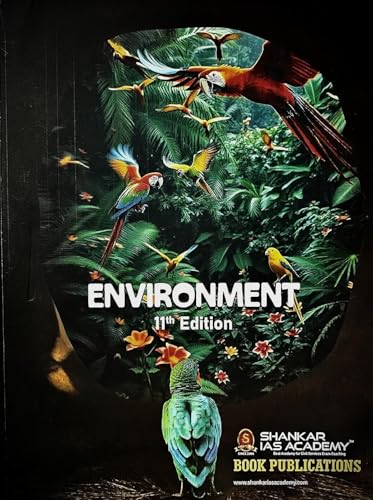
Environment — Shankar IAS Academy (11th Edition)
- 505 pages covering ecology, biodiversity and climate change
- Organised around the environment questions Prelims actually asks
- Updated for current conventions and protected-area listings
Read the chapters on biodiversity, protected areas, climate change conventions, and environmental organizations closely. These are the highest-yield sections and the source of most directly lifted Prelims questions. The lists of National Parks, Biosphere Reserves, and Ramsar sites are tedious but they get tested verbatim, so don’t skim them.
What to skip: the species-by-species pages of the IUCN appendices on a first read; come back to those in your second revision. Don’t skip the pollution chapters, though. Pollution is the single most-asked environment topic in Prelims, with 43 questions in our environment PYQ analysis, and most of them test what a pollutant is and what it does. The honest weakness is that the Shankar IAS Academy book is a compilation, not a textbook, so its explanations can feel like bullet points stitched together. If you want the reasoning behind a concept, you’ll fill that gap from the NCERT below.
PMF IAS Environment for Civil Services: the structured alternative
Buy this instead of Shankar IAS if you learn better from explanation than from lists. Environment for Civil Services by PMF IAS runs about 590 pages and trades some of Shankar’s brevity for genuinely clearer build-up of concepts, especially in ecology, biogeochemical cycles, and pollution.
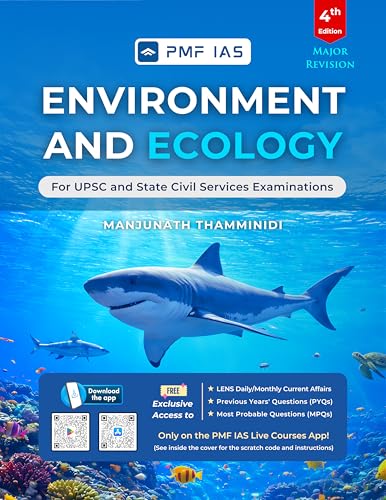
PMF IAS Environment for Civil Services
- 590 pages, more structured than Shankar IAS
- Diagram-heavy treatment of ecology and climate systems
- Clear separation of Prelims facts from Mains argument
The strength of PMF IAS is that it teaches before it lists. The diagrams and the way it sequences food chains, energy flow, and nutrient cycling are noticeably better for someone with no science background. Read the foundational ecology chapters here even if your core book is Shankar, because this is where conceptual confusion gets resolved.
The catch is the obvious one: it overlaps heavily with Shankar IAS. Owning both and reading both cover-to-cover is exactly the trap this article warns against. Pick one as your spine. The other becomes a reference you dip into for a confusing topic, nothing more. Don’t buy this if you’ve already revised Shankar twice and feel solid, you’d be paying for redundancy.
NCERT Class 12 Biology: the foundation everyone skips
Read the four ecology chapters before you open any compilation. The NCERT Class 12 Biology textbook ends with a unit on ecology and environment that does something no coaching compilation does well: it explains the why behind populations, ecosystems, biodiversity, and conservation. That foundation makes everything in Shankar or PMF click instead of feeling memorized.
You don’t need the whole 227-page book. Read only the last unit: the chapters on Organisms and Populations, Ecosystem, Biodiversity and Conservation, and Environmental Issues. That’s roughly 50 to 60 pages and it’s the cheapest, highest-return reading on this entire list. This is where the conceptual confidence comes from, and it’s exactly what people skip because it feels too basic. It isn’t.
When not to over-invest: don’t read the genetics, biotechnology, or human-physiology units for environment prep. They’re useful general knowledge but they aren’t where this subject gets tested. Stick to the ecology unit and move on. One quiet payoff is terminology: terms like ecological pyramid, trophic level, and ecological succession show up in Prelims worded exactly as the NCERT defines them, so reading it once saves you from second-guessing options later.
Rajagopalan’s Environmental Studies: From Crisis to Cure
Pick this up only if you want Mains depth and a more analytical lens. Environmental Studies: From Crisis to Cure by R. Rajagopalan is a proper textbook, around 400 pages, written with the structure and argument that a compilation lacks. It’s the book to reach for when you want to write a GS Paper 3 answer that reasons rather than recites.
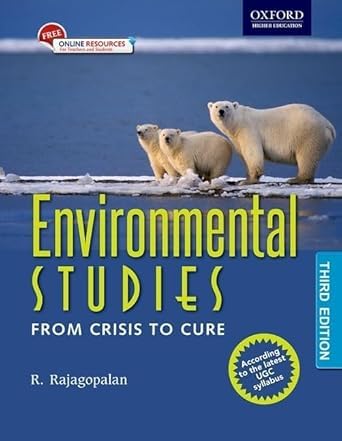
Environmental Studies: From Crisis to Cure — R. Rajagopalan
- 400 pages, university-level environmental studies
- Strong on policy, pollution and sustainability debates
- Useful for Mains argument rather than Prelims recall
Its value sits in the chapters on sustainable development, environmental governance, and the policy-versus-ecology tension. Rajagopalan connects causes to consequences, which is exactly the framing examiners reward in answer writing. If you’re using a structured approach to Mains preparation, this is a strong supplement.
Be clear-eyed though: this is a supplement, not a core book. It’s not optimized for the rapid factual recall Prelims demands, and reading it before you’ve locked down a compilation is putting depth before coverage. Skip it entirely if you’re a first-attempt aspirant still building your factual base.
Majid Husain’s Environment and Ecology: the heavy reference
This is the most comprehensive book on the list, and that’s both its strength and its warning. Environment and Ecology by Majid Husain runs about 652 pages, the heaviest title here, and it covers the syllabus with a breadth that no compilation matches.
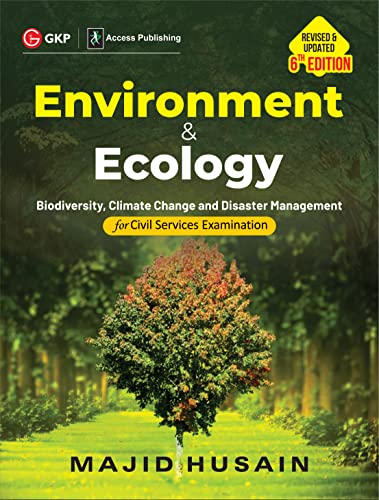
Environment & Ecology for Civil Services — Majid Husain (6th Edition)
- 652 pages, the heaviest environment reference on this list
- Detailed treatment of ecosystems and environmental governance
- Overkill for most candidates
If you have a specific gap (say, the detail on environmental conventions, treaties, or pollution control mechanisms), Majid Husain usually has the most thorough treatment. Use it as an encyclopedia: go in for a topic, get what you need, come out. The sections on international environmental agreements are particularly strong for Mains case-building.
The honest stance: most aspirants should not read this cover-to-cover, and many shouldn’t buy it at all. Its breadth becomes a liability when revision time runs short, and that’s the whole secret with environment, the book you can revise three times beats the book that’s complete but unread. Buy it only if you’re an environment optional candidate or you genuinely enjoy depth and have the months to use it. For everyone else, the topics on environmental laws in India and environment impact assessment are better learned from focused notes than from a 652-page reference.
Environment books for UPSC compared
| Book | Author | Best for / Notes |
|---|---|---|
| Environment | Shankar IAS Academy | The default core book. Compact (~505 pages), maps onto Prelims, best for fast revision. |
| Environment for Civil Services | PMF IAS | Structured alternative to Shankar (~590 pages). Better explanations for non-science aspirants. |
| NCERT Class 12 Biology (ecology unit) | NCERT | The foundation. Read only the last unit (~50-60 pages) before any compilation. |
| Environmental Studies: From Crisis to Cure | R. Rajagopalan | Mains depth supplement (~400 pages). Analytical, good for GS3 answer reasoning. |
| Environment and Ecology | Majid Husain | Heavy reference (~652 pages). Encyclopedia for gaps; optional candidates only. |
How to use this list (reading order)
Read in this order, and stop the moment you’re solid rather than collecting more books. The sequence matters because foundation before compilation before reference is what stops environment from becoming a memorization slog.
- NCERT Class 12 Biology, ecology unit only. 50 to 60 pages. Build the conceptual base first.
- One core compilation: Shankar IAS or PMF IAS. Pick by learning style (lists vs explanation). Read it once, slowly.
- Revise the core book twice. This is the step everyone skips and the one that actually moves your score.
- Add Rajagopalan only for Mains depth, once your factual base is locked.
- Use Majid Husain as a lookup, never as a primary read, unless environment is your optional.
Pair each revision with the last five years of Prelims environment questions. You’ll notice the same protected areas, conventions, and species names recur, which tells you exactly where to concentrate. Don’t wait until you’ve finished reading to start solving, give yourself permission to revise and test in parallel.
The bottom line
For most aspirants the right shelf is two books: the NCERT ecology unit plus one of Shankar IAS or PMF IAS, revised until it’s dull. Add Rajagopalan if you want Mains depth and keep Majid Husain for lookups. The candidate who revises a lean list three times will out-score the one who owns all five and finished none. That’s the whole game with environment, and it’s worth getting right early.
Frequently Asked Questions
Which is the best book for environment for UPSC?
Shankar IAS Environment is the default best book for most aspirants because it is compact (around 505 pages), maps closely onto how Prelims tests the subject, and revises fast. PMF IAS Environment for Civil Services is an equally strong alternative if you prefer explanation over lists. Pick one as your core, not both.
Is Shankar IAS or PMF IAS better for environment?
Both cover the syllabus well and overlap heavily. Shankar IAS is more compact and list-driven, ideal for fast revision. PMF IAS is more structured and explains concepts better, which helps aspirants without a science background. Choose by learning style and use only one as your primary book.
Is NCERT enough for environment in UPSC?
NCERT alone is not enough, but the Class 12 Biology ecology unit is an essential foundation. Read its chapters on populations, ecosystems, biodiversity, and environmental issues before any compilation. Then pair it with one core book like Shankar IAS or PMF IAS for full coverage.
How many environment books do I need for UPSC?
Two are enough for most aspirants: the NCERT Class 12 Biology ecology unit plus one compilation (Shankar IAS or PMF IAS). Add Rajagopalan only for Mains depth and use Majid Husain as a reference. Revising a lean list twice beats owning five unread books.
How many questions come from environment in UPSC Prelims?
Environment and ecology typically account for 15 to 20 questions in UPSC Prelims, making it one of the highest-yield sections. It also feeds GS Paper 3 in Mains. This high weight is why a single well-revised book matters more than wide reading.
Do I need Majid Husain’s Environment and Ecology for UPSC?
Most aspirants do not. Majid Husain’s Environment and Ecology is a comprehensive 652-page reference best used as a lookup for specific gaps like conventions and treaties. Read it cover-to-cover only if environment is your optional subject or you have ample time.
Tell Google you want more of this.
Add Anantam IAS as a preferred sourceOne tap, and this site shows up more often in your own Top Stories, AI Overviews and AI Mode. Remove it any time.