Polycrisis and Permacrisis: A World of Cascading, Interlocking Shocks (UPSC GS2/GS3)
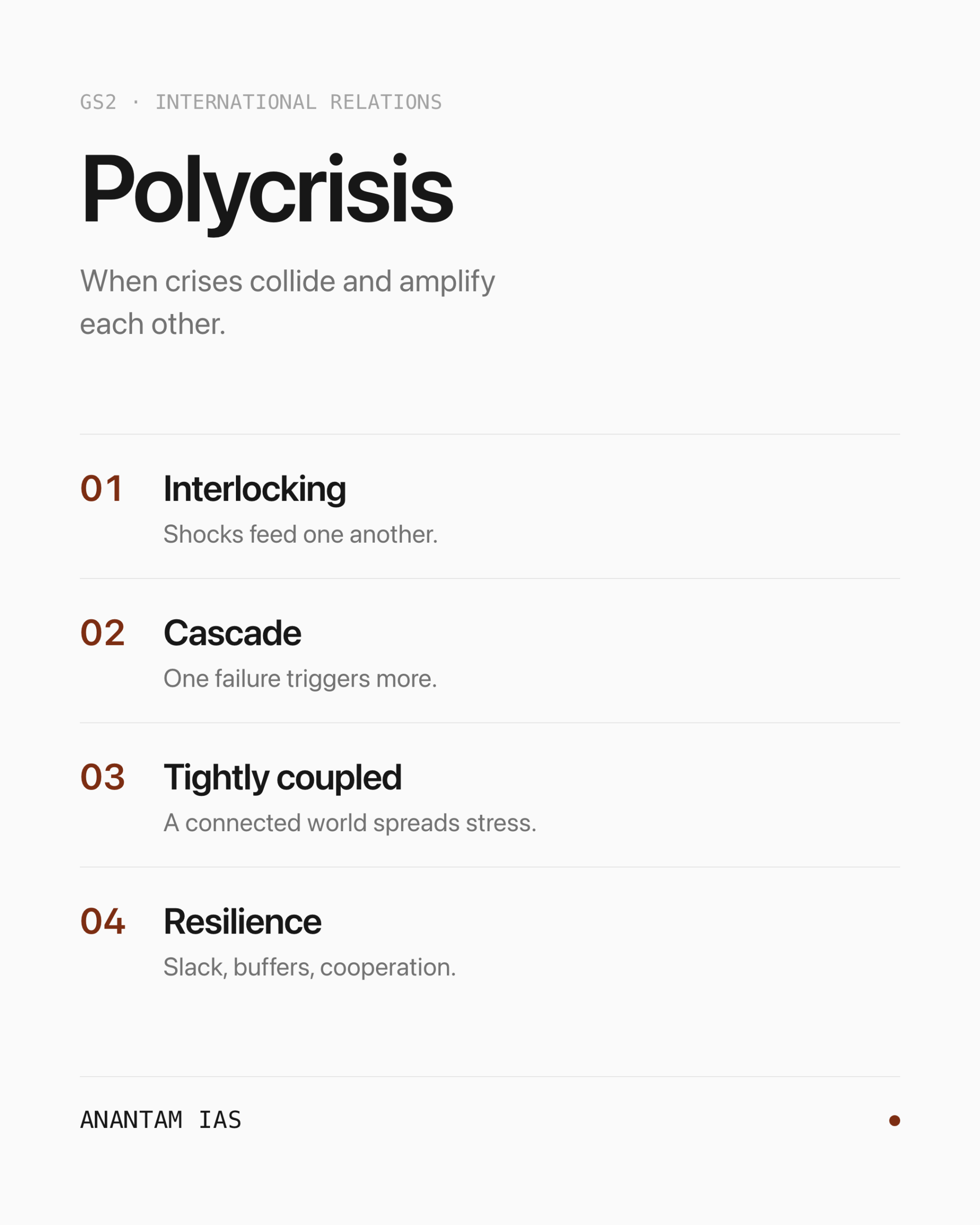
A polycrisis is several distinct crises hitting at once and feeding each other, so the whole is worse than the sum of its parts. Permacrisis is the exhausting period of instability that follows. Here is the full picture — the origin, the mechanics of cascading risk, the global debate and the India angle — explained for UPSC GS2 and GS3.
For about three years the world felt like it was lurching from one emergency straight into the next, with no breathing room in between. A pandemic shut down the planet. Before the recovery had found its feet, Russia invaded Ukraine and sent the price of wheat, fertiliser, oil and gas through the roof. Inflation roared back to levels not seen in forty years, central banks slammed on the brakes with the steepest rate hikes in a generation, and poorer countries that had borrowed heavily during the pandemic suddenly found their debt unpayable. And behind all of it, the climate kept breaking records — heatwaves, floods and droughts that made food even scarcer. None of these was a freak accident on its own. What made the moment frightening was that they all arrived together and fed on each other. That tangle has a name now: polycrisis.
The word is having a real moment, and not only at Davos. It captures something an ordinary news bulletin misses — that a war, a price shock, a debt squeeze and a heatwave are not separate stories but threads of one knot, each pulling the others tighter. For a UPSC aspirant this is gold, because it sits exactly where GS2 and GS3 overlap: international relations and global governance on one side, the economy, energy, food and environment on the other. Learn to explain the polycrisis well and you have a single, flexible frame that fits questions on global risk, the reform of multilateral institutions, energy and food security, and India’s place in a more dangerous world. So let’s build that frame carefully — what the word means, where it came from, why a hyper-connected world makes it worse, and what it asks of India.
What Polycrisis Actually Means
Start with a clean definition, because the value of the word lies in its precision. A polycrisis is a situation in which several distinct crises — say, a pandemic, a war, an energy shock and a debt crunch — happen at the same time and interact, so the combined damage is worse than the sum of the parts. That last clause is the whole point. A polycrisis isn’t just a long list of bad things piling up at once. It’s bad things that amplify each other, where the harm done together is greater than what each would do alone. The Cascade Institute, a research group that has tried to pin the idea down, describes it as a set of crises that are “causally entangled” — meaning they cannot be fully understood, or solved, in isolation from one another.
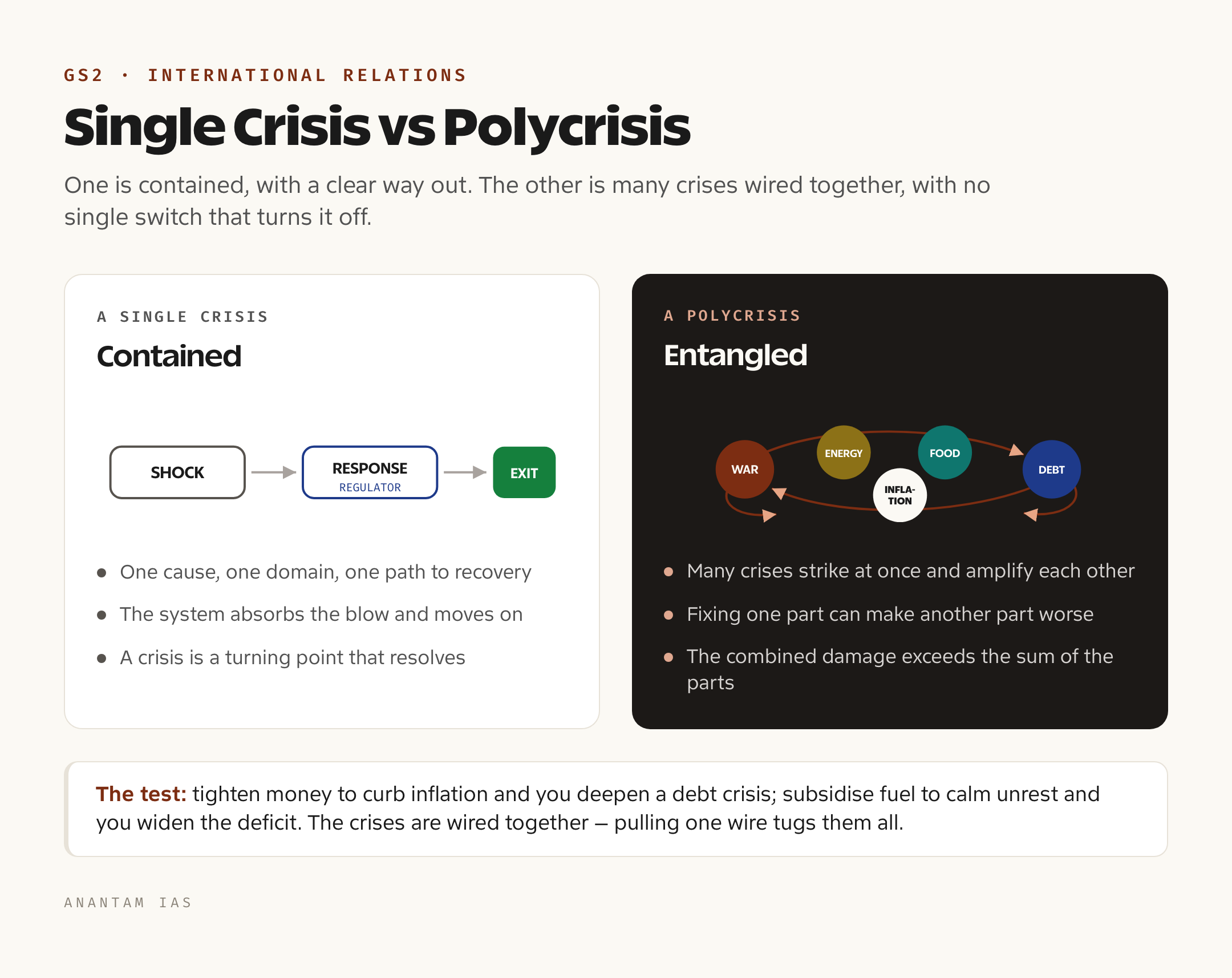
Picture the difference with a simple test. A single crisis, however severe, is contained: one cause, one domain, one broadly understood path to recovery. A bank fails, a regulator steps in, the system absorbs the blow. A polycrisis breaks that containment. The pandemic disrupts supply chains, which pushes up prices, which forces interest rates higher, which makes poor countries’ debts unpayable, which forces them to cut food and fuel subsidies, which sparks unrest — and meanwhile a drought has already thinned the harvest. Each link makes the next one worse, and the feedback runs in loops rather than straight lines. So you can’t fix one piece while ignoring the rest. Tighten money to kill inflation and you deepen the debt crisis. Subsidise fuel to calm the streets and you widen the deficit. The crises are wired together, and pulling one wire tugs all of them.
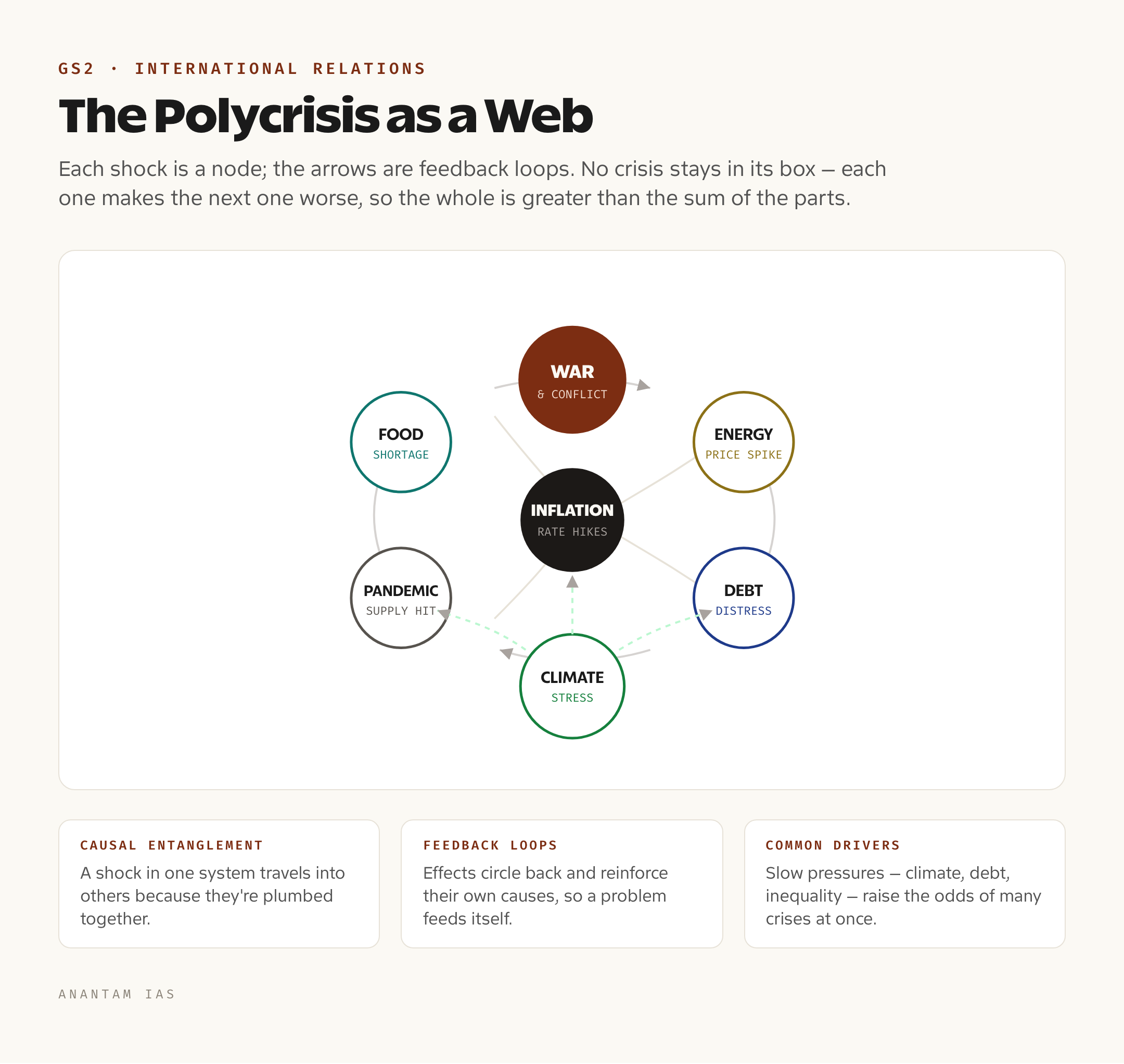
This is why analysts reach for the language of systemic risk — risk that lives not in any single part but in the connections between parts. Three ideas do most of the work here. The first is causal entanglement: a shock in one system, like energy, travels into others, like food and finance, because they’re plumbed together. The second is feedback loops: effects circle back and reinforce their own causes, so a problem feeds itself instead of fading. The third is common drivers: deeper, slow-moving pressures — climate change, debt, inequality, the brittleness of just-in-time global supply chains — that quietly raise the odds of many crises at once. Get those three terms into an answer and you’ve shown you understand the mechanism, not just the mood. And the mechanism is what separates a real concept from a headline.
Where the Word Came From: Morin, Juncker, Tooze and Davos
The idea is older than the buzz, which is worth knowing if you want to sound informed rather than trendy. The term was coined in the early 1990s by the French philosopher and sociologist Edgar Morin, who, working in the tradition of complexity and systems thinking, argued that the modern world’s problems — ecological, economic, social, cultural — are so interwoven that treating them one at a time misses the picture. For two decades the word sat quietly in academic corners. Then European politics gave it a second life. Jean-Claude Juncker, as President of the European Commission around 2015 and 2016, used “polycrisis” to describe the experience of trying to govern Europe while the Greek debt drama, Russia’s first aggression against Ukraine, Brexit and a refugee emergency all unfolded at once.
What pushed the word from a European in-joke to a global keyword was the economic historian Adam Tooze, who began writing about the polycrisis as the pandemic gave way to the war in Ukraine, and who took the idea to the main stage of the World Economic Forum at Davos in 2023. As Tooze has been careful to say, he didn’t invent the term — he borrowed Morin’s idea, by way of Juncker — but he gave it the analytical sharpness that made it stick. His point is that the post-2020 world isn’t living through one crisis after another so much as one condition in which crises are permanently entangled. Once Davos adopted the language, it spread fast, and the World Economic Forum’s annual Global Risks Report became its most visible home. So the word arrived with real intellectual weight behind it — a complexity theorist’s insight, road-tested by a European statesman, then sharpened by a historian for a world that had just lived through the very thing it described.
How a Hyper-Connected World Turns Shocks Into Cascades
So why does our particular era seem so prone to these cascades? The honest answer is connection itself. A modern economy is hyper-connected and tightly coupled — a phrase engineers use for systems where the parts are linked so closely, with so little slack, that a failure in one races straight into the next before anyone can isolate it. Just-in-time supply chains hold almost no spare inventory, so a single closed port or grounded factory ripples worldwide within days. Finance moves at the speed of a keystroke, so a wobble in one market is priced into every other before lunch. Energy, food and fertiliser trade globally, so a war on the Black Sea coast raises the price of bread in Cairo and Karachi. The same wiring that makes the world efficient in good times makes it fragile in bad ones — efficiency and resilience pull in opposite directions, and for decades the world bought efficiency. Layer onto that the slow common drivers — a warming climate, a mountain of debt built up over years of cheap money, deep inequality, and political polarisation that makes cooperation harder — and you have a system primed to convert any single shock into a chain reaction.
The 2020-2023 stretch is the textbook case, and it pays to be able to narrate it as a chain. COVID-19 froze production and snarled supply lines. Governments spent enormously to cushion the blow, and central banks held rates near zero, so debt swelled everywhere — by the time the war began, the UN was warning that more than fifty developing economies were in or near debt distress. Then the invasion of Ukraine struck the seams of the world economy directly, hitting food, energy and finance at once, since Russia and Ukraine together are giants in wheat, sunflower oil, gas and fertiliser. Prices spiked, inflation hit roughly twice its pre-pandemic average, and to fight it central banks raised rates at the fastest pace in decades — which made the dollar surge and pushed those already-fragile debtor nations toward the edge. The UN estimated that 1.7 billion people across more than a hundred countries were exposed to at least one of the food, energy or finance shocks, and the World Bank later described the whole episode as the start of a “lost decade” for poverty reduction. One pandemic, set against a backdrop of climate stress and a wall of debt, had cascaded into a war-driven cost-of-living emergency on every continent. That is a polycrisis in motion.
Permacrisis: When the Emergency Never Ends
If polycrisis describes how crises interlock, permacrisis describes how that feels to live through — and it captured the public mood so well that Collins Dictionary made it the word of the year for 2022. Collins defines permacrisis as “an extended period of instability and insecurity, especially one resulting from a series of catastrophic events.” It’s a blend of “permanent” and “crisis,” and the dictionary’s editors chose it precisely because it named the dizzying sense of lurching from one unprecedented event to the next with no return to anything like normal. Where a crisis is, by its old definition, a turning point that resolves one way or the other, a permacrisis is the unsettling experience of a crisis that won’t resolve — the emergency that becomes the weather.
The two words are cousins, and an exam answer that distinguishes them cleanly will read well. Polycrisis is structural: it’s about how many crises are wired together and amplify one another. Permacrisis is temporal and psychological: it’s about how long the turbulence lasts and how it wears on societies, governments and ordinary people. Collins picked permacrisis in the same season when its compilers noted that “crisis” itself had become one of the most-used words of the year — the cost-of-living crisis, the energy crisis, the climate crisis, the political crisis all jostling in the same headlines. The danger of the permacrisis, as commentators warned, is crisis fatigue: when every month brings a fresh emergency, attention frays, outrage dulls, and the long, patient work of fixing the deeper drivers gets crowded out by the scramble to survive the latest shock. So the two ideas belong together. The polycrisis explains why the shocks keep colliding; the permacrisis explains why it feels like they’ll never stop.
The WEF Framing, the Critics, and What India Should Take From It
The most institutionalised version of this thinking is the World Economic Forum’s Global Risks Report, an annual survey of hundreds of experts across business, government, academia and civil society that has become a fixed reference in policy circles. Its recent editions read like a field guide to the polycrisis. In the near term the survey has repeatedly put geopolitical and geoeconomic confrontation, state-based armed conflict, and misinformation and disinformation at the top of the worry list. Over a ten-year horizon, environmental risks dominate — extreme weather, biodiversity loss and irreversible changes to the planet’s systems. And the report’s signature insight is that these categories don’t sit in separate boxes: geopolitical, societal, environmental and technological risks converge and reinforce one another, with societal polarisation, for instance, feeding misinformation, inequality and unrest in a self-tightening loop. The WEF’s worry is blunt — a true polycrisis can overwhelm the capacity of institutions to respond, producing cascading failures faster than any government can patch them.
Not everyone is sold on the word, and a good answer should say so. Critics argue that “polycrisis” is too vague to be useful — that calling everything a polycrisis can become an excuse to throw up your hands, a way of saying the world is simply too complicated to govern, which lets leaders off the hook for specific failures. Some on the left have gone further, asking whose polycrisis this really is. For much of the Global South, they point out, perpetual crisis is not a shocking new condition that arrived in 2020 but the ordinary texture of life — debt, famine, conflict and climate stress have been constants for decades, not novelties. To frame the polycrisis as a sudden Western awakening, in this view, centres rich-world anxieties and erases the long experience of poorer nations. There’s a sharper edge to the critique too: that the language can be used to justify the same old prescriptions — more loans, more austerity for indebted countries — while ducking the structural reform of a global financial system that keeps those countries vulnerable in the first place.
That last point is where India and the wider Global South have a real stake, and it gives the topic its policy bite. India sits squarely in the blast radius of the polycrisis — a large net importer of oil and fertiliser, deeply exposed to climate shocks across farming and water, and reliant on a global trade and finance system it does not control. When energy prices spike or the dollar surges, the costs land hard on Indian households and the current account. So the case India has been making in forums like the G20 fits this analysis precisely: that the architecture of global governance and finance — built in 1945 and barely retuned since — is no longer fit to manage twenty-first-century, interlocking risk. The argument runs that the most exposed countries need cheaper finance, faster debt relief, and a real voice in the institutions that govern the world, rather than rules written for a calmer age. India’s framing of climate change as a development-and-equity question, not just an environmental one, lands the same way: in a polycrisis, you can’t ask a country to cut emissions while it’s also fighting food, fuel and debt shocks unless you help it build resilience across all of them at once. The deeper lesson for India, and the one worth ending an answer on, is that resilience now matters as much as growth — strategic reserves, diversified supply chains, domestic manufacturing of critical goods, and a reformed multilateralism are how a country stops being a passenger in someone else’s cascade.
For Your Mains Answer
This topic is unusually versatile, which is exactly why it rewards preparation. It maps cleanly onto GS Paper 2 — international relations, the role and reform of global groupings and institutions, and the effect of policies of developed countries on India’s interests — and onto GS Paper 3 — the economy, mobilisation of resources, energy and food security, and disaster and risk management. It’s also a ready-made frame for the Essay paper on themes of uncertainty, resilience and a connected world. The skill examiners reward is the one this article models: define the concept with precision, show the mechanism, fold in the critics, and bring it home to India with concrete policy stakes.
How to Build the Answer
Lead with the definition and the one line that carries it — many crises colliding, where the whole is worse than the sum of the parts. Then explain the mechanism in three named moves: causal entanglement, feedback loops, common drivers. Give the 2020-2023 cascade as your worked example, narrated as a chain rather than a list. Add the permacrisis distinction to show range. Bring in the WEF Global Risks Report for institutional weight, then the critics for balance, and close on India — import exposure, climate vulnerability, and the case for resilience and reformed global governance. That arc — define, mechanism, example, critique, India — fits almost any version of the question.
Common Mistakes to Avoid
Don’t treat polycrisis as a fancy synonym for “lots of problems” — the amplification, the worse-than-the-sum point, is the whole idea, and leaving it out costs marks. Don’t confuse polycrisis with permacrisis; one is about how crises interlock, the other about how long the instability lasts. Don’t present the WEF view as settled truth without noting the critics, especially the Global South critique. And don’t stop at the global picture — an answer that never reaches India’s specific exposure and policy response will read as borrowed, not owned.
A Compact Answer Spine
Polycrisis = several distinct crises colliding and amplifying each other, so combined harm > sum of parts → mechanism: causal entanglement + feedback loops + common drivers (climate, debt, inequality, tightly coupled supply chains) → example: COVID → debt build-up → Ukraine war hits food/energy/finance → inflation → fastest rate hikes in decades → debt distress for 50+ economies, 1.7 billion exposed, a “lost decade” for poverty → permacrisis = the extended instability that follows (Collins word of 2022) → WEF Global Risks Report frames converging risks → critics: too vague, Western-centric, “whose polycrisis?” → India: import-exposed and climate-vulnerable, so the case is resilience + reformed global governance.
Diagram or Flowchart Idea
Draw a small web: place pandemic, war, energy, food, inflation, debt and climate as nodes around a circle, then connect them with arrows showing how each feeds the next. Mark two or three loops to make the feedback visible. Beside it, a one-line contrast box — “single crisis: contained, one exit” versus “polycrisis: entangled, no single switch.” A web plus a contrast says the whole concept faster than a paragraph.
A Balanced-Conclusion Line
A line that lands the marks: “The polycrisis is less a prophecy of doom than a diagnosis — it tells us that in a tightly wired world, security comes not from fighting one fire at a time but from building resilience across all of them, and from a global order rewired for the risks of this century rather than the last.”
How to Use Data Without Cramming
You need only a handful of anchors, not a database: inflation at roughly twice its pre-pandemic average in 2022, more than fifty developing economies in or near debt distress, 1.7 billion people exposed to at least one of the food-energy-finance shocks, and the World Bank’s “lost decade” verdict on poverty. Attribute them plainly — “as the UN warned in 2022,” “the World Bank later described” — and they’ll read as authority rather than clutter.
Frequently Asked Questions
What is a polycrisis in simple terms?
A polycrisis is when several different crises — for example a pandemic, a war, an energy shock and a debt crunch — strike at the same time and feed off each other, so the combined damage is worse than what each would cause on its own. The key idea is amplification: the crises are causally entangled, so you can’t understand or fix one without dealing with the others. The 2020-2023 period, when COVID, the Ukraine war, inflation, debt and climate stress collided, is the standard example.
How is a polycrisis different from a single crisis?
A single crisis is contained — one cause, one domain, and a broadly understood path back to normal. A polycrisis breaks that containment: shocks travel across systems through feedback loops, so tackling one part can worsen another. Tighten money to curb inflation and you deepen a debt crisis; subsidise fuel to calm unrest and you widen the deficit. The crises are wired together, which is why the whole is greater than the sum of the parts.
What does permacrisis mean, and how is it linked to polycrisis?
Permacrisis, Collins Dictionary’s word of the year for 2022, means an extended period of instability and insecurity arising from a string of catastrophic events — a blend of “permanent” and “crisis.” Polycrisis describes the structure of how crises interlock and amplify; permacrisis describes the experience of that turbulence dragging on with no return to normal. One explains why the shocks collide, the other why it feels like they never stop.
Why does the polycrisis matter for India?
India is heavily exposed: it imports most of its oil and fertiliser, faces serious climate risks to farming and water, and depends on a global trade and finance system it doesn’t set the rules for. So energy spikes, a strong dollar or debt squeezes hit Indian households and the external account directly. That exposure underpins India’s case in forums like the G20 for cheaper finance, faster debt relief and reform of post-1945 global governance — and for building domestic resilience through reserves, diversified supply chains and self-reliant manufacturing.
Practice Questions
Prelims MCQs
- With reference to the concept of “polycrisis,” which statement is most accurate?
(a) It refers to any country experiencing more than one election crisis
(b) It refers to several distinct crises occurring together and amplifying each other so the combined effect exceeds the sum of the parts
(c) It refers to a single crisis that recurs every year
(d) It refers to a crisis confined entirely to the financial sector
Answer: (b) A polycrisis is defined by the interaction and amplification of distinct, simultaneous crises that are causally entangled. - The term “polycrisis” was originally coined by which thinker before being popularised in later decades?
(a) Adam Smith
(b) John Maynard Keynes
(c) Edgar Morin
(d) Amartya Sen
Answer: (c) The French philosopher and sociologist Edgar Morin coined the term in the early 1990s; it was later popularised by Jean-Claude Juncker and the historian Adam Tooze. - “Permacrisis,” named Collins Dictionary’s word of the year in 2022, is best described as which of the following?
(a) A blend of “permanent” and “crisis” denoting an extended period of instability
(b) A crisis affecting only the polar regions
(c) A permanent solution to recurring crises
(d) A type of financial derivative
Answer: (a) Permacrisis is a portmanteau of “permanent” and “crisis,” meaning an extended period of instability resulting from a series of catastrophic events. - Which annual publication is most closely associated with framing the world’s interconnected and cascading risks in terms of a polycrisis?
(a) The Human Development Report
(b) The World Economic Forum’s Global Risks Report
(c) The World Bank’s Doing Business Report
(d) The IMF’s World Economic Outlook only
Answer: (b) The World Economic Forum’s Global Risks Report surveys experts on converging geopolitical, environmental, societal and technological risks. - In the analysis of a polycrisis, the term “tightly coupled” system refers to which of the following?
(a) A system where parts are so closely linked, with little slack, that a failure in one rapidly spreads to others
(b) A system held together by international treaties
(c) A currency union of neighbouring states
(d) A supply chain that holds large buffer stocks
Answer: (a) Tight coupling means low slack between linked parts, so a shock races through the system before it can be isolated, turning single shocks into cascades.
Mains Practice Questions
- Explain the concept of a “polycrisis.” How does it differ from a single crisis, and what mechanisms cause distinct crises to amplify one another? (15 marks, 250 words)
- “The same connectivity that makes the global economy efficient also makes it fragile.” Critically examine this statement in the context of cascading global risks and the polycrisis. (15 marks, 250 words)
- Distinguish between “polycrisis” and “permacrisis.” Using the 2020-2023 period as an example, illustrate how interlocking crises produced a prolonged condition of instability. (15 marks, 250 words)
- The concept of polycrisis has been criticised as too vague and Western-centric. Evaluate these criticisms, particularly the Global South perspective on perpetual crisis. (10 marks, 150 words)
- Discuss India’s vulnerability to the global polycrisis and assess how resilience-building and the reform of global governance can reduce that exposure. (15 marks, 250 words)