Pravasi Bharatiya Divas: Significance, History, and UPSC Relevance
Pravasi Bharatiya Divas marks Gandhi's return from South Africa on 9 January 1915 and honours the Indian diaspora. A complete UPSC guide.
Pravasi Bharatiya Divas (PBD) is observed every year on 9 January to mark the contribution of the overseas Indian community to the development of India. The date commemorates the return of Mahatma Gandhi from South Africa to Mumbai on 9 January 1915 — widely regarded as the moment the Indian freedom movement acquired its most influential leader. Since its inception in 2003, PBD has become the flagship event of the Ministry of External Affairs (MEA) for engaging with the Indian diaspora, now estimated at over 32 million across 200+ countries and the single largest in the world.
Origin and Evolution of Pravasi Bharatiya Divas
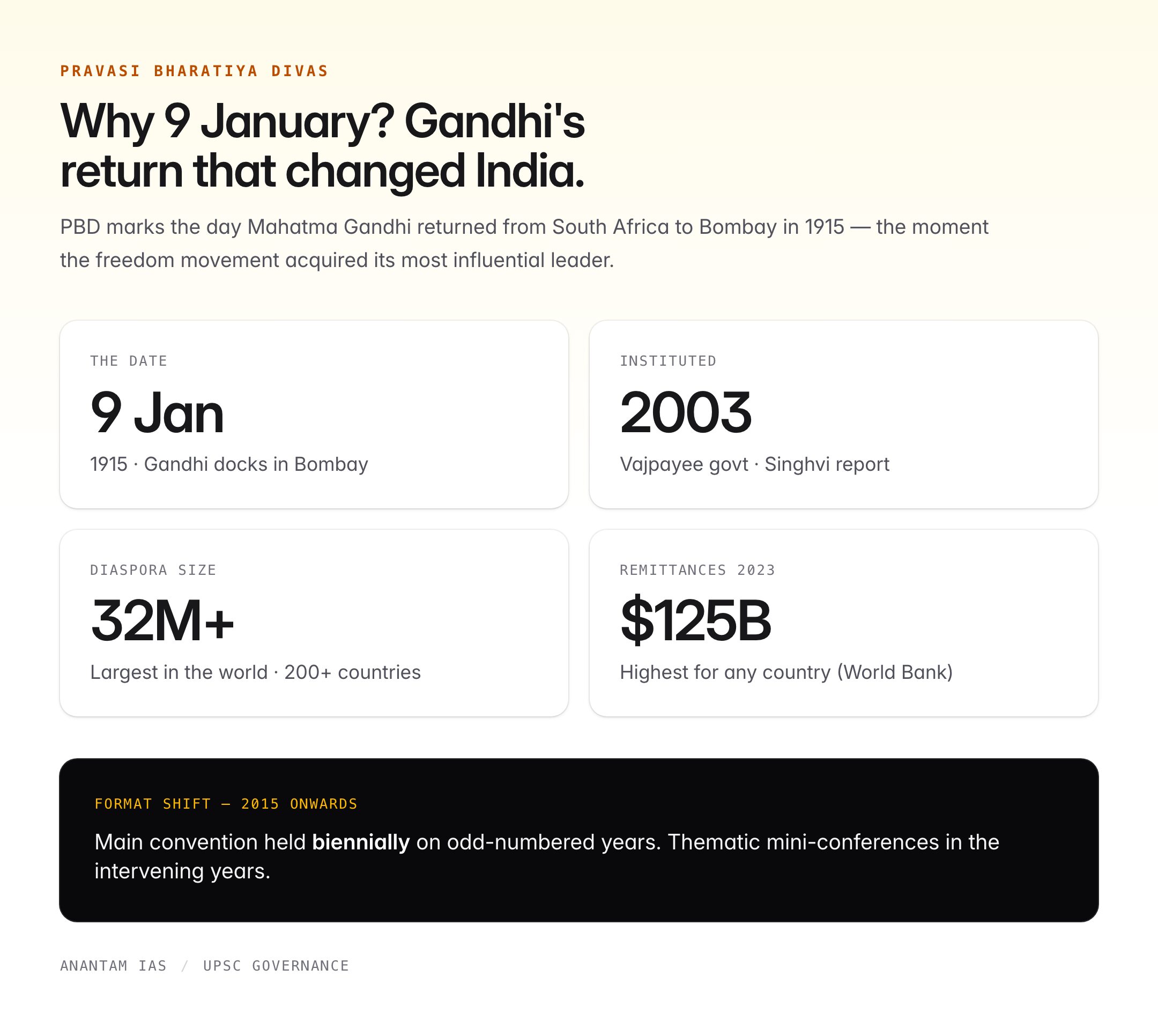
The idea of a dedicated day for non-resident Indians emerged from the L.M. Singhvi High-Level Committee on the Indian Diaspora (2000), which submitted its report in January 2002. The committee recommended structured engagement with people of Indian origin, legal reforms (including Overseas Citizenship of India), and an annual convention. Acting on these recommendations, the Atal Bihari Vajpayee government instituted PBD in 2003.
The first convention was held in New Delhi on 9 January 2003 with former Mauritius Prime Minister Sir Anerood Jugnauth as chief guest. From 2015, the format was revised: the main convention is now held biennially (every two years) on odd-numbered years, while thematic or regional mini-conferences (PBD Conferences) are organised in the intervening period.
| PBD Edition | Year | Host City | Chief Guest |
|---|---|---|---|
| 1st | 2003 | New Delhi | Sir Anerood Jugnauth (Mauritius) |
| 9th | 2011 | New Delhi | Kamla Persad-Bissessar (Trinidad & Tobago) |
| 14th | 2017 | Bengaluru | Antonio Costa (Portugal) |
| 15th | 2019 | Varanasi | Pravind Jugnauth (Mauritius) |
| 16th | 2021 | Virtual | Chandrikapersad Santokhi (Suriname) |
| 17th | 2023 | Indore | Mohamed Irfaan Ali (Guyana) |
| 18th | 2025 | Bhubaneswar | Christine Carla Kangaloo (Trinidad & Tobago) |
Objectives of Pravasi Bharatiya Divas
The conventions pursue a cluster of objectives that balance emotional connect with strategic gain:
- Strengthen diaspora engagement with the Indian state and with each other.
- Showcase investment, skill, and knowledge opportunities in India.
- Resolve grievances of overseas Indians, particularly migrant workers in the Gulf.
- Honour outstanding contributions of the diaspora through the Pravasi Bharatiya Samman Award.
- Build a global network of people of Indian origin (PIO) to act as India's soft-power ambassadors.
Every convention revolves around a theme. Recent themes have included "Role of Indian Diaspora in Building an Inclusive and Developed India" (2023) and "Diaspora's Contribution to a Viksit Bharat" (2025), linking PBD to the Viksit Bharat @2047 vision.
Pravasi Bharatiya Samman Award (PBSA)
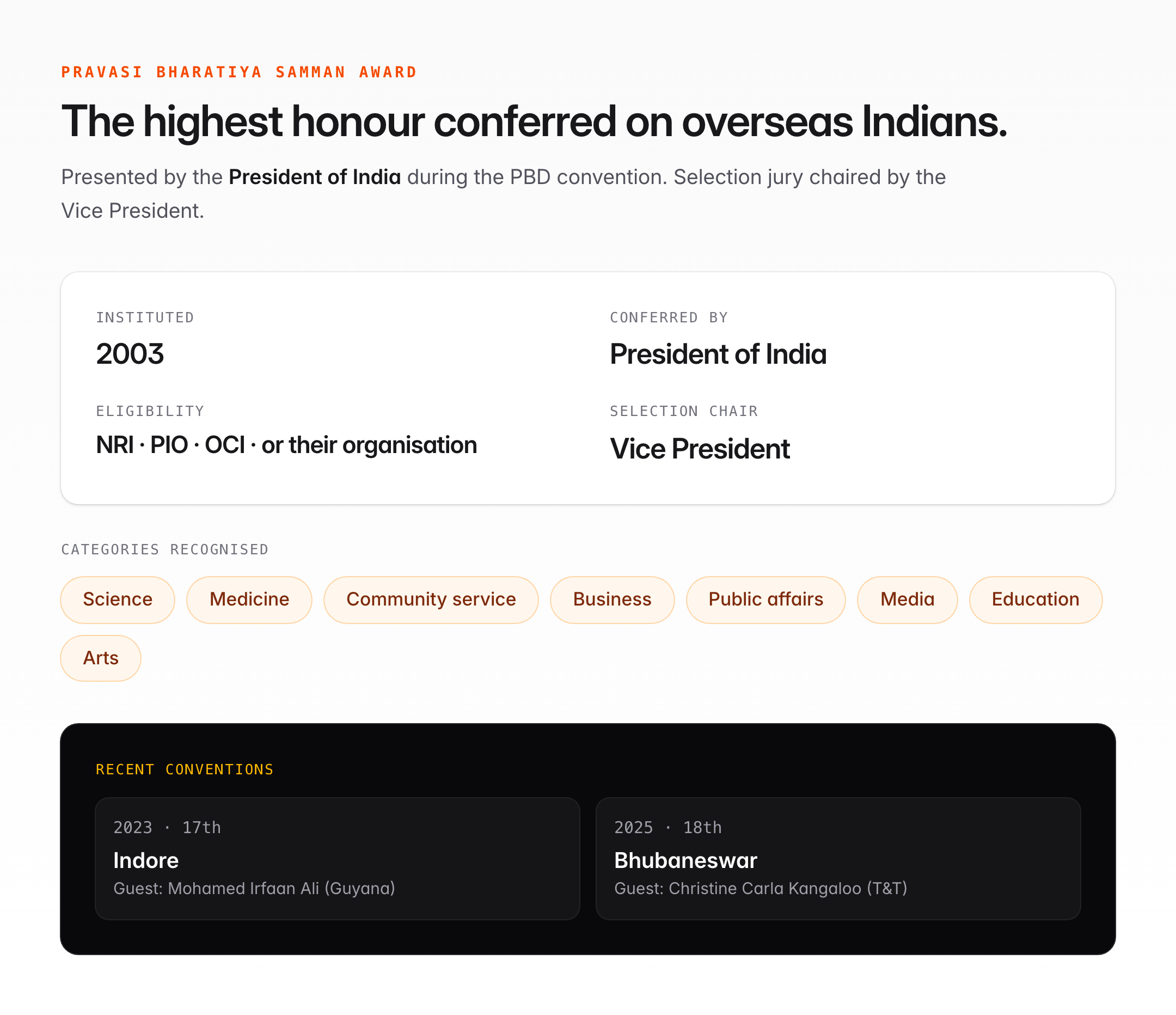
The Pravasi Bharatiya Samman Award is the highest honour conferred on overseas Indians. It is presented by the President of India during the PBD convention. The award recognises exceptional and meritorious contribution in fields such as public service, community welfare, philanthropy, science, technology, arts, and the promotion of India’s image abroad.
| PBSA Feature | Detail |
|---|---|
| Instituted | 2003 |
| Conferred by | President of India |
| Eligibility | NRI, PIO, OCI, or organisation run by them |
| Categories | Science, medicine, community service, business, public affairs, media, education, arts |
| Selection authority | Jury chaired by the Vice President of India |
| Announced | On PBD (9 January) |
The Indian Diaspora: Scale and Significance
India's diaspora is both the largest in the world and among the most economically productive. Remittances to India reached USD 125 billion in 2023, the highest for any country (World Bank). The diaspora is concentrated in three geographic clusters:
| Region | Estimated Population | Character |
|---|---|---|
| Gulf (UAE, Saudi Arabia, Kuwait, Qatar, Oman, Bahrain) | ~9 million | Predominantly blue-collar, short-term migrants |
| North America (USA, Canada) | ~5.5 million | Highly skilled, professional, high-income |
| Southeast Asia (Malaysia, Singapore) | ~3 million | Historical and recent migration |
| Europe (UK, Netherlands) | ~2.5 million | Mix of historical and skilled migration |
| Africa, Caribbean, Pacific | ~2 million | "Girmitiya" descendants from 19th-century indentured labour |
Institutional Framework for Diaspora Engagement
PBD is part of a larger institutional architecture governing overseas Indians:
- Ministry of External Affairs (MEA) — nodal ministry after the merger of the erstwhile Ministry of Overseas Indian Affairs (2016).
- Overseas Citizenship of India (OCI) — introduced via the Citizenship (Amendment) Act, 2005; provides lifelong visa and most rights except voting and public office.
- Person of Indian Origin (PIO) card — merged with OCI in 2015.
- Pravasi Bharatiya Kendra — located in New Delhi; cultural and knowledge centre for the diaspora.
- Indian Community Welfare Fund (ICWF) — supports distressed Indians abroad.
- Pravasi Kaushal Vikas Yojana (PKVY) — pre-departure skilling and orientation for emigrant workers.
Achievements of PBD
Two decades after its launch, PBD has delivered measurable outcomes:
- Policy changes: introduction of OCI, merger of PIO with OCI, e-Migrate system for safe recruitment, and the MADAD portal for grievance redressal.
- Investment platforms: VAIBHAV Summit (2020), Global Pravasi Rishta Portal, and state-level diaspora conclaves.
- Soft-power projection: visible diaspora engagement during the G20 Presidency (2023) and at global forums.
- Disaster response: Vande Bharat Mission (2020) evacuated over 7 million Indians during COVID-19 — informed by PBD-era networks.
Criticism and Challenges
Despite successes, PBD faces structural criticisms. Low-income Gulf workers, who send the bulk of remittances, remain under-represented at conventions compared with affluent North American professionals. The girmitiya diaspora (descendants of indentured labourers in Fiji, Mauritius, Guyana, Suriname, Trinidad) has been better included since 2015. Critics also point to inadequate attention to diaspora-of-colour discrimination, wage theft in Gulf states, and Kafala system reforms. The PBSA selection has occasionally been criticised for political skew.
UPSC Relevance
Pravasi Bharatiya Divas is a high-probability area for Prelims and Mains. For Prelims, aspirants should remember the date (9 January), its association with Gandhi’s return in 1915, the year PBD was institutionalised (2003), the biennial format since 2015, the award by the President, and the Vice President-chaired selection jury. For GS Paper II (Mains), PBD connects to Indian diaspora, soft power, bilateral relations, and institutional mechanisms for overseas Indians. For GS Paper III, the remittance story (USD 125 billion) ties into the external sector, balance of payments, and migration economics. In Essay, themes like “The diaspora as a strategic asset” draw directly on PBD. The L.M. Singhvi Committee (2000), OCI framework, ICWF, and Vande Bharat Mission are frequently tested connected facts. Prepare PBD not as an isolated observance but as a window into India’s diaspora policy architecture.