Pressure Groups in India: Types, Methods, Role in Democracy and 2024-26 Updates (UPSC Polity)
Pressure groups in India — sectional vs promotional, methods of influence, major movements, regulation gaps, and 2024-26 developments for UPSC GS-II.
Pressure groups are organised collections of people who try to influence government policy without contesting elections. Unlike political parties, they do not seek to capture power — they try to shape it. India’s democratic ecosystem is thick with pressure groups: trade unions, business associations, caste organisations, farmer federations, environmental movements, student organisations, professional bodies, rights collectives, and faith-based networks. They are an essential — but under-regulated — layer of Indian democracy. For UPSC, pressure groups sit squarely in GS Paper II (Indian polity, governance, civil society) and often surface in Essay papers.
The dramatic repeal of the three farm laws in November 2021 after a year-long farmers' protest, and the return of farmer agitations in 2024-25 demanding a legal guarantee of MSP, are the most visible recent examples of pressure-group politics at national scale.
What Are Pressure Groups? Distinctive Features
A pressure group (also called an interest group or lobby group) actively tries to influence government policy in a particular direction. Key characteristics:
- Specific, focused interests — not comprehensive political programmes.
- Do not contest elections or seek to form government.
- Use a wide range of methods — lobbying, protests, media campaigns, litigation, expert input.
- Represent sectional interests or promote a cause.
- Membership usually voluntary and specialised.
The label "pressure group" captures their primary function: applying pressure on decision-makers to advance a defined goal.
Types of Pressure Groups in India
Based on Interest
| Type | Description | Indian Examples |
|---|---|---|
| Business Groups | Industrial and commercial interests | FICCI, CII, ASSOCHAM, NASSCOM, PHDCCI |
| Trade Unions | Workers' interests | AITUC (CPI), BMS (RSS-linked), INTUC (Congress), HMS, CITU (CPM), SEWA |
| Agrarian Groups | Farmers' interests | Bharatiya Kisan Union (BKU), All India Kisan Sabha, Shetkari Sanghatana, SKM |
| Professional Associations | Specific professions | IMA, Bar Council of India, Institute of Chartered Accountants |
| Caste / Community Groups | Caste or community | Maratha organisations, Jat organisations, Lingayat associations, Muslim Personal Law Board |
| Tribal Groups | Tribal rights | Adivasi Mahasabha, Jharkhand Andolan network |
| Student Organisations | Student interests | ABVP, NSUI, SFI, AISF, AISA, AASU |
| Religious Groups | Religious interests | RSS, VHP, Jamaat-e-Islami Hind, AIMPLB, Bharat Sadhu Samaj |
| Environmental Groups | Environment | Chipko Movement (legacy), Narmada Bachao Andolan, Greenpeace India, Centre for Science and Environment |
| Rights Groups | Civil and human rights | PUCL, NCHRO, Human Rights Watch India, PUDR |
Based on Nature of Activity (Almond–Powell Typology)
Sectional / Interest Groups represent a specific section of society and work for their members' material interests. Examples: trade unions (workers), FICCI (businesses), BKU (farmers). Their goals are narrow and member-focused.
Promotional / Cause Groups promote a cause or idea benefiting society at large, not just their own members. Examples: Narmada Bachao Andolan (rehabilitation of the displaced), MKSS / RTI Movement (transparency), PUCL (civil liberties). Their goals are broad and public-interest-oriented.
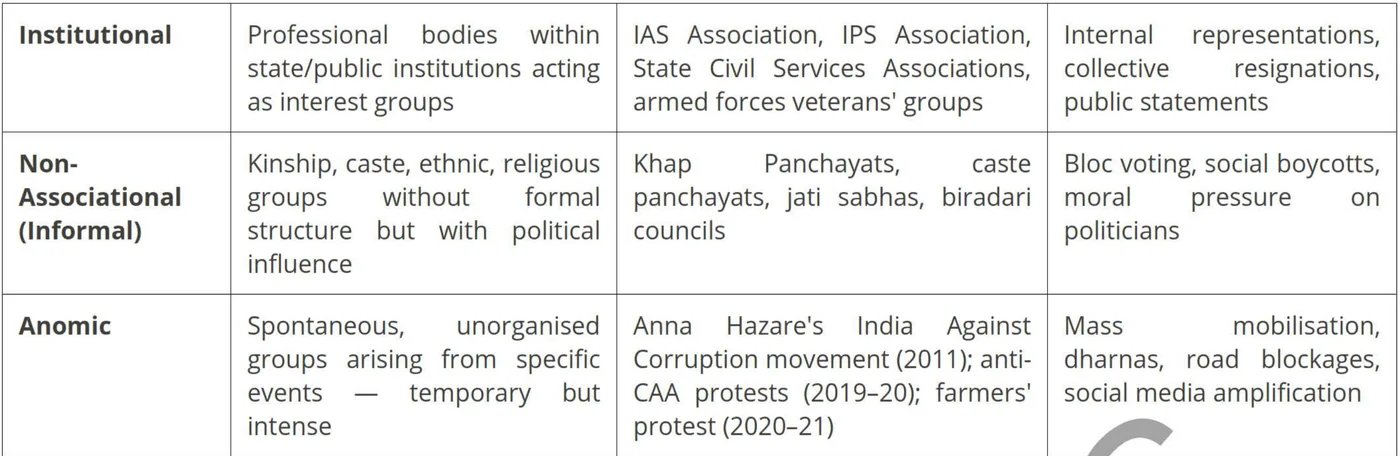
Institutional Groups operate within government institutions and influence policy from inside — bureaucratic associations, officers' lobbies, military veteran bodies. Less visible, often highly effective.
Anomic Groups emerge spontaneously around a specific grievance — flash-mob protests, riots, sudden student agitations. They lack formal structure and usually dissipate quickly, though they can catalyse formal groups.
Methods Used by Pressure Groups
| Method | Description | Indian Example |
|---|---|---|
| Lobbying | Direct contact with legislators, ministers, bureaucrats | CII pre-budget consultations with Finance Ministry |
| Public Campaigns | Media, social media, awareness drives | #MeToo; RTI campaigns |
| Protests & Agitations | Strikes, dharnas, rallies, bandhs | Trade-union all-India strikes; farmer protests 2020-21 and 2024-25 |
| Litigation (PIL) | Filing cases in courts | PILs on air pollution, environmental clearances, electoral transparency |
| Electoral Influence | Endorsements; funding parties | Business associations' electoral-bond contributions (pre-2024 striking down) |
| Expert Input | Research and policy papers | Think tanks (CPR, ORF, CSDS) submitting pre-legislative briefs |
| International Advocacy | Seeking global pressure | Human rights groups at UN Human Rights Council |
Pressure Groups vs Political Parties
| Feature | Pressure Groups | Political Parties |
|---|---|---|
| Goal | Influence policy on specific issues | Capture political power |
| Elections | Don't contest | Contest |
| Accountability | To members / donors | To the electorate |
| Scope | Narrow, issue-specific | Broad, comprehensive programme |
| Membership | Voluntary, specialised | Open to general public |
| Registration | Not required under election law | Must register with ECI |
| Methods | Lobbying, protests, litigation | Campaigning, governance, legislation |
In practice, the line blurs. Many trade unions are affiliated with parties (BMS-BJP, INTUC-Congress, AITUC-CPI, CITU-CPM, HMS-Socialist). Student organisations function as youth wings. The RSS operates as a "socio-cultural" organisation while shaping the BJP's agenda — a relationship without a precise parallel in most democracies.
Role in Indian Democracy
Positive Contributions
Representation of diverse interests. Parliament alone cannot represent India's every social segment. Pressure groups give voice to farmers, workers, tribals, minorities, women, the disabled, the landless, and environmental causes.
Policy input and expertise. Groups like CII, NASSCOM, and think tanks feed technical expertise that legislators and bureaucrats often lack. Pre-budget consultations shape economic policy.
Check on government power. The RTI Movement led to the Right to Information Act, 2005 — one of India’s most consequential governance reforms. Environmental groups have forced accountability on industrial projects via PIL.
Democratic participation between elections. The farmers' movement of 2020-21 — a coalition of over 40 unions, largely from Punjab, Haryana and Western UP — showed how organised collective action can overturn central legislation. Three farm laws were repealed in November 2021.
Social change. The anti-dowry movement, child-rights activism, LGBTQ+ advocacy (leading to the Navtej Singh Johar, 2018 decriminalisation), the #MeToo movement, and the decade-long privacy coalition behind Puttaswamy (2017) illustrate the transformative power of cause groups.
Negative Aspects
Narrow interests over public good. Powerful lobbies can stall environmental regulation, tax reform, or labour protection. The pesticide industry's response to proposed bans, or the hydrocarbon lobby's response to climate regulation, are classic examples.
Inequality of influence. Well-funded business associations have disproportionate access compared to tribal collectives or the informal-sector workforce.
Disruption of public life. Bandhs, blockades and violent agitations impose costs on ordinary citizens. The Supreme Court (e.g., Bharat Kumar v. State of Kerala) has ruled that bandhs violate fundamental rights of uninvolved citizens.
Communal and divisive politics. Caste and religious pressure groups can deepen social divisions.
Lack of internal democracy. Many pressure groups are not internally democratic — leadership is concentrated and member views are not systematically canvassed.
Case Studies: Major Pressure-Group Movements
Narmada Bachao Andolan
Led by Medha Patkar from the mid-1980s, the NBA opposed the Sardar Sarovar Dam and the displacement of tribal communities along the Narmada Valley. Through hunger strikes, Supreme Court litigation, and international advocacy (World Bank withdrawal in 1993), the movement pushed rehabilitation and resettlement into the policy mainstream — culminating in the Right to Fair Compensation and Transparency in Land Acquisition, Rehabilitation and Resettlement Act, 2013.
RTI Movement
The Mazdoor Kisan Shakti Sangathan (MKSS), led by Aruna Roy, began in Rajasthan in the 1990s demanding access to village muster rolls and government expenditure records. A decade-long campaign produced the Right to Information Act, 2005 — arguably the single most consequential transparency reform in modern Indian governance.
Farmers' Movements (2020-21 and 2024-25)
Over 40 farmer unions — primarily from Punjab, Haryana and Western Uttar Pradesh — occupied Delhi's borders from November 2020 to December 2021. The movement combined traditional dharnas with digital mobilisation and international media outreach. The government repealed all three farm laws in November 2021. The Samyukta Kisan Morcha (Non-Political) relaunched protests in February 2024 demanding a legal guarantee of Minimum Support Price, debt waiver, and pension. The movement continued through 2024-25 as a more decentralised but persistent pressure on both the Union and state governments.
Anti-CAA / Shaheen Bagh (2019-20)
A women-led sit-in in Delhi catalysed a nation-wide protest against the Citizenship (Amendment) Act, 2019. Though it did not achieve repeal, it reshaped political discourse and added to the Court's docket via petitions under Articles 14, 21 and 25.
#MeToo India (2018 onwards)
A sectoral movement that surfaced sexual-harassment accusations across media, film, and publishing — forcing internal complaints committees, resignations, and a revisit of the POSH Act, 2013. A 2024 Supreme Court judgment (Initiatives for Inclusion Foundation v. Union of India) directed all states to ensure functioning Internal Committees.
Regulation of Pressure Groups — India's Missing Framework
India does not have a formal lobbying statute comparable to the US Lobbying Disclosure Act, 1995. Key regulatory gaps:

- No registration requirement for lobby groups.
- No disclosure norms for lobbying activities or meetings.
- No limits on indirect campaign contributions from interest groups (aside from party-funding ceilings).
- Foreign Contribution (Regulation) Act, 2010 (FCRA) — the only relevant instrument — regulates foreign funding of NGOs and has been tightened substantially since 2020, producing a chilling effect on many cause groups (Oxfam India, CPR, Amnesty India). Licences of several high-profile NGOs were cancelled in 2022-24.
The 2nd Administrative Reforms Commission and various parliamentary committees have recommended a transparent lobbying framework; no legislation has been enacted.
Latest Developments (2024-26)
Electoral Bonds Struck Down
In Association for Democratic Reforms v. Union of India (15 February 2024), a 5-judge Constitution Bench unanimously struck down the Electoral Bonds Scheme 2018 as unconstitutional, holding it violated the right to information under Article 19(1)(a). The SBI was directed to release all bond data to the ECI for public disclosure. This was the culmination of a decade-long campaign led by ADR, Common Cause, CPI(M), and academic researchers — a textbook pressure-group-plus-PIL success story.
2024 Lok Sabha Outcomes and Pressure Groups
The 2024 election returned a coalition NDA government with reduced BJP strength. Pressure groups — especially agrarian, rural-jobs (NREGA workers’ collectives), and civil-liberties groups — became more visible in negotiating policy. The Samyukta Kisan Morcha’s MSP agitation, the Bhartiya Mazdoor Sangh’s public statements against labour-code rollout, and NITI Aayog CEO-level consultations with state farmers’ bodies through 2024-25 illustrate this renewed leverage.
Judicial Activism on Civil Society
The Supreme Court in 2024 stayed FCRA licence-cancellation orders for several NGOs where due process was not followed (e.g., CPR v. Union of India). Parliamentary standing committees are currently examining whether FCRA rules need procedural safeguards.
Business Associations' Lobbying
CII, FICCI, ASSOCHAM, and the Confederation of All India Traders (CAIT) remained the most active pre-budget lobbyists for the 2024-25 and 2025-26 Union Budgets. Digital platforms (NASSCOM, IAMAI) have grown in influence on Digital Personal Data Protection Act, 2023 rule-making (MeitY consultations, 2024-25).
#JudicialReforms and Lawyer Pressure Groups
The Supreme Court Bar Association and Bar Council of India have taken public positions on Collegium functioning, judicial appointments delays, and the National Judicial Appointments Commission proposal. This is a distinct professional-institutional-pressure-group dynamic UPSC essays frequently touch.
Challenges and Way Forward
- A transparent lobbying framework with registration, disclosure of meetings and funding sources — balanced against free-association protections.
- Pre-legislative consultation made mandatory for Bills (a 2014 DoPT policy that is honoured in the breach).
- FCRA reform — procedural due process before licence cancellation; judicial oversight of enforcement discretion.
- Electoral finance reform post-ADR 2024 — moving to public funding or transparent digital registers.
- Internal democracy audits for major associations (trade unions, business chambers).
UPSC Relevance
GS-II mapping:
- Role of civil society and NGOs — pressure groups as a subset of civil society.
- Government policies, regulatory bodies — DoPT pre-legislative consultation; FCRA.
- Citizens' charters, transparency — linked to RTI Movement.
- Salient features of the representation of the people's act — overlap with political funding.
Prelims bullets:
- Almond-Powell classification: sectional, promotional, institutional, anomic.
- RTI Act 2005 born of MKSS/RTI Movement.
- Electoral Bonds struck down in ADR v. UoI (Feb 2024).
- Farm laws repealed November 2021 after year-long protest.
- FCRA, 2010 regulates foreign funding; tightened 2020 amendments.
- India has no statutory lobbying-registration law.
- Navtej Singh Johar (2018) — LGBTQ+ advocacy-backed decriminalisation of Section 377.
Mains angles:
- "Pressure groups strengthen democracy by supplementing parliamentary representation, but weaken it when they substitute for the electoral process." Discuss with Indian examples. (GS-II, 250 words)
- Do you agree that India needs a statutory lobbying framework? Substantiate. (GS-II, 150 words)
Frequently Asked Questions
Watch on YouTube
Related video from the Anantam IAS YouTube channel.
What is the difference between pressure groups and civil society?
Civil society is the broader space between state, market and family. Pressure groups are a subset focused specifically on influencing policy. All pressure groups are civil-society actors; not all civil-society actors are pressure groups.
Are political parties and pressure groups the same?
No. Political parties contest elections and aim to form governments. Pressure groups influence policy without contesting elections. The boundary blurs in India because many trade unions and student organisations are affiliated to parties.
What are examples of pressure groups in India?
Business (FICCI, CII, ASSOCHAM), trade unions (BMS, INTUC, AITUC, CITU), farmer (SKM, BKU), professional (IMA, BCI), student (ABVP, NSUI, SFI), environmental (NBA, CSE), rights (PUCL, ADR, Common Cause), caste (Maratha Kranti Morcha, Patidar Anamat Andolan).
Why doesn't India have a lobbying law?
Historical association of "lobbying" with corruption, absence of political consensus, and concerns about infringing Article 19(1)(c) free-association rights. The 2nd ARC recommended transparency norms; successive governments have not legislated.