
Electoral Bonds were interest-free bearer instruments that allowed individuals and companies to donate money anonymously to political parties in India. Launched through the Finance Act, 2017 and notified as the Electoral Bond Scheme on 2 January 2018, they replaced older mechanisms of political finance and quickly became the dominant channel for party donations. On 15 February 2024, a five-judge Constitution Bench of the Supreme Court unanimously struck down the scheme as unconstitutional for violating the right to information of voters under Article 19(1)(a). For UPSC, this is one of the most important intersections of polity, economy, and electoral reform in recent years.
What Were Electoral Bonds
An electoral bond was a promissory note, in the nature of a bearer bond, issued only by the State Bank of India (SBI). A donor could buy bonds of denominations Rs 1,000, Rs 10,000, Rs 1 lakh, Rs 10 lakh, and Rs 1 crore after completing KYC at SBI, and donate them to any eligible political party. The receiving party could encash the bond in a designated SBI account within 15 days. The donor's identity was not disclosed on the instrument or in any public record — only the bank knew.
Key Features
| Feature | Detail |
|---|---|
| Issuing bank | State Bank of India only |
| Eligibility to receive | Political parties registered under Section 29A of RP Act, 1951 that secured at least 1% votes in the last general election |
| Denominations | Rs 1,000 / Rs 10,000 / Rs 1 lakh / Rs 10 lakh / Rs 1 crore |
| Validity | 15 days from issue |
| Anonymity | Donor's identity not disclosed publicly |
| Sale windows | 10 days each in January, April, July, October; extra window in a general election year |
| Eligible buyers | Indian citizens, Indian-incorporated companies, HUFs |
| Tax treatment | Donor got deduction under Section 80GGB/80GGC; party's receipt exempt under Section 13A |
Legal Changes Introduced Alongside
The Electoral Bond Scheme was made possible by changes to four statutes through the Finance Act, 2017 (a Money Bill).
| Statute Amended | Change |
|---|---|
| Representation of the People Act, 1951 | Exempted parties from disclosing donations received via electoral bonds (Section 29C). |
| Companies Act, 2013 | Removed the 7.5% cap on a company's donations tied to average net profits and the requirement to name beneficiaries in the profit and loss account. |
| Income Tax Act, 1961 | Exempted parties from maintaining a record of donations through electoral bonds. |
| Foreign Contribution (Regulation) Act, 2010 | Amended to permit donations from Indian subsidiaries of foreign companies. |
Arguments For the Scheme
The government defended the scheme on several grounds.
- Curbing cash in politics. Bonds could be bought only through banking channels, reducing untraceable cash.
- Donor protection. Anonymity shielded donors from political retaliation by rival parties.
- Clean money. KYC at SBI and banking traceability ensured funds came from accounted sources.
- Preserving banking secrecy. Sensitive client information stayed with the bank.
- Simplification. Replaced a messier patchwork of electoral trusts, cash, and cheques.
Arguments Against
Critics, including the Association for Democratic Reforms (ADR), the Election Commission of India (in Supreme Court affidavits), and the Reserve Bank of India (initial views), raised several concerns.
| Concern | Explanation |
|---|---|
| Violation of voter's right to information | Voters could not know who funded the parties they voted for. |
| Unequal access to information | Only the ruling party could, in principle, access SBI's donor data. |
| Money laundering risk | Bearer nature enabled layered donations. |
| Removal of corporate donation cap | Allowed even loss-making shell companies to donate unlimited sums. |
| Quid pro quo | Donors could fund parties in exchange for policy favours. |
| Foreign influence | FCRA amendment permitted contributions from Indian subsidiaries of foreign entities. |
| Money Bill route | Passed as a Money Bill, bypassing the Rajya Sabha. |
Data Released by SBI (March 2024)
After the Supreme Court ordered disclosure, SBI released electoral bond purchase and redemption data to the Election Commission, which published it. Key takeaways:
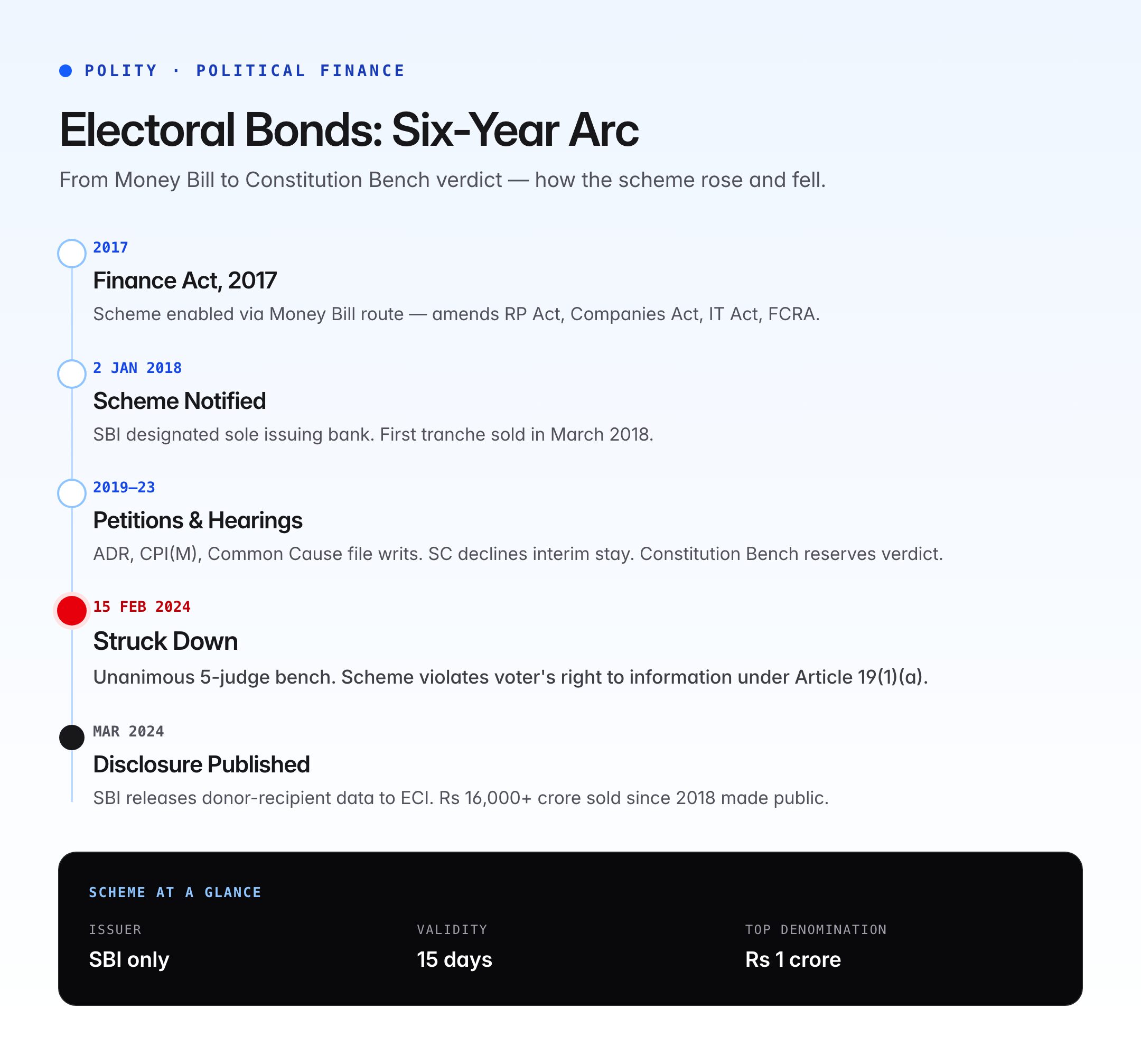
- Between March 2018 and January 2024, bonds worth over Rs 16,000 crore were sold.
- A small number of large corporate donors accounted for the bulk of purchases.
- The ruling party at the Centre received the largest share; major regional parties also featured prominently.
- Several donors appeared to have received government contracts, tax relief, or regulatory actions shortly before or after making donations — prompting quid-pro-quo allegations.
Supreme Court Verdict: 15 February 2024
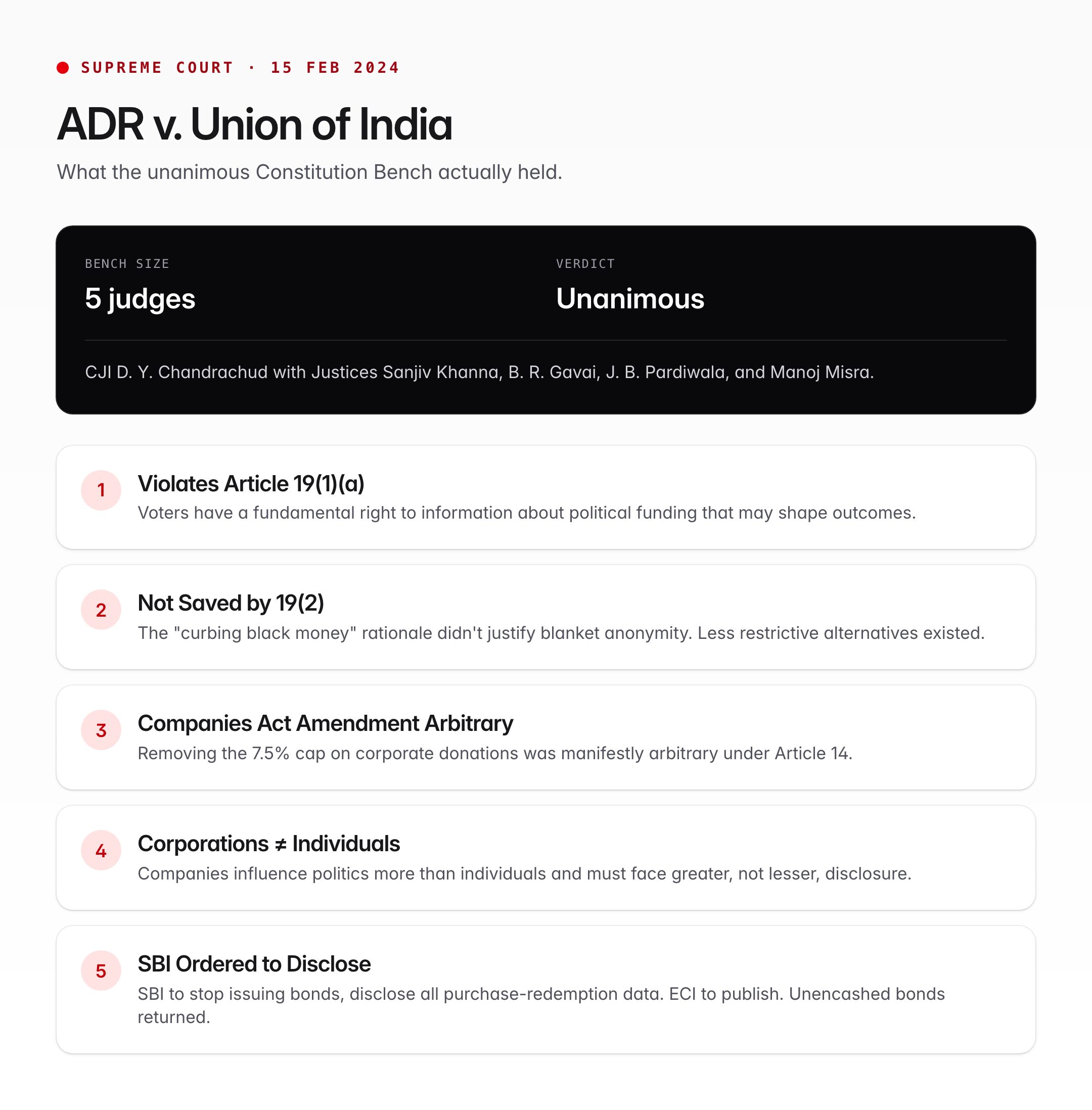
In Association for Democratic Reforms v. Union of India, a five-judge Constitution Bench led by CJI D. Y. Chandrachud and including Justices Sanjiv Khanna, B. R. Gavai, J. B. Pardiwala, and Manoj Misra unanimously struck down the scheme. Key holdings:
- Violation of Article 19(1)(a). Voters have a fundamental right to information about political funding that may influence political outcomes. Anonymous electoral bonds violated this right.
- Not saved by Article 19(2). The "curbing black money" rationale did not justify the blanket anonymity, and less restrictive alternatives existed.
- Section 182 of Companies Act unconstitutional. Removing the 7.5% cap and beneficiary disclosure was manifestly arbitrary under Article 14.
- Unequal treatment of corporate vs individual donations was arbitrary — corporations influence politics more than individuals and must face greater, not lesser, disclosure.
- Directions. SBI was ordered to cease issuing bonds and to disclose all purchase and redemption data to the ECI, which was to publish it. Unencashed bonds were to be returned.
Reforms Needed in Political Finance
The judgement reopened the reform debate. Suggestions under discussion:
- Cap on individual and corporate donations with real-time public disclosure.
- National Electoral Fund — a neutral pool into which donors contribute and which is distributed by vote share.
- State funding of elections, as recommended in principle by the Indrajit Gupta Committee (1998) and the Law Commission's 255th Report (2015).
- Full audit of party accounts by the Comptroller and Auditor General.
- Transparent online donation platforms with donor-level disclosure.
- Ban on corporate donations by loss-making or recently incorporated companies.
- Strengthened ECI powers under the RP Act to deregister non-compliant parties.
Electoral Bonds vs Other Channels
| Channel | Disclosure | Current status |
|---|---|---|
| Cash donations | Above Rs 20,000 disclosed in Form 24A (now Rs 2,000 threshold) | Active, restricted |
| Cheque / online transfer | Named, disclosed | Active |
| Electoral Trusts (Electoral Trust Scheme 2013) | Donors and recipients disclosed to ECI | Active |
| Electoral Bonds | Donor anonymous | Struck down in February 2024 |
Timeline
| Year | Event |
|---|---|
| 2017 | Finance Act, 2017 introduces scheme; amends four statutes. |
| 2018 | Electoral Bond Scheme notified on 2 January; first tranche sold in March. |
| 2019–23 | Multiple writ petitions filed by ADR, CPI(M), and Common Cause. SC declines interim stay. |
| 2023 | Constitution Bench reserves verdict after hearings. |
| 15 February 2024 | Supreme Court strikes down the scheme. |
| March 2024 | SBI and ECI publish donor and recipient data under SC orders. |
Quick Revision Table
| Point | Fact |
|---|---|
| Launched | 2 January 2018 |
| Enabling law | Finance Act, 2017 |
| Issuing bank | State Bank of India |
| Anonymous to public | Yes |
| Struck down | 15 February 2024 |
| Bench size | 5-judge Constitution Bench |
| CJI | D. Y. Chandrachud |
| Ground | Violation of Article 19(1)(a) |
| Case name | Association for Democratic Reforms v. Union of India |
| Total bonds sold | ~ Rs 16,000+ crore (2018–2024) |
UPSC Relevance
Electoral Bonds is a high-priority topic across Prelims and Mains. For Prelims, remember the issuing bank (SBI), denominations, validity, eligibility (1% vote share), and the Finance Act 2017 route. For Mains GS Paper II, it is central to questions on electoral reforms, transparency in political funding, the RP Act, 1951, and the role of the Election Commission of India. GS Paper II questions on fundamental rights, Article 19(1)(a), and judicial review can cite the 2024 verdict as landmark precedent. GS Paper III connects the scheme to money laundering, shell companies, and corporate governance. For Ethics (GS IV), it is a textbook case on conflict of interest, transparency, and public trust in democratic institutions. In Essay writing, the electoral bonds saga illustrates the tension between privacy claims and democratic accountability, and the role of the judiciary in protecting constitutional morality. Aspirants should also prepare state funding of elections, the Indrajit Gupta Committee, the 255th Law Commission Report, and the Dinesh Goswami Committee as linked reform proposals.
Tell Google you want more of this.
Add Anantam IAS as a preferred sourceOne tap, and this site shows up more often in your own Top Stories, AI Overviews and AI Mode. Remove it any time.