The Prevention of Corruption Act and Section 17A: Consent to Investigate and the Chilling-Effect Debate (UPSC Ethics — GS IV)
Section 17A places a permission requirement in front of the investigation itself, not only in front of the prosecution. Both the harms it is meant to prevent and the impunity it may create are real, and the available evidence does not tell us which effect dominates.
The Prevention of Corruption Act, 1988 consolidated provisions that had been scattered between the Indian Penal Code and the Prevention of Corruption Act, 1947. It is usually taught as a list of offences, which is the least interesting thing about it. The more consequential part of the statute is the set of permissions it places in front of those offences — the requirement that someone in authority agree before a public servant can be prosecuted, and, since 2018, before a public servant can even be investigated.
That second gate is Section 17A. A police officer may not conduct any enquiry, inquiry or investigation into an offence alleged against a public servant where the allegation is relatable to a recommendation made or a decision taken in the discharge of official functions, without previous approval from the government or the removing authority. Whether that provision protects honest decision-making from harassment or insulates the powerful from scrutiny is the sharpest open question in Indian probity law. The honest answer is that both effects are real and the available evidence does not establish which one dominates.
What the 1988 Act Was Built to Punish
The Act works through a small number of offences and a special forum. Section 7 penalised a public servant accepting gratification as a motive or reward for an official act. Section 11 dealt with a public servant obtaining a valuable thing, without consideration or for inadequate consideration, from a person concerned in any proceeding or business transacted by that public servant. Section 12 punished abetment. Section 13 created the composite offence of criminal misconduct, and Section 14 dealt with habitual offenders. Trial was confined to Special Judges appointed under Sections 3 and 4.
Two structural features mattered more than the offence definitions. Section 19 made previous sanction of the appropriate government or authority a condition precedent to taking cognizance of an offence under Sections 7, 11, 13 and 15. Section 20 created a presumption in favour of the prosecution once acceptance of gratification was proved. The statute was, in other words, already a mix of protective and punitive machinery before 2018 touched it.
One gap in the original design is worth noticing, because the 2018 amendment closed it. Bribe-giving was not a standalone offence. A person who paid a bribe was reached through abetment under Section 12, which meant the supply side of the transaction was legally derivative of the demand side.
What the 2018 Amendment Changed
The Prevention of Corruption (Amendment) Act, 2018 was the product of a long legislative gestation — a 2013 Bill, examination by the Law Commission and a Rajya Sabha Select Committee, and pressure from India’s treaty obligations after ratifying the United Nations Convention against Corruption. Five changes matter.
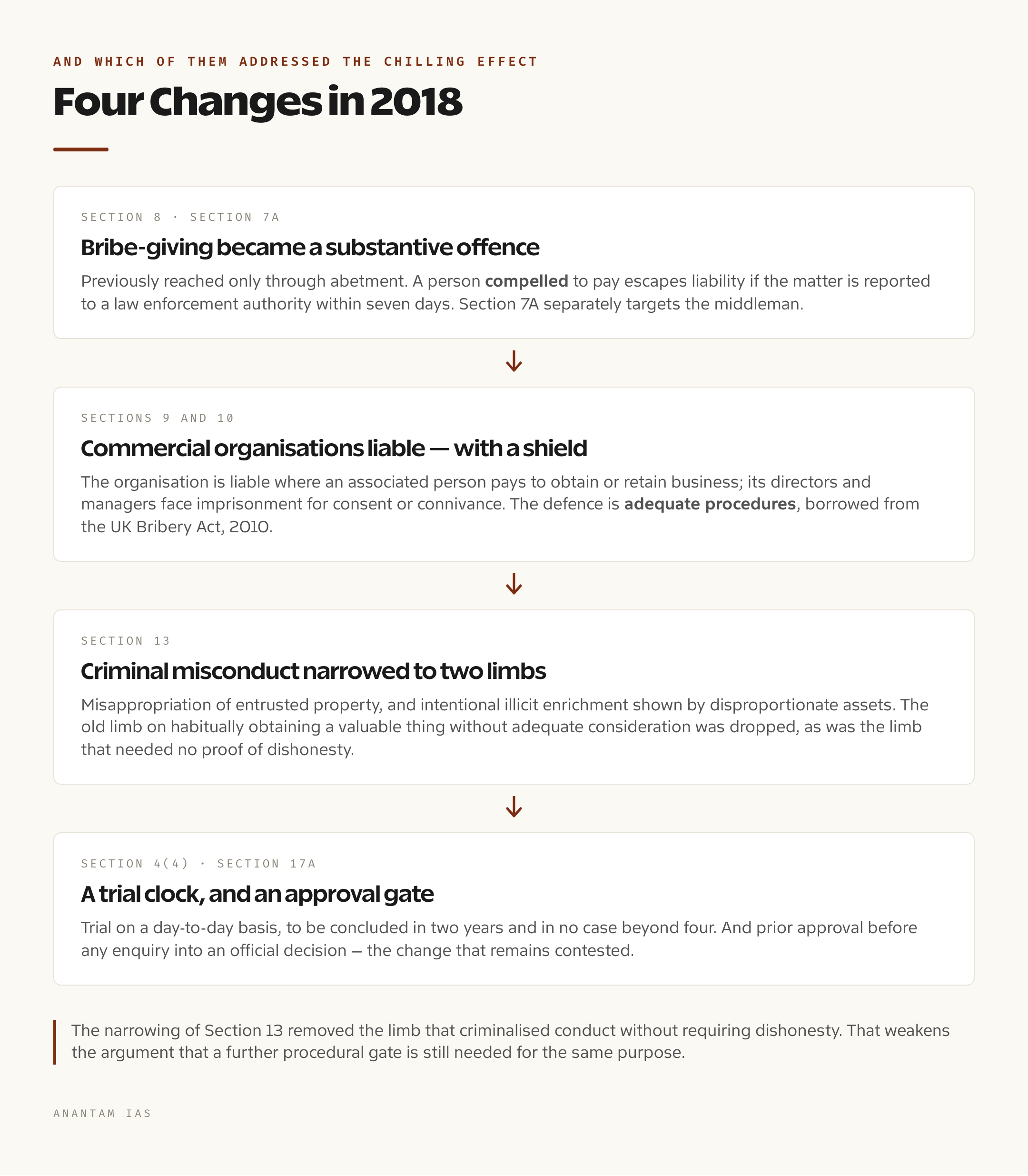
Bribe-giving became a substantive offence. The recast Section 8 punishes a person who gives or promises an undue advantage to another person to induce or reward a public servant to perform a public duty improperly. It carries a proviso of real importance: a person compelled to give an undue advantage is not liable if the matter is reported to a law enforcement authority or investigating agency within seven days. Section 7A separately targets the middleman who takes an undue advantage to influence a public servant by corrupt or illegal means or by exercise of personal influence.
Commercial organisations were brought in — and given a shield. Section 9 makes a commercial organisation liable where a person associated with it gives an undue advantage to a public servant to obtain or retain business or an advantage in the conduct of business. Section 10 exposes the director, manager or officer whose consent or connivance made the offence possible to imprisonment. The shield is the defence available to the organisation: that it had in place adequate procedures in compliance with prescribed guidelines designed to prevent such conduct. That defence is borrowed almost directly from the corporate offence in the United Kingdom’s Bribery Act, 2010, and it converts compliance design into a legal asset rather than a cost centre — the mechanism examined in more detail in corporate governance and business ethics.
Criminal misconduct was narrowed sharply. The pre-2018 Section 13 had several limbs, including habitually obtaining a valuable thing without consideration or for a consideration known to be inadequate, and the much-litigated limb covering the obtaining of a pecuniary advantage by abusing position or without any public interest. The amended Section 13 keeps two things: dishonest or fraudulent misappropriation of property entrusted to or under the control of the public servant, and intentional illicit enrichment during the period of office, established through possession of pecuniary resources or property disproportionate to known sources of income that cannot be satisfactorily accounted for. Punishment rose to four to ten years. The dropped limbs are the substance of the chilling-effect argument, because one of them required no proof of dishonest intention at all.
Trial acquired a statutory clock. The Special Judge is to hold trial on a day-to-day basis and endeavour to conclude it within two years, extendable by recorded reasons in periods of up to six months, subject to an outer limit of four years.
And Section 17A appeared.
Section 17A: The Gate Before the Gate
Four features of the provision deserve precision, because most summaries lose them.
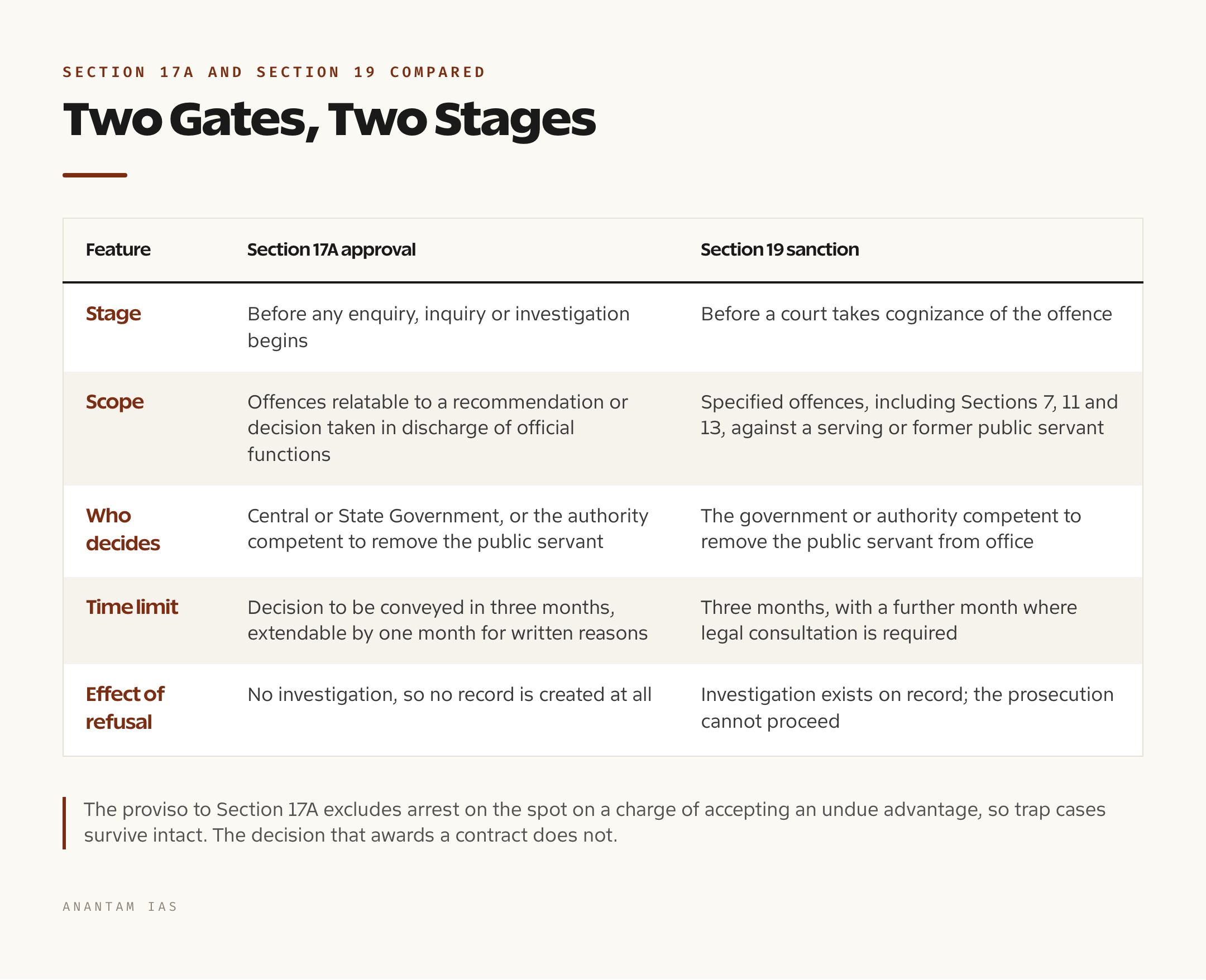
It bites at the enquiry stage, not the cognizance stage. Section 19 stops a court from taking cognizance. Section 17A stops a police officer from beginning to look. This is a difference in kind: a prosecution refused sanction has at least been investigated, and a record exists. An enquiry never permitted leaves no record at all.
Its trigger is subject-matter, not rank. Approval is needed where the alleged offence is relatable to a recommendation or decision made in the discharge of official functions or duties. A public servant of any seniority is covered; conduct unconnected to official decision-making is not.
The approving authority is the employer. For a person employed in connection with the affairs of the Union, it is the Central Government; for State affairs, the State Government; for anyone else, the authority competent to remove the person from office at the time of the alleged offence.
There is a carve-out and a clock. No approval is needed where a person is arrested on the spot on a charge of accepting or attempting to accept an undue advantage — the trap case survives intact. And the authority is to convey its decision within three months, extendable by one month for reasons in writing.
The Case for Prior Approval
The argument is not frivolous, and dismissing it is the commonest error in an answer on this topic.
Administrative decision-making in India routinely involves discretion exercised on incomplete information under time pressure — allocating a resource, choosing between bids, setting a tariff, granting or refusing a permission. Every such decision produces a loser with an incentive to allege motive. Before 2018, an allegation that a decision had conferred a pecuniary advantage without public interest could support an enquiry without any allegation of dishonesty, because the relevant limb of the old Section 13 did not require it. An officer could face years of investigation for a decision that was merely wrong, or merely one of several defensible options.
The consequences are documented in the behaviour of the system rather than in any single statistic. Officers began routing ordinary decisions upward, seeking committee cover for choices within their own competence, preferring the file that moves slowly to the file that moves. Public-sector bank officials became reluctant to restructure stressed accounts, since a restructuring that later fails looks, in retrospect, like a favour. The cost of this caution falls on the public, not on the officer, which is exactly why it persists.
The second ARC’s report on ethics in governance made a version of this point long before 2018, recommending that the protective architecture be rationalised rather than simply removed — its wider recommendations are set out in the Second ARC on ethics in governance. A system that punishes error as though it were corruption does not get honest decisions. It gets no decisions.
The Case Against
The objections are equally serious.
The approving authority may be part of the problem. Where a decision was taken under political direction, or where a senior officer’s decision implicates the department itself, the authority asked to permit the enquiry has an institutional interest in refusing. The statute asks a body to authorise an investigation into its own functioning. A three-month deadline for a decision does not solve this, because a refusal within three months is still a refusal.
Delay is itself a sanction. Corruption cases depend on contemporaneous material — call records, file movements, bank entries, witnesses who have not yet been persuaded to forget. Four months of permitted deliberation before an enquiry may begin is four months in which that material degrades.
The carve-out is narrower than it looks. On-the-spot arrest covers the constable and the clerk. It does not cover the decision that allocates a contract, which is where the money is. The provision’s protective reach therefore correlates with seniority in practice even though it does not classify by rank in terms.
And it weakens the informant’s position. A disclosure about a decision now has to survive an approval stage before anything happens, which lengthens the period in which the discloser is exposed and nothing is moving — the structural weakness discussed in whistleblowing in India.
Two Predecessors That Did Not Survive
Section 17A did not arrive on clean ground. India has tried this twice before by executive and legislative means, and both attempts were struck down.
The Single Directive was a set of executive instructions requiring the CBI to obtain prior sanction of the government before initiating an enquiry against officers of and above the rank of Joint Secretary. In Vineet Narain v. Union of India (1997), arising from the hawala transactions, the Supreme Court held the directive could not stand in the way of the statutory duty to investigate, and issued directions on the CBI Director’s fixed tenure and the CVC’s status that shaped the institutional architecture that followed.
The protection was then re-enacted in statutory form as Section 6A of the Delhi Special Police Establishment Act, 1946, inserted through the Central Vigilance Commission Act, 2003. It required prior approval of the Central Government before the CBI could enquire into an offence under the Prevention of Corruption Act alleged against officers of Joint Secretary rank and above. A Constitution Bench struck it down in Subramanian Swamy v. Director, CBI (2014) as violative of Article 14, holding that the classification of senior officers for special protection had no rational relation to the object of the Act and that it impeded the tracking of precisely the corruption that does the most damage. The Court later held that this declaration of invalidity operates from the date the provision was inserted, since Section 6A was procedural rather than penal.
The obvious question is whether Section 17A shares the defect. It differs in one significant respect: it does not classify by rank, so the specific Article 14 reasoning in Subramanian Swamy does not transfer directly. Whether a subject-matter filter applied to all public servants survives the same scrutiny is a question that has been argued in various forms and cannot be described as settled. Say that, rather than asserting a conclusion the law has not reached.
Corruption and Error Are Not the Same Offence
The ethical core of this debate is a distinction the criminal law finds genuinely hard to draw.
A wrong decision is one that a competent, honest officer would not have taken. A dishonest decision is one taken for a consideration or to confer a benefit the officer had no business conferring. The two are separated by mental state, and mental state is inferred from conduct — which means the inference is easiest to draw when the outcome was bad. Retrospective reasoning from outcome to motive is the specific failure mode here, and it is what officers fear.
A system that cannot distinguish the two produces two symmetrical injustices. If error is treated as corruption, honest officers stop deciding. If corruption is treated as error, the dishonest ones are never reached, because every corrupt decision can be dressed as a judgement call. The correct answer is not a gate but a record. Reasons written on the file at the time, disclosed conflicts, published criteria for discretionary choices and a documented departure from the norm where one occurs will distinguish error from dishonesty far better than a permission requirement will — and they do it prospectively rather than by asking a department to adjudicate on itself. This is the difference between answerability for the reasoning and liability for the outcome, developed further in accountability and responsibility.
How the Presumption Under Section 20 Works
Section 20 is routinely misdescribed as reversing the burden of proof for corruption. It does something narrower and more defensible.
Where it is proved that a public servant accepted, obtained or attempted to obtain an undue advantage, the court shall presume, unless the contrary is proved, that the advantage was accepted as a motive or reward for improper performance of a public duty. The presumption operates on the purpose, not on the fact. Acceptance must still be established by the prosecution; what the accused then has to displace is the inference about why.
That distinction has done substantial work. Courts held for years that proof of demand is essential and that recovery of tainted currency alone will not sustain a conviction, since an officer may be handed money without having asked for it. A Constitution Bench in Neeraj Dutta v. State (NCT of Delhi) (2022) clarified that where there is no direct oral or documentary evidence of demand — the complainant has died, or turns hostile — demand may be proved by circumstantial evidence, after which the Section 20 presumption becomes available. The separate deeming rule attached to illicit enrichment under Section 13 operates on the same logic: possession of disproportionate assets that cannot be satisfactorily accounted for supports the inference of intentional enrichment, because the officer is the only person who can explain their own bank balance.
The Honest Position
The empirical question at the centre of this debate is unresolved, and an answer that pretends otherwise is weaker than one that says so.
Both harms are real. Decision paralysis is real: it shows up as delay, over-referral and risk aversion in exactly the areas where discretion is unavoidable, and it has costs that no one is prosecuted for. Impunity is real: a permission requirement administered by the employer will sometimes be used to protect, and refusals are not easy to see or challenge. What we do not have is evidence that establishes which effect is larger. Conviction rates, case pendency and perception indices each measure something adjacent to the question rather than the question itself, and the strongest claims on both sides rest on anecdote — a distinguished officer prosecuted for a policy decision on one side, an obviously blocked enquiry on the other. The limits of the measurement problem are set out in the Corruption Perceptions Index.
What can be said with confidence is narrower. The protective case is strongest where the old law criminalised conduct without requiring dishonesty, and that specific defect was fixed in 2018 by rewriting Section 13 — which weakens the argument that a further procedural gate is still needed for the same purpose. The accountability case is strongest at the point where the approving authority and the potential accused sit in the same chain of command, and no time limit repairs that. A defensible position is that the design should shift from permission to published reasons: an approval or refusal recorded in writing, reviewable, and reported in aggregate. That converts an invisible discretion into an accountable one without pretending the chilling effect was imaginary.
FAQ
What does Section 17A of the Prevention of Corruption Act require? Prior approval of the appropriate government or the competent removing authority before a police officer conducts any enquiry, inquiry or investigation into an offence alleged against a public servant where the allegation relates to a recommendation made or decision taken in the discharge of official functions.
How is Section 17A different from Section 19? Section 19 requires previous sanction before a court takes cognizance of specified offences — a gate before prosecution. Section 17A operates earlier, before any investigation begins. A case may therefore be stopped twice, at different stages and by different reasoning.
Is prior approval needed in a trap case? No. The proviso to Section 17A excludes cases involving arrest of a person on the spot on a charge of accepting or attempting to accept an undue advantage, so trap operations are not affected.
What changed in the definition of criminal misconduct in 2018? Section 13 was narrowed to two limbs — dishonest or fraudulent misappropriation of property under the public servant’s control, and intentional illicit enrichment shown through disproportionate assets. The earlier limbs, including habitually obtaining a valuable thing without adequate consideration, were dropped.
Did the 2018 amendment make bribe-giving an offence? Yes. Section 8 makes giving or promising an undue advantage a substantive offence rather than merely abetment, with a protection for a person compelled to pay who reports the matter to a law enforcement authority within seven days.
Does Section 20 reverse the burden of proof? Only partly. Once acceptance of an undue advantage is proved, the purpose is presumed unless the contrary is shown. The fact of acceptance, including demand, must still be established by the prosecution.
Practice Questions
Prelims MCQs
- Section 17A of the Prevention of Corruption Act requires prior approval before: (a) A court takes cognizance of an offence (b) A police officer conducts an enquiry or investigation into an official decision (c) A public servant is suspended (d) A commercial organisation is prosecuted — Answer: (b) the provision operates at the investigation stage and is triggered by the allegation being relatable to a recommendation or decision made in discharge of official functions.
- Which statement about Section 6A of the Delhi Special Police Establishment Act is correct? (a) It was upheld as a reasonable classification (b) It applied only to State government officers (c) It was struck down as violative of Article 14 (d) It was repealed by the 2018 amendment — Answer: (c) a Constitution Bench held in 2014 that protecting officers of Joint Secretary rank and above had no rational relation to the object of the Act.
- Under the amended Section 13, criminal misconduct covers: (a) Any decision causing loss to the exchequer (b) Misappropriation of entrusted property and intentional illicit enrichment (c) Habitually accepting valuable things without adequate consideration (d) Failure to declare assets — Answer: (b) the 2018 amendment reduced the offence to these two limbs and raised the punishment to four to ten years.
- The presumption under Section 20 arises: (a) As soon as an allegation of corruption is made (b) Once acceptance of an undue advantage is proved (c) Only where assets are disproportionate to known income (d) On the filing of a charge sheet — Answer: (b) the presumption operates on the purpose of the acceptance, not on the fact of acceptance, which the prosecution must still prove.
- The defence available to a commercial organisation under Section 9 is that it: (a) Was unaware of the transaction (b) Had adequate procedures in compliance with prescribed guidelines to prevent such conduct (c) Derived no benefit from the contract (d) Reported the matter within seven days — Answer: (b) the adequate-procedures defence follows the corporate offence model used in the United Kingdom’s Bribery Act, 2010.
Mains Practice Questions
- “Section 17A protects honest decision-making; it also protects the dishonest.” Examine this tension and suggest a design that reduces both risks. (250 words)
- Distinguish between an erroneous administrative decision and a dishonest one. What documentary practices help a system tell them apart? (150 words)
- Trace the judicial treatment of prior-approval protections for senior public servants and assess what it implies for the constitutional standing of a subject-matter filter. (250 words)
- The 2018 amendment narrowed the definition of criminal misconduct while adding a procedural gate before investigation. Evaluate whether these two changes address the same problem twice. (250 words)
- “Decision paralysis has victims, but they are invisible.” Discuss the ethical significance of harms caused by administrative caution. (150 words)