PPV&FRA Explained: India’s Triple Rights Framework and the PepsiCo Potato Verdict
PPV&FRA explained: statutory authority under the 2001 Act, triple rights for breeders, researchers and farmers, and the landmark PepsiCo FC5 potato verdict.
The Protection of Plant Varieties and Farmers’ Rights Authority, abbreviated as PPV&FRA, is a statutory body that administers what is arguably the world’s most farmer-friendly plant intellectual property regime. It sits under the Ministry of Agriculture and Farmers’ Welfare and is established under the Protection of Plant Varieties and Farmers’ Rights Act of 2001. Where most countries grant exclusive rights to plant breeders and stop there, India built a unique three-cornered framework that grants distinct, enforceable rights to breeders, to researchers, and to farmers all at once, in the same statute, on the same registered variety.
For UPSC, the topic threads through three syllabus areas. It belongs to GS-III under science and technology and under agriculture. It belongs to GS-II under government policies and intellectual property. It also has a recurring current-affairs presence because the PepsiCo versus Indian farmers case (the FC5 potato dispute that ran from 2019 to 2023) became a textbook example of how the farmers’ rights provisions actually bite when a multinational tries to enforce a registration aggressively. A candidate who can summarize the triple-rights structure, explain Section 39 farmers’ rights with one line of statutory text, and narrate the PepsiCo case from registration to revocation has covered the topic at the depth examiners expect.
This guide treats the PPV&FRA as a single coherent regime. We cover the legal foundation, the unique structure of three simultaneous rights, the registration process that breeders actually navigate, the landmark case that defined “public interest” under the Act, and the prelims-style traps and mains-style debate points that surface most often. Throughout we pay particular attention to the policy logic of why India chose this framework over the alternative (joining the UPOV 1991 convention, which most large agricultural economies use).
Quick Facts on the PPV&FR Authority
- Parent ministry: Ministry of Agriculture and Farmers’ Welfare.
- Establishing law: Protection of Plant Varieties and Farmers’ Rights Act, 2001.
- Founded: Authority became operational in 2005, with rules notified the same year.
- Headquarters: New Delhi, with branch offices and DUS (Distinctness, Uniformity, Stability) test centres at ICAR institutes.
- Unique feature: India is the only country with a sui generis system that grants enforceable rights to farmers as cultivators and conservers.
- WTO commitment: India’s framework satisfies the TRIPS Article 27.3(b) obligation to protect plant varieties either by patents, by an effective sui generis system, or by both.
- Categories of varieties registrable: New, Extant, Essentially Derived, and Farmers’ Varieties.
- Landmark case: PepsiCo v. Indian Farmers (FC5 potato), with Delhi High Court ruling in July 2023.
- GS paper relevance: Prelims (Sci-Tech, Agriculture, Polity), GS-II (Government Policies, IPR), GS-III (Agriculture, Biotechnology).
What PPV&FRA Is and What It Does
PPV&FRA is a statutory authority, not a regulator in the SEBI mould. Its main functions are: registration of plant varieties (new, extant, essentially derived, and farmers’ varieties), grant and management of breeders’ rights certificates, payment of benefit-sharing to farmers and farming communities for genetic material used by breeders, recognition and reward for community conservation, and a National Gene Fund into which benefit-sharing payments accumulate. It also adjudicates disputes between rights-holders and third parties through quasi-judicial proceedings, with appeals lying to the Plant Varieties Protection Appellate Tribunal and onward to the High Courts.
The Authority has a chairperson and members drawn from agricultural science, law, and farmer organizations. Its chairperson reports to the Ministry of Agriculture and is accountable to Parliament through annual reports. Decisions on registration and revocation are quasi-judicial and reasoned, which is why the PepsiCo revocation order (2021) ran to several pages of detailed factual findings before getting to the public-interest paragraphs.
Background and Historical Context
India’s plant variety law was born of two pressures, one international and one domestic. Internationally, the 1995 TRIPS Agreement under the World Trade Organization required member countries to extend intellectual property protection to plant varieties. Article 27.3(b) gave members a choice: patents, an effective sui generis system, or a combination. Most developed economies acceded to the UPOV (International Union for the Protection of New Varieties of Plants) Convention of 1991, which gives strong, exclusive rights to breeders and limits farmer-saved seed to a narrow exception. UPOV 1991 was unacceptable to India because the country’s farming structure (more than 85 percent smallholders, large-scale seed-saving traditions, and a deep agro-biodiversity inheritance) could not be reconciled with the UPOV-91 farmers’ privilege.
India’s broader intellectual property architecture is laid out in the National IPR Policy and the IPR policy and Indian innovation ecosystem discussion, both of which provide the context within which the PPV&FR Act operates. Domestically, the Indian seed industry, organized farmer movements, and biodiversity advocates argued for a framework that recognized farmers as creators of plant genetic resources rather than merely consumers of breeders’ work. This was already established practice: a substantial fraction of the genetic base of commercially registered varieties has come from landraces selected and improved by farmers over generations, often without compensation. Excluding farmers from the rights structure would have been both ethically and politically untenable.
The Protection of Plant Varieties and Farmers’ Rights Act passed in 2001 after a long parliamentary debate. The Authority was constituted in 2005, certificates of registration began issuing in 2007, and the first benefit-sharing claims followed. By the early 2020s, more than 4,000 varieties had been registered across cereals, pulses, oilseeds, fibres, vegetables, and fruits, with farmer-bred varieties making up a non-trivial fraction (often more than 30 percent of total registrations in any given year, though concentrated in self-pollinated crops where smallholder breeding is possible).
The Triple Rights Framework
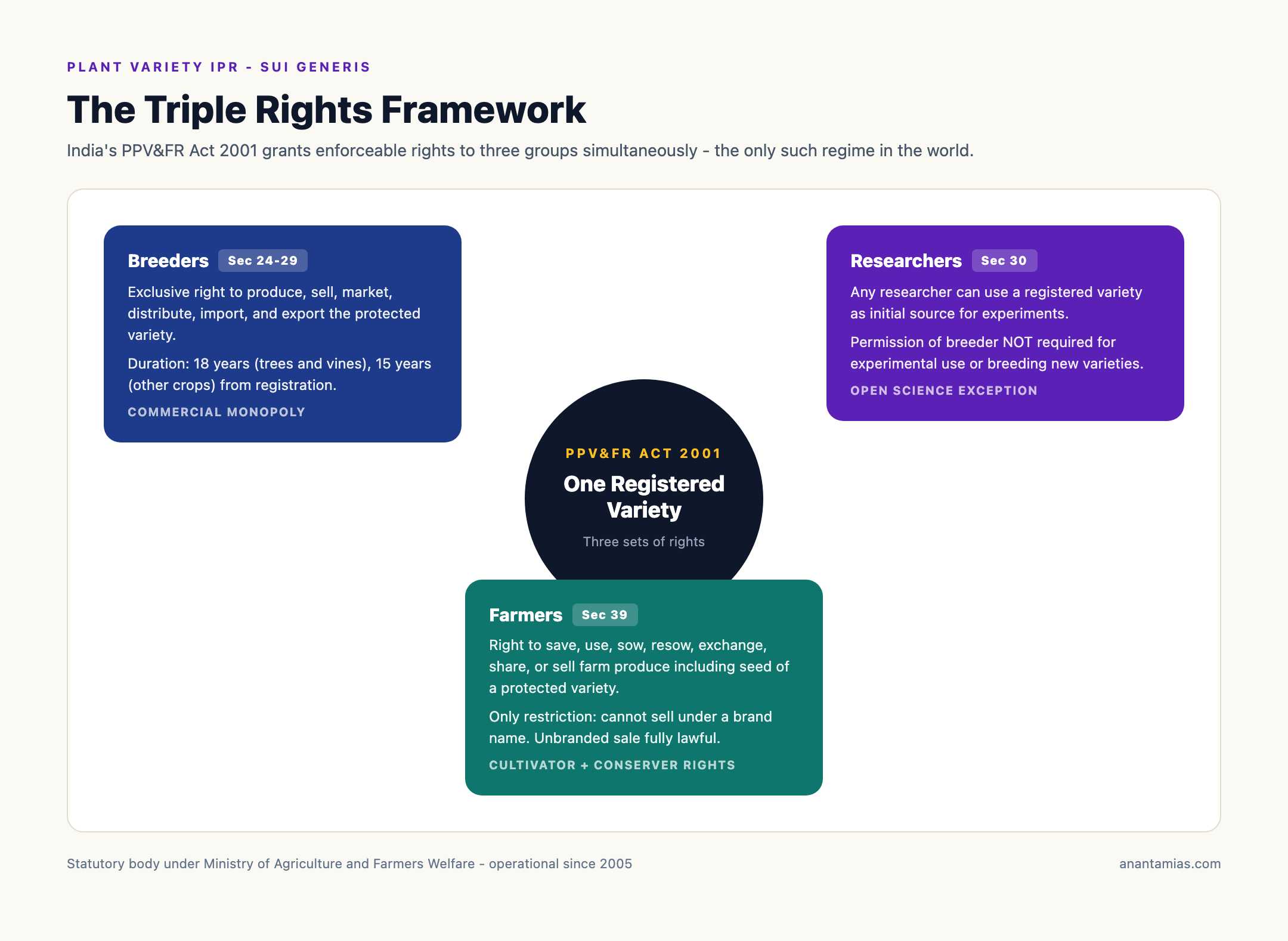
What makes the Indian Act unique globally is its simultaneous grant of three distinct sets of rights on the same registered variety. Each set has its own scope, holders, and limitations.
Breeders’ Rights (Sections 24-29) give the registered breeder the exclusive right to produce, sell, market, distribute, import, and export the protected variety. Duration is 18 years for trees and vines, 15 years for other crops (counted from the date of registration). The breeder can license others, collect royalties, and enforce against infringers. These are the “standard” rights that look most like the UPOV-91 model.
Researchers’ Rights (Section 30) allow any researcher to use a registered variety as an initial source for conducting experiments or research, including the use of the variety as a basis for creating other varieties. Permission of the breeder is not required for experimental use. The researchers’ exception is what keeps the Indian framework compatible with public-sector plant breeding at ICAR institutes and state agricultural universities.
Farmers’ Rights (Section 39) are the radical piece. The Act explicitly recognizes farmers as both cultivators and conservers, and grants them the right to save, use, sow, resow, exchange, share, or sell their farm produce, including seed of a variety protected under the Act. The only restriction is that they cannot sell such seed under a brand name. A farmer growing a registered variety can sell the resulting wheat seed in a gunny sack as ordinary “wheat seed” but cannot package it as “FarmerCo Wheat Seed” with branding that competes with the breeder’s commercial channel.
In addition, Section 39 protects farmers from innocent infringement: if a farmer can show they did not know they were growing a protected variety, courts must consider that as a defence. The Act also creates a benefit-sharing mechanism through the National Gene Fund, into which breeders’ payments flow when they have used farmer-conserved genetic material.
Why PPV&FRA Matters
The framework matters for three reasons that examiners reward when written clearly. First, it operationalizes the constitutional commitment to farmers’ welfare and to the protection of community knowledge under Article 39 of the Directive Principles. Second, it creates a credible alternative to the UPOV-91 model that other Global South countries (notably across Africa and Southeast Asia) have studied closely while drafting their own plant variety statutes. Third, it draws a sharp legal line that companies, including multinationals, cannot cross when enforcing rights against smallholders, as the PepsiCo case made clear. Recent developments such as the Patents Amendment Rules 2024 sit alongside the PPV&FR framework in shaping how innovation and access are balanced across India’s IP landscape.
A parallel current-affairs development is the new seeds bill, which deals with seed quality regulation and works alongside the PPV&FR Act rather than overlapping it. For India’s seed sector specifically, the framework supports a domestic breeding ecosystem that includes large private seed companies, public-sector ICAR institutes, state agricultural universities, and farmer-breeders. Registrations have been increasing year on year, and benefit-sharing payments, while modest, signal that the gene-fund mechanism works at least in principle.
Detailed Analysis: The PepsiCo FC5 Potato Case
The dispute became the defining case for the Act’s farmer-protection provisions and is repeatedly cited in legal commentary, agricultural policy analysis, and UPSC mains questions on agricultural IPR.
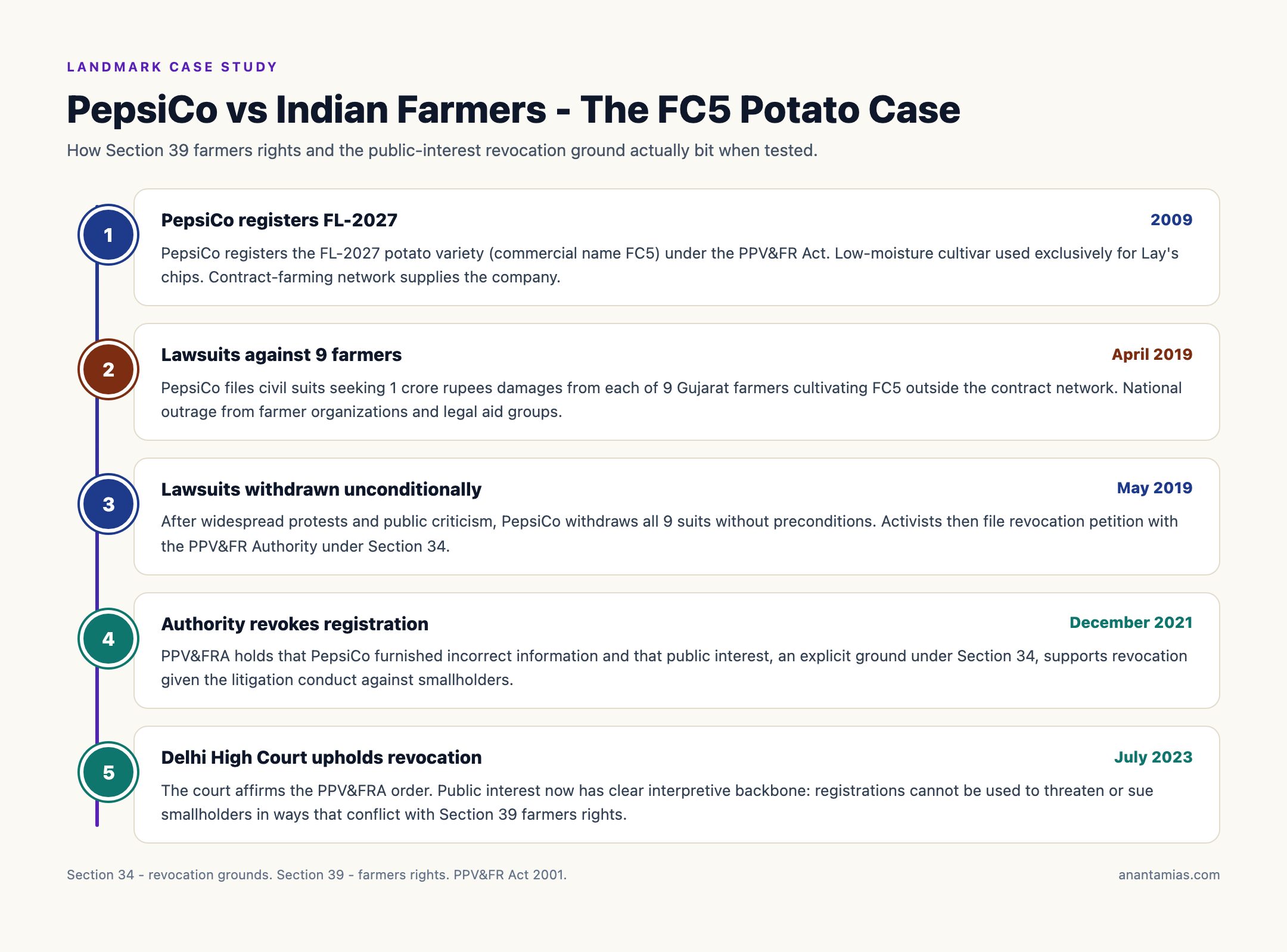
The variety in question was FL-2027, marketed commercially as FC5, a potato cultivar with low moisture content that PepsiCo’s Frito-Lay division uses for Lay’s chips. PepsiCo registered FL-2027 in India under the PPV&FR Act in 2009 as a new variety. The company runs a contract-farming network in which growers supply potatoes for chip processing under exclusive purchase agreements.
In April 2019, PepsiCo discovered that nine farmers in Gujarat were cultivating FC5 potatoes outside the contract-farming network. The company filed civil suits seeking damages of one crore rupees from each farmer. The lawsuits drew immediate national outrage. Farmer organizations, legal aid groups, and several state governments criticized the action. PepsiCo offered to withdraw the suits if the farmers joined the company’s contract network or undertook never to grow FC5 again. By mid-2019, the company withdrew the suits unconditionally.
The matter then moved into the PPV&FRA itself. Activist Kavitha Kuruganti, on behalf of farmers’ rights organizations, filed a revocation petition under Section 34 of the Act, arguing among other things that PepsiCo’s registration was based on incorrect application information and that maintaining it was “against public interest.” In December 2021, the Authority revoked PepsiCo’s registration, holding that incorrect information had been furnished and that public interest, an explicit ground for revocation under Section 34, supported revocation given the company’s litigation conduct against smallholders.
PepsiCo appealed to the Delhi High Court. In July 2023, the court upheld the PPV&FRA’s revocation order. The judgment is important because it gave Section 34’s “public interest” ground a clear interpretive backbone: when a registration is used as an instrument to threaten or sue smallholder farmers in ways that conflict with the explicit Section 39 farmers’ rights, public interest weighs against maintaining the registration.
The case is now the leading Indian authority on the inter-relationship between breeders’ rights and farmers’ rights, and it gives the Section 39 framework real enforcement bite.
The Variety Registration Process
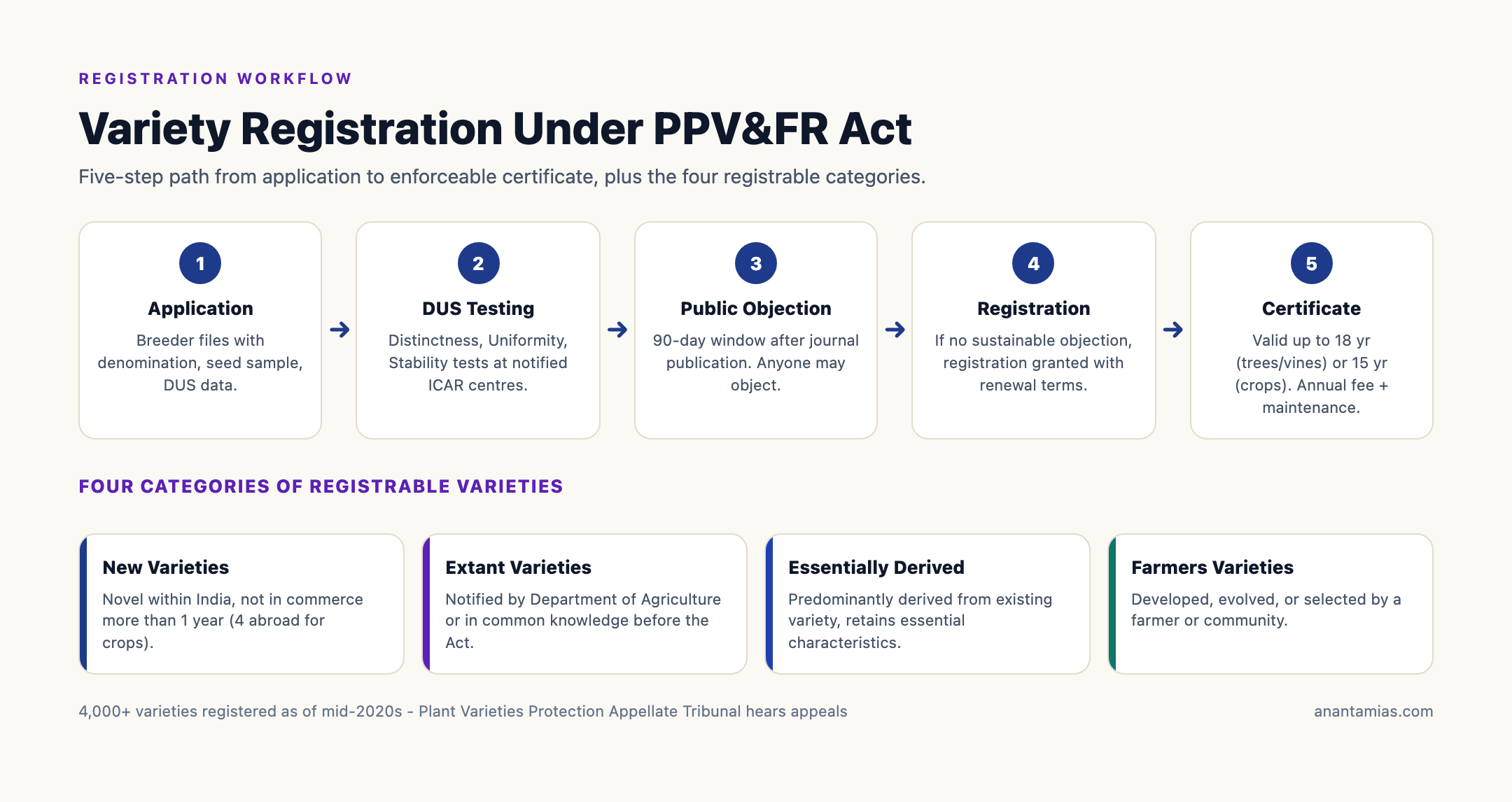
The path from a breeder’s invention to a registered, enforceable right runs through several steps. The breeder files an application with the Authority along with seed samples, denomination details, and DUS (Distinctness, Uniformity, Stability) data. The Authority sends the variety for DUS testing at notified ICAR test centres, which run the variety against the closest existing varieties in the relevant crop. After DUS clearance, the variety is published in the Plant Varieties Journal and a 90-day public objection period opens. Anyone, including farmers’ groups and other breeders, can object on grounds including incorrect information, lack of distinctness, or public interest.
If no sustainable objection is filed, the registration is granted with a certificate. The certificate is valid for 9 years initially for crops (6 for trees), renewable in tranches up to the statutory total of 15 or 18 years. The breeder pays an annual fee and is required to maintain the variety’s defining characteristics throughout the protection period.
Registrable categories are: New Varieties (novel within India and not in commerce for more than 1 year, or 4 years abroad for crops), Extant Varieties (notified by the Department of Agriculture or in common knowledge before the Act came into force), Essentially Derived Varieties (predominantly derived from an existing variety while retaining its essential characteristics), and Farmers’ Varieties (developed, evolved, or selected by a farmer or community).
Comparative Snapshot: PPV&FR vs UPOV 1991
The clearest comparative line is between India’s framework and UPOV 1991, the international convention most other large agricultural economies have joined. Under UPOV 1991, the breeder’s right is broader and the farmers’ privilege narrower. Farmers may save seed for use on their own holding only, may not exchange or sell saved seed, and bear a higher burden of proof in disputes. India’s framework expands the farmers’ rights substantially: explicit rights to save, use, sow, resow, exchange, share, or sell, and an unbranded-sale carve-out that has no parallel in UPOV-91.
The trade-off is that India is not a UPOV member. International breeders have to register separately in India and accept the Indian framework’s farmers’-rights restrictions on enforcement. Several European seed associations have lobbied India to join UPOV-91; the consistent Indian position has been that the existing sui generis system meets TRIPS obligations and works for Indian agriculture.
Challenges in Implementation
The Authority faces three persistent issues. First, awareness among smallholders of their rights under Section 39 remains uneven; outreach by state agricultural extension and by NGOs has improved this, but legal literacy is still patchy. Second, benefit-sharing payouts from the National Gene Fund remain small relative to the estimated genetic-material contributions from farmer-conserved landraces; the assessment formulas are conservative and contested. Third, capacity inside the Authority for handling complex cases (the PepsiCo revocation took two years) is limited, and the Plant Varieties Protection Appellate Tribunal has had periodic vacancies that slow appeals.
The wider story of how innovation feeds into Indian farming, including biotechnology in agriculture, shapes the demand side for new varieties. Going forward, several reform areas are under discussion. Linking PPV&FRA registrations with the Biological Diversity Act regime (so that benefit-sharing flows to communities recognized under that statute), digitizing DUS test data for transparency, and tightening the disclosure requirements for varieties using farmer-bred parental lines are all on the policy table.
Prelims Pointers
- The PPV&FRA is a statutory body, not a constitutional body, established under the 2001 Act.
- It functions under the Ministry of Agriculture and Farmers’ Welfare, not the Ministry of Environment.
- Section 39 grants farmers the right to save, use, exchange, share, or sell unbranded seed of a protected variety.
- Section 30 grants researchers the right to use a registered variety as initial source for further research.
- Breeders’ rights last for 18 years (trees and vines) or 15 years (other crops) from registration.
- The PepsiCo registration for FL-2027 (commercial name FC5) was revoked in December 2021 and the revocation upheld by the Delhi High Court in July 2023.
- India’s framework is sui generis, satisfying TRIPS Article 27.3(b) without joining UPOV.
Mains Practice Questions
- “India’s Protection of Plant Varieties and Farmers’ Rights Act represents a uniquely balanced approach to agricultural intellectual property.” Discuss with reference to the triple-rights framework and the PepsiCo case. (250 words, GS-III)
- Examine why India chose a sui generis system instead of joining UPOV 1991, and assess the implications for the Indian seed industry and for smallholder farmers. (250 words, GS-II/III)
- Discuss the role of “public interest” as a ground for revocation under the PPV&FR Act, with reference to the FC5 potato case. (150 words, GS-II)
Way Forward
Three priorities deserve sustained attention. First, deepen farmer awareness through structured outreach in vernacular languages, with model documents that smallholders can use to assert Section 39 rights without litigation. Second, strengthen the National Gene Fund through clearer benefit-sharing formulas and quicker disbursement, so that the gene-fund mechanism becomes a meaningful incentive for community conservation rather than a symbolic one. Third, integrate PPV&FRA digital records with the Biological Diversity Authority’s databases so that the country’s two main agro-biodiversity statutes work as a coherent system rather than parallel silos.
The case for the framework, beyond India’s borders, is that it offers a working model for other countries seeking TRIPS compliance without UPOV membership. Several African and Southeast Asian jurisdictions have studied the Indian Act in detail. Continued documentation of the Indian experience, including outcomes of cases like FC5, helps that diffusion.
Frequently Asked Questions
What is the PPV&FRA and which ministry does it fall under?
The PPV&FRA is the Protection of Plant Varieties and Farmers’ Rights Authority. It is a statutory body established under the PPV&FR Act of 2001 and operates under the Ministry of Agriculture and Farmers’ Welfare. Headquartered in New Delhi, it administers the registration of plant varieties and the rights framework attached to them.
What are the three rights granted under the PPV&FR Act?
The Act grants three distinct sets of rights on the same registered variety: breeders’ rights (exclusive commercial rights for the registered breeder), researchers’ rights (the right to use a registered variety as an initial source for research and for breeding new varieties), and farmers’ rights (the right to save, use, sow, resow, exchange, share, or sell the variety’s seed in unbranded form).
Can a farmer sell seeds of a protected variety?
Yes, with one restriction. Under Section 39 of the PPV&FR Act, a farmer can save, use, sow, resow, exchange, share, or sell seed of a protected variety. The only thing they cannot do is sell that seed under a brand name. Selling unbranded seed (in a generic sack labeled simply with the crop name) is fully lawful.
What was the PepsiCo FC5 potato case about?
PepsiCo had registered the FL-2027 potato variety (commercial name FC5) under the PPV&FR Act in 2009. In 2019 the company sued nine farmers in Gujarat for one crore rupees each, alleging unauthorized cultivation. National outrage forced the lawsuits to be withdrawn. The PPV&FRA later revoked PepsiCo’s registration in 2021, citing incorrect information and public interest, and the Delhi High Court upheld the revocation in July 2023.
Why is India not a member of UPOV?
UPOV 1991 grants strong exclusive rights to plant breeders and severely restricts what farmers can do with saved seed, which conflicts with the structure of Indian agriculture and the Section 39 farmers’ rights. India’s sui generis framework under the PPV&FR Act fully satisfies TRIPS Article 27.3(b) without requiring UPOV membership.
Which categories of varieties can be registered with the PPV&FRA?
Four categories are registrable: New Varieties (novel within India), Extant Varieties (already in common knowledge before the Act), Essentially Derived Varieties (predominantly derived from an existing protected variety), and Farmers’ Varieties (developed, selected, or evolved by a farmer or community).
How long do breeders’ rights last in India?
For trees and vines, 18 years from the date of registration. For all other crops, 15 years. The certificate is initially issued for a shorter term (9 years for crops, 6 for trees) and renewed in tranches subject to annual fee payments and continued maintenance of the variety’s defining characteristics.
What is Section 39 of the PPV&FR Act?
Section 39 sets out farmers’ rights. It explicitly recognizes the farmer as a cultivator and conserver, grants the right to save, use, sow, resow, exchange, share, or sell farm produce including seed of a protected variety, prohibits only branded sale, and creates a defence against innocent infringement. It is the section most often invoked in disputes involving smallholders.
What is the National Gene Fund?
The National Gene Fund is a fund administered by the PPV&FRA, into which breeders pay benefit-sharing amounts when they use farmer-conserved or community-bred genetic material. The fund supports community conservation programmes and pays out to recognized communities. Disbursements have been modest in absolute terms but the mechanism is active.
Has the PPV&FR Act been amended since 2001?
The principal Act has remained substantively intact. The PPV&FRA has issued rules and notifications updating procedural and operational aspects, including DUS test guidelines, fee structures, and benefit-sharing assessment criteria. Several reform proposals (notably linking with the Biological Diversity Act) have been under discussion but no major statutory amendment has been enacted to date.